Desert Online General Trading LLC
Dubai, United Arab Emirates
Desert Online General Trading LLC
Dubai, United Arab Emirates

Full description not available
P**A
Best book on mindfulness I've read
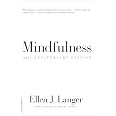
I can only speak for myself, but I find meditation to be a difficult practice to adhere to regularly, and quite time-consuming. Mindfulness as defined by Langer (Harvard psychologist and multi-decade theoretical and empirical mindfulness scientist) is the resulting mental state of meditation, but meditation is not the only path to becoming more mindful. Simple principles about how we pay attention to, and make sense of, experience can similarly increase our level of mindfulness. She gives many examples throughout the book that are easy to implement in my daily life. For example, she argues that behavior always makes sense from the actor's perspective, otherwise they wouldn't do it. Thinking in those terms has fundamentally improved my relationships with the people in my life, particularly family members I've often found it difficult to get along with. A nice extra benefit has been, by seeing others' perspectives compassionately like that, they tend to reciprocate and try harder to do the same with me. I think the greatest value of the book is not the advice itself -- most good advice about living well/mindfully has been known for centuries if not millennia (e.g. seeing things from others perspective) -- but rather it's the research she cites; the sayings she uses to convey core principles (e.g., "Most people worry about making the right decision, when they should just focus on making their decisions right."); and the novel perspective she provides on how to think about what it means to live well. I still would (one day) like to establish a regular meditation practice, but I have become much more mindful simply by applying principles I learned from reading this.
M**K
Excellent! Lifts your mind to reveal another, amazing dimension of thought
I like the clear explanations and examples of the difference between mindlessness and mindfulness. It helped me to better understand the actions taken by important people in my life.I got a bit bogged down in the experiments however, I quickly realized and appreciated the impotance of sharing them as they added a fuller understanding of the each of the topics being considered in each particular chapter.Dr. Ellen Langer will greatly expand your understanding of the mind-body connection, when-why-how you go through life on auto-pilot using the directions that were programmed into you during your formative years.It explained for me why I see things differently than others as I typically and deeply see, hear and feel things around me that others do not even notice. Often, especially in the past, I was told, that because others do not see things mindfully, I must be imagining things or that I am too sensitive only to discover a short time later that I was right all along. This book has helped me understand that often I operate in a mindfullness mode.I loved the chapter on health. It confirmed what I have been teaching for years. You "Question Everything" when you go to the doctor. You do not go to the doctor and relinquish your responsibility for your own health.My goal in teaching my classes on How We Beat Diabetes is to share what my husband and I did in 2003 to literally beat the type 2 diabetes that he suffered with for over 25 years. Even more impotant I want to help people understand what is going on in their bodies, how positive thinking can change the course of their condition, and how they can and must become empowered patients and a proactive partner with their doctor in their own healthcare! It amazes me how many people place their lives into the hands of another person without ever knowing that the course you are given is truly the right one for you. Research your condition and ask, ask, ask questions.Dr. Langer and I speak the same language and I truly appreciate her wisdom in this book.
B**L
Superb
This is a superbly crafted work detailing the research conducted by Ellen Langer and her colleagues over the past fifteen years, at Yale, City University of New York, and, for the past twelve years, in the Department of Psychology at Harvard.The nature of the studies, methodology and focus of the research endeavors are incredibly interesting. For those interested in epistemology, this book is essential reading. The following are some excerpts that I found particularly poignant:"We experience the world by creating categories and making distinctions among them." p.11.The creation of new categories, as we will see throughout this book, is a mindful activity. Mindlessness sets in when we rely too rigidly on categories and distinctions created in the past Once distinctions are created, they take on a life of their own." P. 11"The rhythm of the familiar lulls us into mindlessness." P.21"The way we first take in information ( that is, mindfully or mindlessly) determines how we will use it later." P.25"The future may be as capable of "causing" the present as is the past." P. 32"When children start a new activity with an outcome orientation, questions of "Can I?" or "What if I can't do it?" are likely to predominate, creating an anxious preoccupation with success or failure rather than drawing on the child's natural, exuberant desire to explore. Instead of enjoying the color of the crayon, the designs on the paper, and a variety of possible shapes along the way, the child sets about writing a "correct" letter A. Throughout our lives, an outcome orientation in social situations can cause mindlessness." P.34"Those who can free themselves of old mindsets, who can open themselves to new information and surprise, play with perspective and context, and focus on process rather than outcome are likely to be creative, whether they are scientists, artists, or cooks." P. 115"People create uses for objects. A use is not inherent in an object, independent of the people using it. The successful use of an object depends on the context of its use." P.122"Will children taught "it depends" grow up to be insecure adults? Or will they be more confident in a world of change than those of us brought up with absolutes?" p.124."We pick up rules before we have a chance to question them." p.125"The early signs of change are warnings and, to the mindful, opportunities."Required reading for the mindful.
Trustpilot
2 days ago
1 month ago
1 week ago
1 month ago