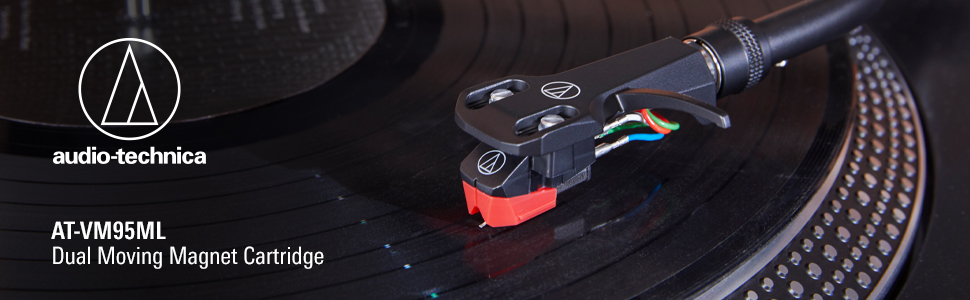
🎧 Elevate Your Vinyl Game with Sonic Precision and Effortless Style
The Audio-Technica AT-VM95ML is a high-performance dual moving magnet cartridge featuring a 2.2 x 0.12 mil MicroLinear stylus for exceptional detail retrieval and low distortion. Its durable low-resonance polymer housing and threaded inserts enable easy, nut-free installation on any half-inch mount turntable. Compatible with all VM95 series replacement styli, this cartridge delivers rich textures, pristine highs, and expansive stereo imaging, making it a top choice for audiophiles seeking a transformative vinyl listening experience.





| ASIN | B07JLYHFR9 |
| Best Sellers Rank | #4,647 in Musical Instruments ( See Top 100 in Musical Instruments ) #21 in DJ Turntable Cartridges |
| Customer Reviews | 4.6 4.6 out of 5 stars (754) |
| Date First Available | October 12, 2018 |
| Is Discontinued By Manufacturer | No |
| Item Weight | 1.44 ounces |
| Item model number | AT-VM95ML |
| Manufacturer | Audio technica |
| Product Dimensions | 4 x 1 x 3 inches |
F**A
A Vinyl Game Changer: The VM95ML Experience
I recently upgraded my turntable with the Audio-Technica AT-VM95ML cartridge, and the difference is nothing short of drastic. This is not a subtle improvement; it's a complete sonic revelation that has breathed new life into every single record in my collection. If you're on the fence about upgrading your phono cartridge, this is the one to jump for. Unlocking Hidden Detail and Nuance The most noticeable change is the incredible level of detail retrieval provided by the MicroLinear (ML) stylus. Where my previous stylus (likely an elliptical or conical) provided a good, enjoyable sound, the VM95ML digs deep into the record grooves to extract every last piece of musical information. Rich Textures: Every nuance and color of the music is highlighted in stunning clarity. I'm hearing complex layers in the mix—subtle cymbal decays, background harmonies, and bass lines—that were previously smeared or simply missing. Pristine Highs: The high frequencies are silky smooth and extended, yet completely free of harshness. This stylus minimizes a phenomenon called "inner groove distortion" (IGD) so that the music sounds just as clean and detailed on the final tracks of a side as it does on the first. Expansive Soundstage: The stereo imaging is fantastic. The instruments are precisely placed across a wide and deep soundstage, giving the music a three-dimensional presence that completely immerses you in the performance. The Final Verdict The Audio-Technica AT-VM95ML has transformed my vinyl playback. It is an extraordinary value proposition for any serious listener, delivering performance that easily rivals cartridges costing two or three times as much. For anyone seeking to hear the full artistry and detail embedded in their records, this cartridge is the essential upgrade.
W**P
Affordable Excellent Cartridge with Micro Linear Stylus
I have replaced an old Shure M93E without too much expectations but I was totally surprised with the huge improvement in sound quality. First off, it had clear highs yet very little scratch noise from the disc. I played old and new discs and every disc sounded just great. Also, it had wonderful stereo separation. I didn't know vinyl sounded so good. I was pondering over mm from more expensive brands and even mc cartridges but I am glad that I made the right decision. Also, I liked the fact that the stylus has 1000 hours of life which was one of the main reasons that I chose to go with ML, I think it is well worth paying extra for the better stylus such as ML.
A**.
Comparison & Full Review: This AT-VM95ML cartridge vs. the VM540ML & AT-VM95E/AT95E
MY SHORT REVIEW: I love the AT-VM540ML and its predecessor the AT-440MLB. This AT-VM95ML cartridge is the affordable AT-VM95E upgraded from an elliptical stylus to a micro-linear stylus. Is it worth the extra $100? As a long-time user of the VM95E and its predecessor AT95E, I can tell you that it sounds MUCH better. And to my ears, 99% as good as the $270 AT-VM540ML. Why I can't stop listening to my LPs with this cartridge: • My old “worn out” vintage records now sound better than many new reissue LPs—all the way to the INNER TRACKS. • Dynamic punch and “inner detail”: exciting and lively, but with superb low-level resolution for all genres tested, for example: Miles Davis "Kind of Blue" (50th anniversary Mark Wilder analog lacquers), Talking Heads "Speaking in Tongues" 1980s US LP pressing, The Cure "Love Cats" 45 RPM very bass-heavy club single, "Manitas de Plata" flamenco guitar 1965 Connoisseur SocietyLP, Deutsche Grammophon "Mozart Piano Concertos 17 & 21" w/Geza Anda, Linda Ronstadt/Nelson Riddle Orchestra "What's New," etc. • The most affordable Micro-Linear (aka FineLine, Shibata, Van Den Hul) stylus-cartridge combo I could find ($100 less than the superb VM540ML with nearly-equal sound quality) • Easy to install with built-in screw holes: no fumbling with tiny nuts, lol (for alignment tips, see below) Below is my detailed review, which is nearly identical to my review of the VM540ML and AT-440MLB, except where the sound or performance differs a bit. -- MY RIDICULOUSLY LONG REVIEW (FOR TURNTABLE FANATICS ONLY, OR INSOMNIACS): I’ve tried many cartridges on my old Dual turntables and never found a truly musically satisfying combo—until switching to Audio-Technica micro-linear stylus cartridges. Of the three I own, this is the best one in terms of sound-quality to price ratio. My box of abandoned cartridges includes Grado (ZF3E+, Prestige Green, Black, Silver1), Ortofon (ultra-light OM10 & 20), and an AT95E (nearly identical to the newer VM95E). This AT-VM95L is the most affordable micro-linear (aka Fine Line) stylus cartridge available as far as I know. It's Audio Technica's answer to the third-party-manufactured micro-linear stylus upgrades that have been sold for years. This cartridge's core design began in the 1970’s and so its superb sound quality I believe reflects many iterative improvements over decades. But the main reason it sounds so good, I think, is the micro-linear stylus. WHAT’’S A MICRO-LINEAR (ML) STYLUS? One that’s shaped like a pointed butter knife rather than an elliptical or spherical cone. Its flat sides aim up and down the path of the record groove while it's thin-edged sides contact a long "line" that runs from top to bottom of the groove walls (rather than two tiny groove contact point as with elliptical or conical styli). The Shibata—granddaddy of this stylus design philosophy—was invented by JVC to handle quadrophonic LP’s 30,000-50,000 kHz ultra-high frequency modulation signal, so time-domain resolution is superb with this needle. My experience with this cart (anecdotal of course, your subjective mileage may vary): • INNER GROOVE DISTORTION (IGD) ELIMINATED! I thought that many of my old LPs were worn out, especially on the inner tracks. But the ML stylus of this cartridge plays them crisply with no hint of "fuzziness"...all the way to the last seconds of each album. Yes! • MY VINTAGE VINYL SOUNDS SO MUCH BETTER IN GENERAL. I’ve been digging into my sizable “unplayable old crap" LP pile (albums that I thought were trashed by the cheapo turntables of previous owners). The VM95L extracts nearly ALL of the virgin groove info (surface area untouched by the old heavy turntable arms and elliptical/round needles of yore). • CLARITY AND INNER DETAIL? WAY MORE. For example, I can now easily "pick out" acoustic bass, horn, and cymbal brush work when Miles and his crew are colliding in a polyphonic frenzy on original 1960’s Van Gelder pressings. • WHAT ABOUT SURFACE NOISE? Often LOWER than with my elliptical styli—the VM95L stylus contact area often increases the signal-to-noise ratio (more music signal ÷ same groove wear noise) and thus sounds less noisy. This does vary depending from LP to LP—however, it's never WORSE than the other cartridges mentioned above. • HUGE DYNAMIC RANGE “PUNCH”—This cart has less total signal level than Grado's “moving iron” carts (4mv vs. 5 mv) but the perceived dynamic range "bite" of horns and snare drums is much more present and “real” to me with this cartridge, often MORE so than many XRCD and SACD files I play with a top-end studio DAC converter. • FREQUENCY RESPONSE IS NEAR-NEUTRAL AFTER BREAK-IN (~30 LP plays), with some gentle bass and treble boost in the 20-100 Hz and 5K-15K range (around +1.5 dB per Audacity needle-drop using Analogue Productions "20-20Khz" LP sine-wave sweep track). Interestingly, my more expensive VM540ML & 440MLb carts actually sound more boosted in the bass and treble than this one. This cart sounds great with both my humble NAD PP2 phono preamp (~$100 used) and Yamaha entry-level 1990’s receiver (built-in phono pre-amp) • ZERO CARTRIDGE HUM—a problem with all of the Grado cartridges I've used on vintage Dual 1218 and 1219 tables. With this cartridge? Silent! • LOWER RECORD AND STYLUS WEAR - For this stylus, the A-T pamphlet recommends inspection after 1,000 hours (about 3 times longer than for their elliptical needles). The reason, A-T says, is that the much larger stylus-to-groove contact area spreads out the wear on both needle and record groove, and the thinner profile tracks rather than "pounds" the vinyl's highest-frequency squiggles. Will the 1.8- to 2.2-gram recommended tracking weight generate more wear than the 1.0-gram weight of the other AT carts mentioned above matter for wear? Probably not. See this eye-opening record-wear test by VWestlife: https://youtu.be/kZOj-eO8Mvw?si=eCz49ZfaylRSYaVI. RANDOM TIPS: • AUDITION PROSPECTIVE CARTRIDGES WITH FAMILIAR HEADPHONES - It’s amazing how much turntable/cartridge coloration and definition (or lack thereof) you can hear with headphones. Ironically, on my Grado SR80 headphones, the Grado cartridges above are horribly muddy and fuzzy in comparison to this AT cart. The Ortofons and AT95E are somewhere in between. • Any micro-linear stylus will dredge up old crud out of dirty record grooves. Reason It's making contact with the FULL depth of the grooves. You’ll see it caking your needle, blech! So for the first few plays, I’d clean it often, and with stylus cleaning fluid every 10-15 LP plays. I also clean all my records (even new ones) with Mobile Fidelity's "One Record Cleaning Solution" https://www.amazon.com/gp/product/B003DX0JPW/ and it makes a HUGE improvement in used vinyl sound quality. If you have a fancy record cleaning machine, even better! • To perfectly align this cartridge or any other, download and print out the free “Stupid Protractor” PDF (search and ye shall find). It really is “stupid easy” to use this one (and I’ve struggled with many of ‘em). • A “quick and dirty” way to tune cartridge "brightness" or “dullness”: If this or any cartridge sounds too bright, raise up your LP by putting a cork pad or spare LP under the one you’re playing (most records are pressed with an outer rim lip to keep them from damaging each other). This effectively reduces the VTA (vertical tracking angle), which often differs from one master lacquer to the next (there was no industry standard cutting stylus angle). If your cartridge sounds too dull, try to RAISE your VTA at the tonearm pivot—if you can’t (this was a fancy “audiophile” turntable feature), try removing your rubber mat and replacing with a sheet of paper to get a bit more VTA height (this worked for me on an old Dual CS 606 turntable). • More hacks to tune cartridge "brightness" or “dullness”: Cable length and thickness affects the high-frequency curve. I’ve found that longer cables (6 feet +) "dull" the HF and shorter cables (1.5 feet) brighten the sound. Why? Phono preamps have different capacitance (picoFarad or "pF") and resistance (ohm load) personalities and cable length and gauge effects the former. You can also tweak here with a $9 pair of RCA "Y" adapters and some 20-cent resistors and capacitors. Search online, lots of tutorials! This VM95L cartridge sounds best with phono preamps “tuned” to carts in the 100-200 pF range (typical) and sounds perfect with the entry-to-mid-level phono preamps mentioned above. Caveat: These are my subjective impressions only, YMMV. And, I'm in no way affiliated with Audio Technica or Amazon, nor have I received compensation or product in exchange for my reviews. Just a fellow music-lover always searching for better sound. Happy listening—whatever gear you’re enjoying! - Andrew FULL MANUFACTURER SPECIFICATIONS (THIS WAS NOT IN THE PRODUCT DESCRIPTION AT THE TIME OF THIS REVIEW) * Frequency Response 20 - 25,000 Hz * Channel Separation 23 dB (1 kHz) * Vertical Tracking Angle 23° * Vertical Tracking Force 1.8 to 2.2g (2.0g standard) * Stylus Construction Nude Square Shank * Recommended Load Impedance 47,000 Ω * Coil Impedance 3.3 kΩ (1 kHz) * DC Resistance 485 Ω * Coil Inductance 550 mH (1 kHz) * Output Voltage 3.5 mV (@ 1 kHz, 5 cm/sec) * Output Channel Balance 1.5 dB (1 kHz) * Stylus Shape Microlinear * Cantilever Aluminium Pipe * Static Compliance 20 x 10 – 6 cm / dyne * Dynamic Compliance 10 x 10 – 6 cm / dyne (100 Hz) * Mounting 1/2” centres * Cartridge Weight 6.1g * Dimensions 17.2 x 18.9 x 28.3 ( H x W x D mm) * Accessories Included: * Two 11 mm installation screws; * Two 8 mm installation screws; * Two washers * Non-magnetic screwdriver * Recommended Load Capacitance 100-200 pF * Replacement Stylus AT-VMN95ML * Stylus Size 2.2 x 0.12 mil * Type VM Stereo Dual Magnet * Wire Used for Coil T.P. Copper
C**N
Very good cartridge for the money
This is a very good cartridge. I basically wanted to try the new mounting system to see if it would be easier. Boy, is it ever and it is aver good sounding cartridge too boot!! The ML stylus gets down in the groove and really brings out the sound of your vinyl. The bass is deep without being muddy and the mids and highs are very clear. And it sits low enough in the groove that if you have surface scratches, they are hardly noticeable. The redesigned mounting of the cartridge is great and makes it very simple. I’ve had AT cartridges over the years (I’m 68) and it seemed like you needed 3 hands to install them and was very awkward to do. This new mounting system is a breeze and only takes about a minute to install it on your Headshell. Then all you have to do is do the alignment and set VTF and your ready to go. My only complaint, and it’s not enough to remove a star, is the low output of only 3.5 mv. If they increased it to 4.5- 5.5mv it would sound fantastic!!! And I know AT doesn’t read these reviews but if they did I would suggest that they adopt the new mounting system to their top of the line VM cartridges (VM 520, 530, 540, etc.), It would make their top line cartridges even better.
L**A
Muito boa! Adquiri em 2022 e até hoje não me arrependo nem um pouco. Tenho uma AT120LP, veio com a atvmn95e, que era uma ótima agulha pelo seu custo benefício, mas a 95ml por ser microlinear vai no fundo do sulco dos discos, extraindo um som muito mais envolvente e rico em detalhes. Tinha discos que eram muito ruins de ouvir mais próximo do centro do disco, por gerarem os famosos inner groove distortion (distorção de sulco interno), onde o disco soava com uma distorção ou sibilância muito grande, mas com a 95ml resolveu a grande maioria dos problemas. Só precisa regular bem certinho o anti-skate e o contrapeso pra ela durar bastante e seus discos também! Como aguenta até 1.000 horas, ela acaba sendo um bom custo benefício, mesmo tendo um valor mais salgado. Ah, obviamente precisa ter no mínimo um receiver okay e caixas boas/revisadas pra poder perceber o desempenho da agulha.
M**I
Very good performer.
さ**〜
ラインコンタクト針であるマイクロリニア針を採用しているため、歪みが少ない。特にボーカルのサ行のかすれが激減する。 針自体やレコード盤の寿命が長くなるのも良ポイント。 今年発売された製品は価格が倍になっているため、本製品のコストパフォーマンスが際立つ。
G**E
Spectacular! The amount of detail this stylus/cartridge is able to pick is just unbelievable. Worn, old vinyls still sound incredible with this little red box. Bargain!
P**L
I presume that I am not the first person to realise that hi-fi magazines and reviewers use hyperbole to sell the latest pieces of gear and create mythologies about the glorious products of the past, and of course to sell magazines and get hits and in so doing pay the mortgage and feed the kids, so I have learnt to take reviews with a bit of a pinch of salt and come to the understanding that the differences between product X and product Y are often not so much seismic as subtle. And the case is the same here (indeed it seems to me to be especially the case with phono cartridges and CD players). I changed the Rega Carbon cartridge on my Rega P1 to a Rega Bias 2 which was a nice warm sounding cartridge. However, the Bias 2 suffered from considerable hum as it neared the centre of a record and did not track the inner disk so well in the RB110 arm (Rega MM cartridges are unshielded so perhaps there is a trade off here, a higher output - about 7mv - and warmer sound at the cost of a little hum, assuming you can live with that - as goes the tracking, I found out much later that Rega themselves apparently no longer recommend the Bias 2 for use on the P1, presumably an arm/cartridge mass issue - the Bias 2 is pretty light at 4.5g). I then changed from the Bias 2 to an Audio Technica AT VM95e. This was slightly less warm sounding but tracked better in the RB110 arm (especially once I had blu tacked a little neodymium magnet to the back of the arm base to make up for its lack of anti-skate, although this didn’t improve tracking with the Bias 2). The VM95 cartridge mass is 6.1g. I also bought an AT95c stylus for use on old, worn records. The sound here was very similar, but the VM95e was that little bit more refined and clearly a better tracker. No noticeable hum at all with this cartridge, but a lower output than the Bias 2 (4mv vs 7mv). Taking into account the difference in output between the Rega Bias 2 and VM95 cartridges, once I had added a little increase in volume via the amplifier, I felt the “weight” of the sound of the VM95e was really not that different from the Bias 2 and that what I lost in warmth was made up for in terms of better detail and better tracking. And it was a little over half the price of the Bias 2, so overall an excellent move for the money However, over the course of time, and being an obsessive perfectionist like most hifi addicts, I noticed that on some records the VM95e still had some issues, for example struggling a bit with loud horn passages on Freddie Hubbard’s Open Sesame (Blue Note 80 series). I also have a Rega P3/Elys 2 set up (yes, there is a little hum but less than with the Bias/P1). This combination tracks these passages in Open Sesame better, but you can still tell it’s a disk that puts demands on a stylus. So, getting to the denouement of a long story, after reading between the lines of a legion of reviews online, I purchased an AT VM95ML yesterday evening. Amazingly it arrived this morning. I clicked the stylus into the body of the cartridge on the Rega P1 and ... well, the difference is subtle and not seismic, but .... better resolution of detail, a little less body but less bloat to the bass, and better tracking. The VM95ML has slightly less output than the VM95e (3.5mv vs 4mv) which is actually noticeable and needs to be taken into account when comparing the sound. Overall, however, I think this is a really good sounding stylus and a very good tracker. Ultimately, I was intending to use it as a possible replacement for the Elys 2 on my P3. Although the Elys 2 has it detractors it is a cartridge that I have been happy with, but I’d prefer to have a cartridge that was shielded as, although the problem is at an endurably low level in this instance, I really am sensitive to hum. I have not as yet been able to make a direct comparison between the VM95ML and the Elys 2 but my initial impression from my listening session today on my P1 outfit is that, despite the VM95 styluses having a certain “house” sound (and so too the Regas), the VM95ML is likely to sound nearer to the Elys 2 than to the VM95e or VM95c. I surmise this may be down to the fact that both the VM95ML and Rega Elys 2 have nude styli and the VM95e and VM95c are bonded. [November 2020: I surmised wrong, the Elys is not nude.] Of course, the VM95ML costs around three times as much as the VM95e. Is it three times better? In the sense that a giraffe is three times taller than a gazelle, probably not, but in the sense that “would you notice the difference every time you played it and is that a good difference”’ then the answer is yes. More to the point, a micro line stylus properly set up apparently has a lifespan of 1000 hours whereas an elliptical is supposedly only around 250 hours. That is according to Audio Technica. I’m not entirely sure those figures are definitive, I certainly managed well over 250 hours on my first VM95e stylus, probably more like in excess of 400 before I felt it needed changing, but if there really is anything in them (and the user treats the stylus with care, of course!), then the VM95ML’s £100 price difference above the VM95e would appear to have some sound justification. In short then, the VM95e is very good, with a sound that will keep many people happy. The VM95ML clearly shares the house sound of the series but it is also clearly a step up in all respects except value for money in terms of which, however, it promises to be comparable. I think I’ve said quite enough. Update: We’ll, 24 hours have passed and I clearly haven’t said enough and it seems I must humbly eat some of my words above. I couldn’t resist it and so I replaced the Elys 2 on my P3 with the VM95ML. A rather delicate job as the contacts on the VM95 seemed just a tiny bit fatter than those on the Elys and I’d stupidly just had a strong cup of coffee. Word to the caffeinated wise: calm down, take a break and drink a big cup of water, then try again when your hands have stopped trembling. Anyway, no damage done. And the result? Well, really not subtle in this set up (P3, Elex-R, B&W 705s vs P1, Cyrus 8, MA Bronze 2). In common parlance, OMG or, (for those who know the film Team America, JTFC!). The Elys 2 is now officially retired as the VM95ML is superior in almost every respect: the lower output makes little difference here, no hum, better tracking (at 2.0g vs 1.75g), more detailed but not fatiguing treble, more balanced mid-range, less bloated but better detailed bass, less noticeable surface noise). And everything I throw at it sounds good, from Herbie Hancock to Lucinda Williams, The Delines to Blue Oyster Cult, Monteverdi to Culture, what I thought was a thin-sounding RCA reissue of Surrealistic Pillow no longer sounds thin, what I took as over-emphasised bass on the first track of Crosby, Stills & Nash is now controlled, a dead sounding near 45 year old first UK issue of Pretzel Logic sounds alive, and Freddie Hubbard’s trumpet sounds clean and free of any hint of distortion. I hesitated over spending around £140 on this cartridge but couldn’t resist taking a punt on it when I saw it on Amazon Marketplace for £120. If I’d spent the larger amount then I’d have still thought it was the best hifi bargain I’d purchased for some time .... all-in-all I am extremely pleased with the VM95ML, it is breathing new life into my record collection. Of course, there is in here some testament to the capabilities of the Rega P3/RB330 over the Rega P1/RB110, but it is the VM95ML that puts these differences in clear perspective. I’ve read a bit about there being synergy between Rega tone arms and cartridges but, pace Rega’s propaganda, this is synergy. Helpfully, the interchangeability of styli on the VM95 cartridge led me to this purchase by my taking a punt on the humble VM95e in the first instance. Maybe it is also leading me on a very steep learning curve to feel a little less cynical about the hifi reviewing trade, which if I recall is where I started this review. P.S. 26 November 2019. After more listening, tinkering and evaluation a quick summing up: Assuming you experience the same anti-skate issue on the Rega P1 as I did, the easiest method to overcome this is by affixing a small neodymium magnet to the back of the arm base, and this improves the inner disk tracking with the AT VM95e and Rega Carbon. The Rega Bias 2 really doesn’t seem to work properly on the Rega P1, magnet or no magnet; this is a problem of tracking and not sound. The 95e sounds marginally more refined than the Carbon and maybe tracks a little better, but some occasional sibilance is evident on vocals. Popping the 95ML stylus into the cartridge improves things a little more and effectively eliminates sibilance, it is also a significantly better tracker than the 95e, but it’s virtues are much more apparent on the Rega P3 where it really shines. It offers audible improvements over the Elys 2 in all respects (though personally I don’t think the Elys 2 is a bad cartridge). And, unlike Rega’s cartridges, there is no hum from AT’s. Because the AT is taller than the Elys, VTA is out very slightly (about 1 degree from optimum) but, this doesn’t negatively affect the sound in this instance and I’m happy to follow Rega’s advice and avoid shims. In terms of value for money, the P3/95ml combination is well worth it, but (having made the comparison through my main system) the basic P1/Carbon is an astonishingly good music maker nonetheless. However, the P3 is clearly engineered to a higher standard than the P1 and the 95ML is clearly the better cartridge here. In and of itself the P3 has the edge in clarity and dynamic punch over the P1, but it is nonetheless an edge rather than a gulf. The P1 has an exceptionally engaging sound which, if it isn’t exactly 100% hifi like the P3, is definitely 100% fun. I mention all this because I’ve never found any reviews directly comparing the P1 and P3. P.P.S. 25 November 2020. Hmmm ... well, one year on and I've decided quite a lot depends on the system. In my P1/Cyrus 8 DAC/MA set up the 95E sounds markedly more punchy than the Carbon compared to how it sounds in my P3/Rega Elex R/B&W set up where the Carbon (mounted on a P1) sounds livelier. The Carbon has a nice relaxed sound in the Cyrus system but is veiled and considerably less dynamic in comparison with the 95E in this set-up. The VM95ML remains doing good work in the Rega Elex/B&W system and it has kept me extremely happy, so I have no plans to replace it. Early in the year I acquired another P3 (yes, I know, it's a sickness, but I got it very cheaply) and added it to my Cyrus system. For most of this year I had the 95E set up on that turntable and the Carbon on the P1 (hence the above observations). However, I did notice that the 95E had some difficulty consistently tracking demanding records which became an increasing niggle for me. I swapped the 95ML into this system on a couple of occasions and noted its more-or-less flawless tracking by comparison, but it seemed to lack the punch in this system compared to the 95E (could this be anything to do with the different phono stage set-ups? I use a Rega Fono Mini in the Cyrus system, in the other system the Elex R has its own phono stage, but this is supposed to be the same as the Fono Mini and so ought to make no appreciable difference. Certainly, also, the lower output of the 95ML seemed somehow more dramatically noticeable in this system compared to the 95E. Maybe it's all down to the different sonic characters of the amps and speakers?). Consequently, I went back to reading loads of reviews in an attempt to winnow some sort of objective sense out of them. There seemed little point plumping for another 95ML in this system if it didn't deliver the same sonic benefits that it imparted to the other system. Then a couple of weeks back, based on all this winnowing, I decided to plump for a VM95EN. Problem solved! This seems to track as well as the 95ML but works the sonic magic in the Cyrus set up, while the 95ML does the job in the other system. I have heard tell in various reviews that as a step-up from the 95E and in comparison with the 95ML the 95EN is the hardest to justify in terms of value for money, but I disagree with this assessment. The 95EN is worth the extra money over the 95E for tracking alone, but it is also a "better" sounding cartridge for my money with improvements in detail retrieval and realism (more akin to the 95ML). The 95E still has real punch to its sound, in part perhaps due to its higher output. However, the 95ML doesn't sound as good in this system as it does in the other, and that again more than justifies the 95ENs price: it's no longer questionable value if the relatively-better-value-but-more-expensive-alternative doesn't actually sound better in the set-up in question. And, as the 95ML lights-up my Elex/B&W system, so too does the 95EN light-up my Cyrus/MA system. So, here we are a year on from my last P.S. and where am I? Very happy with the following set-ups: Cyrus 8 DAC/MA Bronze 2 fed by a VM95E/Rega P1/Pro-Ject Phono Box E and VM95EN/Rega P3/Rega Fono Box Mini (the Pro-Ject Phono Box E is another story, but absolutely a bargain at £50) and Rega Elex R/B&W 705S2 fed by a Rega VM95ML/P3. Lessons learned: it helps to have more than one turntable and one system in order to make comparisons between turntable cartridges and, although there are clearly objective differences between cartridges and that as a rule you get what you pay for, how well a cartridge performs depends in part on the degree to which it matches the system that you partner it with. Oh, and, the process of getting it right might cost you rather more money than you might have paid out if only we lived in an ideal world where you could get things right on the first go. But, when you're satisfied that you've got it right just hold off tinkering and listen to the music. Consequently, I won't be trying the Shibata until the Microline needs replacing. Update: 16 July 2022. I see quite a lot of people have read and felt my review was helpful, so maybe another update is due for your kindness and evident patience. Almost another two years further down the line and I’m still using the 95ML on my main system and it’s still tracking and sounding superb having played some 400 albums so far. I have not been tempted to replace it with the Shibata version and I’m pretty sure I’ll stick with it when it needs replacement. On the other system the 95EN is still in place on the P3 and the 95E is still doing most of the work on the P1. I’m now on my third 95E stylus and, although I initially thought that managed better for wear than the 250 hours suggested by Audio Technica, I suspect my initial estimate of use must have been an overly generous estimate as the second 95E had played no more than 250 albums before I felt it needed replacing (however, maybe I have also become more adept at noticing the slightest effects of the initial signs of stylus wear and tear on tracking, probably because I’ve got used to the superior tracking abilities of the ML and EN versions of the 95). I’ve replaced the Monitor Audio Bronze 2 speakers in my second system with ATC SCM7s which are a considerable improvement, sounding both more detailed and more natural, but these have not embarrassed either of the cartridges in use in this system (although they have embarrassed some of the CDs in my collection), in fact the 95EN sounds more noticeably better than the 95E through them than it sounded through the (more forgiving) Bronze 2s. And, for anyone who’s curious in the knowledge that ATC rate their notoriously inefficient SMC7s as needing an amplifier with a minimum of 75wpc to drive, the Cyrus 8 (well, it’s actually an 82DAC) rated at 75wpc is more than capable of driving them; they’re much less efficient than the Bronze 2s but the 82DAC has ample power in reserve which never came in to play before, so it’s doing what it was designed to do with the new ATCs whereas it was just sleepwalking with the old MAs. Anyway, back to my experience of Audio Technica’s 95 series cartridges: after much use and careful listening, I remain extremely contented, nay almost ecstatically happy. For those of a certain age, in the words of Tony the tiger “They’re great!” P.S. Image of neodymium magnet on the P1 for those who are not sure how to set it up. Essential that you get the polarity the right way, but it’s easy to figure out: if the magnet is the right way round then the stylus tracks the inner groove well, if it’s the wrong way round it mistracks badly. Also, images of both systems to prove that I’m not making all this stuff up!.
Trustpilot
2 months ago
2 months ago