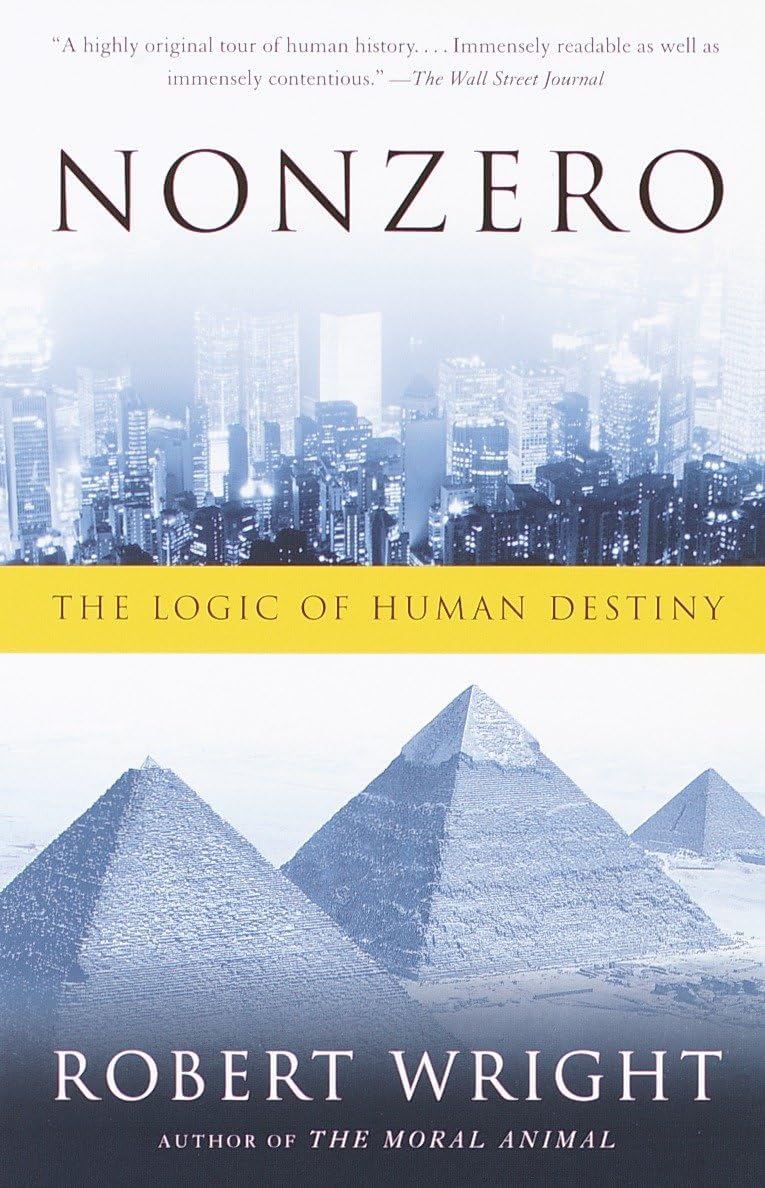

Nonzero: The Logic of Human Destiny (Vintage)
Product ID: 8853149
Desertcart purchases this item on your behalf and handles shipping, customs, and support to Netherlands.
In his bestselling The Moral Animal , Robert Wright applied the principles of evolutionary biology to the study of the human mind. Now Wright attempts something even more ambitious: explaining the direction of evolution and human history–and discerning where history will lead us next. In Nonzero: The Logic of Human Destiny , Wright asserts that, ever since the primordial ooze, life has followed a basic pattern. Organisms and human societies alike have grown more complex by mastering the challenges of internal cooperation. Wright's narrative ranges from fossilized bacteria to vampire bats, from stone-age villages to the World Trade Organization, uncovering such surprises as the benefits of barbarian hordes and the useful stability of feudalism. Here is history endowed with moral significance–a way of looking at our biological and cultural evolution that suggests, refreshingly, that human morality has improved over time, and that our instinct to discover meaning may itself serve a higher purpose. Insightful, witty, profound, Nonzero offers breathtaking implications for what we believe and how we adapt to technology's ongoing transformation of the world. Review: Blew my mind! - Robert Wright is an American journalist, scholar, and prize-winning author. In his landmark book `Nonzero - The Logic of Human Destiny'(1) he opens with the following quote from Charles Darwin: "As man advances in civilisation, and small tribes are united into larger communities, the simplest reason would tell each individual that he ought to extend his social instincts and sympathies to all members of the same nation, though personally unknown to him. This point being once reached, there is only an artificial barrier to prevent his sympathies extending to the men of all nations and races."(2) If we asked archeologists to present us with a list of archeological laws or truths, one of them would undoubtedly be that as we rise through soil samples two things happen: 1. We approach the artefacts of the present day 2. Artefacts grow in complexity These two facts together form the basis of Robert Wright's argument that the human race does indeed have a destiny and that destiny is greater complexity. Increasing Complexity in Human Civilisation In the first half of his book he takes us on a tour of the history of human civilisation from savages through tribes and chiefdom's to city states and nations. In doing so it becomes evident that human civilisation is in the process of creating larger and larger social brains. The culmination of which, through the growth of transport and communications technology, is perhaps happening in our lifetimes - the development of one planetary brain!!! Increasing Complexity in Organic Life In the second half of the book, Wright turns our attention to how the same pattern of a movement towards greater complexity, is also the case in organic life. Single cells work together by specialising in certain tasks to form more complex life forms. The single cell benefits from the increase in complexity and flourishes. This process continues until we end up with the bewilderingly complex organic life forms we see today. Just watch any program with Sir David Attenborough in it to marvel at how many niches in the environment have been exploited in some astonishing way. Game Theory as the Driver Wright believes that the driving force for all this is Game Theory and the seemingly limitless number of nonzero sum games that cam be played over billions of years. What is a nonzero sum game? Well an example of a zero sum game is tennis. When one person wins the other loses. So crudely put, the winner gains 1 and the loser loses 1. Sum total = 0. An example of a nonzero sum game is as follows: Imagine that you and I live in two different hunter gatherer tribes around 50,000 to 100,000 years ago. Let's also suggest that my tribe lives on the coast and your tribe lives in the hills. We would both be involved in activities that revolve around fishing, trapping, preparing food, repairing tools and turning by-products into useful items; for example: turning fur pelts into clothing. Because my tribe lives near the coast we have developed an advanced method of catching fish and often have a surplus of fish. Our traps, however, aren't as fruitful. As a result, red meat is a delicacy and we are poorly clothed. Meanwhile, up in the hills, your tribe have evolved trap technology. As a result you have a surplus of red meat and your wardrobe of clothes is astonishing. The challenge for your tribe is to vary the diet with the limited number of fish you can find and the time it takes to catch them. When we meet, we could either exchange fish for red meat and fur pelts or we could exchange fishing technology for trapping technology. Either way, through the exchange we are both better off and both tribes experience an increase in the quality of their lives through a varied diet and my tribe might become almost a well dressed as your tribe. This is a nonzero sum. Increasing Opportunities to Play Nonzero Games If we accept that nonzero games lead to a better quality of living through greater complexity (1850's London would have been a great place to visit, but I wouldn't want to live there) then the question organisations and individuals would do well to ask themselves is how can I maximise my opportunities to play nonzero games? Here are some suggestions: * Take an honest interest in others for example: Friends, customers, team members etc. * When listening to someone talk about a problem or challenge they are facing, ask yourself "How can I help them over and above just giving advice?" * Say `Yes' more often - For a classic illustration on this read "Yes Man" by Danny Wallace. (3) Bibliography: (1) Wright, Robert; 2000 "Non Zero - The Logic of Human Destiny" Pantheon Books, New York (2) Darwin, Charles; 1871 "The Descent of Man" Published by John Murray, United Kingdom. (3) Wallace, Danny; 2005 "Yes Man", Simon Spotlight Entertainment, New York - London - Toronto - Sydney. Review: Yet here we are with our Brains "switched on". - This is an outstanding read, even if you do not end up agreeing with everything, even most things the author lays out. The book covers Cultural Evolution, Biological Evolution, and the possibility that these processes have a Direction, Purpose,and Design(er) and Purpose, through the mechanism of Increasing Complexity driven by Cooperation in order to reap Zero Sum Benefits. The most compelling case is made for Cultural Evolution, Followed by Biological Evolution, and a distant third for Intelligent Design. Given that Cultural Evolution is currently on the threshold of a paradigm shift which we and our children will impact and be impacted by this discussion alone is worth the price of the book! There is an entire other sociology book waiting to be written on what options we as a species should consider as this paradigm shift (or singularity) approaches....Sadly Prof. Wright's spends very little time here and his prescriptions are less than heartening. Nonetheless the strong case he makes for the directional nature of Cultural Evolution and the divergent possible outcomes this represents are fascinating independently of whether one buys his arguments (or those of Stephen Jay Gould) regarding Biological Evolution.... for as the title of this review says..."Yet here we are with our Brains switched on!" as any readers is likely to be after finishing this book.
| Best Sellers Rank | #244,010 in Books ( See Top 100 in Books ) #422 in History of Civilization & Culture #456 in Systems & Planning #550 in Cultural Anthropology (Books) |
| Customer Reviews | 4.4 out of 5 stars 235 Reviews |
R**S
Blew my mind!
Robert Wright is an American journalist, scholar, and prize-winning author. In his landmark book `Nonzero - The Logic of Human Destiny'(1) he opens with the following quote from Charles Darwin: "As man advances in civilisation, and small tribes are united into larger communities, the simplest reason would tell each individual that he ought to extend his social instincts and sympathies to all members of the same nation, though personally unknown to him. This point being once reached, there is only an artificial barrier to prevent his sympathies extending to the men of all nations and races."(2) If we asked archeologists to present us with a list of archeological laws or truths, one of them would undoubtedly be that as we rise through soil samples two things happen: 1. We approach the artefacts of the present day 2. Artefacts grow in complexity These two facts together form the basis of Robert Wright's argument that the human race does indeed have a destiny and that destiny is greater complexity. Increasing Complexity in Human Civilisation In the first half of his book he takes us on a tour of the history of human civilisation from savages through tribes and chiefdom's to city states and nations. In doing so it becomes evident that human civilisation is in the process of creating larger and larger social brains. The culmination of which, through the growth of transport and communications technology, is perhaps happening in our lifetimes - the development of one planetary brain!!! Increasing Complexity in Organic Life In the second half of the book, Wright turns our attention to how the same pattern of a movement towards greater complexity, is also the case in organic life. Single cells work together by specialising in certain tasks to form more complex life forms. The single cell benefits from the increase in complexity and flourishes. This process continues until we end up with the bewilderingly complex organic life forms we see today. Just watch any program with Sir David Attenborough in it to marvel at how many niches in the environment have been exploited in some astonishing way. Game Theory as the Driver Wright believes that the driving force for all this is Game Theory and the seemingly limitless number of nonzero sum games that cam be played over billions of years. What is a nonzero sum game? Well an example of a zero sum game is tennis. When one person wins the other loses. So crudely put, the winner gains 1 and the loser loses 1. Sum total = 0. An example of a nonzero sum game is as follows: Imagine that you and I live in two different hunter gatherer tribes around 50,000 to 100,000 years ago. Let's also suggest that my tribe lives on the coast and your tribe lives in the hills. We would both be involved in activities that revolve around fishing, trapping, preparing food, repairing tools and turning by-products into useful items; for example: turning fur pelts into clothing. Because my tribe lives near the coast we have developed an advanced method of catching fish and often have a surplus of fish. Our traps, however, aren't as fruitful. As a result, red meat is a delicacy and we are poorly clothed. Meanwhile, up in the hills, your tribe have evolved trap technology. As a result you have a surplus of red meat and your wardrobe of clothes is astonishing. The challenge for your tribe is to vary the diet with the limited number of fish you can find and the time it takes to catch them. When we meet, we could either exchange fish for red meat and fur pelts or we could exchange fishing technology for trapping technology. Either way, through the exchange we are both better off and both tribes experience an increase in the quality of their lives through a varied diet and my tribe might become almost a well dressed as your tribe. This is a nonzero sum. Increasing Opportunities to Play Nonzero Games If we accept that nonzero games lead to a better quality of living through greater complexity (1850's London would have been a great place to visit, but I wouldn't want to live there) then the question organisations and individuals would do well to ask themselves is how can I maximise my opportunities to play nonzero games? Here are some suggestions: * Take an honest interest in others for example: Friends, customers, team members etc. * When listening to someone talk about a problem or challenge they are facing, ask yourself "How can I help them over and above just giving advice?" * Say `Yes' more often - For a classic illustration on this read "Yes Man" by Danny Wallace. (3) Bibliography: (1) Wright, Robert; 2000 "Non Zero - The Logic of Human Destiny" Pantheon Books, New York (2) Darwin, Charles; 1871 "The Descent of Man" Published by John Murray, United Kingdom. (3) Wallace, Danny; 2005 "Yes Man", Simon Spotlight Entertainment, New York - London - Toronto - Sydney.
M**N
Yet here we are with our Brains "switched on".
This is an outstanding read, even if you do not end up agreeing with everything, even most things the author lays out. The book covers Cultural Evolution, Biological Evolution, and the possibility that these processes have a Direction, Purpose,and Design(er) and Purpose, through the mechanism of Increasing Complexity driven by Cooperation in order to reap Zero Sum Benefits. The most compelling case is made for Cultural Evolution, Followed by Biological Evolution, and a distant third for Intelligent Design. Given that Cultural Evolution is currently on the threshold of a paradigm shift which we and our children will impact and be impacted by this discussion alone is worth the price of the book! There is an entire other sociology book waiting to be written on what options we as a species should consider as this paradigm shift (or singularity) approaches....Sadly Prof. Wright's spends very little time here and his prescriptions are less than heartening. Nonetheless the strong case he makes for the directional nature of Cultural Evolution and the divergent possible outcomes this represents are fascinating independently of whether one buys his arguments (or those of Stephen Jay Gould) regarding Biological Evolution.... for as the title of this review says..."Yet here we are with our Brains switched on!" as any readers is likely to be after finishing this book.
D**K
Natural Selection's Argument for Directionality
Wright is a masterful author who tackles an important and intellectually-interesting issue: Is evolution, specifically natural selection, simply "random" as suggested by Stephen Jay Gould et alia or is it "directional" from the simplest to the most complex? Using archeology, paleaeontology, human history in broad scopes, game theory's zero-sum and nonzero-sum outcomes, kin versus individual selection, Richard Dawkin's memes from his book "The Selfish Gene," and a posteriori logic, Wright tackles the issue directly, concisely, forcefully, and elegantly. His answer to the question, in contradistinction to his Marxist antagonists like Gould (See the sociological critique "Defenders of the Truth" by Ullica Segerstrale for sociobiology's reprecussion in academia), is that the evidence points unquestionably to the nonzero sumness outcomes of organisms to develop from the simplest to more complex organisms, implying at least a "directional" undercurrent in sociobiology rather than simple "random" effects that his nemeses posit. This conclusion inevitably suggests the subsidiary question whether evolution is teleological -- that is, directed to some ostensive purpose or goal (which he rejects, but not without empathy for those who find oppositely). On his principal argument and the evidence he evinces for it, however, Wright is consistent, coherent, logical, and persuasive. Three caveats: (1) his notion that natural selection's directionality from simplicity to complexity seems to suggest "progress" towards some higher purpose leads Wright to argument unconincingly for a one-world government about midway; (2) Wright, as masterful though he be with the facts and prose, is not a scientist and does not hold himself out to be; but he amply draws from primary and secondary sources to support all the evidence necessary to make his directionality of natural selection very compelling. (3) All evolutionary scientists insist that natural selection is entirely random, so this theory, plausible as it might seem, is contrary to science. One annoyance: This highly documented work is supported with a peculiar "note" system that is simultaneously confusing and awkward. The ubiquitous "dagger" instead of individual endnotes or footnotes is highly aggravating. Finally, one has to ask, Is Wright's thesis really important to an understanding of ourselves, and if so, how? I found his directionality thesis of natural selection both compelling and important in that there is "progress" in a very generic sense, but did not find Wright's politial and economic "solutions" interposed midway supported by any evidence, but was sort of an ad hoc notion from his own political biases (see his articles in the New Republic magazine and elsewhere). I actually found the opposite conclusions to be supported by the supposition that biodiversity to be the impetus behind natural selection's constantly undergoing improvements and balancing of traits. "NonZero" is an important, well-written, and scientifically supported case for natural selection's inherent directionality from simplest to the more complex organisms. Being at the top of the evolutionary pyramid in terms of complexity, homo sapiens needs to find ways to use this increasing complexity to its own advantage. I assume that a more reflective, less ad hoc intrusion midway, will be forthcoming to "demonstrate," if Wright can, that one-world government is a solution to some of our predicaments. The same evidence actually seems to support the opposite conclusion. Highly recommended.
D**Y
Applying Game Theory to Multiple Disciplines
You may have heard of the prisoner's dilemma: Two criminals suspected of committing crime together are captured and isolated in different interrogation rooms. They are each given two choices: if you rat on your buddy and you get off with a year in prison OR if you keep quite and if we find you guilty you get life. If neither confesses they both go free but if one confesses one gets a year while the other gets life. If they both confess they both get a year. So what would you do? If you totally trust each other neither of you would confess and you would both be better off. Turns out that there are lots of things in life that are a lot like that. This book looks at how when complex systems interact they usually benefit each other. My interest in this book originated in my research into a concept I call "The Conscious Web". The simple idea that as the Internet grows in complexity and we use it as a system to exchange information it will eventually take on a life of its own. It will gain from the information we feed it and build higher levels of vocabularies to exchange ideas. This book speaks volumes about the value of the exchange of ideas. How when you give something away you can often become richer. It draws examples from biology, history, politics, psychology, sociology and my favorite topic: technology. Anyone interested in "the unfolding superorganism" that our world is becoming should consider the book.
F**R
Nonzero is for those who are interested in learning about the true nature of evolution
In order to convey the degree of my enthusiasm for Nonzero, and to reveal the ideology that I believe is at the core of some of the negative reviews of this book, I'm presenting my reaction to a negative review here by Doginfollow. To Doginfollow: You appear to be an atheist extremist, aka "hard atheist," who cannot stand to see an intelligent argument that suggests even the possibility of a progressive directionality of the evolution of life. That notion is so against your atheist ideology (that life is purposeless) that you had to sit down and write a thoughtful, seemingly intelligent, criticism of Wright's book. I know your type well. You are in the same vein as Stephen Jay Gould. You wrote: "Here, unfortunately, he is trying to be original." And you said, "…the lack of a scholarly foundation for his [Wright's] arguments is painfully evident throughout the book." Did you miss the 347 footnotes? Did you not notice the extensive bibliography at the back of the book? Wright was not "trying to be original," but rather he was trying to be honest and to present his insights in a clear manner, understandable to the average person (rather than the stlited manner of pseudo-philosophers). Wright is remarkably free of bias. He is a deep thinker who has studied the subject thoroughly and has achieved original insights. He was courageous enough to present his views in a straight-forward manner. The evidence and indications in Nonzero suggesting directionality and the nature of that direction, are strong. Nonzero is an exceptionally valuable book.
M**N
ehh
ehh
J**Y
An Optimistic View of our Evolutionary Path
For me, the ultimate evaluation of a non-fiction book comes from how much the reading of it changes the way you think or behave. This book is like a peek into humanity from somewhere beyond time and space that is both inspiring and comforting. In the final chapters, Wright paints an exciting future that is ripe with new possibilities and transcends the boundaries between science and religion. He manages to explore ideas with incredibly profound religious and scientific implications in a way that is accessible and enjoyable for the reader. Wright's ideas about an evolution towards increasing cooperation and "non-zero sumness" (and eventually possibly a shared global consciousness) are admittedly speculative. But whether you believe his hypotheses or not, you can't help but be changed by thinking about them. I think of this books as one of the best books of the past decade and think it is a must-read for anyone, but especially those working in science, religion or politics.
B**8
A Must Read for Anthropology Buffs and Futurist Geeks Alike
A compelling assertion of the inevitability of the emergence of more and more complex connections between humans in society and even genes which, as the other reviewers mention, covers human history in a brush strokes similar to those of Jared Diamond's Gun's, Germs and Steel, focusing on the large trends of the last five thousand years. Yes, dense; yes, ambitious. But the importance of nonzero sumness has never been so eloquently and ingeniously demonstrated. One star is removed for the loose and muddled chapters that bookend the rest of the work. They contain valid points, but sloppy writing.
M**S
Bill Clinton hat es öffentlich empfohlen
Kürzlich las ich ein Interview mit Bill Clinton, in dem er dieses Buch als außerordentlich wichtig und für ihn bedeutsam empfahl. Ich habe es nur auf Englisch finden können. Es ist aber auch so faszinierend, weil es die Geschichte der Menscheit so ganz anders erzählt. Es ist aber kein Geschichtsbuch, sondern ein philosphischer Ansatz der der Entwicklung der Menschheit eine Bedeutung und Richtung zu geben versucht. Ein spannender und überaus lesenswerter Beitrag zur Globalisierungsdebatte
R**A
Enriching the layers of noosphere!
Robert Wright's 'love' for non-zero-sumness, distances him more and more from getting closer to love as we understand it. This commoner's view finds eloquence in Radha-Krishna lore stimulating Octavio Paz to pen a memorable volume in the last years of his life. Wright also distances himself from experimental psychologist Harry F. Harlow's discovery of love in infant monkeys. Equally unforgivable is the neglect of the foundation of social bonding in attachment theory of John Bowlby. The outcome therefore is replication of 'selfish gene' or 'self interest' by thrusting 'non-zero-sumness' from cellular organelles to global organizations. Yet throughout the book NONZERO, most surprisingly, the author wonders to embrace Pierre Teilhard de Chardin: the noosphere, the Omega, the God. In this goal, the author begins with the biological evolution; where arguments become shaky Wright invokes cultural evolution; at places curious amalgam of gene-culture coevolution is applied. How biological and cultural streams meet remains an open question. However, Wright keeps students of animal behaviour and students of history busy in trying to understand each other! Does the author ultimately succeed in giving a new perspective on cooperation? On humanly bonds of love! The attempt is marvelous; the author questions the authority of God as reflexively as the authority of science. The twin beliefs needs to reconcile in good karma. This is a savvy thesis of Robert Wright for our common future. Indeed to reinforce the layers of the noosphere.
R**C
Optimistic hope for the human race?
It gives me hope that, perhaps, we aren’t doomed with democracy and capitalism broken in their current format.
V**A
History
Great book
J**I
Five Stars
as advertised
Trustpilot
1 month ago
1 month ago