
DOWNLOAD THE APP


Customer Services
Copyright © 2025 Desertcart Holdings Limited
DOWNLOAD THE APP

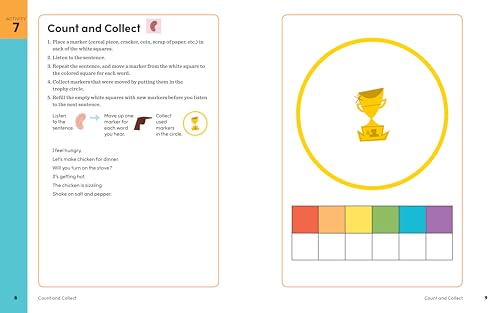


Learn to Read for Kids with Dyslexia: 101 Games and Activities to Teach Your Child to Read (Phonics Makes Readers) [Braun M.Ed., Hannah] on desertcart.com. *FREE* shipping on qualifying offers. Learn to Read for Kids with Dyslexia: 101 Games and Activities to Teach Your Child to Read (Phonics Makes Readers) Review: Keeps my child engaged - My son is about 30 pages into the book and looks forward to doing the lessons. He's in kindergarten, so in addition to school he also does 2 pages of the book 3 nights a week. Being dyslexic myself, this has been an eye opener to do along with him. I can relate to his thought process and help guide him through his struggles. There are many great aspects of the book, but my favorite part is the writing exercises for the alphabet. Each letter is demonstrated using circles and stars to show him where to place his pencil, where to draw the line, and where to end the process. He used to write all of his letters with no rhyme or reason and no particular starting or ending point. Whenever he brings work home from school, I can clearly see what letters have been practiced in the book versus the lessons the he hasn't done yet. It's a remarkable improvement! After he completes this book, I will likely order another one in hopes that the repetition of the lessons will help him build confidence and help with his poor short term memory. This is a great book with great lessons. Review: What I didn't know I needed--fills the gap! - I've been working on letters with my daughter since she was 3. Now that she is 6 1/2, I have finally googled symptoms of dyslexia and faced the reality that she appears to be not simply a "slow reader." I also ordered several books and studied the website of the International Dyslexia Association. That is where I learned the concepts of "structured literacy" and realized that I had long ago neglected "phonemic awareness" and moved past it before she was ready. The exercises in this workbook are the first thing I have found that specifically address this in a way that does not immediately frustrate her or turn her off the way a standard workbook does. (But she is often tired/stretched at the end of them, which is how I know she is learning--specifically, she is learning awareness of sounds that I didn't know I needed to teach.) Because so many of the exercises are picture-based and interactive in novel/unpredictable ways (spinning the paperclip to determine which picture to match the beginning sound of), they appeal to her curiosity and keep her interested. They are also easy to repeat when the concept still needs work. And they are short, so easy to find time to do AND they challenge and reinforce the concepts without being exhausting or tedious. I know that these exercises seem "easy" to a lot of people and kids, but for my otherwise bright/advanced kid whose mind is REALLY resistant to limiting her writing to the way the letters are "supposed" to go and becomes suddenly exhausted and distracted when I ask her to sound out words or letters, it is PERFECT--the early intervention I was looking for. My many thanks to the author and publisher!!


| Best Sellers Rank | #10,584 in Books ( See Top 100 in Books ) #3 in Teaching Students with Learning Disabilities #3 in Communicative Disorders in Special Ed. (Books) #25 in Parenting Books on Children with Disabilities |
| Book 1 of 2 | Learn to Read for Kids with Dyslexia |
| Customer Reviews | 4.6 4.6 out of 5 stars (2,526) |
| Dimensions | 8 x 0.34 x 10 inches |
| ISBN-10 | 164152104X |
| ISBN-13 | 978-1641521048 |
| Item Weight | 2.31 pounds |
| Language | English |
| Print length | 136 pages |
| Publication date | October 30, 2018 |
| Publisher | Callisto Kids |
| Reading age | 6 - 9 years, from customers |
J**C
Keeps my child engaged
My son is about 30 pages into the book and looks forward to doing the lessons. He's in kindergarten, so in addition to school he also does 2 pages of the book 3 nights a week. Being dyslexic myself, this has been an eye opener to do along with him. I can relate to his thought process and help guide him through his struggles. There are many great aspects of the book, but my favorite part is the writing exercises for the alphabet. Each letter is demonstrated using circles and stars to show him where to place his pencil, where to draw the line, and where to end the process. He used to write all of his letters with no rhyme or reason and no particular starting or ending point. Whenever he brings work home from school, I can clearly see what letters have been practiced in the book versus the lessons the he hasn't done yet. It's a remarkable improvement! After he completes this book, I will likely order another one in hopes that the repetition of the lessons will help him build confidence and help with his poor short term memory. This is a great book with great lessons.
C**S
What I didn't know I needed--fills the gap!
I've been working on letters with my daughter since she was 3. Now that she is 6 1/2, I have finally googled symptoms of dyslexia and faced the reality that she appears to be not simply a "slow reader." I also ordered several books and studied the website of the International Dyslexia Association. That is where I learned the concepts of "structured literacy" and realized that I had long ago neglected "phonemic awareness" and moved past it before she was ready. The exercises in this workbook are the first thing I have found that specifically address this in a way that does not immediately frustrate her or turn her off the way a standard workbook does. (But she is often tired/stretched at the end of them, which is how I know she is learning--specifically, she is learning awareness of sounds that I didn't know I needed to teach.) Because so many of the exercises are picture-based and interactive in novel/unpredictable ways (spinning the paperclip to determine which picture to match the beginning sound of), they appeal to her curiosity and keep her interested. They are also easy to repeat when the concept still needs work. And they are short, so easy to find time to do AND they challenge and reinforce the concepts without being exhausting or tedious. I know that these exercises seem "easy" to a lot of people and kids, but for my otherwise bright/advanced kid whose mind is REALLY resistant to limiting her writing to the way the letters are "supposed" to go and becomes suddenly exhausted and distracted when I ask her to sound out words or letters, it is PERFECT--the early intervention I was looking for. My many thanks to the author and publisher!!
T**B
Learn to read for dyslexic child.
This book helped my great grandson reed. The teacher saw improvement.
N**S
An easy supplement for younger children
This book is very cute and easy to implement with my child, however it is geared for younger children. My daughter who is in 4th grade and severely impacted by dyslexia is still too old/advanced for this book. She reads at a 1st grade level, but because of the curriculum she already receives, this is just too young. She does enjoy it, so we still add it in. I am glad she enjoys it and there's no hard in adding it.
M**.
Fun learning tool
This book has helped a student of mine with reading. Fun mini games to play and things to do that the student didn’t realize he was working!
A**R
a+++++++++++
a+++++++++++ work was just right
Q**Y
Confusing
Right off the bat with lessons 1 and 2, words should have accompanied the corresponding graphics as it’s very open to interpretation what you think it’s called. For example, a picture of clouds is actually “sky.” Frustratingly, if the parent or child sees it as clouds then you have unanswered, non rhyming segments and a pause occurs which can be upsetting as these kids already feel confused or “less than.” Activity 2 repeats this frustrating issue as it has a thermometer above a man running- but the words needed are “hot” and “runner.” Also a purple circle is “dot.” Strawberry jam is actually “jar.” Parents likely need to review the lesson ahead of time so both of them don’t feel frustrated with it. It’s not pick up and go either. There are lessons that require tools. They might be basic but a parent needs to look ahead and have those on hand. We didn’t have paper clips for example and that was required for the spinner in a game.
B**2
Wonderful, must have book for any primary schooler with learning differences :))
This is a great book to work on syllables, sounds and words. Very well done, colorful and easy to follow for the child and the parent :) This is my son’s favorite homework book as it is well illustrated and fun to do. A must have if your child has dyslexia. It makes sense to the children and I would recommend this book from 1st grade to .... My son told me that from Kindergarten the words were difficult and that he did not know what to do with all that. This book helped him tremendously to review the sounds, the blending sounds, to understand how words work in a sentence. To review and practice his letters and mostly to ENJOY learning !!!!!
S**A
Interesting, simple and helpful
M**M
Can try
D**A
Lots of fun reading activities for my grade 1, systematic learning, helped alot
B**Y
Beautiful book and very colourful. As an educator would highly recommend it. My only criticism is that I could not use it for 12 year olds...more between 7 and 10 year olds; primary schools.
L**S
I have been working through loads of different ideas to try and make things easier for my son. This book is inviting because of the colours and activities. I would say you need to read each activity first so that you know what is expected before doing it together so they don't try and get out of doing it. To anyone even looking at this review, the fact you are looking to provide additional support for a person who has Dyslexia is brilliant, this book will help. Life is tough and Dyslexia makes it so much harder - but it is only a hitch :-)
Trustpilot
1 week ago
3 weeks ago