🛠️ Drive Leak-Free, Steer with Confidence!
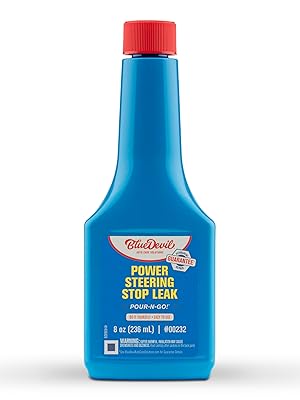
BlueDevil Power Steering Fluid + Stop Leak is an 8 oz formula designed to permanently restore and seal power steering systems by rejuvenating rubber seals and stopping leaks in gas and diesel engines, ensuring smooth and reliable steering performance with easy, safe application.




| Manufacturer | BlueDevil Products |
| Brand | BlueDevil Products |
| Model | 00232 |
| Item Weight | 0.01 ounces |
| Product Dimensions | 7.4 x 1.15 x 1 inches |
| Item model number | 00232 |
| Is Discontinued By Manufacturer | No |
| Manufacturer Part Number | 00232 |
| Voltage | 12 Volts |
M**4
Actually Worked, Unlike Lucas, Bar's Leaks or Prestone!
**READ 1 YEAR UPDATE AT BOTTOM OF REVIEW** **READ 20 MONTH UPDATE AT BOTTOM OF REVIEW** **READ 40 MONTH UPDATE AT BOTTOM OF REVIEW*** Original Review written December 2014: I do all my work on my car myself, I also own 8 different cars. I have an in-floor hydraulic lift in my garage... So, I recently installed a new rack, high and low pressure lines, and a new pump in a 2006 Pontiac Grand Prix GXP. I had a slight leak from a seal near the pump, I checked everything and could not figure out what was wrong as the vehicle seemed to only leak while running. I turned to a stop leak as I knew the leak was probably coming from an O-Ring and I didn't have the time to remove and replace every single seal. I tried three fluids; here is a rundown for how each fluid worked.... Prestone: Prestone AS263 Power Steering Fluid with Stop Leak - 32 oz. : Only $4 at Wal-Mart, cheap, simple, probably a great fluid, won't do **** for stopping a leak. After pouring in over 2, 32oz bottles, I moved onto other stop leaks. Next try was the Lucas... Lucas: Lucas 10008 Power Steering Stop Leak 12 oz. : I love Lucas products, as their products have normally worked before, especially the Lucas Heavy Duty Oil Stabilizer (10001) . I thought I would give Lucas a try. Thick fluid, the bottle says results are normally immediate, yet may require two bottles. Mind you, each bottle costs about $10 and is 12oz. I tried two bottles over the period of one week, following all the directions. At the end of this week, I still had a leak. Luckily, Lucas has a money back guarantee, and after the Lucas failed, I was glad to utilize this guarantee. Although Lucas failed for me, made my pump whine worse than as if it was empty, and temporarily stained my garage floor, I got my money back. Skip Lucas for the stop leak. Bar's Leaks: Bar's Leaks 1600 Power Steering Repair - 16 oz. : Same viscosity as regular power steering fluid. Thought maybe the mixing of the two fluid was the answer. Nada!! Stained my garage worse than Lucas (Knowing how to get a stain out helps...brake fluid and baking soda were my friend through this ordeal). No money back guarantee. I should've just added water to the reservoir, maybe that would've worked better than Bar's and also cost less. Don't waste your money here. After three other failed stop leaks, I thought I would have to waste even more time that I didn't have to fix the damn leak. I turned to Google, searched "Best power steering stop leak" and every forum lit up with the words "BlueDevil". I did my research, and found that most reviews, on numerous sites and forums, for any BlueDevil product was a positive review. BlueDevil fixed my leak in under 5 minutes. After using about 114oz of the other stop leaks combined, I was truly amazed at how 3oz of BlueDevil (1/3 of the 8oz bottle) stopped the leak. If you are curious as if it is worth the money, I will tell you that buying anything else is truly a waste. I still have 5oz of BlueDevil stop leak left, and with how well it is holding up (about a week so far), I don't think I will even need to add more. For the peace of mind, I will now forever turn to BlueDevil before Lucas or any other brand. For those of you who take the logic of "It's a stop leak, so although it might stop the leak, it will plug up something else!" You are all fools and clearly do not understand how a stop leak works. I would never try a radiator stop leak, as those actually do plug everything. As for power steering, the only logical place you could have a fixable leak without having to replace major parts is at a seal. Power steering stop leak works by "expanding" the O-Rings between those seals. If my car was 20 years old, I wouldn't try a stop leak first, as it might simply destroy whatever is left of those O-Rings. In a system that is only a few years old, a stop leak will, and obviously for me, work! Also, if you're faced with having to replace a power steering system or spending $10 to see if this works, spend the $10, you may just save yourself thousands. ***1 Year Update*** (December 2014 to January 2016) Still working like a champ! I have put about 15k miles since the original writing of this review (December 2014). I have since used this to fix a leak on a friend's car roughly 8 months ago and his car has also not had any further leaks (1999 Dodge Durango, all factory pump rack and hoses). For all of the negative reviews, I can only assume that you had a leak on a part of the PS system that was made of metal, such as the rack itself or the high pressure hose. Even the low pressure hose has metal parts. It's not possible to "seal" a leak on a metal part of the PS system, the pressure of the fluid in most of those parts is simply too high. This simply seals the places where all of the parts of the system connect. If you have a hole, this is not a patch and will not work. If you really don't know where your leak is coming from and you have to decide between a bottle that costs <$15 and repairs that could cost upwards of $1000 you really can't go wrong giving this a try. I would be amazed to hear about how this fluid could harm a system that is dysfunctional and needs to be replaced to begin with. My leak came from where the high pressure hose connects to the pump itself, and no amount of tightening or new O-rings seemed to solve the problem. Good luck! *****20 Month Update***** I wrote the original review back in December 2014. I am writing this in August 2016. Since using this product in my Grand Prix, I have put over 30,000 miles on the vehicle, and have not done anything to the power steering in 20 months. The fluid in the reservoir is starting to get slightly yellow, which is to be expected after 30,000 miles. I still have no leaks. As for my friend with the 1999 Dodge Durango, he also has no leaks and has put about 8,000 miles onto his car since we put the stop leak in his car in May of 2015. I have since used this on a 2002 HONDA Accord. Yes I know, a Honda that takes "special" fluid. My friends car had a huge leak, and his dealer quoted him $1400 to replace the rack and pump. Knowing he would have to spend $1400 anyways, he knew that this stuff wouldn't make it worse on an already broken system. I put about 4oz of this in his car and within about 15 minutes, no leaks. He has been driving the car roughly two months now, and has had no problems using this in his car. He saved $1400, and I got dinner! Win-win lol. It works. I don't know what else to say. If you're faced with spending hundreds, or thousands in my friends case, this stuff really can't hurt an already broken system. *****40 Month Update***** The Grand Prix I have still works exceptionally well. It now has about 190k miles on it, and Blue Devil has held up for almost 4 full years now. I have since put on a total of 70K miles since my original review back in December 2014. I am writing this in April 2018. I have since done a flush of the power steering system, and it did come out a very light brownish red color. All is still runninf well with this car though! As for my friends Durango who I helped add this to, he sold it about 5 months ago, and he still had no problems with the power steering. My friend with the Accord still owns his car. He changed the power steering fluid as well, and did not have any problems afterwards. I am not in any way paid to do this, I just like to because I do a lot of research and what people say as first hand experience is what I find to be the best research for car additives and such. Good luck with your cars guys and gals!
R**N
The first stop-leak product in 40 years that delivered on its features.
Over the course of 40 years of caring for my own, friends' and family's cars, BlueDevil Power Steering Stop Leak is the first I can remember that truly and completely lived up to its name and promises. I simply followed the bottle directions and added about 3 ounces of the product to the PS reservoir that was already low after a continual slow lear (about 1 oz. per day). After a couple of hours of driving over 2 days, the level in the reservoir stopped dropping. Since I filled it slightly over the Max Cold level, it conveniently lost about 1 oz. and stopped just at that Max Cold mark. This problem began late last winter after a long trip to Vermont and back in a 2009 Subaru Impreza. The PS pump was making quite a bit of noise, and I noticed that the fluid level in the reservoir was well below the Min Cold level, but not yet empty (which would have quickly destroyed the PS pump). After refilling the reservoir, I began to look for leaks and spotted one at the rear of the PS pump. It was leaking very slowly out of the high pressure switch. I kept refilling the reservoir every week when it hit the min cold mark. Eventually, when the weather warmed up, I replaced the PS pump. But the leak persisted, and it wasn't from the usual places, the ends of the power steering hoses. Turns out the leak was from the seal on the driver's side of the steering rack. Repair meant replacing the steering rack, a $1k+ job at most places. I did some online research and found this BlueDevil Power Steering Stop Leak. The manufacturer's website said it would work if the seals had simply become hardened with age. If they were physically damaged, it wouldn't help. I found such honesty refreshing. Reading comments on this AZ webpage convinced me that a $12 payout was well worth the risk. All other stop leaks (radiator, oil gaskets, a/c) work by trying to clog up the source of the leak. And you usually end up with a clogged radiator/oil passages/A/C system. This works by softening the neoprene seals, allowing them to again seal tightly against the shafts. It did, and no more leaks. The only suggestion I could make about the product is to have a fluid level indicator on the side of the bottle, similar to what most motor oil bottles use. Then the user won't have to guess how much is 1/3 of a bottle.
L**R
Fixed Leak on First Application
This product was recommended by my mechanic who had quoted me $1,000 of labor to install a rack-and-pinion on my 2001 Acura TL (I provide him the part). He stressed that I should follow the instructions on the bottle to a tee. My rack-and-pinion was draining the entire power-steering reservoir in one hour of driving so I expected to need several application of BlueDevil stop leak to fix my problem. It actually stopped leaking with the very first application. I am highly impressed with this product.
R**N
Worked for Me
1997 BMW Z3 with power steering fluid leak. Usually do not believe in trying "snake oil" but this seemed to have a good reputation and thought, "Just Might". Well it did work. Been in car for over 6 months and reservoir has not lost enough that I have to add. Took out a measured amount and then replaced with this stuff to the same amount. Works as described which is not all that common anymore.
O**Z
It really works but be prepared to overhaul the entire system to get it repaired properly.
My Honda Integra power steering rack and pump were leaking but didn't have the funds to replace both. I found this bottle recommended on a few forums and decided to give it a go. It does work after adding basically the whole bottle if the leaks are bad but it is a double edged sword. This fluid causes the seals to swell up to hopefully seal the leak but at the over time some seals can over swell and damage themselves more, causing a bigger leak. So in reality this is a temporary fix at best, not a permanent one. Before the seals burst in my pump it lasted with no leaks for a few months, hopefully that's long enough for people to save up enough for a proper repair.
A**1
If At First You Don't Succeed
SEE THREE YEAR UPDATE AT THE END. I actually had a similar experience to another reviewer. My 1998 Toyota Sienna Minivan was diagnosed with a leak from the power steering rack. I was advised that there was no way to repair other than replacing the entire rack which when combined with labor totaled close to $1000. Not about to make that kind of an investment in a 17-year-old second car with 140,000 miles on it. The next step was to take the risk and try to stop the leak internally. Since there was so much fluid leaking overnight, I figured what do I have to lose? I started with Prestone with leak stop. Since it was relatively inexpensive, I didn't mind so much that it went through the system rather quickly. The next step was to try something more "invasive". It seemed like Lucas was the best option. They do offer a money back guarantee so I thought if they are so confident, why not? The first bottle didn't seem to have a major effect. It's rather heavy in viscosity so that itself may have allowed it to stay in the system a little bit longer, but it all eventually poured through nevertheless. I went on Amazon to see what else people had used and I noticed one of the things I hadn't tried was Blue Devil. The reviews were better than decent, and I figured that this would be my last attempt before I resigned myself to putting an aluminum pan underneath the engine area, and to continue filling as needed with the inexpensive Prestone which was only four dollars for 32 ounces at Walmart. Despite the inconvenience, you can buy a lot of fluid for $1000...250 bottles in fact. The Blue Devil itself is the consistency of alcohol, very thin and more solvent like. At least it was different. When I went out to my car after a weekend of not driving, I just habitually opened the hood to add fluid. To my surprise, I overflowed the reservoir almost immediately. Was it plugged up? What had I done to my vehicle? Well, I've been driving it now for about a week and I see little or no fluid dripping from the rack. Did I save $1000? Maybe, but as of now only time will tell. I gave this product five stars because it actually did something and seems to have plugged up the leak or at worst slowed it down to a manageable level. Since the instructions were to use only one third of a bottle, I still have two thirds left. I wonder why they don't just put it in a smaller bottle and say... "use it all". If I have further issues I'll try a little bit more. At this point, as you may be able to tell from the preceding, I'm ecstatic! UPDATE: A month later, still working! UPDATE: Three years later, had to add a little more. Continues to hold. My mechanic still doesn't believe me.
M**G
VERY impressed
Owning a Chevy Astrovan, with it's idiotic COMBINATION Power Steering Pump\Power Brake Booster (a VERY bad idea!), you just figure you'll be replacing the unit every year or so, or at least adding gallons of power steering fluid until it does fail completely. (Door locks and fuel pumps are also a pain on Astrovans.) And I had tried about half a dozen other "stop leak" products, including NAPA's generic version, and they never seemed to help. BUT THIS STUFF. I only added a very small amount of Blue Devil (trying hard to never overfill a reservoir), WEEKS ago, and haven't had to add anymore fluid or stop leak since then! As a Mail Carrier I have to wrestle the steering wheel from side to side THOUSANDS of times a day, sharply, in all kinds of weather, getting to mailboxes, doing Y turns etc., so I think it's a good test!
J**K
DO NOT BUY!! Will ruin your Power Steering System and cost you $$$
*** I DO NOT RECOMMEND THIS PRODUCT *** I don't mean to be a disgruntled customer, but here's what happened. Like many, I had a leak in the power steering. Specifically, it was leaking from the seal of the driver side steering rack boot. I had tried one other product (Lucas) and although it did slow it down, it did not completely stop the leak The leak was relatively slow and needed a bottle of fluid added after about 1.5 to 2 months. I had read all the rave reviews about Blue Devil and decided to give it a try. I followed the directions by adding ~3 oz and drove the car for a little over an hour with the BD product in the reservoir. Upon return to home, I noticed that the reservoir was a little low but thought maybe I hadn't filled it all the way or that there was some "room in the lines" from what had been lost previously. The next day, I decided to try the car again and see if I could get the results everyone else was supposedly getting. I followed the directions again by adding a little more and driving the car for about 40 minutes to my destination. When I turned into the parking lot, I noticed the steering was very difficult. I parked the car and opened the hood ... the power steering fluid reservoir was EMPTY. I went about my business and purchased 3 additional bottles of power steering fluid before attempting a return trip. I filled the reservoir to the max line and started heading towards home. While I was changing lanes, I noticed a little jerk in the wheel so I decided to pull off just to check everything (20 mins of driving). As soon as I got out of the car (still running) I could here the PS pump whining horribly. I opened the hood and guess what ... the reservoir was EMPTY AGAIN! At this point, I know what I'm up against and it's not going to do any more damage than is already there so I filled the reservoir again and drove the rest of the way home, pulled the car in the garage, put some cardboard underneath and shut it down. Upon looking underneath the car, it was evident that the fluid had begun pouring out the driver steering boot. The reservoir was EMPTY for the 3rd time. Blue Devil did not stop any leak...in fact, it made everything worse. Now, I knew going into this that if it didn't work I'd probably have to at a minimum replace the seals in the rack & pinion or replace the entire assembly all together (I've opted for the latter since I have no idea what other damage this stuff may have caused). However, in addition to the $12 I spent on this product and the ~$15 I spent on the additional 3 bottles of PS fluid. I'm now replacing the entire rack & pinion assembly at $260 (after core return), my PS pump is now shot ($112) and I'm also replacing the high pressure hose ($60) and an inline filter ($14). I'm not too upset about the $260 for the assembly (even though the seal kit would have only been $35), but I'm livid at the extra $$$ for the pump, hoses, and filter because of this stuff.
Trustpilot
3 weeks ago
5 days ago