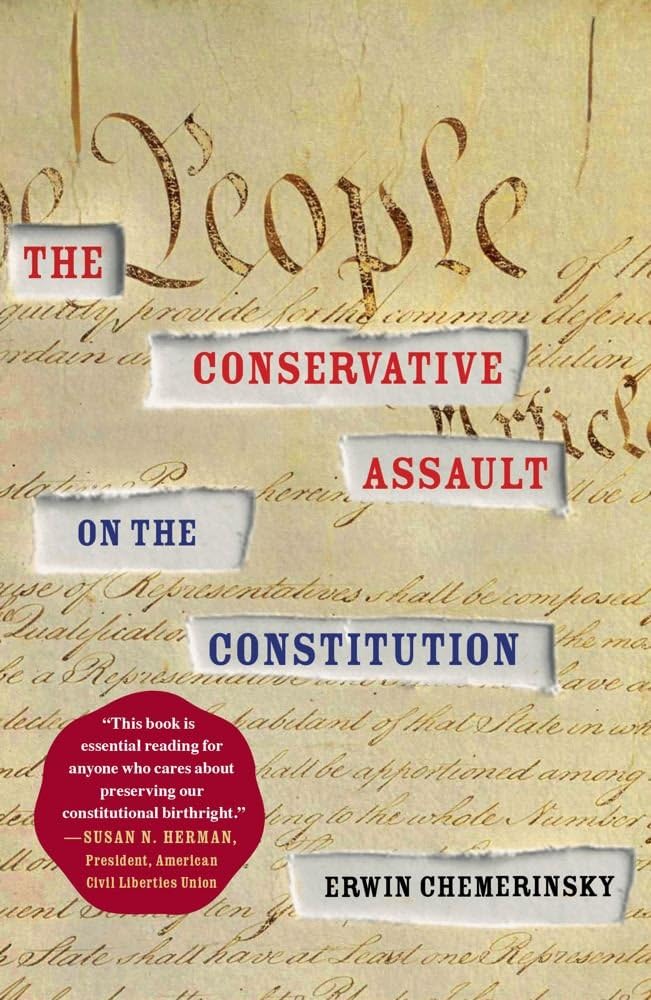
The Conservative Assault on the Constitution
Product ID: 803830033
Desertcart purchases this item on your behalf and handles shipping, customs, and support to Netherlands.
Buy The Conservative Assault on the Constitution by (ISBN: ) from desertcart's Book Store. Everyday low prices and free delivery on eligible orders. Review: I've attended seminars at which Erwin Chemerinsky has spoken three or maybe four times. The first time, I was persuaded he was a genius. The second time I was a little uneasy. He speaks typically for an hour without notes of any sort, dissecting recent Supreme Court decisions with a chipper sense of good will. I know this sounds harsh, but when the anecdotes are delivered in the same cadence time and time again, you do start to wonder. So I picked up his latest book with more than a little curiosity. What would he sound like in The Conservative Assault on the Constitution? He sounds the the way he always does: Possessed of an uncanny and almost omniscient grasp of recent Supreme Court decisions. But what can he tell us about how conservatives have hijacked the courts and turned the Constitution into a necromancer's spell? The story is by now familiar to all practitioners. Beginning with President Richard Nixon, the right has taken aim at the courts, the Supreme Court in particular. It has created an ideology all its own, originalism, and has transformed it into a cloak used to advance a very contemporary agenda: support for school desegregation has eroded, as have the rights of those accused of crime. Although we give lip service to federalism, the power of the federal government has grown at the expense of the people. The courts are increasingly friendly to big business and hostile to civil rights claims. Anyone who has practiced law during the past 20 years has watched the courts drift further and further to the right. I was encouraged to see Chemerinsky chronicle this trend. I am so caught up in individual cases I often fail to see the larger picture. I know that civil rights claims rarely make it to a jury trial any longer. I know that the Fourth Amendment is vanishing. I know that immunity claims for government officials expand year by year. But I really didn't have a sense of what a tidal wave these changes represent until reading Chemerinsky's book. A good law school professor and dean, he is a patient teacher. I was encouraged to read him take aim at sovereign immunity, the bizarre notion that in this republic of ours government is somehow beyond the reach of ordinary justice: "A doctrine derived from the premise `the king can do no wrong' deserves no place in American law. The United States was founded on rejection of monarchy and royal prerogative. American government is based on the fundamental recognition that the government and government officials can do wrong and must be held accountable. Sovereign immunity undermines that basic notion." Amen, I say. Oddly, Chemerinsky writes about sovereign immunity but neglects mention of an even more potent tool in the conservative arsenal of weapons used to keep ordinary people out of court, qualified immunity. This most obvious tool of judicial activism gives the benefit of the doubt to government actors in close cases and accounts for more dismissals prior to trial than any other legal doctrine. By way of example, the Practicing Law Institute in New York each year published a two-volume practice aid on litigation arising under 42 U.S.C. Section 1983, a federal statute that permits ordinary people to sue government actors for violating a person's federal rights. Fifteen years ago, one small chapter in the second volume of the aid was devoted to qualified immunity. The second volume of last year's aid was devoted to qualified immunity cases, and was more than 1,000 pages long. Just where did this doctrine come from? No one claims he framers intended it; no statute was passed by Congress to limit these claims. No, conservative judges cooked it up, and when they did, no one complained it was due to activism. I wanted to hear Chemerinsky's take on this doctrine. Strangely, the book is silent on the topic. Chemerinsky calls for an end to the sham federal judicial confirmation hearings have become. He notes, correctly, that there is no such thing as a neutral way to interpret the constitution. Policy references are required to apply constitutional doctrine to conflict. We should require judges to answer hard questions about controversies rather than permit them to dodge questioning with dishonest locutions suggesting that Supreme Court justices are mere umpires: they do make law. We are entitled to know what kind of laws they will make on cases likely to come before them. If they won't answer questions honestly, then perhaps the Senate ought to refuse to vote to confirm. That would be a refreshing change. The Constitution is not a democratic document, he argues. It is designed to create a constitutional democracy in which minorities are provided protection against the will of a majority. Yes, a majority of Americans may want prayer in the schools. That does not mean the Court stages a coup when it votes against school prayer: it simply means the minority is protected from a majority that is too filled with its own vision of the good to respect competing visions. This book is a good read on recent and emerging trends in constitutional doctrine: It is, after all, the work of one of the nation's foremost professors of constitutional law. But for all that, the book delivers far less than it promises. It is not enough to remind again and again that our liberties hang in a balance far too often tipped by 5-4 votes. That this rightward coup has taken place is apparent. Chemerinsky avoids discussing the social and intellectual history of how this happened. I wanted to read about the creation, funding and staffing of right-wing think tanks, and the hijinks of the Federalist Society. These were the seedbeds of the surge to the right; originalism's secret history was first worked out at retreats and seminars. It became the ticket to judicial advancement only after it first won the hearts and minds of law students, professors and intellectuals patrolling think tanks and looking for power. The book providing a critical history of this has not yet been written. This book is vintage Chemerinsky: concise, accurate in the main, and delivered with the crisp good will of a man who can recite the Supreme Court's recent doctrinal history almost as if from memory. But for all its brilliance, the book has a detached feel. It is the book of an intellectual unfamiliar with conflict at the trial level. That doesn't make it a bad book; it is simply limited. But do read it. If nothing else, it will serve as a counterweight to the silent coup taking place decision by decision in the United States Supreme Court. Review: This is not an unbiased book. The author makes it very clear where he stands. However, like in any persuasive argument, the author gains the highest remarks for scholarship by demonstrating complete control of knowledge and backs every single point with a rich variety of information. The book is divided into chapters that expose the Conservative assault on different areas of law and rights: equality and segregation in education, criminal procedure, executive powers, access to the courts, individual rights and a conclusion sowing all the arguments together. All chapters are brilliantly construed with cases, studies and historical background to make the general argument of the book almost unbeatable. The zenith is saved for last, on the conclusion, where the author shows how Conservative judges have a strong political agenda but successfully hide it under the cloak of "judicial discretion" as opposed to judicial activism. The cases Mr. Chemerinsky cites make it crystal clear how the Conservative majority of the Supreme Court in the past 40 years has been just as activist as the Warren Court. Incredible read, highly recommended.
| ASIN | B0078XXB6M |
| Customer reviews | 4.9 4.9 out of 5 stars (26) |
| Dimensions | 21.23 x 13.89 x 2.11 cm |
| Item weight | 295 g |
| Language | English |
N**S
I've attended seminars at which Erwin Chemerinsky has spoken three or maybe four times. The first time, I was persuaded he was a genius. The second time I was a little uneasy. He speaks typically for an hour without notes of any sort, dissecting recent Supreme Court decisions with a chipper sense of good will. I know this sounds harsh, but when the anecdotes are delivered in the same cadence time and time again, you do start to wonder. So I picked up his latest book with more than a little curiosity. What would he sound like in The Conservative Assault on the Constitution? He sounds the the way he always does: Possessed of an uncanny and almost omniscient grasp of recent Supreme Court decisions. But what can he tell us about how conservatives have hijacked the courts and turned the Constitution into a necromancer's spell? The story is by now familiar to all practitioners. Beginning with President Richard Nixon, the right has taken aim at the courts, the Supreme Court in particular. It has created an ideology all its own, originalism, and has transformed it into a cloak used to advance a very contemporary agenda: support for school desegregation has eroded, as have the rights of those accused of crime. Although we give lip service to federalism, the power of the federal government has grown at the expense of the people. The courts are increasingly friendly to big business and hostile to civil rights claims. Anyone who has practiced law during the past 20 years has watched the courts drift further and further to the right. I was encouraged to see Chemerinsky chronicle this trend. I am so caught up in individual cases I often fail to see the larger picture. I know that civil rights claims rarely make it to a jury trial any longer. I know that the Fourth Amendment is vanishing. I know that immunity claims for government officials expand year by year. But I really didn't have a sense of what a tidal wave these changes represent until reading Chemerinsky's book. A good law school professor and dean, he is a patient teacher. I was encouraged to read him take aim at sovereign immunity, the bizarre notion that in this republic of ours government is somehow beyond the reach of ordinary justice: "A doctrine derived from the premise `the king can do no wrong' deserves no place in American law. The United States was founded on rejection of monarchy and royal prerogative. American government is based on the fundamental recognition that the government and government officials can do wrong and must be held accountable. Sovereign immunity undermines that basic notion." Amen, I say. Oddly, Chemerinsky writes about sovereign immunity but neglects mention of an even more potent tool in the conservative arsenal of weapons used to keep ordinary people out of court, qualified immunity. This most obvious tool of judicial activism gives the benefit of the doubt to government actors in close cases and accounts for more dismissals prior to trial than any other legal doctrine. By way of example, the Practicing Law Institute in New York each year published a two-volume practice aid on litigation arising under 42 U.S.C. Section 1983, a federal statute that permits ordinary people to sue government actors for violating a person's federal rights. Fifteen years ago, one small chapter in the second volume of the aid was devoted to qualified immunity. The second volume of last year's aid was devoted to qualified immunity cases, and was more than 1,000 pages long. Just where did this doctrine come from? No one claims he framers intended it; no statute was passed by Congress to limit these claims. No, conservative judges cooked it up, and when they did, no one complained it was due to activism. I wanted to hear Chemerinsky's take on this doctrine. Strangely, the book is silent on the topic. Chemerinsky calls for an end to the sham federal judicial confirmation hearings have become. He notes, correctly, that there is no such thing as a neutral way to interpret the constitution. Policy references are required to apply constitutional doctrine to conflict. We should require judges to answer hard questions about controversies rather than permit them to dodge questioning with dishonest locutions suggesting that Supreme Court justices are mere umpires: they do make law. We are entitled to know what kind of laws they will make on cases likely to come before them. If they won't answer questions honestly, then perhaps the Senate ought to refuse to vote to confirm. That would be a refreshing change. The Constitution is not a democratic document, he argues. It is designed to create a constitutional democracy in which minorities are provided protection against the will of a majority. Yes, a majority of Americans may want prayer in the schools. That does not mean the Court stages a coup when it votes against school prayer: it simply means the minority is protected from a majority that is too filled with its own vision of the good to respect competing visions. This book is a good read on recent and emerging trends in constitutional doctrine: It is, after all, the work of one of the nation's foremost professors of constitutional law. But for all that, the book delivers far less than it promises. It is not enough to remind again and again that our liberties hang in a balance far too often tipped by 5-4 votes. That this rightward coup has taken place is apparent. Chemerinsky avoids discussing the social and intellectual history of how this happened. I wanted to read about the creation, funding and staffing of right-wing think tanks, and the hijinks of the Federalist Society. These were the seedbeds of the surge to the right; originalism's secret history was first worked out at retreats and seminars. It became the ticket to judicial advancement only after it first won the hearts and minds of law students, professors and intellectuals patrolling think tanks and looking for power. The book providing a critical history of this has not yet been written. This book is vintage Chemerinsky: concise, accurate in the main, and delivered with the crisp good will of a man who can recite the Supreme Court's recent doctrinal history almost as if from memory. But for all its brilliance, the book has a detached feel. It is the book of an intellectual unfamiliar with conflict at the trial level. That doesn't make it a bad book; it is simply limited. But do read it. If nothing else, it will serve as a counterweight to the silent coup taking place decision by decision in the United States Supreme Court.
I**N
This is not an unbiased book. The author makes it very clear where he stands. However, like in any persuasive argument, the author gains the highest remarks for scholarship by demonstrating complete control of knowledge and backs every single point with a rich variety of information. The book is divided into chapters that expose the Conservative assault on different areas of law and rights: equality and segregation in education, criminal procedure, executive powers, access to the courts, individual rights and a conclusion sowing all the arguments together. All chapters are brilliantly construed with cases, studies and historical background to make the general argument of the book almost unbeatable. The zenith is saved for last, on the conclusion, where the author shows how Conservative judges have a strong political agenda but successfully hide it under the cloak of "judicial discretion" as opposed to judicial activism. The cases Mr. Chemerinsky cites make it crystal clear how the Conservative majority of the Supreme Court in the past 40 years has been just as activist as the Warren Court. Incredible read, highly recommended.
A**N
Chemerinsky has also written and published many Constitutional Law text books. They are well written, structured and for the serious reader of Constitutional law, an absolute necessity. My particular favorite is Federal Jurisdiction, Fifth edition. I wish to assure the readers that it is possible to discuss this subject without anger, bias or expletives. I learned that in college nearly 30 years ago but, it seems to now be a lost art. I would recommend a better understanding of the many and varied views on the subject before forming an opinion or a bias. As a rule, If you only see two sides to an issue, you are not looking hard enough.
G**.
I bought this book in order to get a liberal, progressive interpretation on some issues I consider critical to our daily lives. Professor Chemerinsky provides a wonderful first person narrative on some very intricate and complicated issues and carefully lays out the underlying cases heard by the Supreme Court that have influenced or directed contemporary thinking on these subjects. I genuinely appreciate the careful, logical thinking and reasoning on each case; I wish there was more of a reflective analysis against the thinking or beliefs of the framers of the Constitution. Chemerinsky's essays on the flawed thinking of recent Supreme Court decisions is refreshing and his openly progressive position clarifies any bias toward a more liberal interpretive perspective. I think the totality of the work would be significantly enhanced if there were anecdotal entries identifying issues or interpretations encountered by the founding fathers that contribute to or support the more progressive perspective, or; give cause to discount or reduce any conservative inerpretation, contemporary or otherwise. Overall, this is a work that any reasonably minded person should read in order to be more informed and aware of how the Supreme Court's works may affect every citizen's life.
R**W
The author leads the reader through case after case, often quoting from both the majority and dissenting opinions, showing how the court arrived at Roe vs. Wade, for instance, and how subsequent Courts have worked to erode and limit a woman's rights since it was decided. That's just one example. He takes separation of church and state, habeas corpus rights and personal privacy and gives a historical account of each, showing how the increasingly conservative court, while decrying "judicial activism," has actually been consistently activist on issues that involved conservative ideology, overturning previous decisions with abandon, while claiming smugly that they are respectful of previous decisions. The most damning point he makes is the two-faced posture of the Gang of Four(Scalia, Roberts, Alito and Thomas). On the one hand they pretend to be strict constructionists, limiting individual's rights to those explicitly enumerated in the Constitution and its amendments. For example, they ruled against a victim of police negligence whose children were murdered by an ex-spouse after she asked for protection and the cops didn't bother to take any action, saying that the Constitution does not guarantee police competence (or words to that effect) but they were adamant in the recent ruling that corporations have the rights of individuals as far as campaign spending is concerned...clearly not a "right" explicitly granted in the Constitution. Ideology trumps principles with these guys. Real hypocrites! This is a very dense book, and the reader must have an interest in the details of case law and legal precedents to stay with it. I recommend it highly to anyone with those interests.
Trustpilot
1 month ago
2 months ago