Major Works (Oxford World's Classics)
Product ID: 767473368
Desertcart purchases this item on your behalf and handles shipping, customs, and support to Netherlands.
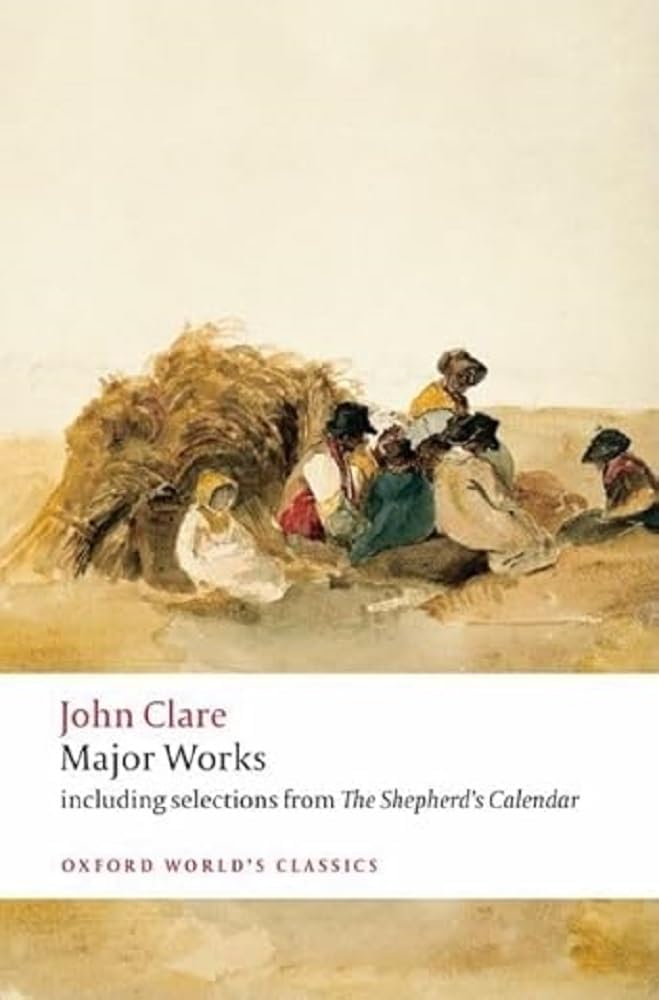
This authoritative edition was originally published in the acclaimed Oxford Authors series under the general editorship of Frank Kermode. It brings together a generous selection of Clare's poetry and prose, including autobiographical writings and letters. John Clare (1793-1864) is now recognized as one of the greatest English Romantic poets, after years of indifference and neglect. Clare was an impoverished agricultural labourer, whose genius was generally not appreciated by his contemporaries, and his later mental instability further contributed to his loss of critical esteem. But the extraordinary range of his poetical gifts has restored him to the company of his contemporaries Byron, Keats, and Shelley, and this fine selection illustrates all aspects of his talent. It contains poems from all stages of his career, including love poetry, and bird and nature poems. Written in his native Northamptonshire, Clare's work provides a fascinating reflection of rural society, often underscored by his own sense of isolation and despair. Clare's writings are here presented with the minimum of editorial interference, and with a new Introduction by the poet and scholar Tom Paulin. ABOUT THE SERIES: For over 100 years Oxford World's Classics has made available the widest range of literature from around the globe. Each affordable volume reflects Oxford's commitment to scholarship, providing the most accurate text plus a wealth of other valuable features, including expert introductions by leading authorities, helpful notes to clarify the text, up-to-date bibliographies for further study, and much more. Review: 詩人中の詩人 - John Clareは、私個人の判断では、イギリス詩人の中で最も詩的感覚にあふれた詩人です。この本は彼の詩の一般向け選集としては最も充実したものです。 彼の英語は標準的な文法には従わず、独自の単語もあり、私のような普通の英語教育しか受けていない者にはとても読みにくい面があるのですが、それでも、くらいついているといつの間にかその世界を味わうことができます。日本語の翻訳も2件ありますが、それでは味わえない世界を探検してみてはいかがでしょうか。 Review: A Real World & Doubting Mind - John Clare Major Works. Edited by Eric Robinson and David Powell. Oxford World's Classics, 2008. Paperback 531 pages. ISBN-10: 0199549796 It's more than sad that John Clare (1793-1864), a major poet of towering genius, should have been so unfairly marginalized by society that he never succeeded in being accepted into the canon of English literature. Any reader of English poetry knows of Byron, Shelley, and Keats; glance in any anthology and you will find them represented by large chunks of their work. But although Clare was their contemporary and his work is certainly as great if not greater than theirs, it can take a long time to discover him and, as the sprinkling of reviews here attests, few bother to read him. It's true that Clare was born into the lowest and most oppressed class of all and that, as a peasant and agricultural laborer, he remained (at least in the formal sense) uneducated, never did learn how to spell or punctuate, and was so poor that there were times when he couldn't afford to buy paper or even ink. It's also true that, after suffering a nervous breakdown, he was certified as insane and spent the last twenty-two years of his life in a lunatic asylum. But despite this it has to be said that the man was a veritable fountain of the most sublime poetry, and some of his finest work was actually written during his asylum years. Clare's exquisite sensitivity to the world around him was so acute, and his love of that world was so great, a superabundance of marvelous lines embodying his perceptions and feelings constantly flowed from him and at his death, besides many thousands of pages of a prose which is often every bit as interesting as his poetry, he left over 3500 poems less than one tenth of which saw print during his lifetime as he never did achieve the kind of success he both deserved and longed for. His complete poems were not even published until the 20th Century when they appeared in the extremely expensive and now virtually unobtainable 9-volume Oxford English Texts edition of 1989-1996; sadly, no reader's edition of this scholarly magnum opus has appeared and most of his prose still remains in manuscript. The present 531-page 'Major Works', edited by Eric Robinson, is the fullest and finest selection of Clare's work to have appeared. This gives us, besides over 400 pages of poetry and 60 pages of prose, an Introduction, Chronology, Notes, Further Reading, Glossary, and Index. It is an edition that all lovers of Clare must be grateful for and is well-printed (though in a rather small typeface) on a somewhat soft poor quality paper (which does not take kindly to readers who like to scribble notes) and is bound in a thermoplastic binding with sturdy paper wrappers which feature a highly appropriate color illustration. This illustration, a detail from 'Harvesters Resting' by Peter de Wint (1784-1849), depicts a group of peasant harvesters at rest from their labors in the field and serves wonderfully to lead us directly into Clare's world, a real world of real things and of real people with no pretensions to superiority, the kind of people who knew the meaning of real work and who weren't afraid of getting their hands dirty. As a peasant, Clare may be said to depict in his works not the somewhat artificial and attenuated world of the upper classes but a far more vigorous and earthy world, a world bursting with life and teeming with an abundance of forms. Nothing is too mean for him to notice, nothing is beneath his gaze: men and women of all sorts and conditions and their joys, sufferings, and hardships; animals, birds, fish, frogs, bees, flies, beetles, spiders, ants, trees, flowers, fields, rivers, streams, storms, floods - all of these and more are set before us in the most powerful and moving verses. As an example of how powerful his work can be readers should look up his poem "The Flood" (pp.193-4), a poem which is readily available on the internet. Daniel Myers tells us that ""The Flood" is an account of an actual flood witnessed by Clare, but also an account of the flood roiling within him, a presentiment of [the madness] he knew was to engulf him." This is an interesting reading I would agree with. I would add, however, that although the flood may symbolize Clare's approaching madness, we needn't restrict ourselves to this single meaning. It seems to me that the flood water as it crashes against the stone bridge also symbolizes the growing anger and frustration and despair of Clare himself, as representative of the vigorous life of the peasantry, crashing in futility against the cold, hard, stony and unyielding mass of the privileged upper class of exploiters whose enclosures were dismantling the world he loved and that was so much a part of him. In his very first poem, "Helpstone", Clare wrote: "Accursed wealth, o'er bounding human laws Of every evil thou remainst the cause... Thou art the bar that keeps from being fed And thine our loss of labor and of bread..." (p.4) Lao Tzu said of the Tao, the universal law that is in harmony with human nature: "If kings and barons can abide by it, All creatures will arrive as guests to a banquet." * Nature is Abundance; it spreads out before us a banquet to which all, whether human or non-human, are invited. Clare's outrage that the common people have been shut out from this banquet of Nature's abundance by the greed of their social superiors, along with the many other stresses in his life such as poverty, ill health, difficulties with publishers, etc., are reasons enough, one would think, to eventually drive someone as sensitive as him into madness. "The Flood" closes with the somber lines: "- On roars the flood - all restless to be free Like trouble wandering to eternity." (p.194) For a while, as a 'peasant poet' and therefore something of an interesting oddity, Clare had been lionized by the smart set. But as time went by their interest fell off. The world was changing and the public's taste for poetry was drying up as novel-reading became more popular. If he had been born in the heyday of poetry twenty years earlier he might have succeeded in getting more of his work published and carving out a niche for himself in the canon, but it was not to be. To fully appreciate his poetry one needs to know something of his life and he himself in his 'Autobiographical Fragments' has provided the best account. An excellent edition of these fragments, along with much other biographical material, will be found in John Clare - By Himself (Fyfield Books) This is a thoroughly enjoyable and truly fascinating book and is written in an incredible prose that reminds one at times of Joyce's "Ulysses". After learning something about the life and character of the man who wrote "The Flood", I feel sure that the poem will bring tears to the eyes of at least some readers when they return to it. *(see The Tao Te Ching: A New Translation With Commentary 32.1)
| Amazon 売れ筋ランキング | 洋書 - 153,156位 ( 洋書の売れ筋ランキングを見る ) Literature & Fiction (洋書) - 39,054位 |
| おすすめ度 | 5つ星のうち4.8 139 レビュー |
忠**門
詩人中の詩人
John Clareは、私個人の判断では、イギリス詩人の中で最も詩的感覚にあふれた詩人です。この本は彼の詩の一般向け選集としては最も充実したものです。 彼の英語は標準的な文法には従わず、独自の単語もあり、私のような普通の英語教育しか受けていない者にはとても読みにくい面があるのですが、それでも、くらいついているといつの間にかその世界を味わうことができます。日本語の翻訳も2件ありますが、それでは味わえない世界を探検してみてはいかがでしょうか。
T**I
A Real World & Doubting Mind
John Clare Major Works. Edited by Eric Robinson and David Powell. Oxford World's Classics, 2008. Paperback 531 pages. ISBN-10: 0199549796 It's more than sad that John Clare (1793-1864), a major poet of towering genius, should have been so unfairly marginalized by society that he never succeeded in being accepted into the canon of English literature. Any reader of English poetry knows of Byron, Shelley, and Keats; glance in any anthology and you will find them represented by large chunks of their work. But although Clare was their contemporary and his work is certainly as great if not greater than theirs, it can take a long time to discover him and, as the sprinkling of reviews here attests, few bother to read him. It's true that Clare was born into the lowest and most oppressed class of all and that, as a peasant and agricultural laborer, he remained (at least in the formal sense) uneducated, never did learn how to spell or punctuate, and was so poor that there were times when he couldn't afford to buy paper or even ink. It's also true that, after suffering a nervous breakdown, he was certified as insane and spent the last twenty-two years of his life in a lunatic asylum. But despite this it has to be said that the man was a veritable fountain of the most sublime poetry, and some of his finest work was actually written during his asylum years. Clare's exquisite sensitivity to the world around him was so acute, and his love of that world was so great, a superabundance of marvelous lines embodying his perceptions and feelings constantly flowed from him and at his death, besides many thousands of pages of a prose which is often every bit as interesting as his poetry, he left over 3500 poems less than one tenth of which saw print during his lifetime as he never did achieve the kind of success he both deserved and longed for. His complete poems were not even published until the 20th Century when they appeared in the extremely expensive and now virtually unobtainable 9-volume Oxford English Texts edition of 1989-1996; sadly, no reader's edition of this scholarly magnum opus has appeared and most of his prose still remains in manuscript. The present 531-page 'Major Works', edited by Eric Robinson, is the fullest and finest selection of Clare's work to have appeared. This gives us, besides over 400 pages of poetry and 60 pages of prose, an Introduction, Chronology, Notes, Further Reading, Glossary, and Index. It is an edition that all lovers of Clare must be grateful for and is well-printed (though in a rather small typeface) on a somewhat soft poor quality paper (which does not take kindly to readers who like to scribble notes) and is bound in a thermoplastic binding with sturdy paper wrappers which feature a highly appropriate color illustration. This illustration, a detail from 'Harvesters Resting' by Peter de Wint (1784-1849), depicts a group of peasant harvesters at rest from their labors in the field and serves wonderfully to lead us directly into Clare's world, a real world of real things and of real people with no pretensions to superiority, the kind of people who knew the meaning of real work and who weren't afraid of getting their hands dirty. As a peasant, Clare may be said to depict in his works not the somewhat artificial and attenuated world of the upper classes but a far more vigorous and earthy world, a world bursting with life and teeming with an abundance of forms. Nothing is too mean for him to notice, nothing is beneath his gaze: men and women of all sorts and conditions and their joys, sufferings, and hardships; animals, birds, fish, frogs, bees, flies, beetles, spiders, ants, trees, flowers, fields, rivers, streams, storms, floods - all of these and more are set before us in the most powerful and moving verses. As an example of how powerful his work can be readers should look up his poem "The Flood" (pp.193-4), a poem which is readily available on the internet. Daniel Myers tells us that ""The Flood" is an account of an actual flood witnessed by Clare, but also an account of the flood roiling within him, a presentiment of [the madness] he knew was to engulf him." This is an interesting reading I would agree with. I would add, however, that although the flood may symbolize Clare's approaching madness, we needn't restrict ourselves to this single meaning. It seems to me that the flood water as it crashes against the stone bridge also symbolizes the growing anger and frustration and despair of Clare himself, as representative of the vigorous life of the peasantry, crashing in futility against the cold, hard, stony and unyielding mass of the privileged upper class of exploiters whose enclosures were dismantling the world he loved and that was so much a part of him. In his very first poem, "Helpstone", Clare wrote: "Accursed wealth, o'er bounding human laws Of every evil thou remainst the cause... Thou art the bar that keeps from being fed And thine our loss of labor and of bread..." (p.4) Lao Tzu said of the Tao, the universal law that is in harmony with human nature: "If kings and barons can abide by it, All creatures will arrive as guests to a banquet." * Nature is Abundance; it spreads out before us a banquet to which all, whether human or non-human, are invited. Clare's outrage that the common people have been shut out from this banquet of Nature's abundance by the greed of their social superiors, along with the many other stresses in his life such as poverty, ill health, difficulties with publishers, etc., are reasons enough, one would think, to eventually drive someone as sensitive as him into madness. "The Flood" closes with the somber lines: "- On roars the flood - all restless to be free Like trouble wandering to eternity." (p.194) For a while, as a 'peasant poet' and therefore something of an interesting oddity, Clare had been lionized by the smart set. But as time went by their interest fell off. The world was changing and the public's taste for poetry was drying up as novel-reading became more popular. If he had been born in the heyday of poetry twenty years earlier he might have succeeded in getting more of his work published and carving out a niche for himself in the canon, but it was not to be. To fully appreciate his poetry one needs to know something of his life and he himself in his 'Autobiographical Fragments' has provided the best account. An excellent edition of these fragments, along with much other biographical material, will be found in John Clare - By Himself (Fyfield Books) This is a thoroughly enjoyable and truly fascinating book and is written in an incredible prose that reminds one at times of Joyce's "Ulysses". After learning something about the life and character of the man who wrote "The Flood", I feel sure that the poem will bring tears to the eyes of at least some readers when they return to it. *(see The Tao Te Ching: A New Translation With Commentary 32.1)
C**M
A very good selection of John Clare's Writings
I came across a poem by John Clare, which appealed to me and I bought the book because I knew little about him - I cannot explain how I had missed his works. The book is a good selection and I spent quite some time enjoying these writings.
W**Y
D
One of my favorite poets.
S**N
Book
Comprehensive
D**D
Classic - literally
I love the Oxford Classics, so well edited and annotated. This is no exception. A great read.
Trustpilot
4 days ago
1 month ago