


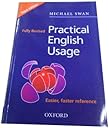

Practical English Usage (3rd Edition)
Product ID: 68463403
📚Comprehensive Guide
📝Practical Exercises
🔍Clear Explanations
Buy anything from 5,000+ international stores. One checkout price. No surprise fees. Join 2M+ shoppers on Desertcart.
Desertcart purchases this item on your behalf and handles shipping, customs, and support to Netherlands.
📖 Elevate Your English Game!
Practical English Usage (3rd Edition) is an essential resource for anyone looking to master the intricacies of the English language. Published on April 21, 2005, this paperback edition offers clear explanations, practical exercises, and a comprehensive guide to common language issues, making it an invaluable tool for both learners and educators.
| ASIN | 0194420981 |
| Best Sellers Rank | 42,851 in Books ( See Top 100 in Books ) 59 in English as a Foreign Language Exams 275 in English Language Study for Young Adults 4,368 in Education & Reference for Children |
| Customer reviews | 4.6 4.6 out of 5 stars (942) |
| Dimensions | 23.37 x 3.56 x 15.49 cm |
| Edition | 3rd |
| ISBN-10 | 9780194420983 |
| ISBN-13 | 978-0194420983 |
| Item weight | 907 g |
| Language | English |
| Part of series | PRACTICAL ENGLISH USAGE |
| Print length | 688 pages |
| Publication date | 21 April 2005 |
| Publisher | OUP Oxford |
J**S
Almost everything you need to know
I'm about to embark on my first TEFL job, so bought this book as it seems to be the definitive single volume work on English grammar. It looks as though It will be useful to both native English speakers and to learners of English. The layout is simple: a brief but interesting and entertaining introduction followed by an encyclopaedic guide to various points of English grammar listed alphabetically, and finally a comprehensive index. The middle section lists most of the grammatical points you're likely to come across, and many that you might expect not to fall within the scope of a book on grammar: such things a taboo words, differences between British and American usage and difficult words that are similar but not identical in meaning (such as 'continually' and 'continuously'). Before beginning this review I decided to put the book to the test by looking up something that has always flummoxed me (and I've been speaking English for a very long time now!); the difference between 'which' and 'that' when used as conjunctions. I couldn't find anything that would enlighten me, not in the alphabetical encyclopaedia nor the index. I had better luck with a second test; when to use 'may' and when to use 'might'. This was easy to find, and the explanation was very lucid. Oh well, the English language is so vast and complex that a truly exhaustive grammar book would no doubt have to run to several volumes. For a single volume that will fit into my backpack and not cause any problems at the airport, this is probably as good as it gets. If my TEFL experience brings to light any particular problems or highlights, I'll let you know.
D**E
The Bible of English Grammar
The authority on English grammar and indispensable for any English language teacher, this book is a must. References are NOT of page numbers but paragraph sections and so the format, at first, can be off-putting. But once a person gets the hang of it, it is the best guide for English grammar I know of. The way it is organised - alphabetically - makes it easy to find what you want using the index; and the examples are concise but effective enough to get the message across. Included are supplementary pages of common mistakes made by basic, intermediate, advanced and very advanced students of English and what is correct, which I have not seen in any other textbooks. Has really opened up a new world for me with the English language, and shown me why I say certain things the way I do and what mistakes I am making. Well worth the price.
R**E
Swan 1 - Parrott 0
Designed alphabetically, this is, for me, the best English grammar reference book around. It's sufficiently detailed without being too dry to read. His explanations are generally clear and helpful. The main alternative, Parrott (apparently you have to share your name with a bird to publish English grammar books for some reason!) is much more heavy going. So while Parrott sits gathering dust on the shelf, Swan is almost constantly in use. A great reference book and an essential aid for TEFL teachers. Just one thing to remember - it is a reference book so don't expect exercises - it's not that sort of book.
T**S
Another reasonable investment
Like Leech et al's A-Z Of English Grammar And Usage, reviewed previously, this is a dictionary of English Grammar, not, as it were, a book telling a story. They're not designed to be read cover-to-cover, although I will admit that's what I did with both of them. Swan's book is a degree or two more academic than Leech's, which is not to say it's better, just for a slightly more specialist audience. It's well written, begins with a contents overview which is very useful for accessing specific areas of interest, which is followed by a glossary of Language Terminology, which is good, but sometimes lacking when it comes to actual definition. Like the Leech book, it suffers from the drawback that if you don't know the word to look for, how are you going to look it up? Also like Leech, Swan can be vague, as in the case of tenses. Kendris and Kendris (501 Spanish Verbs) suggest that English has three tenses, Past, Present and Future, where Spanish has 14. Leech and Swan both say English has two, Past and Present. I don't know why Future isn't a tense, and they don't tell me. However, Swan does provide an excellent table called Active Verb Forms which shows what look to me like 12 tenses. But you have to know where to look. Another puzzle: what ever happened to Parts of Speech? I was taught, and used to teach, these (adjective, adverb and so on, through to verb). There is neither mention of the term nor of an alternative, and nor is there of Interjections, which used to be on the list, and I assume is still an extant term because I heard it used the other day by a linguist on Radio 4 (ergo, it must be!). I am also, by extension, left wondering at the status of Determiners in my list. Do they carry the same weight as, say, conjunctions in the pantheon of word types? A part of the problem, of course, derives from deficiencies in my formal education, which emerged as I read through the glossary - I'd never previously come across things like copular verbs (not quite as interesting as they sound, I'm afraid), postmodifiers or question tags, to name but three from a long list I made as I went along. But the non-committal nature of some of Swan's explanations doesn't help. And if I may be allowed to sound, for just a moment, like an old fogey, I found it most baffling that Swan should spend a whole section apparently excusing misuse of words, as in the "controversy" over "less" and "fewer" in supermarkets. Frankly, I consider using "less" rather than "fewer" on a plain with saying "much" when you mean "many". It's true, as Swan says, that language develops, and as it does so do the meanings of words: take "nice" (originally meaning something like "exact") or "perplex" (formerly a term for tangled fibre used in the textile industry). But those who, for example, say "reticent" when they mean "reluctant" are robbing some of us of a useful word. Amazingly, I once heard a head teacher describe somebody as "reticent to speak". Thanks Ted, I thought. Nevertheless, like Leech's book, overall this is a worthwhile investment if you have a professional interest in English.
R**Y
Useful resource
Useful when doing CELTA OR TESOL courses. And when a teacher of EFL or ESOL.
J**G
Great!
This book was recommended to me by a friend. It is great! It is detailed and explains all the different types of situations/contexts where a certain word/phrase can be used. It is easy to use and navigate through. Great for anyone wishing to teach English as a Foreign Language.
L**E
Fantastic service from this vendor
Great service. I have quite difficult delivery instructions in my building, but everything arrived perfectly. Great book. Just as described. I'd feel confident ordering from them again.
J**S
Poor
Disappointing. Delivery was great just the content isn’t that great. Looked up infinitives and found the definition was unclear
P**1
Répond à toutes les attentes d'un enseignant et d'un enseigné. Cet index alphabétique est une trouvaille ! Toutes les particularités sont démontées, expliquées mais attention, ce pavé de 600 pages n'est qu'en anglais....
ఏ**?
I have an abject disrelish for grammar books. If I was the only man left on the solar system, and was tasked with populating it, and was surrounded by the most gorgeous women, plopping in a grammar book somewhere in the mix would surely result the extinction of human race. I hate books that say utterly incomprehensible stuff like Subjunctive, postpositive adjective, Grapheme-phoneme correspondences and what not. This book however, is thankfully made for humans, and not grammar / English teachers and consequently uses words and explanations that you and I can understand. It tells us which sentences are wrong and which arent. At each point, if the explanation gets too complex, it simply shuts the explanation down and says, this is how it is b*tches! Now, that is how I like my grammar. Easy, Simple, Clear, and Dirty!
E**N
First off, the book arrived in good condition and second the delivery was quick. I would buy again from this seller. About the book. During my years at university we used a 1980's version of this book, which has been an excellent, detailed resource then and still is today. Though years of use took a toll on this version, so I searched for a replacement of the same. The "Third Edition" which I am reviewing has everything the previous edition has and then some. It is current, the volume is larger in size, there are many new lists and topics, examples are clear and simple, and one new section which I love is the "Don't Say It!" 130 common mistakes in English and how to avoid them. Above all this book comes from a knowledgeable, resourceful author and trusted university press. One can never go wrong with publications from Michael Swan and Oxford. I am very satisfied with this purchase.
L**B
There is truly no other book like it. It categorizes Common English Usage so easily that you can look up "over" and find what the difference is between "over" and "above". It explains things very clearly and I must say I have not run across any explanation than seems unclear or lacks detail. I used this book heavily while teaching English in Hungary and it is an excellent book for teachers to have, as well as learners of English. I must say though it is a rather advanced book in the sense that someone who does not understand basic English grammar already might have some problems with the explanations. Have fun reading guys!
M**G
Il pacco è arrivato in 4 giorni tramite Dhl, dall'India !!, il libro era in perfette condizioni , ricoperto con una pellicola protettiva ed inserito in un pacco di cartone tipo amazon standard! Come già scritto da altri; le varie voci sono messe in ordine alfabetico , poste in relazione con altre simili ( esempio big, large e great) non mancano approfondimenti utili come sulle headlines dei giornali.Una miniera di informazioni ,di facile consultazione per chi già conosce l'inglese!
Trustpilot
3 weeks ago
1 month ago