
Buy anything from 5,000+ international stores. One checkout price. No surprise fees. Join 2M+ shoppers on Desertcart.
Desertcart purchases this item on your behalf and handles shipping, customs, and support to Netherlands.
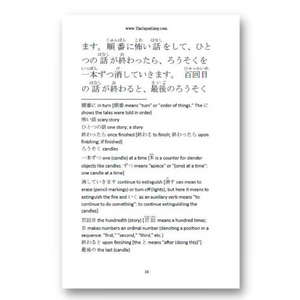
Four classic Hikoichi folktales — every sentence broken down for upper-beginner readers of Japanese. Hikoichi is the clever young man of Kyushu legend who outwits lords, tengu, and the occasional smug retainer with nothing but quick thinking and a straight face. This volume gathers four of his most beloved stories, presented in full Japanese with line-by-line vocabulary, grammar notes, native-speaker audio, and a simple English translation for self-checking. New in the 2026 edition: Bonus unlock code inside the book — redeem at Makoto+ to study every sentence from this book interactively, on the web or in the mobile app New watercolor illustration and audio QR codes on every story's opening page Hook teaser and Before-You-Read intro for each story, pointing you toward the grammar and vocabulary patterns to watch for Full Exercises section for each story: Comprehension Questions, Particle Fill-in, Grammar Pattern Hunt, Translation Comparison, and Answer Key Resized furigana — ruby now sits closer to the base text, the way good Japanese typography should Running headers, page numbers, and sumi-e section ornaments throughout What's inside: Four full Hikoichi stories, each presented three ways: with line-by-line vocabulary, in plain Japanese (no furigana, for real reading practice), and in English summary Word-by-word breakdowns with furigana over every kanji Grammar spotlights, cultural notes, and language tips throughout Free MP3 audio downloads — natural speed and slowed down — recorded by a native speaker Free Anki decks for pre-study Bonus unlock code for Makoto+ Sentence Explorer No sign-up required to access the audio The four stories: 1. The Young Lord — The lord lines up five identical children and asks Hikoichi to pick the real heir. One quiet observation does the work. 2. The Hanami — A cherry-blossom picnic turns into a lesson in thinking ahead. The retainers laugh first. Hikoichi laughs last. 3. The Living Umbrella — A "living" umbrella that opens by itself when it rains. Some things are too good to be true. 4. Tengu's Straw Raincoat — Hikoichi sets out to outwit a long-nosed mountain spirit with nothing but a hollow bamboo pipe. The trade goes well. The cover-up does not. Who this is for: Upper-beginner to lower-intermediate learners. You'll need solid kana and a working sense of basic grammar. (New to hiragana? Take our free two-week crash course at TheJapanesePage.com/hiragana.) Questions or requests for future readers? The authors' personal email addresses are inside the book. Review: The Perfect Book for Japanese Students Wanting to Improve Kana / Kanji Reading - This series is virtually perfect for students of Japanese who have Hiragana and Katakana memorized but know few or none of the Kanji. The stories are from traditional Japanese folklore, which means they're interesting and clever, and most of it is presented in Hiragana, with Furigana for each Kanji character. I think there may be some sparse Katakana, but for the most part it's Hiragana. It's not only an excellent way to improve your Kana reading, it's also invaluable for improving vocabulary, something recorded language courses like Pimsleur and Rosetta sorely miss. Reading new words in context of an interesting story assists greatly in visualizing and remembering them. In this sense the formatting of the book too is excellent: Every page has the Kana at the top (with Furigana above whatever Kanji characters appear,) and phrase-by-phrase translations in Romaji (English phonetic) at the bottom of the page. Which means you can check a given word's translation instantly - a big, big help when you're using an e-reader like a Kindle or Fire, because you're thereby spared the necessity of doing endless page-flips to get to some general glossary located far from the page you're on. It's right there where you need it, but below everything else so you don't "cheat" with inadvertent glances while you read. In the third volume of this series the author inexplicably omits the Furigana completely, which makes that third book (and presumably those subsequent to it,) useless to anyone without a large number of Kanji memorized. I'm currently at something like 28, total. Hopefully that odd decision will be corrected, but this and Volume 2 are indispensable for beginning-to-intermediate Japanese students looking to move from "stare-at-each-character" reading to fluid sight-reading of Kana and, eventually, Kanji. Just an excellently-conceived and -executed series with clever, interesting short stories. Review: For upper beginners - This is a very good book for beginners, and by beginners I mean those who are familiar with hiragana, katakana I more than 100 kanji. Why did I mention kanji? Simply because when I started to learn the Japanese language, I tried to read it and it became a disaster for my self-confidence. So I waited for some time and studied hard so today I can open a book which claims to be for beginners and not to fall into depression when I realize that I can read it at once. Stories in this book are very lightly written, and if you had mentioned knowledge you will find unknown words, but you won't be so much disappointed in yourself - especially because you can mark those words, and study them after. There is a dictionary, and even some words, like Japanese phrases you can't translate literary, are translated not so good, the dictionary itself is of a great help. And those Japanese phrase I'm talking about are things someone who is not so much beginner will recognize and understand, so it is not a big problem. Another bonus is free audio you get with a book, which is always good to have.


| Best Sellers Rank | #1,251,437 in Books ( See Top 100 in Books ) #314 in Japanese Literature #600 in General Japan Travel Guides #3,383 in Foreign Language Instruction (Books) |
| Customer Reviews | 4.4 out of 5 stars 306 Reviews |
U**6
The Perfect Book for Japanese Students Wanting to Improve Kana / Kanji Reading
This series is virtually perfect for students of Japanese who have Hiragana and Katakana memorized but know few or none of the Kanji. The stories are from traditional Japanese folklore, which means they're interesting and clever, and most of it is presented in Hiragana, with Furigana for each Kanji character. I think there may be some sparse Katakana, but for the most part it's Hiragana. It's not only an excellent way to improve your Kana reading, it's also invaluable for improving vocabulary, something recorded language courses like Pimsleur and Rosetta sorely miss. Reading new words in context of an interesting story assists greatly in visualizing and remembering them. In this sense the formatting of the book too is excellent: Every page has the Kana at the top (with Furigana above whatever Kanji characters appear,) and phrase-by-phrase translations in Romaji (English phonetic) at the bottom of the page. Which means you can check a given word's translation instantly - a big, big help when you're using an e-reader like a Kindle or Fire, because you're thereby spared the necessity of doing endless page-flips to get to some general glossary located far from the page you're on. It's right there where you need it, but below everything else so you don't "cheat" with inadvertent glances while you read. In the third volume of this series the author inexplicably omits the Furigana completely, which makes that third book (and presumably those subsequent to it,) useless to anyone without a large number of Kanji memorized. I'm currently at something like 28, total. Hopefully that odd decision will be corrected, but this and Volume 2 are indispensable for beginning-to-intermediate Japanese students looking to move from "stare-at-each-character" reading to fluid sight-reading of Kana and, eventually, Kanji. Just an excellently-conceived and -executed series with clever, interesting short stories.
A**S
For upper beginners
This is a very good book for beginners, and by beginners I mean those who are familiar with hiragana, katakana I more than 100 kanji. Why did I mention kanji? Simply because when I started to learn the Japanese language, I tried to read it and it became a disaster for my self-confidence. So I waited for some time and studied hard so today I can open a book which claims to be for beginners and not to fall into depression when I realize that I can read it at once. Stories in this book are very lightly written, and if you had mentioned knowledge you will find unknown words, but you won't be so much disappointed in yourself - especially because you can mark those words, and study them after. There is a dictionary, and even some words, like Japanese phrases you can't translate literary, are translated not so good, the dictionary itself is of a great help. And those Japanese phrase I'm talking about are things someone who is not so much beginner will recognize and understand, so it is not a big problem. Another bonus is free audio you get with a book, which is always good to have.
P**.
A short book.
I don't think this book is bad for its price. The two stories are rather short, but that was to be expected. The kanji do tend to be a bit small, but I didn't have trouble reading the words I knew. (Granted, I've got two years of college Japanese under my belt and I'm studying Chinese on my own now, so I've got some experience with Chinese characters - which makes it easier to read them when they're small.) For the first story, the furigana (small letters written above kanji to show pronunciation) were as easy to read as the rest of the story. However, they were less clear in the second story (or parts of it) and might be difficult for somebody that's new to the syllabaries to read. The vocabulary lists gave romaji (these, Latin letters), too, though. So that should clear up any problems. Now, while I say the kanji are small, keep in mind that I mainly use my iPod Touch for Kindle books (although I think they look a little small in the screenshots that have been put up of a Kindle, too, but that might just be the screenshots - I don't have an actual Kindle). I loaded it on my laptop just to see how it looks, and the kanji are perfectly legible there. So I think this is really more about the device you have than the book itself. Also, while I can't find a way on the Kindle for PC, I can enlarge pictures (which is what the Japanese text is as I write this) on my Kindle for the iPod Touch. And, while the kanji wasn't always the clearest, they, and the furigana, always became legible if it wasn't earlier. My main complaints about the book are overuse of furigana and how the book was arranged, but these don't really affect the book itself much. Since furigana is provided in the section that lists the vocab under the sentences, I think it should have been left out of the Japanese only section: that way you can practice remembering how to read the kanji; plus, furigana can simply be distracting if you already know the kanji.
W**H
This book isn't bad. There are 5 stories
I am a little past beginner in Japanese. Can read/write in both hiragana and katakana and know some kanji. A little rusty, but anyway....This book isn't bad. There are 5 stories, each a little more difficult than the next. All stories have 3 parts, one with the Japanese on top and a sort of dictionary of the words on the bottom of each page. If you have ever looked at any books similar to this, it is the same format. Most of these Japanese reading books for beginners have the vocabulary on the bottom. There isn't a lot of kanji, so nothing really out there. The second part of each story is strictly in Japanese. Then the third part is the summary. The summary is the only thing I have issue with. When I bought it, I though it would have been and actual translation of the story in English, but they are just summaries. So, just be aware of that when purchasing. If you are a beginner then this might be frustrating for you. I am a little further along so isn't a big deal for me personally. I would put the difficulty level somewhere between the various children stories, and the other Japanese reader books. That is not meant as an insult, but it seems to fit nice for a "next step" in reading.
K**O
Nice learning tool
This is a very nice little book that helps you to learn to read Japanese. The page by page, nearly line by line, translation makes reading and learning new words very convenient. There are not too many words per page, which makes it easy to follow along. I purchased both the MP3/PDF and book versions and find the book version to be most convenient to use; it's very easy to turn pages and find earlier materials you are interested in. The kanji are also easier to learn when presented in the context of a story. The MP3 files help you to improve your ability to hear and recognize Japanese words and sentences. I rate this book at the highest level, and look forward to reading others in the series.
M**N
A True Reader for Japanese Language Learners
I have purchased other Japanese readers but this is the first book I have started and finished AND comprehended! The four short stories are entertaining for beginners and I'd say even more advanced (I studied Japanese for 4 years and absolutely enjoyed these stories). The running gloss I love because as a learner I tend to forget a word even if I've seen it 5 times already, and with this gloss I can count on the word being included on the same page without going back to look for it. Reading these readers I think are a good foundation before moving on to the more advanced Breaking into Japanese Literature, Exploring Japanese Literature, A Japanese Reader (Miller), etc. I also love how each story 3 versions: Japanese with furigana and running gloss, Japanese with furigana, and then the English version. I finished this book rather quickly and wouldn't mind reading it again and again...I just ordered the Japanese Reader vol. 5....たのしみ!!><
J**N
Japanese Reader Collection Volume 1: Hikoichi
I like the book and the audio is great. I am working through the book with my Japanese tutor and she likes it too. The downside is that for some reason, this book does not function properly with my Japanese pop-up kindle dictionary. I have 4 J-E dictionaries and none of them work properly with this book. My dictionaries' pop-up features work when I highlight words in other dictionaries so I think there is something about this book that it doesn't work with the dictionary feature. The book has complete vocabulary Japanese to English glosses and explanations in the text, which is fantastic, but I would like to read the Japanese only version with my dictionary to help me learn more about the vocabulary in other contexts. Is this issue a bug or was the book designed that way because of all the English in it? Anyway, I still recommend the book for the great stories, Japanese to English vocabulary glosses, audio and included English version. Just don't expect to use you Kindle Japanese Dictionary with this series.
J**L
Nice little book
This and its siblings (the inch-high samourai and the little match girl) are nice little books of which one would like to find more on kindle store. It is the right level for a student who has mastered the kana and the basic constructions. It is true that the writing is sometimes pale, making the reading less easy. There seem to be a hardware problem here. If this is any solace, it is worse with other Japanese books for Kindle (see samples from Akutagawa or Natsume Soseki) There is, however, a simple trick to enlarge the characters: change the orientation and make the long side of the device horizontal. The little books become quite readable then. It is also true that short reminders of some relevant grammar points would be welcome.
R**N
Excellent concept
This book is really useful for those wanting to improve their Japanese reading skills. Japanese text with meticulous explanations of everything. Definitely worth purchasing.
V**U
Makes for a good stepping stone
I bought this book in paper version and find it very easy to use. There are three versions of each of the four stories - an English summary, a full Japanese version and a Japanese version with vocabulary under the text. Vocabulary and text are on the same page so they are easy to cross-check. This is for beginners as the stories really are quite simple, all kanji have hiragana and all words are translated, even simple ones. If you're only just starting to read, though, it does give a sense of accomplishment to be able to do it yourself. The stories are short and amusing so it isn't a chore to get through them painstakingly, like you might find with other books. It feels like a good place to start. The kanji and hiragana are also very big and clear. Book arrived quickly and in excellent condition.
D**.
Idóneo para aprender
El libro está bien organizado para avanzar poco a poco en el aprendizaje del japonés. Quizá le añadiría alguna explicación gramatical
C**E
Hikoichi
Hikoichi is the first book I bought from thejapanesepage.com / theJapanShop.com people and I’m very happy with it. It's more grown up the Graded Readers series, the layout is nice, as are the extra downloads, and I consider the site/company a trusted source for Japanese language learning. The book is easy to read, the Japanese text a good size. You’re given 3 versions of the stories to work through (there are 4 stories altogether), first you have the Japanese text with a running glossary, next is just Japanese and then just English. There’s also furigana (small hiragana for pronunciation) above the Kanji and a vocabulary list in the back. They also let you know who the book is suitable for, beginners and upper beginners. Would, and do, recommend.
N**A
Excellente collection
Une petite collection bien pensée quand on veut s'initier à la lecture de textes en japonais, pour peu qu'on comprenne un peu l'anglais. La version Kindle n'est pas idéale, mais elle reste utile si on ne dispose pas de la version papier. Les explications du vocabulaire japonais se font phrase par phrase, donc pas de soucis de navigation. Les explications grammaticales par contre viennent après le texte, ce qui peut être un peu fastidieux sur Kindle.
Trustpilot
1 month ago
4 days ago