Buy anything from 5,000+ international stores. One checkout price. No surprise fees. Join 2M+ shoppers on Desertcart.
Desertcart purchases this item on your behalf and handles shipping, customs, and support to Netherlands.
🚀 Upgrade your network, upgrade your hustle.
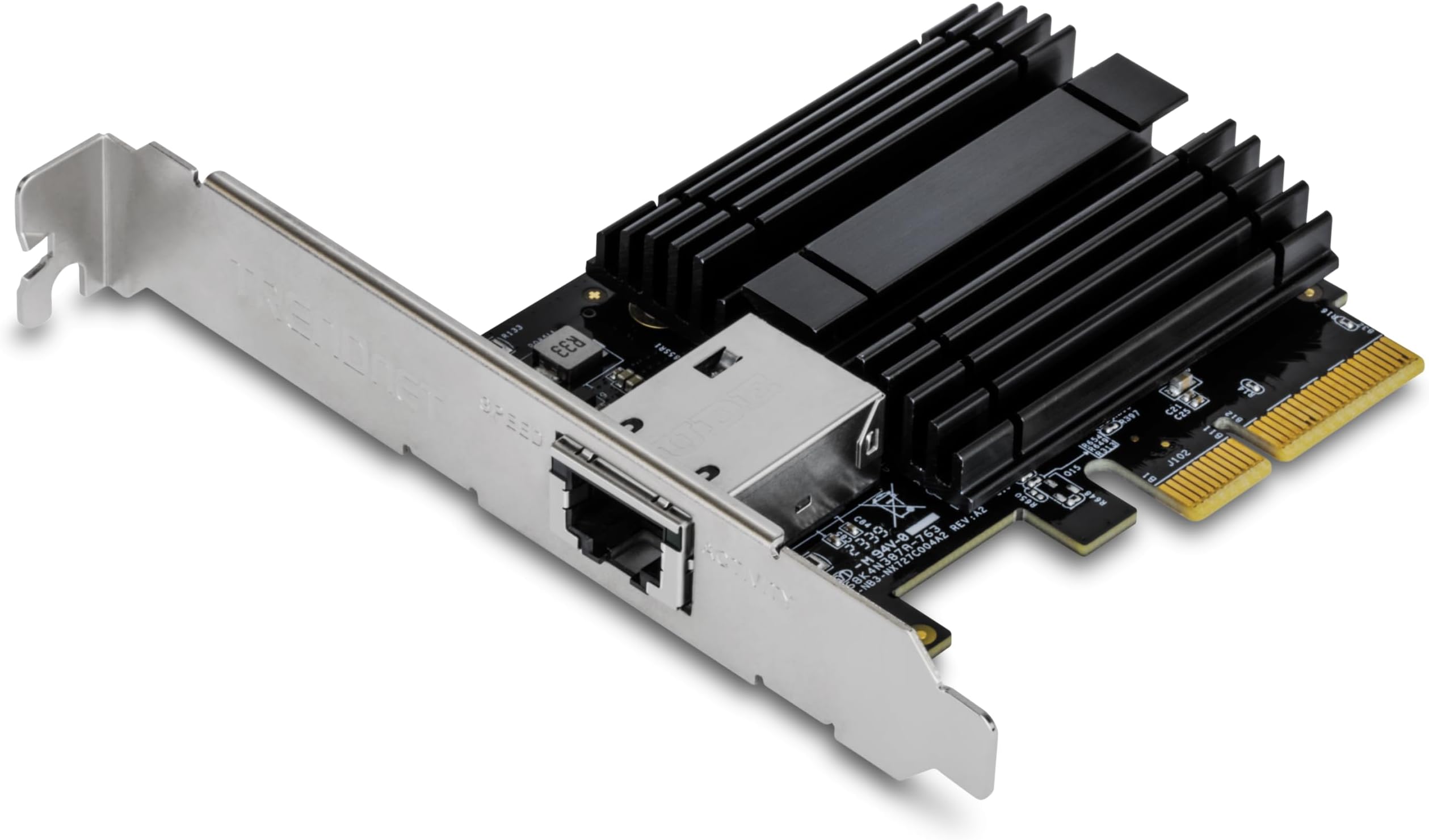
The TRENDnet TEG-10GECTX is a high-performance 10 Gigabit PCIe network adapter that converts a PCI Express slot into a blazing fast 10Gbps RJ-45 Ethernet port. Featuring PCIe Gen 3.0 x4 interface, NDAA and TAA compliance, and support for multiple speeds including 2.5GBASE-T over Cat5e cables, it’s designed for professionals seeking reliable, future-proof connectivity. Compatible with Windows and Windows Server, it includes both standard and low-profile brackets and is backed by a 3-year manufacturer warranty.


| ASIN | B01N5AOWW6 |
| Best Sellers Rank | #25 in Internal Computer Networking Cards |
| Brand | TRENDnet |
| Built-In Media | Quick Installation Guide, TEG-10GECTX |
| Color | Silver |
| Compatible Devices | Desktop |
| Compatible Operating System Family | Windows |
| Customer Reviews | 4.4 out of 5 stars 1,001 Reviews |
| Data Link Protocol | Ethernet |
| Data Transfer Rate | 10000 Megabits Per Second |
| External Testing Certification | FCC, CE |
| Global Trade Identification Number | 00710931140323 |
| Hardware Interface | Ethernet |
| Item Dimensions L x W x H | 4.7"L x 2.5"W x 0.7"H |
| Item Type Name | TRENDnet 10 Gigabit Pcie Network Adapter, Supports 802.1Q Vlan, Standard and Low-Profile Brackets, Windows, Server, Linux, Nbase-T, TEG-10GECTX |
| Item Weight | 62 Grams |
| Manufacturer | TRENDnet |
| Mfr Part Number | TEG-10GECTX |
| Minimum Required Operating System Version | Windows 10, Windows 11 |
| Model Number | TEG-10GECTX |
| Product Dimensions | 4.7"L x 2.5"W x 0.7"H |
| UPC | 710931140323 |
| Unit Count | 1.0 Count |
| Warranty Description | 3 Year Limited |
T**B
Good card so far!
Plug and play, works well, good value for the money, good speed
J**L
Essential to future proofing your system
I recently upgraded the network at my home. I ended up wiring all rooms to Cat8, and installed a Wifi 7 Mesh based on 2 Eero 7 Max routers. I know what people say: it's too fast, I'll never need it, etc. However, if I'm spending days in the attic pulling and fishing network cables all over the house, I'm going to install the latest standard wiring. This way, I don't have to worry about it again, probably for decades. This card was the second to last item that needed upgrading my entire network: my PC connection. The existing port maxed at 1GB. This card was the 4th card I purchased from Amazon, by the way. And it was the best outcome. 1st try was a much cheaper alternative. It supported 10/2.5/1gb speeds on paper. However, it started having temperature issues. The card would get so hot, it would start dropping the connection. I was worried about fire hazards as well. 2nd try was a more expensive alternative (the entire card was covered with a nice shiny red heatsink!). However, it only supported 10/1gb. Max 7 has 2.5gb ports as well. Why settle for slower? 3rd try was a generic card running on Intel chipset. It was advertised as 10/2.5/1, however, in reality, it was only 1000/100mb. The speed tests were obvious. My suggestion: go with this card. Excellent component overall. Here's a little review: 1. Good temperature distribution, heatsink is pretty large, and effective. 2. The drivers are available on the manufacturer's website. You don't need to keep searching into the depths of internet, like some intel models. 3. This card utilizes PCI Express 3.0. If you look at the market, overwhelming majority of cards are designed for 2.0 architecture. Being able to utilize 3.0 is an advantage. 4. Jumbo frames: I'm not big on this topic. If you are using NAS or Outbound VPN, I can see the advantage. My current router does not support it anyhow, but I checked the options, you can change the driver settings and utilize 16kb frames if that's what you'd like. 5. Price range.. Excellent hardware for this price point. 6. High and low profile brackets for different cases (not very useful, but thoughtful) Overall... The card works. I can get 1gb/2.5gb/10gb. The speed test result is attached for 2.5gb. I'll update the post once I receive the 10gb switch. PS: Little known issue with 10gb ports on routers and switches... Most hardware today, come with 2 ports that can support 10gb. Sounds great, right? However, the practice is a little bit different. Port 1, is used for input (from your modem) (in my case, my ISP, who can provide 8gb fiber input, so it's a must). Port 2, is used to connect your 2nd router for mesh purposes (this way, you have a 10gb backhaul, assuming you have the necessary wiring). Guess what? No port left for the PC or any other hardware. Therefore, until I buy a 10gb switch, and route the mesh through the switch, I won't be able to test 10gb on the PC. Seeing how this card handled 2.5gb, I have no reservations, I'm sure the card will outperform as I came to expect.
M**H
Great way to upgrade a motherboard that maxes out at 1Gbps
I upgraded my fiber internet service from 1Gbps to 2Gbps, but my motherboard's built in ethernet maxed out at 1Gbps. This product was the perfect solution to use a spare PCIe slot and upgrade my connection. One tip, I was having issues when the computer was idle. Seems the PCIe slot was being put in a low power state and when I'd come back to use the PC, I couldn't connect to the internet. So, I looked into the following power saving settings in the card's properties, changed them and it resolved the issue: I set each of these to a disabled state: Energy-Efficient Ethernet, Green Ethernet, & Power Saving Mode. Now my internet is rock solid and stable. This was a great upgrade!
R**N
Bought for a Zima Blade, works
Had to remove the high profile support bracket. Plugged it in, connected to my 10Gbe switch, also connected up the Gbe port. Logged on over the Gbe connection - assigned a static IP to the 10Gbe port ( ZimaOS even listed it as 10). Pulled the Gbe and connected over the 10Gbe. Worked fine. Ran Iperf3 to my NAS over the 10Gbe and got: [ ID] Interval Transfer Bitrate Retr [ 5] 0.00-10.00 sec 9.41 GBytes 8.08 Gbits/sec 49 sender [ 5] 0.00-10.00 sec 9.40 GBytes 8.08 Gbits/sec receiver Don't like the Retr number, we'll keep in testing and see what happens So for now it's a solid 4.5 - 4.7 ( I almost never give 5s things can always be improved) Shipping ( not under their control mostly) product box creased on one side, the shipping box and all the rest of the shipment was fine. Card fine as review shows.
M**S
please understand hardware and networking before posting a review
What can I say, it works as intended. I've got 2 of these: one is in an Ubuntu 22.04 server (an old 4770 i7 machine) and the second and Arch Desktop (a ryzen 3900x). Both recognized the cards immediately and set their speeds appropriately with auto-negotiate enabled. Both machines are connected through a 10g copper port switch connected to an OPNsense router (1520 XeonD) with a 10g port. People trying to speed test these with file transfers are going about it the wrong way ad will never see the total throughput because of drive read/write speeds and protocol limitations of the chosen share method (i.e. SMB). The easiest and truest method to test is to run iperf3 as a server on a machine with a 10g interface, on the second machine run an iperf3 test as a client to your machine. BUT that will not really give you the actual result you want, as standard iperf3 tests are run as a single process and will probably cap out around 2-4 gigs. You need to run the client with the -P option to enable more processes, I typically use 10. Example: on the server end: iperf3 -s on the client end: iperf3 -c (ip of the server) -P 10 iperf3 -c (ip of the server) -P 10 -R That gives me the output that I would expect to see, typically in the 8.4 - 9.4 gig range. Also be sure to run it in reverse as well with the -R option the second time. The cards work exactly as intended for 10g, though admittedly I have not tried 2.5g or just standard 1g because I haven't the need to. And 5 gig is incredibly uncommon to find so I won't bother with it. I've attached 3 screenshots to show you the results of the 3 iperf3 tests I mentioned. The first pic is if you run iperf3 -c (ip of server) and caps out at 3.73g second is iperf3 -c (ip of server) -P 10 and caps at 9.34g third is iperf3 -c (ip of server) -P 10 -R and caps at 9.37g BTW I should note that I'm not actually using Cat6a for any of these machines. I'm actually using standard cat5e, but the lengths are less than 10 feet. If I had to go longer or started to notice issues, I'd up it to cat6a but it's not always necessary. Just an FYI
E**N
does not support linux
DOES NOT WORK WITH LINUX. i was shipped a v4 model, which apparently dropped linux support the last 3 revisions had. dumb
A**N
Stable in Windows, 10G speeds... can't ask for simpler reliable card.
Working well and stable on a Windows 10 machine, connecting at 10gbit without any issues. SFP+ transceiver is Ubiquiti 10G going to Ubiquiti Enterprise 8 PoE switch SFP+ port, same transceiver. Simple plug and play with Windows, but user reviews here are accurate, download the Marvell AQN-100 drivers and there is a firmware, which can be accomplished in Windows. Once driver is installed it will be ID'ed as "Marvell AQtion Felicity Network Adapter" ... everything working seamlessly, much easier managing files on the home environment with the speed boost from 1g to 10g. Its an extremely compact card (and heatsink) compared to the Mellanox ConnectX3 which was having stability issues installed in the same box. Tip...Download the drivers and firmware update first before installing, Windows didn't know what it is for me * iPerf3 results showing ~7-9gbit consistently to my 10Gbit enabled Synology NAS ** Received hardware v3.0R
M**C
It works like a champ with Windows 11, Unlike the Intel X540 chipset.
I first bought an Intel X540 NIC for my Windows 11 PC. I was able to manually install drivers (which required research), but no matter how much I messed with the NIC settings, I was never able to achieve speeds higher than 3.3Gbps despite many sellers claiming it works (it works flawlessly with Linux, though). I am happy to report, however, that the Trendnet TEG-10GECTX works perfectly with Windows 11. It came with a driver disc, but since I don't have a CD ROM drive I just went to their website and downloaded the drivers. It's a great addition to my homelab, and I'm now able to enjoy my 5Gbps speeds. Would recommend.
A**W
Worked out of the box on Linux
Worked out of the box on Linux with atlantic kernel module. Works with any SFP+.
T**S
Small and fast, no issues
Arrived with full hight bracket mounted and half hight in the box. Easy swap. Works well in booth 2.5 Gbps and 10 Gbps mode. Pushes speed jus fine with iperf. Works well with 9k jumbo frames (could not test 16k since i have nothing at the other end that support it..)
A**R
Great power efficiency, but could not get ASPM to work
Works great, Barely gets warm Only issue, is that I could not get ASPM to work, I did see another comment in a review saying it was supported, but I could not get it to work on my UbuntuServer or Truenas machine. (My X710-da2 works fine)
V**9
Excelente
Agregué conectividad a mi QNAP en minutos, por ser PCIe Gen 2 es apta para equipos legacy.
M**S
Fungerade direkt ur lådan
Fungerar bra i Linux och ger full hastighet i 2.5Gbps.
Trustpilot
1 month ago
2 weeks ago