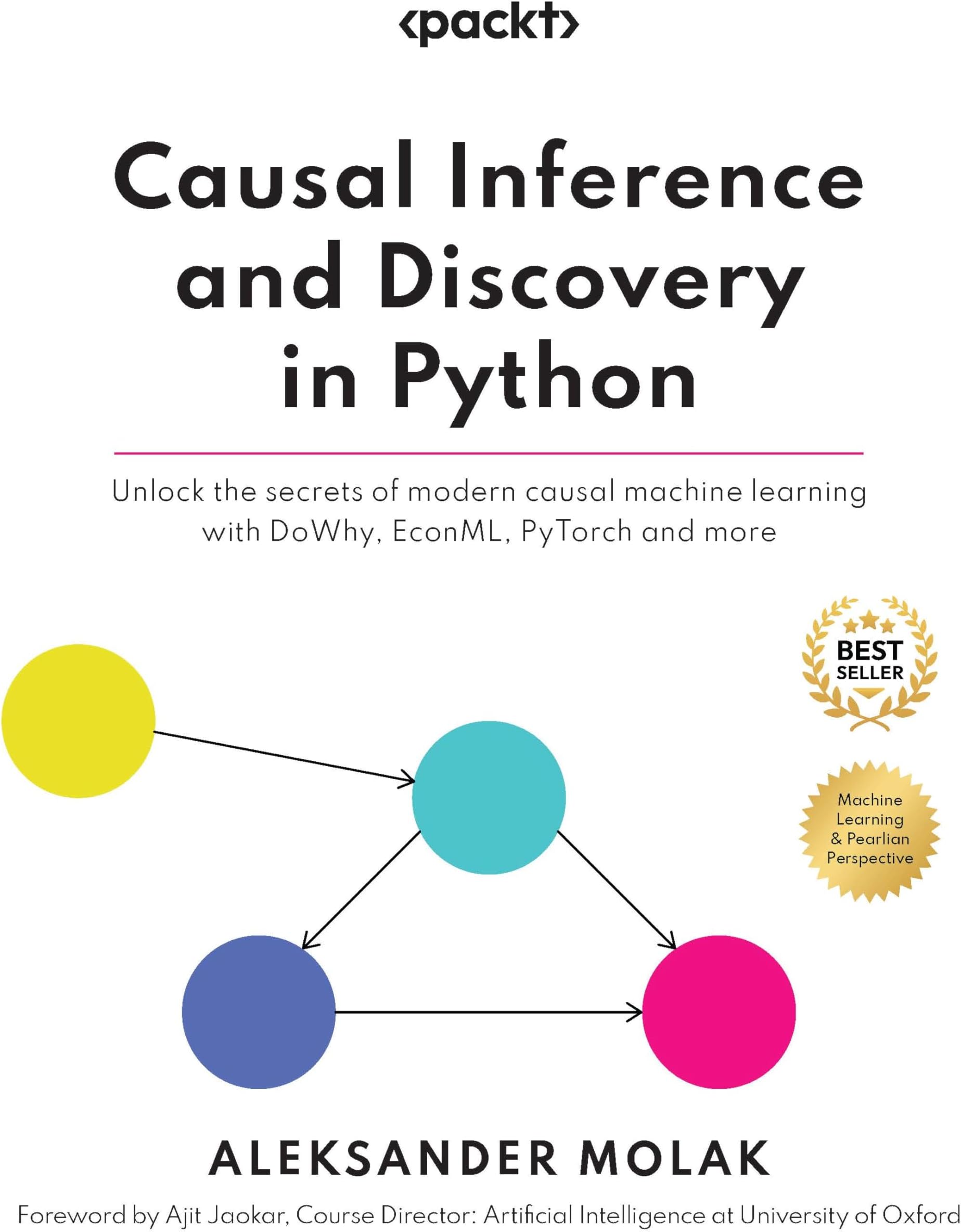
Causal Inference and Discovery in Python: Unlock the secrets of modern causal machine learning with DoWhy, EconML, PyTorch and more
Product ID: 533157307
Desertcart purchases this item on your behalf and handles shipping, customs, and support to Netherlands.
Demystify causal inference and casual discovery by uncovering causal principles and merging them with powerful machine learning algorithms for observational and experimental data Get With Your Book: PDF Copy, AI Assistant, and Next-Gen Reader Free Key Features Examine Pearlian causal concepts such as structural causal models, interventions, counterfactuals, and more Discover modern causal inference techniques for average and heterogenous treatment effect estimation Explore and leverage traditional and modern causal discovery methods Book Description Causal methods present unique challenges compared to traditional machine learning and statistics. Learning causality can be challenging, but it offers distinct advantages that elude a purely statistical mindset. Causal Inference and Discovery in Python helps you unlock the potential of causality. You’ll start with basic motivations behind causal thinking and a comprehensive introduction to Pearlian causal concepts, such as structural causal models, interventions, counterfactuals, and more. Each concept is accompanied by a theoretical explanation and a set of practical exercises with Python code. Next, you’ll dive into the world of causal effect estimation, consistently progressing towards modern machine learning methods. Step-by-step, you’ll discover Python causal ecosystem and harness the power of cutting-edge algorithms. You’ll further explore the mechanics of how “causes leave traces” and compare the main families of causal discovery algorithms. The final chapter gives you a broad outlook into the future of causal AI where we examine challenges and opportunities and provide you with a comprehensive list of resources to learn more. By the end of this book, you will be able to build your own models for causal inference and discovery using statistical and machine learning techniques as well as perform basic project assessment. What you will learn Master the fundamental concepts of causal inference Decipher the mysteries of structural causal models Unleash the power of the 4-step causal inference process in Python Explore advanced uplift modeling techniques Unlock the secrets of modern causal discovery using Python Use causal inference for social impact and community benefit Who this book is for This book is for machine learning engineers, researchers, and data scientists looking to extend their toolkit and explore causal machine learning. It will also help people who’ve worked with causality using other programming languages and now want to switch to Python, those who worked with traditional causal inference and want to learn about causal machine learning, and tech-savvy entrepreneurs who want to go beyond the limitations of traditional ML. You are expected to have basic knowledge of Python and Python scientific libraries along with knowledge of basic probability and statistics. Table of Contents Causality – Hey, We Have Machine Learning, So Why Even Bother? Judea Pearl and the Ladder of Causation Regression, Observations, and Interventions Graphical Models Forks, Chains, and Immoralities Nodes, Edges, and Statistical (In)dependence The Four-Step Process of Causal Inference Causal Models – Assumptions and Challenges Causal Inference and Machine Learning – from Matching to Meta- Learners Causal Inference and Machine Learning – Advanced Estimators, Experiments, Evaluations, and More Causal Inference and Machine Learning – Deep Learning, NLP, and Beyond Can I Have a Causal Graph, Please? (N.B. Please use the Read Sample option to see further chapters) Review: Unlocking the Power of Causal Inference - Causal Inference and Discovery in Python is a valuable addition to the library of Data Scientists and researchers who are interested in Causal Inference. This book offers a comprehensive and practical guide to causal inference and discovery methods. The book starts with a solid foundation by explaining the fundamentals of causal inference and how it differs from Machine Learning. It takes readers through the concepts of causality, counterfactuals, direct acyclic graphs and causal discovery, making these complex ideas clear and understandable to a wide audience, from beginners to seasoned data scientists. The practical examples, along with clear explanations and code snippets, make it easy for readers to follow along and apply what they've learned. What sets this book apart is its strong emphasis on hands-on implementation. The author provides numerous real-world examples and practical exercises using Python libraries such as EconML, doWhy, gCastle. and Causica. These libraries enable readers to implement causal analysis techniques efficiently, which is essential for anyone looking to apply causal inference in their data projects. Another notable feature of the book is its attention to potential pitfalls and challenges in causal analysis. It doesn't just stop at teaching the "how" but also delves into the "why" behind certain methodologies and the limitations of causal inference techniques. This level of depth and transparency is essential for building a deep understanding of the subject matter. The book also covers advanced topics like causal discovery algorithms, providing readers with a well-rounded overview for this particular area. While this book is a valuable resource for anyone interested in causal inference, it may not be suitable for absolute beginners in Python. Some prior familiarity with Python programming and basic data science concepts is recommended to fully grasp the content. In summary, Causal Inference and Discovery in Python is a commendable resource for those looking to demystify the complexities of causal analysis and apply it to real-world problems. Its hands-on approach, coupled with clear explanations and practical examples, makes it a must-read for data scientists, researchers, and analysts seeking to understand and leverage causal inference in Python. Review: Causation is not correlation - Casual Inference and Discovery in Python is a great book - it's approachable, clear, filled with examples and code to follow through. I'm only in the first half of the book, but I feel that it's helping me with my perspective as a data scientict. Causation is not correlation, so this book won't make you better, but there's a good correlation between reading it and feeling like you have more tools to solve real-world problems



| Best Sellers Rank | #212,941 in Books ( See Top 100 in Books ) #7 in Computer Programming Logic #119 in Artificial Intelligence (Books) #172 in Python Programming |
| Customer Reviews | 4.5 out of 5 stars 160 Reviews |
R**.
Unlocking the Power of Causal Inference
Causal Inference and Discovery in Python is a valuable addition to the library of Data Scientists and researchers who are interested in Causal Inference. This book offers a comprehensive and practical guide to causal inference and discovery methods. The book starts with a solid foundation by explaining the fundamentals of causal inference and how it differs from Machine Learning. It takes readers through the concepts of causality, counterfactuals, direct acyclic graphs and causal discovery, making these complex ideas clear and understandable to a wide audience, from beginners to seasoned data scientists. The practical examples, along with clear explanations and code snippets, make it easy for readers to follow along and apply what they've learned. What sets this book apart is its strong emphasis on hands-on implementation. The author provides numerous real-world examples and practical exercises using Python libraries such as EconML, doWhy, gCastle. and Causica. These libraries enable readers to implement causal analysis techniques efficiently, which is essential for anyone looking to apply causal inference in their data projects. Another notable feature of the book is its attention to potential pitfalls and challenges in causal analysis. It doesn't just stop at teaching the "how" but also delves into the "why" behind certain methodologies and the limitations of causal inference techniques. This level of depth and transparency is essential for building a deep understanding of the subject matter. The book also covers advanced topics like causal discovery algorithms, providing readers with a well-rounded overview for this particular area. While this book is a valuable resource for anyone interested in causal inference, it may not be suitable for absolute beginners in Python. Some prior familiarity with Python programming and basic data science concepts is recommended to fully grasp the content. In summary, Causal Inference and Discovery in Python is a commendable resource for those looking to demystify the complexities of causal analysis and apply it to real-world problems. Its hands-on approach, coupled with clear explanations and practical examples, makes it a must-read for data scientists, researchers, and analysts seeking to understand and leverage causal inference in Python.
T**L
Causation is not correlation
Casual Inference and Discovery in Python is a great book - it's approachable, clear, filled with examples and code to follow through. I'm only in the first half of the book, but I feel that it's helping me with my perspective as a data scientict. Causation is not correlation, so this book won't make you better, but there's a good correlation between reading it and feeling like you have more tools to solve real-world problems
A**.
I was skeptical, but I was wrong
I bought this book because a friend recommended it to me. According to the "badge" on the cover, the book approaches causality from a "Pearlian and Machine Learning Perspective". I was a bit skeptical at first, because I know Pearl's work and it was hard for me to imagine someone could bring much new insight here. In hindsight, I must say this book is a great read. It provides the reader with very intuitive explanations and makes the transition from theory (sometimes pretty complex) to practice seamless. The book is very well written. The author's attitude is positive but realistic. This makes reading the book not only a great educational experience, but also an intellectual adventure of sorts. Highly recommended, and thanks to Glenn for bringing this book to my attention!
J**E
Great resource to learn causal inference
This book is helping me understand the fundamental concepts of causal inference and the various application methods. My journey started with standard statistics, then to bayes, and now causal models. The practical, hands-on book exercises clarified and cemented the many new (to me) concepts unique to causal modeling. I appreciate Mr. Molak taking time to write this excellent book.
S**I
Lovely graduate level textbook
Good textbook. In perfect condition
J**.
Brilliant!
The explanations are clear, beautiful, and well-researched. I've enjoyed it and learned a lot, and this book is a milestone in the current knowledge gap in contemporaneous causal inference. Packt publications are known for their lousy quality; this book is an exception and reflects the author's genius. He is an able auto-editor with deep knowledge of the field of causal inference. For anyone reading this review, do yourself a favor and buy this book.
C**E
Causality using Puthon
The book arrived earlier than indicated. That was good. The book is written for someone that has a basic understanding of causality without going into the mathematical aspects of causality. The book needs more information on getting started with Python for non- python users.
H**C
Great information from theory to python
I love the way it explains the theory with puthon 3xamplea, then uses libraries like econml and fonally introduces advanced techniques like deep learning always with easy to understand python code. Recomended.
T**S
Causal Inference
Great book! Very in depth, covers some theory and has very good practical examples. Can only recommend!
R**L
An invaluable resource.
I highly recommend this to any data professional in digital marketing or clinical research. It clarifies foundations in a tight and approachable way to non-causal data scientists. I found it quite practical with priority on intuition before formality when breaking down theory.
D**A
Great book, looking forward to new editions
I have a background in Biology/Genomics/Bioinformatics. The book was a great start for someone like me who is used to analyze observational data, and who is starting to work on interventions. I would be more keen to buy another book from the same author/series that would deep into more specialized problems. For instance, in Genomics one deals with e.g. drugs that can affect hundreds or thousands of genes, but this is hidden for us, in some cases due to technical limitations. Otherwise, I strongly appreciate the code resources that come with the book and the access to the Discord community. The author himself has been helpful in solving questions from the community.
J**N
Comprehensive and practical
Highly recommended for beginners and those who want to start empirical analysis using DoWhy
C**N
Some formulas not visible on Kindle
Formulas on Kindle are not shown, a question mark is shown instead or very poorly shown
Trustpilot
1 month ago
5 days ago