

📷 Digitize your past, own your memories—because vintage deserves VIP treatment.
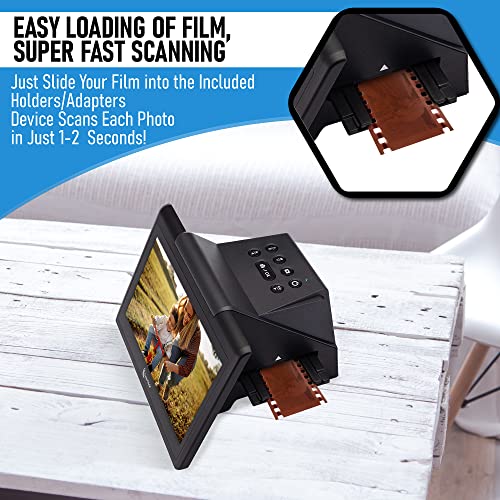
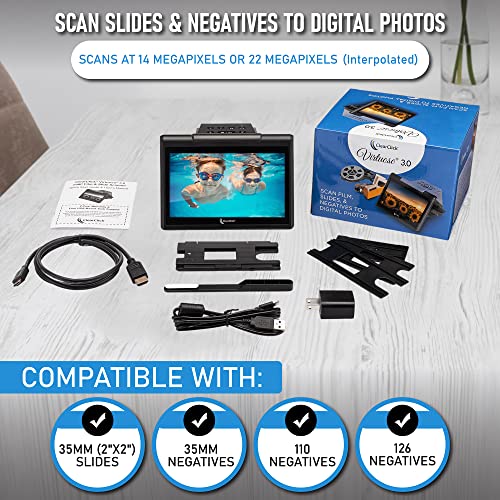
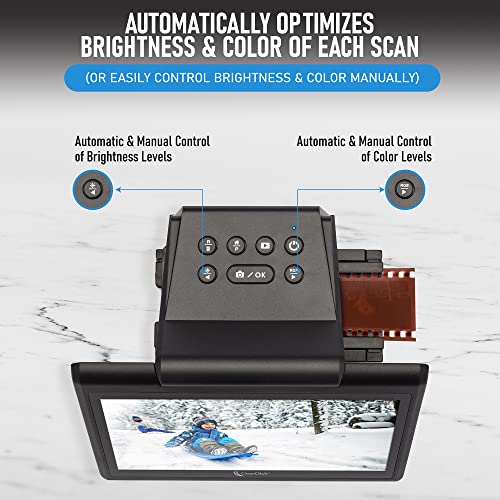
The ClearClick Virtuoso 3.0 is a third-generation film and slide scanner that converts 35mm, 110, and 126 negatives and slides into high-resolution digital photos up to 22 megapixels. Featuring a large 7-inch LCD preview screen, it allows real-time viewing and easy manual adjustments without a computer. Scans save directly to an SD card (up to 32GB), and a mini HDMI output enables instant TV display. Designed for effortless plug-and-play use, it comes with a 2-year warranty and free US-based tech support.


| ASIN | B0BV96NKH2 |
| Batteries Included | No |
| Batteries Required | No |
| Best Sellers Rank | #1,741,817 in Electronics ( See Top 100 in Electronics ) #61 in Film Scanners |
| Brand | ClearClick |
| Colour Screen | Yes |
| Compatible Devices | No Computer Required, SD Card (Not Included; 32GB or Less) |
| Connector Type | USB |
| Country of Origin | China |
| Customer Reviews | 4.4 4.4 out of 5 stars (121) |
| Date First Available | 18 February 2023 |
| Device interface - primary | Buttons |
| Digital storage capacity | 32 GB |
| Display Type | LCD |
| Generic Name | Slide and Negative Scanner |
| Item Dimensions LxWxH | 17.8 x 12.7 x 12.7 Centimeters |
| Item Weight | 499 g |
| Item model number | Virtuoso 3.0 |
| Light Source Type | LED |
| Manufacturer | ClearClick |
| Media type | SD Card |
| Memory Storage Capacity | 32 GB |
| Model | Virtuoso 3.0 |
| Model Name | Virtuoso 3.0 |
| Number of items | 1 |
| Operating System | No Computer Required |
| Optical Sensor Resolution | 22 MP |
| Power Source | Corded Electric |
| Printer Media Size Maximum | 35mm, 110, 126 |
| Product Dimensions | 17.78 x 12.7 x 12.7 cm; 498.95 g |
| Resolution | 22 MegaPixels |
| Standing screen display size | 7 Inches |
G**S
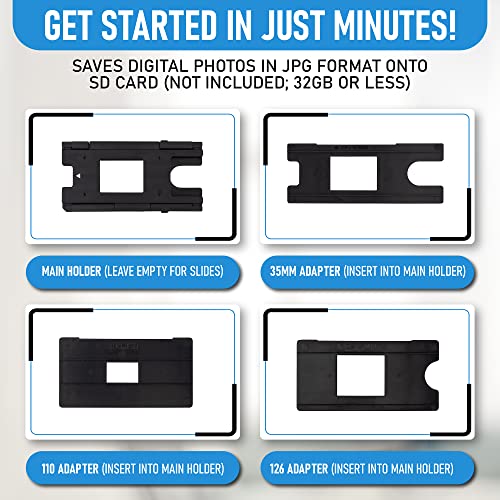
Does what it says. Good resolution on slides. Limited picture adjustment. It is better to use a dedicated app on the computer. Small drawback is that it doesn't connect directly to the computer. Biggest issue is the slide tray. Poorly sized and allows the slides to slip out of alignment. Also only allows one slide at a time. My old unit allowed three.
F**O
easy to use and it works well to see negatives , it also allow you to store them if you want to load them to your computer.
M**N
My ClearClick Virtuoso 3.0 worked very well for one day. On the second day, the exposure light from the unit started to pulsate on and off every second, rendering the device useless. I returned it via Amazon and ordered the equivalent device from Kodak instead. Hopefully, the Kodak device will work well for more than one day! Here is a summary of my observations from when the device worked on the first day. I really liked the 7" display, and the images looked very clear on the screen. Unfortunately, the actual .jpg scans were not nearly as sharp as they looked on the display screen. I set the ClearClick to 14MP (14 MegaPixels) because I did not want to use their "interpolated" resolution of 22MP. When using the 14MP setting, the .jpg files come out at 4320 x 2880 pixels. NOTE: this is only 12.4 MP, so ClearClick is exaggerating when they say it's 14MP. Therefore, a 35mm negative (or color slide) has a resolution of 3048 ppi. This sounds fantastic, and you would expect the scans to look razor sharp. But they're not. When using a dedicated film scanner or a professional flatbed scanner, a resolution of 3000 ppi generates very high-quality images. However, the ClearClick is NOT a scanner. It's simply an inexpensive "camera" that takes a picture of your film. The great advantage is that it only takes 2 seconds to generate the .jpg file. By comparison, when using a dedicated film scanner or a professional flatbed scanner at 3000ppi, it takes at least 3 minutes to make just one complete 35mm scan. The disadvantage of the ClearClick is that the scans are not sharp and that's because they are actually being created by a cheap "camera" with minimal optics. This brings us to another point, the matter of dust specks on the film. Because the ClearClick does not have high-quality optics, there are not too many obvious dust specks on the images. By comparison, when using a dedicated film scanner or a professional flatbed scanner, you might see hundreds of dust specks that the ClearClick simply does not resolve. That's why high-end scanners use special infrared technology to hide dust specks on the film scans. So, how do we deal with the low-quality images from the ClearClick. Well, that depends on your needs. For example, if you go ahead and make a 4" x 6" glossy print from the ClearClick .jpg file, it will look pretty good. However, if you make a poster-size print, it will definitely be "soft." When viewing the ClearClick scans on your computer monitor, they are rather "mushy." Keep in mind that if there are people in your images, their faces won't look great when viewing the files at 100% size on your monitor. I was able to drastically improve the quality of faces in my ClearClick images by importing the files into TOPAZ Photo AI, an expensive program (from TOPAZ Labs) that works miracles on people's faces. The TOPAZ software makes the faces look even better that what you can get from a dedicated film scanner or a professional flatbed scanner. It's absolutely amazing. So, I'm anxiously awaiting the arrival of my new Kodak device with its 7" screen and identical characteristics that match the ClearClick. My workflow is as follows: 1) Obtain the 12.4 MP .jpg file from the SD Card that it was saved on in the ClearClick. 2) Import the ClearClick .jpg file into TOPAZ Photo AI and let it work its magic on the people's faces. Save the enhanced TOPAZ version as a .tif file, rather than a .jpg file, to avoid further re-compression of the image. (NOTE: This can be done as a batch job in TOPAZ, so you can process dozens of files without even being at the computer.) 3) Load the new TOPAZ .tif files into Photoshop and get rid of any obvious dust specks. Apply color corrections and other Photoshop enhancements if needed. Even though I have a high-end flatbed scanner, I prefer using the ClearClick because it's just so darn fast. I do not enjoy traditional film scanning when it takes 3 minutes per image! Hope this helps.
S**E
I love this. Seriously. I'm not shilling for this device or this company. I'm certainly disappointed sometimes when I make a purchase on Amazon like everybody else. Not with Amazon but with the product. This product is great. One minute set up and the only thing you need to read the directions for is to understand the sequence of how to press the buttons. I have 250 old 35 mm slides. All of my mom and dad from the 40s and 50s. I wanted to convert them to a digital format and store them in my Google cloud, as well as put them on a DVD for backup. These are high resolution copies. I wouldn't put much Credence into the color shading you can do with the unit, or the brightness which are the only two aesthetic controls that it has. Once you put these on a memory card you can stick it into your computer and Photoshop works in miracles before and after. Some of them weren't fixable but that's not the fault of the machine. 85% of them were workable and some of them look like brand new. All old kodachromes. The system is great for slides. The slide adapter is like a manual conveyor belt. For less than $200 it's a great buy. That's what local companies get to do this, and then they send it out all over the country to have the work done. And they charge you $30 for a DVD. They also charge you for cloud space. And God forbid if UPS or USPS loses your package they'll offer you $100. Obviously when we all send pictures to be redone these are pictures that are irreplaceable. If you have some spare time do it yourself. If you don't have Photoshop pay for it and download it. It's one of the greatest tools to come out of the internet era.
E**N
Overall I'm pretty happy with this machine. We have about 1,000 slides to digitize and don't want to pay a photo lab to do it for us. The machine gives the options to adjust the color and light saturation in the machine, but the result isn't always what I would expect, once I transfer the pictures to my computer. I've decided to just set everything to the middle settings and do any changes on my computer. That is working out pretty well. Another issue is that the slides move around in the holder and it is sometimes hard to get them in the correct place. And if they are not in the right place the picture can end up cropped on one side with a black line on the other side. That can be corrected by redoing the picture, deleting the bad one and renaming the new one to the original photo's name. All that being said, I'm basically quite happy with my purchase.
Trustpilot
3 weeks ago
2 weeks ago