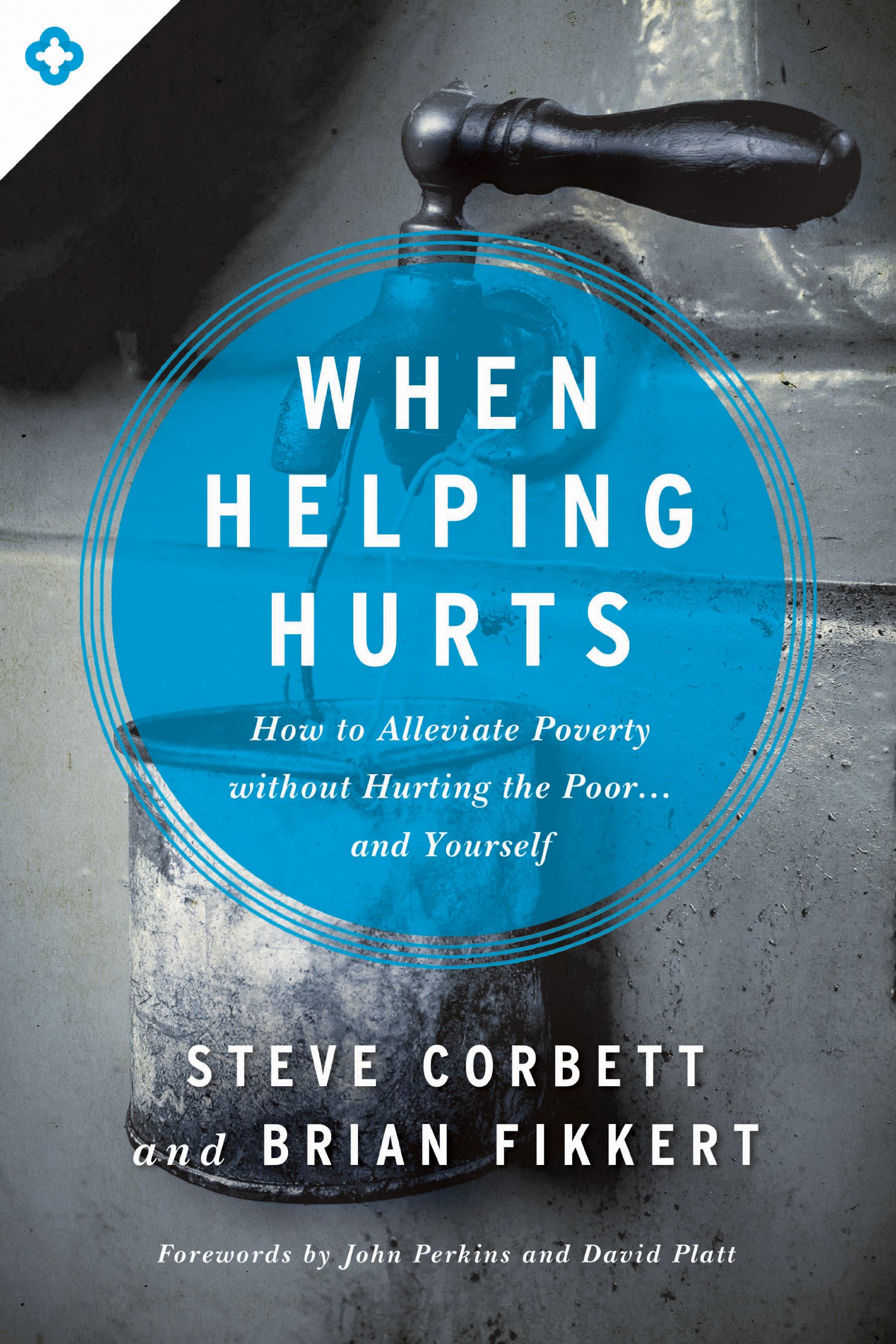
📖 Transform your perspective, transform lives.
When Helping Hurts is a critically acclaimed book that challenges conventional poverty aid by blending biblical principles with practical strategies. It emphasizes sustainable development over short-term relief, cultural sensitivity, and long-term commitment to truly alleviate poverty. With a 4.6-star rating from over 2,400 readers and top rankings in Poverty and Social Work categories, this book is essential for professionals and changemakers seeking impactful solutions.



| Best Sellers Rank | #7,520 in Books ( See Top 100 in Books ) #5 in Poverty #5 in Social Work (Books) #11 in Christian Social Issues (Books) |
| Customer Reviews | 4.6 out of 5 stars 2,471 Reviews |
R**E
Book Review: When Helping Hurts: How to Alleviate Poverty Without Hurting the Poor . . . and Yourself by Steve Corbett & Brian F
When Helping Hurts by Steve Corbett and Brian Fikkert is a book I set my sites on some time ago but thinking it may be a load of tosh I put off reading it. That is, until I received a verbal recommendation from a trusted relative I then decided it was time to dig in. As it turns out it is not a load of rubbish but rather a well thought out analysis of how we as individual Christians, churches, and parachurch organizations have failed, often miserably, at assisting the poor and alleviating poverty and how to address these issues. From the back cover we learn what we can expect from the book Foundation Concepts – Who are the poor? Principles – Should we do relief, rehabilitation or development? Strategies – How can we help people here and abroad? And that is the thrust of the work. These three points are fleshed out by the authors. The book begins with a short history of how we, primarily North American Christians, got to where we are now. What happened between 1900 and 1930 that changed how we address poverty alleviation and why we are failing miserably at addressing it? Why is a Biblical world view important to the methodology of helping the poor? Next we find out what the poor think of our efforts to help them. Its entirely possible we fail as we have no clue how other cultures, even sub-cultures within our own culture, think emotionally and politically of their plight. Failure to recognize these distinctions cause our failures in assisting the poor and therefore our evangelism. From our North American point of view are we really helping the poor or just making ourselves feel better by thinking we have? Poverty is rooted in broken relationships, with God and each other, not in financial or material wealth. Only Jesus can fix that. In chapter 4 we begin to get into the real meat of the work. Help comes in three forms according to the authors: Relief, rehabilitation, and development. Failure to recognize these three and implement them as needed or in correct order can do more harm than good. Many churches and organizations, for example, start and stop with relief. That is, providing immediate help for a need. Though necessary it falls short of providing for the long term needs of the person or persons in need. The authors flesh this out clearly and define what steps, relief, rehabilitation, and development, to take at appropriate times. Of chapter 7 I took special note. Short term mission trips (STM) have always left me wondering how effective they can be. How can a group of people who blow into town for only a week or two expect to provide any long lasting good? Indeed, they can be helpful as the authors explain however they are often not for several reasons the authors lay out. If only relief is provided the STM is doomed to failure. Development is often what is needed and that can’t be done in a two week STM. In helping the poor we must be in it for the long haul by helping the local churches and organizations in the area as necessary. The authors continue and conclude with concrete strategies to help the poor in numerous ways and especially spiritually. The issue is often, "Finding armies of people to volunteer one Saturday to paint dilapidated houses is easy. Finding people to love the people who live in those houses is extremely difficult" (pg. 210). We must take the time to walk and love these folks for the long term. Are you ready? Am I ready? This is a justifiable read. The authors are intelligent and experienced. Expert analysis, true life accounts, and clear strategies are provided. I wholeheartedly commend When Helping Hurts .
T**S
A heartfelt book, good teaching
I got this book for one of my classes with our local church. It is a very well written book, I highly recommend this book to anyone, it gives you additional perspective of lives, other lives than the one you are living now, if you think that you have it bad, it might be a good time to look around, this way you will appreciate the life you have and encourage to help others, in which in turn, they can and will also help you as well, in some other way that would and never could imagine.
C**Y
Are you truly helping?
Great book for anyone in social services. What we think might help my actually be hurting. A great book to evaluate effectiveness of programs. We constantly ask ourselves if we are helping or hurting because of what we learned in this book.
B**Y
A lot of good points in this book - have an open mind, but don't expect to agree with everything
Generally, I found this book interesting and informative, although I did not agree with everything. I should start off by saying that there is a fair bit of theology wrapped up in the authors' arguments so if you're not already a Christian, this book probably isn't for you (or at least skip the first few chapters, which are pretty heavy on theology). At the same time, they don't have a lot of good information that would be applicable whether or not you accept the premise. I'm a Christian, and I didn't agree with it entirely, but still felt I learned a lot. The authors are economists with years of real-world experience in relief and development organizations. Plus, scanning the books notes/references, relatively few seem to be theological works or biblical studies. They're mostly economic studies or articles, some sociological works. So there is a lot of good, scholarly information that they present here that's worth exploring if you're interested in poverty relief efforts that actually work. You just have to wade through some theological reasoning that you may (or may not) fully agree with. So with that being said, I generally appreciated the authors' perspective and focus on what works rather than what suits a particular agenda. Let's be honest, poverty aid is a very politicized topic. The authors challenge some points of many different approaches to poverty relief and economic development. They don't talk much about government aid at all. Their focus is on what we as individuals and communities (specifically church communities) can and should be doing. That's fine for what it is. There is a tinge of anti-government sentiment. They don't come out and say directly that government relief efforts are uniformly harmful, but I wouldn't be shocked to find that they believed that. And I wouldn't agree there. But, as I said, they generally don't talk much about government aid at all, so just don't get this book expecting to learn about the most effective policy solutions. Get a different book for that and read this one for what it is. While the authors don't seem to be fans of government-driven solutions, they are definitely not the "pull yourself up by your bootstraps" type either. They do argue that the poor have some responsibility in participating in poverty solutions and occasionally, they seem to be somewhat patronizing (this is the main reason for giving four stars instead of five). But overall, I think their goal is actually the exact opposite: I think they want to challenge some of the widespread, generally well-meaning, but ultimately very patronizing and condescending views some of us have of the poor. Specifically, this idea that they are helpless and need us to come in fix their lives. In truth, what they need is multifaceted and complex, but a lot of it is just more powerful people and systems getting out of their way so they can access the resources they need to flourish. There's a lot more to it than I can sum up in a comment, but that was my general takeaway and I think the authors do a good job of pushing us rich people to see poor people as, well, people. People every bit as capable as we are of doing good things and being strong and self-sufficient. They don't lionize poor people. Nobody is perfect of course. They just argue (convincingly) that poverty is not solely or even mostly a result of just some people making bad choices. That's just not the reality. So they are not pro-government and not pro-individualism. They are also not entirely pro-charity. They are pro-the-right-kind-of-charity, as in, the kind that actually works. And this is where I found the most value in the book. I think they could have dived into more program evaluation research to support their points (based on my understanding of the research literature, there is strong evidence to support most of their points; they just didn't always reference it, relying more on stories from their personal experiences in relief and development work to illustrate their points), but I assume they knew that wasn't was going to be compelling to their main audience. Most people are not economic, sociological, or political scholars who want to know the ins and outs of how this all works. They're just people who want to help. And to that end, this book gives them tools to do that. Readers will walk away knowing a lot of things that works and things that don't. There is a lot of practical knowledge that people can implement. Mostly for program directors and people like that, but even just for people who want to volunteer a few hours a week or have some money to donate, what they learn from this book can help them make wise choices on where to do that. So I definitely recommend this book to any Christian interested in contributing to poverty relief. And even if you're not a Christian, you will still learn a lot and I don't think you would regret reading this book, even though you wouldn't agree with everything. Whatever your religious inclinations, definitely don't leave your critical thinking at the door (though that would apply to literally every book, not just this one) and expect to find things here that you don't agree with. Don't take everything at face value, but do let yourself be challenged.
M**O
Required reading for missionaries
This is the handbook for mission work or aspiring missionaries. A must read filled with wisdom so you can avoid mistakes when you put your boots on the ground to go and help others. It will make your journey significantly easier.
T**O
Everyone should read.
Come on, this is a classic at this point if you are any bit involved in giving, working, serving, or have any relationship with people in any form of poverty. Read it, and the follow up book "Becoming Whole".
T**K
If I were a rich woman, I would buy this for everyone!
I hope you can tell by the picture how much I have enjoyed this book. It has been marked up one side and down the other as I continue to make notes and highlight things I want to reread. This past summer, I spent a little time in Curtis Bay, Maryland. I was talking to a friend about their ministry in an area which filled with poverty, violence, hopelessness and drugs. I could see the love that this community had for this pastor’s family and the gospel reaching those in darkness as the loved on what many would consider unlovable. She recommended that I read When Helping Hurts. I immediately ordered it and haven’t put it down since! If I were a rich woman, I would buy this book for anyone willing to read it! I live and serve in a community that is also plagued with poverty, drugs, and hopelessness and often “bright futures” for these young people seem hidden behind dark curtains. This is where my heart is and the Lord has used this book to take my passion for investing in these lives to a whole new level. I understand better their true needs and feel more equipped to serve after reading this book. I would recommend this as a top read for anyone!
H**3
Not an "on target" representation of many short term mission teams
The authors take a pretty dim view of short term mission teams that, I think, are founded on 1960's concepts of short term mission teams. At least that is the professed case in the United Methodist Church. I cannot speak for short term mission teams from other denominations. I can speak for the United Methodist Church, because I am responsible for the training of short term mission team leaders in one of the conferences of the UMC. The book is written far better than I could have ever done, but the actual content of the vast majority of the book, until you get to the chapters plugging their analysis and development models, could be found in the training we do at the conference. Indeed, I was a bit offended by the way they wrote of short term mission teams, as if they all were one monolithic model of irresponsibility. Nonetheless, the book is a good resource. I will be able to add it to my "recommended reading list" for the persons attending our seminars. Also, I some of the examples from the book would be good examples and references for our seminar: - The example of giving 8 dollars to save Grace's life and why it was the wrong action to take (pp. 123-126). - The Participatory Continuum (p. 140) provides a useful framework. I'm happy to say that the published policy of the UMC for short term mission teams is directly worded such that the mode of participation is "Community Initiated." I think using the framework reinforces our policy and why it is important. - Concept of Time (p. 153) - I discuss this in one of my sections of our seminar but I had never seen the graphical representation of how if is viewed by country/continent. It is quite odd that neither South America or Central America are on the list, but from my experience, I would place them between Mexico and Africa.
Trustpilot
2 weeks ago
2 months ago