
DOWNLOAD THE APP


Customer Services
Copyright © 2025 Desertcart Holdings Limited
DOWNLOAD THE APP
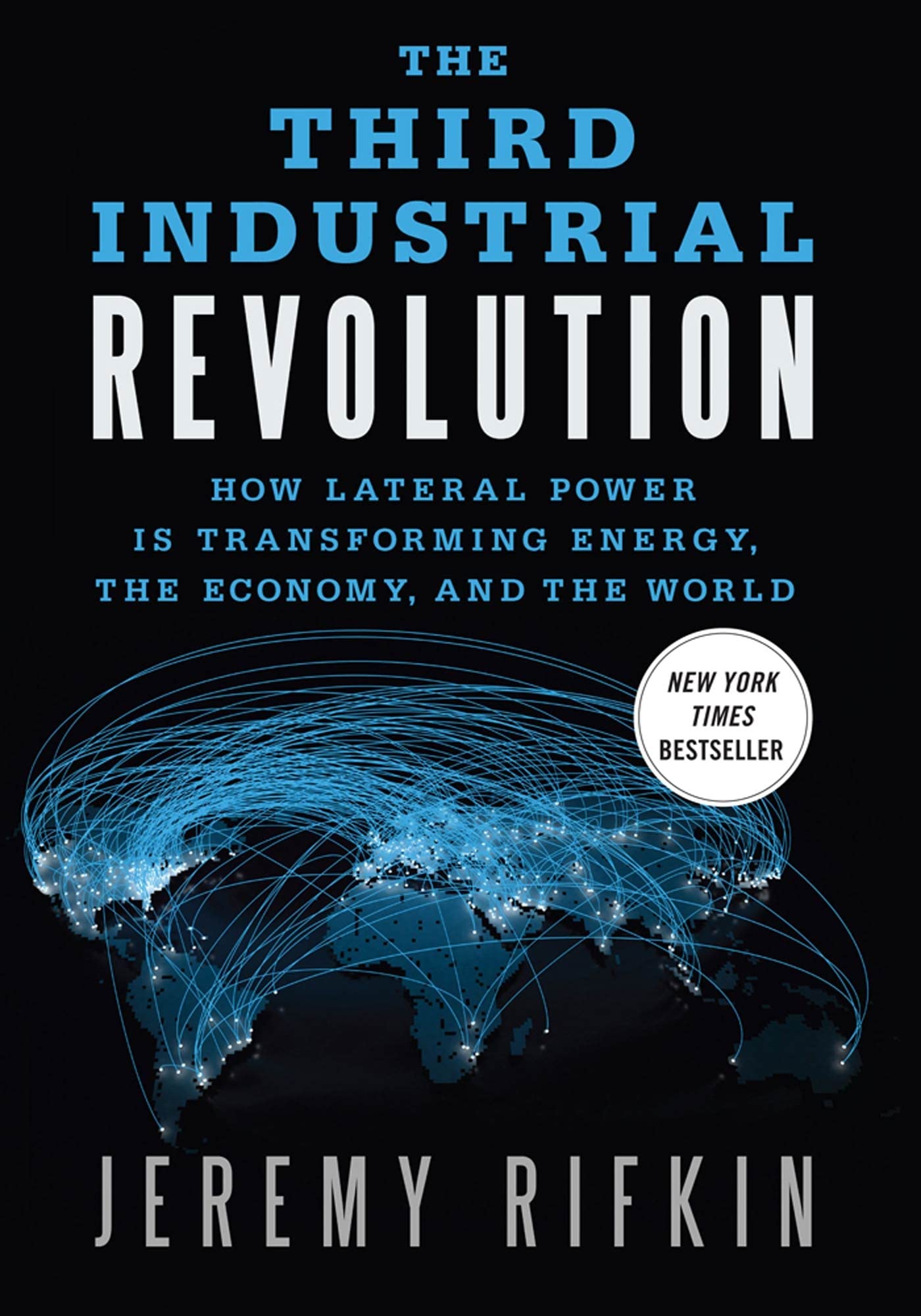

The Third Industrial Revolution: How Lateral Power Is Transforming Energy, the Economy, and the World
I**O
The best model I've found by which to understand deep rooted social and environmental problems and become an agent of change.
This was a second book I bought, this one to share with friends and family. It is the first book I have read on the worlds "economic" crisis which provided a model as to the primary causes. It also offers solutions that can help direct the necessary changes to take place. Most importantly he provides an historical model of this type of industrial change. Rifkin speaks of the coming of a reduction in size of government structures. I find this model especially helpful. The transitions, as he points out, take many years, decades, in fact. And there is a lot of pain, often cause by those opposing the changes. Most of us can bear hard transitions if we see some good in the outcome. Jeremy Rifkin's proposition is that the transitioning to "Lateral (distributed) Power" is the change that provides an empowering, upbeat and to be hoped for outcome.This is not an easy read, but for those emotionally mature enough to have their notions challenged it is well worth the read. Ponder his premise, and think fresh and open thoughts on the Why of economic and social change. I found it freeing.
A**R
The Third Industrial Revolution: How Lateral Power Is Transforming Energy, the Economy, and the World
Jeremy Rifkin outlines in a well written, clear and detail narrative what is needed to transition to a post carbon 21st century society. The Third Industrial Revolution redefines energy production as we have know it and highlights Europe's commitment since 2007 to make generative lateral power production a reality across nations and continents using 5 key technology pillars. His analysis of the driving forces behind these transitions and the economic, industrial, social, and environmental benefits that are being generated to people, business, and governments today provide solid evidence of the financial benefits available now.Anyone who is serious about bringing long term economic growth, jobs and environmental benefit to our world today should read this book. It outlines the most exciting solutions to answer global climate change while creating millions of jobs and reducing cost's across every sector of the world's economy today.Economic Environmental Energy = E3 Wise.
I**N
The railroads led to other necessary businesses like the telegraph industry which also had to be huge
“Our industrial civilization is at a crossroads. Oil and the other fossil fuel energies that make up the industrial way of life are sunsetting, and the technologies made from and propelled by these energies are antiquated,” explains Author Jeremy Rifkin. He is a lecturer at Wharton business school, on new trends in science, technology, the economy, and society, but more impressively is a consultant to the EU on these issues, and also to the Chinese government.This book is a description of the convergence of new communication technologies with new energy systems to create the Third Industrial Revolution. The first two industrial revolutions profoundly changed history, but came with a huge social and environmental costs.First and Second Industrial Revolutions forged the course of the nineteenth and twentieth centuries. These revolutions were based on fossil fuels—coal, oil, and natural gas, which are only found in specific places. As such, these places require geopolitical management, and often significant military investment to secure access to them. This necessitated a centralized energy infrastructure which set the tone for the rest of the economy and social life for two centuries.First Industrial Revolution had as its centrepiece coal-powered, steam-driven machines. The railroad, was one of its most important achievements, with profound consequences. Building a railroad required more capital than even the wealthiest families of the day could afford singlehandedly. This led to the need to concentrate the capital of investors which resulted in the separation of ownership from the management of the business.The challenges of running a railroad were unique. Hundreds of miles of track had to be laid, rail beds had to be maintained, engines and carriages repaired, systems developed to prevent accidents and extensive up-to-the-moment records. This required layers of management and a gargantuan workforce with output optimized through top-down command and control, and tasks broken down into fixed, repeatable stages.The railroads led to other necessary businesses like the telegraph industry which also had to be huge. Other mass-producing giants appeared with centralized factories to reduce the cost of production. For example, small farms gave way to agri-businesses that transformed food production into a factory system.An army of people were needed who could write reports and write critical management documents. The school system was organized along the same lines as businesses with top-down management, fixed tasks and outcomes, to best prepare a literate workforce for life in large, centralized, authoritarian businesses.“The centralized and rationalized business model established during the First Industrial Revolution, carried over to the Second Industrial Revolution (the Oil Age.)” Rifkin explains. The character of the oil industry has been gigantism and centralization, because it too required large amounts of capital, economies of scale, and a top-down command and control structure. The Oil Age required the most expensive organization ever conceived to collect, process, and distribute its energy.Gigantism and centralization affected other industries too: modern finance, automotive, power and utilities, telecommunications, and commercial construction.“In the coming half century, the conventional, centralized business operations of the First and Second Industrial Revolutions will increasingly be subsumed by the distributed business practices of the Third Industrial Revolution.” This is the core message of this book.“We have the science, the technology, and the game plan to make it happen,” says Rifkin and working at the highest levels of the world’s largest economies, he is in a position to know.Hundreds of millions of human beings can now generate their own green energy in their homes, offices, and factories. They can share it with others across intelligent, distributed, electricity networks—‘an intergrid’—just as they do with the information they create and share on the Internet.Here are some facts Rifkin presents: the cost of photovoltaic electricity is expected to decline at a rate of 8% a year, halving the cost of generation every eight years. The commercial growth in solar and wind technology is as dramatic as the growth in personal computers and Internet use, with installations doubling every two years.One hour of sunlight provides enough power to run a global economy for a full year. 40% of the roofs, and 15% of all the building facades in the EU, are suitable for photovoltaic applications.The United States has enough wind resources to power the entire nation several times over. A Stanford University study of global wind capacity estimates that harnessing 20% of the available wind on the planet, would provide seven times more electricity than the world now uses.Hydropower currently makes up the largest portion of green-generated electricity in the world, but the untapped potential, is in small distributed hydropower installations.The geothermal energy beneath the Earth’s surface reaches 4,000 degrees Celsius, and that energy is continuously flowing to the surface. In the United States, the geothermal energy within two miles of the Earth’s surface produces enough energy to provide for America’s needs for 30,000 years.Biomass includes fuel crops, forestry waste, and municipal garbage. The World Bioenergy Association claims that “the world’s bioenergy potential is large enough to meet the global energy demand in 2050.”Conventional energy (coal, oil, gas, and uranium) employed 260,000 in Germany in 2003, whereas renewable energy by 2007 accounted for 249,300 jobs. Put differently, less than 10% of the energy produced by renewable sources, created nearly as many jobs as all other energy sources combined.The Spanish economy, which supports over 188,000 renewable energy jobs and 1,027 renewable energy companies, has produced five times the employment of the conventional energy industry.We have the ability to change from a carbon-based fossil fuel energy regime to a renewable energy regime. We can reconfigure the buildings of the world, and transform every house into a mini power plant that can collect renewable energies on site. We are able to store the renewable energy so that we can ensure a continuous, reliable supply of green electricity to meet demand. Using Internet communication technology we can convert the electricity grid into an intelligent utility network. Millions of people will be able to send the green electricity they generate on their buildings to the grid to share with others just as information is generated and shared on the Internet.We are seeing the movement of cars, buses, trucks, trains to electric plug-in and fuel cell vehicles powered by renewable energies. We are seeing charging stations across countries where people can buy and sell electricity on the distributed electricity grid.The emerging Third Industrial Revolution, is a function of distributed renewable energies, that will be collected at millions of local sites and then aggregated and shared with others. These renewable energies are found everywhere and are partially free—sun, wind, hydro, geothermal heat, biomass, and ocean waves and tides. We are now able to achieve optimum energy levels and at the same time maintain a high-performing, sustainable economy.These are exciting times and they have already begun.Readability Light ----+ SeriousInsights High +---- LowPractical High ----+ LowIan Mann of Gateways consults internationally on leadership and strategy
M**S
Great read. He predicted alot of what has happened.
He predicted alot of what has already happened and has predicted things that are starting to happen. However, there is alot of fluff information about his diplo-political efforts in Europe and US that could be avoided. This is a great philosophy of the future as well.
C**1
A must for climate change policy.
Prompt delivery. The book is used but readable.
J**K
The Third Industrial REVOLUTION
This book is really insightful. It shows how each industrial reveolution started and moved ahead. It also tells the many signs of the 3rd Industrial Revolution happening right now. If the USA get moving we can continue to lead the world, or if we get behind China and India will pass us along with Eruope and many others.If you read this book it will become clear how you can help and be a part of this revolution and profit from it. Your family and children will also be able to advance and profit from this information.I highly recommend this book.
Trustpilot
2 months ago
1 month ago