
Buy anything from 5,000+ international stores. One checkout price. No surprise fees. Join 2M+ shoppers on Desertcart.
Desertcart purchases this item on your behalf and handles shipping, customs, and support to Netherlands.
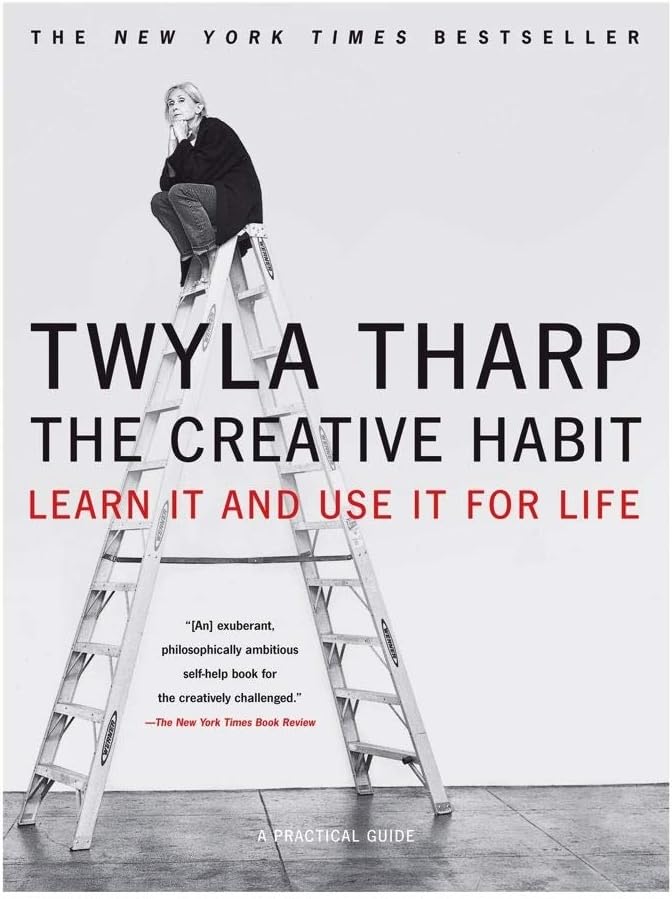
One of the world’s leading creative artists, choreographers, and creator of the smash-hit Broadway show, Movin’ Out , shares her secrets for developing and honing your creative talents—at once prescriptive and inspirational, a book to stand alongside The Artist’s Way and Bird by Bird. All it takes to make creativity a part of your life is the willingness to make it a habit. It is the product of preparation and effort, and it is within reach of everyone. Whether you are a painter, musician, businessperson, or simply an individual yearning to put your creativity to use, The Creative Habit provides you with thirty-two practical exercises based on the lessons Twyla Tharp has learned in her remarkable thirty-five-year career. In “Where's Your Pencil?” Tharp reminds you to observe the world—and get it down on paper. In “Coins and Chaos,” she gives you an easy way to restore order and peace. In “Do a Verb,” she turns your mind and body into coworkers. In “Build a Bridge to the Next Day,” she shows you how to clean the clutter from your mind overnight. Tharp leads you through the painful first steps of scratching for ideas, finding the spine of your work, and getting out of ruts and into productive grooves. The wide-open realm of possibilities can be energizing, and Twyla Tharp explains how to take a deep breath and begin. Review: Inspiring, Practical, Essential - "Creativity is not a gift from the gods," says Twyla Tharp, "bestowed by some divine and mystical spark." It is the product of preparation and effort, and it's within reach of everyone who wants to achieve it. All it takes is the willingness to make creativity a habit, an integral part of your life: In order to be creative, you have to know how to prepare to be creative. In The Creative Habit, Tharp takes the lessons she has learned in her remarkable thirty-five-year career and shares them with you, whatever creative impulses you follow--whether you are a painter, composer, writer, director, choreographer, or, for that matter, a businessperson working on a deal, a chef developing a new dish, a mother wanting her child to see the world anew. When Tharp is at a creative dead end, she relies on a lifetime of exercises to help her get out of the rut, and The Creative Habit contains more than thirty of them to ease the fears of anyone facing a blank beginning and to open the mind to new possibilities. Tharp's exercises are practical and immediately doable--for the novice or expert. In "Where's Your Pencil?" she reminds us to observe the world--and get it down on paper. Amen! In "Coins and Chaos," she provides the simplest of mental games to restore order and peace. In "Do a Verb," she turns your mind and body into coworkers. In "Build a Bridge to the Next Day," she shows how to clean your cluttered mind overnight. To Tharp, sustained creativity begins with rituals, self-knowledge, harnessing your memories, and organizing your materials (so no insight is ever lost). Along the way she leads you by the hand through the painful first steps of scratching for ideas, finding the spine of your work, and getting out of ruts into productive grooves. In her creative realm, optimism rules. An empty room, a bare desk, a blank canvas can be energizing, not demoralizing. And in this inventive, encouraging book, Twyla Tharp shows us how to take a deep breath and begin! Twyla Tharp's rich and remarkable The Creative Habit is a book I will keep close at hand for re-reading and re-inspiring ...f-f-f-frequently. It is one of the most highlighted, underlined, marginal thoughts notes books I have in a library chock full of creativity books. This one is one of the top five on my list. Review: Enjoy the pleasure of her company and the magic of her mind - As is my custom when a new year begins, I recently re-read this book and The Collaborative Habit. The insights that Twyla Tharp shares in them are, if anything, more valuable now than when the books were first published. It would be a mistake to ignore the reference to "habit" in their titles because almost three decades of research conducted by K. Anders Ericsson and his associates at Florida State University clearly indicate that, on average, at least 10,000 hours of must be invested in "deliberate," iterative practice under strict and expert supervision to achieve peak performance, be it playing a game such as chess or playing a musical instrument such as the violin. Natural talent is important, of course, as is luck. However, with rare exception, it takes about ten years of sustained, focused, supervised, and (yes) habitual practice to master the skills that peak performance requires. Tharp characterizes this book as a ""practical guide" but she also frames much of its material within a spiritual context. The creative process can probably be traced back to the earliest humans and yet so much of it remains a mystery. When Henri Matisse was asked if he was always painting, he replied, "No but when the muse visits me, I better have a brush in my hand." Of course, he was also prepared to transform an in inspiration into a work of art...and did on countless occasions. In the first chapter, Tharp acknowledges what she characterizes as "a philosophical tug of war...It is the perennial debate, born in the Romantic era, between the beliefs that all creative acts are born of (a) some transcendent, inexplicable Dionysian act of inspiration, a kiss from God on your brow that allows you to give the world The Magic Flute, or (b) hard work." She adds, "Creativity is a habit, and the best creativity is a result of good work habits. That's it in a nutshell." Throughout the remainder of her book, Tharp draws heavily upon her own personal as well as professional experiences (she would probably not make that distinction) while citing countless examples of other real-world situations that indicate "There are no `natural' geniuses." However, there are immensely creative people in every domain of human initiative. Therein, I think, is her primary purpose: To convince everyone who reads this book that they can be creative if they are willing to work hard enough. Here is a representative selection of what she affirms: o "In order to be creative you have to know how to be creative." o "Build up your tolerance for solitude." o "Trust your muscle memory" when physically exercising. o "If you're like me, reading is the first line of defense against an empty head." o "You never want the planning to inhibit the natural evolution of your work." o "Work with the best." o "Never have a favorite weapon." (Miyamoto Musashi, A Book of the Five Rings, circa 1645) o "Build a bridge to the next day." o "Know when to stop tinkering." o "Creating dance is the thing I know best. It is how I recognize myself." There is so much of enduring (and endearing) value in this book. Perhaps (just perhaps) this brief commentary helps to explain why I read The Creative Habit and The Collaborative Habit at least once a year and consult passages in them more often. Oscar Wilde once advised, "Be yourself. Everyone else is taken." Those who require proof of that need look no further than Twyla Tharp whose career is her art...and whose art is her life.
| Best Sellers Rank | #28,733 in Books ( See Top 100 in Books ) #22 in Popular Psychology Creativity & Genius #55 in Creativity (Books) #504 in Personal Transformation Self-Help |
| Customer Reviews | 4.5 out of 5 stars 1,998 Reviews |
C**N
Inspiring, Practical, Essential
"Creativity is not a gift from the gods," says Twyla Tharp, "bestowed by some divine and mystical spark." It is the product of preparation and effort, and it's within reach of everyone who wants to achieve it. All it takes is the willingness to make creativity a habit, an integral part of your life: In order to be creative, you have to know how to prepare to be creative. In The Creative Habit, Tharp takes the lessons she has learned in her remarkable thirty-five-year career and shares them with you, whatever creative impulses you follow--whether you are a painter, composer, writer, director, choreographer, or, for that matter, a businessperson working on a deal, a chef developing a new dish, a mother wanting her child to see the world anew. When Tharp is at a creative dead end, she relies on a lifetime of exercises to help her get out of the rut, and The Creative Habit contains more than thirty of them to ease the fears of anyone facing a blank beginning and to open the mind to new possibilities. Tharp's exercises are practical and immediately doable--for the novice or expert. In "Where's Your Pencil?" she reminds us to observe the world--and get it down on paper. Amen! In "Coins and Chaos," she provides the simplest of mental games to restore order and peace. In "Do a Verb," she turns your mind and body into coworkers. In "Build a Bridge to the Next Day," she shows how to clean your cluttered mind overnight. To Tharp, sustained creativity begins with rituals, self-knowledge, harnessing your memories, and organizing your materials (so no insight is ever lost). Along the way she leads you by the hand through the painful first steps of scratching for ideas, finding the spine of your work, and getting out of ruts into productive grooves. In her creative realm, optimism rules. An empty room, a bare desk, a blank canvas can be energizing, not demoralizing. And in this inventive, encouraging book, Twyla Tharp shows us how to take a deep breath and begin! Twyla Tharp's rich and remarkable The Creative Habit is a book I will keep close at hand for re-reading and re-inspiring ...f-f-f-frequently. It is one of the most highlighted, underlined, marginal thoughts notes books I have in a library chock full of creativity books. This one is one of the top five on my list.
R**S
Enjoy the pleasure of her company and the magic of her mind
As is my custom when a new year begins, I recently re-read this book and The Collaborative Habit. The insights that Twyla Tharp shares in them are, if anything, more valuable now than when the books were first published. It would be a mistake to ignore the reference to "habit" in their titles because almost three decades of research conducted by K. Anders Ericsson and his associates at Florida State University clearly indicate that, on average, at least 10,000 hours of must be invested in "deliberate," iterative practice under strict and expert supervision to achieve peak performance, be it playing a game such as chess or playing a musical instrument such as the violin. Natural talent is important, of course, as is luck. However, with rare exception, it takes about ten years of sustained, focused, supervised, and (yes) habitual practice to master the skills that peak performance requires. Tharp characterizes this book as a ""practical guide" but she also frames much of its material within a spiritual context. The creative process can probably be traced back to the earliest humans and yet so much of it remains a mystery. When Henri Matisse was asked if he was always painting, he replied, "No but when the muse visits me, I better have a brush in my hand." Of course, he was also prepared to transform an in inspiration into a work of art...and did on countless occasions. In the first chapter, Tharp acknowledges what she characterizes as "a philosophical tug of war...It is the perennial debate, born in the Romantic era, between the beliefs that all creative acts are born of (a) some transcendent, inexplicable Dionysian act of inspiration, a kiss from God on your brow that allows you to give the world The Magic Flute, or (b) hard work." She adds, "Creativity is a habit, and the best creativity is a result of good work habits. That's it in a nutshell." Throughout the remainder of her book, Tharp draws heavily upon her own personal as well as professional experiences (she would probably not make that distinction) while citing countless examples of other real-world situations that indicate "There are no `natural' geniuses." However, there are immensely creative people in every domain of human initiative. Therein, I think, is her primary purpose: To convince everyone who reads this book that they can be creative if they are willing to work hard enough. Here is a representative selection of what she affirms: o "In order to be creative you have to know how to be creative." o "Build up your tolerance for solitude." o "Trust your muscle memory" when physically exercising. o "If you're like me, reading is the first line of defense against an empty head." o "You never want the planning to inhibit the natural evolution of your work." o "Work with the best." o "Never have a favorite weapon." (Miyamoto Musashi, A Book of the Five Rings, circa 1645) o "Build a bridge to the next day." o "Know when to stop tinkering." o "Creating dance is the thing I know best. It is how I recognize myself." There is so much of enduring (and endearing) value in this book. Perhaps (just perhaps) this brief commentary helps to explain why I read The Creative Habit and The Collaborative Habit at least once a year and consult passages in them more often. Oscar Wilde once advised, "Be yourself. Everyone else is taken." Those who require proof of that need look no further than Twyla Tharp whose career is her art...and whose art is her life.
M**A
Creative book
Very nice book I enjoyed it!
W**D
Don't just sit there.
Create something new. This book describes how Tharp, and the intent reader, can amplify their creative energies and direct them into creative output. It is so effective that, just a few pages in, I had to put the book down to go back to some writing that had languished. When I got back to the book, I enjoyed it immensely. If anyone thought for a moment that creativity is some little light that flips on when it will, they are seriously mistaken. Occasional, random flashes do not support a livelihood. The good news is that, whatever your field, creativity can be cultivated. Someone working hard enough and working the right way really can generate what is needed, on a reliable basis. The process she describes is grueling. It involves massive amounts of training and effort, every day, for years at a stretch. Like it or not, that's the way it has to be. Scientific creativity requires identical dedication and single-mindedness, as described by Santiago Ramon y Cajal in his Advice for a Young Investigator . The good news is that the training works. The process is the same for a mathematician as for a painter or dancer. It is certain and effective. This doesn't mean that every painter will become a Picasso or that every dancer can be a Tharp. It does mean that a sufficiently dedicated worker can generate new ideas, good ones, predictably. Maybe, at this point, you can imagine some whiner mewling "I'm dedicated, but that's way too much work and it's boring." Such people have no idea what dedication means. Don't argue with them. It won't do them any good, and it will waste time you could have used productively. I admit that I never learned to appreciate dance, let alone Tharp's oeuvre. I still respect her as an artist and innovator, even though I do not understand her art. This book was very well written - surprisingly well, since dancers I've known tend not to be verbally oriented. I enjoyed the way she opened her thoughts to the reader. It even felt voyeuristic at times, when she shared few words of her private vocabulary. I recommend this to anyone who creates new ideas of their own, or who wants an insider's word on the act of creation. --wiredweird
C**N
Art is a practice
This is a very intriguing and inspiring book for anybody who is even remotely serious about their art. Tharp is a succesful choreographer and uses examples out of her own life as well as those of other artists (in just about any field, so this is not a book about dance) to illustrate the importance of devotion and perseverance when it comes to living a creative life. Habits, discipline and simple hard work are the things she stresses again and again. This books gives a no nonsense approach to art that really speaks to me. The fact that Tharp is a choreographer and sometimes goes beyond what I would be willing to sacrifice for art's sake does not diminish the power of her message, which is like being spoken to by a very strict but wise teacher. Art comes with devotion and keeping up a practice. Depending on inspiration won't get you anywhere in the long run. In between the chapters Tharp offers a series of interesting exercises to keep the creative juices flowing. Some of them are dance oriented, but that does not mean they are any less interesting. This book is one I will read and reread time and again to keep me focused and motivated.
M**M
Helpful for creativity, but not always on point for all forms of it
Much of what the author writes I agree with...but there are some points, for writers at least, that I disagree with on every level. For example, getting angry at the self does not unleash creativity in writers. There were times in my study of martial arts when this tactic worked to help me enhance my skill, precision, and power. But in writing, there is already so much doubt and rage an author can feel for themselves that can fuel imposter syndrome. As a writer and book coach, I would never advise a writer to use this tactic. The fact is that while there are many similarities between physical pursuits like dance or martial arts and writing, not every approach is multi-disciplinary. Still, there was some good advice in this book, and it was nice to see how the author wrote about exercises I myself have tried many times—as well as those I haven’t. Some good takeaways, but writers should take some of the advice with care not to let it lead them to crippling self-doubt.
J**R
Just get it.
Every creative should have this book. To say it revolutionized the way I thought about process, my habits, my schedule, my productivity and my art it an understatement. Not written by someone who's success is built on writing productivity books, but practical advice that you can really put to use from Twyla Tharp, an extremely successful choreographer. Tried and true. Insightful and inspiring.
A**R
Motivating
And most of all in an organized step by step method. Highly recommended not only for artists or fot those thinking artistically. It can be implemented to creative people in every field of creativity.
A**A
J'adore ce livre !
C'est un livre particulièrement agréable à lire de part son format tout d'abord. Et pour tous ceux qui créent et aiment à comprendre le processus créatif, Twyla met à plat tout ce qui déclenche la créativité et l'idée d'excellence. Etayé par de nombreux exemples dans différents secteurs créatifs, pas seulement la danse, elle nous donne une colonne vertébrale à laquelle se référer. Très inspirant !
C**O
La creatività come abitudine
Ballo come un tronco, sono leggiadro come un sasso: cosa c’entro io, umile e pigro lettore, con Twyla Tharp, ballerina e coerografa statunitense? Più di quanto si possa credere, più di una curiosità superficiale; tutù e scarpette rimangono fuori dal colpo di fulmine. Mi è stato sufficiente leggere poche righe per rintracciare una affinità profonda con questo saggio: dove si insiste sulla creatività come un lavoro, una abitudine, un esercizio senza tregua. Il problema è che (in qualsiasi campo si operi) bisogna trasporre un mondo in un altro, cambiargli segnali, linguaggio, vestiti, struttura, valori, per poter essere innovativi ed efficaci: non si può improvvisare, non ci si affida all’estro momentaneo. L’estro stesso risulta presto una tecnica che si deve coltivare quotidianamente, e i frutti si colgono anche (e) quando l’applichiamo inconsciamente, quasi da automi. Tutto ciò che suggerisce l’autrice non è nuovo, neanche una virgola, ma è affilato e diretto il modo in cui lo propone, la banale ed immediata messa a punto di un sistema elementare: non sei un artista, uno scrittore, un ballerino, un pittore? Certo magari sei un ingegnere, un cuoco, un imprenditore, un insegnante, un genitore... “learn it and use it for life”, recita il sottotilo. Non esiste un solo aspetto della vita che non necessiti di creatività, che non ne chieda un baule, un sacco, un silos, una sporta. Proprio perché si tratta di un esercizio, di una abitudine, il libro suggerisce una serie di esercizi pratici che servono a fare il punto, a ricoverare qualcosa di ovvio (probabilmente) di sé stessi, a darsi limiti certi o attaccarsi ad un filo, ad un inizio. Non sono obbligatori, e questo non è un libro che mira ad una psicologia debole, ad un lavaggio del cervello. Vale solo il lavoro sofferto su sé stessi, e non esistono scorciatoie (qualcosa che un italiano medio farà molta difficoltà a capire). Il libro è stato pubblicato per la prima volta nel 2006, ma io l’ho scoperto insieme a quello di Austin Kleon, “Steal Like an Artist”, tradotto e pubblicato anche in italiano (2013); li consiglierei entrambi a chiunque desideri anche solo spargere un pochino di sale nella propria vita, privata o professionale che sia. Per godere di questa lettura è sufficiente un inglese elementare ed un piccolo dizionario, non lasciatevi scoraggiare, ne vale veramente la pena!
P**A
Maravilloso e libro y el servicio de entrega eficiente
E**A
Fácil de leer y motivador
Es un libro muy sencillo de leer pese que esté sólo en inglés. Además conecta contigo de forma muy sincera y honesta, por lo que motiva de una manera màs asertiva en mi caso. Se ve real, no como otros libros que exponen métodos como única verdad. En este libro, la autora explica cómo es un manera de trabajar, sin pretensiones. Muy contento con la compra!
A**R
The Creative Habit spells out success for everyone
I first read this book a number of years ago on the recommendation of a local artist who was a mentor and confidante to many artists. The practical nature of this book's interactive format provides one with new insights every time one returns to its pages to engage in the creative process, kudos to an author whose knowledge and experience touch the mind and heart and soul of the reader. When I was considering what to give my two nieces, both gifted dancers, to celebrate their successes at the end of the season, I immediately thought of Tharp's classic. I cannot think of a better book to accompany them as they travel from Western Canada to NYC again this summer to engage in specialized instruction in a variety of dance forms. Who knows? They may even meet Twyla Tharp. Now, wouldn't that be the cat's pajamas! And one more thing . . . that this book can do for anyone whose creative spark could benefit from a little boost, Tharp's The Creative Habit has practical value not only to artists, dancers, musicians and the like but also to individuals who could use a creative nudge.
Trustpilot
1 month ago
2 weeks ago