We remain fully operational. Our teams are working around the clock to ensure your deliveries continue safely.

DOWNLOAD THE APP


Customer Services
Copyright © 2025 Desertcart Holdings Limited
DOWNLOAD THE APP

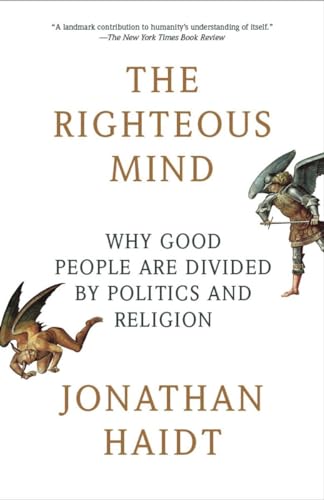

Buy The Righteous Mind: Why Good People Are Divided by Politics and Religion by Haidt, Jonathan online on desertcart.ae at best prices. ✓ Fast and free shipping ✓ free returns ✓ cash on delivery available on eligible purchase. Review: This is a brilliant book very insightful Review: Excellent livre de sociologie sur les comportements humains dans les relations interhumaines et sociales


| Best Sellers Rank | #25 in Political Ideologies & Doctrines #28 in Religious History #33 in Ethics & Morality |
| Customer reviews | 4.7 4.7 out of 5 stars (4,733) |
| Dimensions | 13.13 x 3.15 x 20.24 cm |
| Edition | Illustrated |
| ISBN-10 | 0307455777 |
| ISBN-13 | 978-0307455772 |
| Item weight | 499 g |
| Language | English |
| Print length | 528 pages |
| Publication date | 12 February 2013 |
| Publisher | Vintage |
H**D
This is a brilliant book very insightful
S**N
Excellent livre de sociologie sur les comportements humains dans les relations interhumaines et sociales
J**A
As a psychologist and mother of two young girls I have frequently worried about the negative impact of social media and how to protect children and adolescents from it given the seeming ubiquitous use of smart phones, without being able to fully articulate my concerns. Jonathan Haidt puts together all the pieces of the jigsaw in a clear and eloquent manner, backed by research. This book is a necessary call to action for governments, tech companies, schools and parents.
J**Y
This is arguably one of the best books I have read all around. Although this book delves deep into psychology and psychological theory, it is written for any layperson. As someone with an undergrad in psychology, I remember reading quite a few of the experiments narrated in this book and can say Jonathan does a tremendous job distilling them and presenting them in simple terms. No concept is left unexplained and every idea presented is clearly linked to another, creating a long chain of interconnected concepts. Additionally, Jonathan makes sure that every point he makes is backed up with solid evidence, usually from 3 different perspectives. Each point is addressed with supporting evidence, a critical point-of-view, and then something in the middle of the two extremes. To me, this removed any doubt that his intentions were noble and as close to impartial as one can be. Each chapter ends with a clearly defined "In Sum" section. This helps identify the key points if they weren't explicitly clear to the reader. This was extremely helpful for me as I usually take notes while I read any significant book. To add to the overall feel of the book, I would recommend setting up an account on yourmorals.org (this is presented in the book). It certainly will help the reader with self-knowledge and help place themselves within the context of the book. This is important as the book attempts to help resolve polarization, therefore, knowing where you stand is helpful.
M**E
This was a book club choice, and one of the best that we have read in recent years. I would recommend it to everyone, but particularly those with strong and confirmed moral or political convictions. It will change your views about religion and politics, and hopefully make you more tolerant of other peoples perspectives. Here are my notes: Haidt: The Righteous Mind Overall This was one of our best recent book club choices. It was well written, clear and thought provoking. The main point of the book to me was to demonstrate that morality has a social purpose, as the foundation on which social capital is constructed. What matters is that people share the same moral values, not whether those values are “right or wrong”. It has changed my thinking, and I have bought copies for friends of mine to see if it can also change theirs. Synopsis The book is divided into sections: • Section 1: Intuitions come first, strategic reasoning second The central metaphor is that the mind is like a rider on an elephant, whose job is to serve the elephant without much control of where the elephant is going. Traditionally Western philosophy separated the body and the mind, with the mind being the “ghost in the machine”, but according to Haidt the two are intimately connected. In fact morality is rooted in emotion and not in reason. We act first (the elephant moves), and justify our actions later (the rider). • Section 2: There’s more to morality than harm and fairness The central metaphor is like a tongue with six taste receptors. Morality has evolved to bind social groups together. Haidt identifies 6 different moral foundations, each of which has a role to play in addressing specific human behaviours: Care/Harm: evolved for the protection and care of vulnerable offspring Fairness/Cheating: evolved to encourage sharing and punish cheating Loyalty/Betrayal: evolved to bind people together in social groups and to punish defectors Authority/Subversion: evolved to bind people within a hierarchical social structure within the group Sanctity/Degradation: evolved to protect health by avoiding unsafe foods and encouraging hygienic practises Liberty/Oppression: evolved to balance the personal freedom and group loyalty • Section 3: Morality binds and blinds The central metaphor we are 90 percent bee and 10 percent chimp. We naturally tend to aggregate into large social groups bound by shared morals. In this context religion should not be seen as a parasitic meme, but as a social tool that binds people together into a cohesive and effective unit. Further, our political inclinations are a function of our individual sensitivities to each of the 6 moral foundations. Socialists are primarily driven by Care/Harm considerations for “social justice” and equality of outcomes. Conservatives are more concerned with maintaining social capital in an imperfect world where people cheat and exploit the system. Neither has a monopoly on righteousness, and each has their place in maintaining a balanced society. Critique I thought that this was an excellent book, grounded in science, which succeeds in its main argument that morality is an evolutionary adaptation whose purpose is to behind social groups together. I also very much enjoyed the description of how the field of moral psychology has developed over time. I have only a few points to discuss: 1. Religion as a meme Haidt argues that the new Atheists are wrong in characterising Religion as a pernicious meme, and that instead it has a social purpose in binding people together into a cohesive whole. I think he overstates his case, and that his argument is not incompatible with that of the new atheists (Dawkins, Hitchens etc). Although the set of religions as a whole may well have a social purpose (religion has spontaneously evolved too often for it not to have some use), each individual religion can also be regarded as a meme that exploits humanity’s social needs to propagate itself. Thus when Haidt states that religions change over time to fit the needs of a changing society, the New Atheists would argue that the meme mutates and evolves with its host to ensure its continued propagation. It is merely a question of perspective. 2. Moral foundations of political views Although, the conclusion of Haidt’s discussion of the moral foundations for Conservative and Liberal viewpoints is a refreshing call for tolerance, I thought that this was the weakest part of the book. His claim that political beliefs can be traced back to differing sensitivities to the 6 moral foundations mentioned above was justified by social surveys in which people were asked their political orientation and then asked to answer moral questionnaires. Conservatives and Liberals were then found to have different reactions to questions that targeted particular moral foundations. Correlation is not necessarily causation I thought that some of the graphs showed relatively weak relationships. In order for Haidt to be right the questions must be formulated so that the subject interprets them in the way intended, and that each question must target the intended moral foundation correctly. There is significant room for error and ambiguity there. His results seemed strong enough to draw general but not specific conclusions from. 3. I have an old friend whose politics are different from mine (he is a lifelong Socialist), so I bought him a copy of the book in the hope that it would provide some perspective and allow us to better understand each other’s viewpoints. As I handed it over he took one look and said “Not bloody Haidt, I hated that book.” We continue to avoid discussing politics. I am pessimistic that Haidt’s call for political toleration will be heeded. Overall I thought that this was a terrific book, and one of the best we have read in a while.
Trustpilot
2 weeks ago
1 month ago