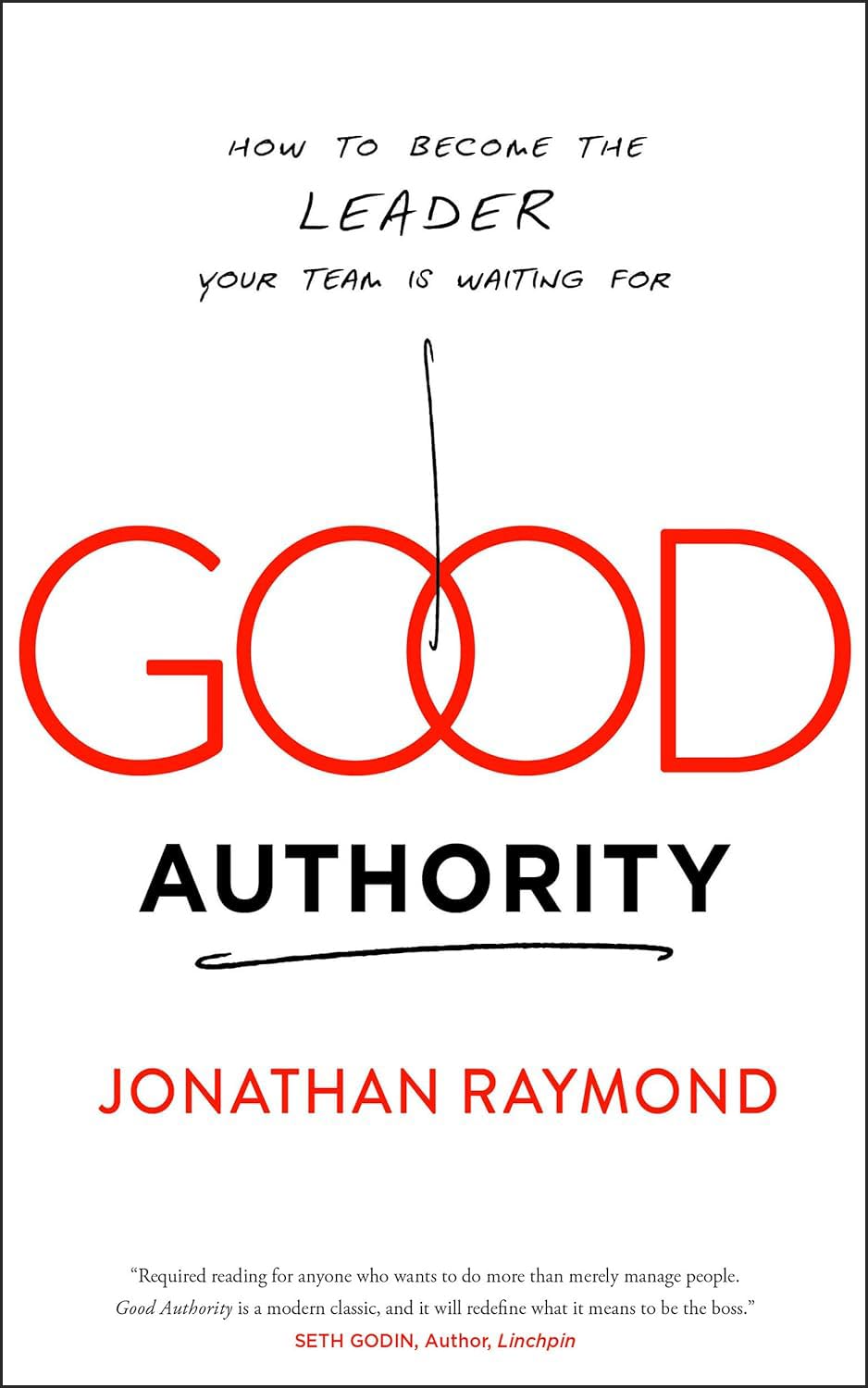
Buy Good Authority: How to Become the Leader Your Team Is Waiting For by Raymond, Jonathan online on desertcart.ae at best prices. ✓ Fast and free shipping ✓ free returns ✓ cash on delivery available on eligible purchase. Review: I found the book somehow interesting at the very beginning, but then I noticed how the book was quickly becoming more and more disconnected. Although I was trying to read the book very carefully (e.g., by taking notes), I couldn't follow the main underlying logics in the content/structure of the chapters, and I had to ask myself several times, 'What is the point you are trying to make, dear author? Be clearer, please!' For instance, it would have greatly helped the reader if the author had worked a little bit more on the writing (it looks like the book has been written in one go without any revision), as well as on the organization of the book itself (what is the underlying narrative/main motive of the book? What is the connection among the various chapters? What about adding some key takeaway points at the end of the chapter, as well as at the end of the book?). For example, if someone asked me now to summarize the book, I wouldn't be able to report any key points, and basically, I will forget everything about this book in a few days’ time. The author also makes very frequent references to (what appear to me as) imaginary situations that he refers to as sort of 'universal examples'; however, these imaginary dialogues among team members are often boring (no one is really interested in the story of Catherine or whatever) and do not get straight to the point, as if they were a sort of mystery story to be solved. Dear author, please just tell me the points you want to make without making reference to long stories that no one cares about, and everyone will forget about them after one second. They are also written using a sort of melodramatic, childish/high-school tone of language I’ve never come across at work. The author also thinks everywhere is like in the US, so please note that all the examples provided in the book make sense only if you live in the US (e.g., the fact you can fire anybody at your wish). I've also found the overly exasperating use of acronyms to refer to some phases, or childish names given to processes, like 'the dial' (come on…), or the fact everything is an archetype. The author often refers the reader to later parts of the book (just tell me now!), and uses a paternalistic tone often to bring 'life lessons' to the reader. I also found the last thought on 'work-balance' (according to the author, there’s no such thing as that), believed by the author to be true for everyone (including the reader) a little bit insulting/depressing. It’s your choice, dear author, to merge work with your private life, but most of the people are also happy (and are better leader/managers) by actually keeping them very well separated. Review: Finally a book that addresses what is still kind of taboo in the workplace - Intermingling of personal and professional development. Mind you, the author doesn't talk about the extra-curricular activities, team-bonding excursions or the lunch yoga class in your office. It is not some "money isn't the only thing that drives people" rehash either. This is the closest roadmap (that I have come across so far) that shows you how you could build a company culture by working on "People Dynamics" , one person at a time. This is a critical tool for people in positions of authority in the workplace. Where the book really shines is giving you a walk-through of the most critical and hard-to-have conversations in your role as a manager or in any role of authority for that matter. The author doesn't just skirt through the uncomfortable parts, he gets down to the intricacies - the tough conversations, holding people accountable, opening up to the vulnerability of being a leader, classifying and profiling people ( in a human sense!) - their strengths, weaknesses, how to mentor them , their motives, and even examples of how a conversation would go! I believe the stories are from personal experiences so you can model your own process. The stories are appropriately placed and as much as needed ( the book is quick to read and an easy read for that matter, unlike the filler books that have to more than 250 pages these days with unneeded stories). When it comes to interpersonal dynamics at the workplace, there is not a manual with a series of linear steps that you can take. I believe with this book, the author has been able to identify AND provide a vocabulary for one of the elusive parts of work life. If I started pointing out everything that stood out to me, I would have to put almost the entire book here. Personally, there is a lot more in these pages that I would have to revisit for again and again. I believe the lessons on Accountability and Archetypes ( doesn't sound Sexy I know) alone would be 1000 times the price of the paperback if not more. I honestly believe most people could be blindsided their entire careers by these blind-spots ( I know people that have been and it certainly was an eye-opener for me). This was a "full" book in my opinion. It wasn't like a commercial where I got a couple of steps but needed to buy something else to get "the real insider secrets". I know the author has a coaching program ( and I am sure it is an excellent one!) but at the end of the book, it was't something I felt I NEEDED to have, there wasn't a sales pitch. I felt I walked with "full" pieces ( a lot of them for that matter) that are immediately implementable and something I would probably be using for years to come! If you are in a position where you manage other people or rely on other people to be managing people, this is a MUST-READ!
| Best Sellers Rank | #198,238 in Books ( See Top 100 in Books ) #62 in Work-Life Balance in Business #551 in Workplace Culture #764 in Communication & Social Skills |
| Customer reviews | 4.8 4.8 out of 5 stars (120) |
| Dimensions | 13.34 x 1.91 x 21.59 cm |
| Edition | Reprint |
| ISBN-10 | 1940858771 |
| ISBN-13 | 978-1940858777 |
| Item weight | 1.05 Kilograms |
| Language | English |
| Print length | 225 pages |
| Publication date | 19 July 2018 |
| Publisher | Ideapress Publishing |
J**D
I found the book somehow interesting at the very beginning, but then I noticed how the book was quickly becoming more and more disconnected. Although I was trying to read the book very carefully (e.g., by taking notes), I couldn't follow the main underlying logics in the content/structure of the chapters, and I had to ask myself several times, 'What is the point you are trying to make, dear author? Be clearer, please!' For instance, it would have greatly helped the reader if the author had worked a little bit more on the writing (it looks like the book has been written in one go without any revision), as well as on the organization of the book itself (what is the underlying narrative/main motive of the book? What is the connection among the various chapters? What about adding some key takeaway points at the end of the chapter, as well as at the end of the book?). For example, if someone asked me now to summarize the book, I wouldn't be able to report any key points, and basically, I will forget everything about this book in a few days’ time. The author also makes very frequent references to (what appear to me as) imaginary situations that he refers to as sort of 'universal examples'; however, these imaginary dialogues among team members are often boring (no one is really interested in the story of Catherine or whatever) and do not get straight to the point, as if they were a sort of mystery story to be solved. Dear author, please just tell me the points you want to make without making reference to long stories that no one cares about, and everyone will forget about them after one second. They are also written using a sort of melodramatic, childish/high-school tone of language I’ve never come across at work. The author also thinks everywhere is like in the US, so please note that all the examples provided in the book make sense only if you live in the US (e.g., the fact you can fire anybody at your wish). I've also found the overly exasperating use of acronyms to refer to some phases, or childish names given to processes, like 'the dial' (come on…), or the fact everything is an archetype. The author often refers the reader to later parts of the book (just tell me now!), and uses a paternalistic tone often to bring 'life lessons' to the reader. I also found the last thought on 'work-balance' (according to the author, there’s no such thing as that), believed by the author to be true for everyone (including the reader) a little bit insulting/depressing. It’s your choice, dear author, to merge work with your private life, but most of the people are also happy (and are better leader/managers) by actually keeping them very well separated.
R**H
Finally a book that addresses what is still kind of taboo in the workplace - Intermingling of personal and professional development. Mind you, the author doesn't talk about the extra-curricular activities, team-bonding excursions or the lunch yoga class in your office. It is not some "money isn't the only thing that drives people" rehash either. This is the closest roadmap (that I have come across so far) that shows you how you could build a company culture by working on "People Dynamics" , one person at a time. This is a critical tool for people in positions of authority in the workplace. Where the book really shines is giving you a walk-through of the most critical and hard-to-have conversations in your role as a manager or in any role of authority for that matter. The author doesn't just skirt through the uncomfortable parts, he gets down to the intricacies - the tough conversations, holding people accountable, opening up to the vulnerability of being a leader, classifying and profiling people ( in a human sense!) - their strengths, weaknesses, how to mentor them , their motives, and even examples of how a conversation would go! I believe the stories are from personal experiences so you can model your own process. The stories are appropriately placed and as much as needed ( the book is quick to read and an easy read for that matter, unlike the filler books that have to more than 250 pages these days with unneeded stories). When it comes to interpersonal dynamics at the workplace, there is not a manual with a series of linear steps that you can take. I believe with this book, the author has been able to identify AND provide a vocabulary for one of the elusive parts of work life. If I started pointing out everything that stood out to me, I would have to put almost the entire book here. Personally, there is a lot more in these pages that I would have to revisit for again and again. I believe the lessons on Accountability and Archetypes ( doesn't sound Sexy I know) alone would be 1000 times the price of the paperback if not more. I honestly believe most people could be blindsided their entire careers by these blind-spots ( I know people that have been and it certainly was an eye-opener for me). This was a "full" book in my opinion. It wasn't like a commercial where I got a couple of steps but needed to buy something else to get "the real insider secrets". I know the author has a coaching program ( and I am sure it is an excellent one!) but at the end of the book, it was't something I felt I NEEDED to have, there wasn't a sales pitch. I felt I walked with "full" pieces ( a lot of them for that matter) that are immediately implementable and something I would probably be using for years to come! If you are in a position where you manage other people or rely on other people to be managing people, this is a MUST-READ!
P**H
I first listened to this audio book and bought the physical book so I could highlight it. Well worth it.
B**S
Jonathan’s treatise successfully uncovers many ingrained leadership blind spots (behaviours and habits) that often go undetected resulting in ineffective leadership. I strongly recommend the Good Authority. Anyone who genuinely desires to better understand the underpinnings of influencing others to make positive change for the greater good would appreciate this read. The book offers a much-needed paradigm for unlocking the hidden potential in others. The structure is set up like a careful surgeon working from the inside-out starting with basic tenets and principles of the Good Authority manifesto. I love #10 “The strength to wait for others to discover their own truth for themselves.” In era where disengagement is at an all time high, that principle alone is a game changer in terms of creating space that generates net value for all stakeholders. In part one, you’ll be challenged to refashion your perspective about the concepts of culture and engagement through the lens of how each are best structured and functions to inform one another. In part two, you’ll explore a uniquely powerful paradigm to help people tap into their greater potential and to empower themselves to achieve greater success. Lastly in part three, you’ll bring it all together to focus on the practical tools and resources to bring about positive change right where you are. If you ever found your asking, “How can I offer the deepest part of my unique talent as a contribution to my community, work environment, or society at large?”, then let the Good Authority be your Sherpa.
D**G
This book is not written by a business school professor or a "thought leader" who's never led a real team. It is from an experienced leader/CEO/founder who somehow hasn't lost his true empathy towards his employees through his career. The book focuses on illustrating a simple but profound mindset shift that helps you to truly balance the needs of an employer and those of an employee. Along with practical tips. If you just read the summary, it may seems too superfluous (accountability and that's it!?) but the book itself does help you connect the dots and nudge your brain to think in different ways. Note 1: if you haven't managed people in your life, you won't get much out of this book. Connecting the ideas to your own management experience is very powerful. Note 2: I personally found the "branding" of the frameworks in the book a bit confusing. However, the actual descriptions were very insightful.
Trustpilot
2 months ago
1 month ago