We remain fully operational. Our teams are working around the clock to ensure your deliveries continue safely.

DOWNLOAD THE APP


Copyright © 2025 Desertcart Holdings Limited
DOWNLOAD THE APP


Buy anything from 5,000+ international stores. One checkout price. No surprise fees. Join 2M+ shoppers on Desertcart.
Desertcart purchases this item on your behalf and handles shipping, customs, and support to Netherlands.
⚡ Align Like a Pro, Cut Like a Boss!
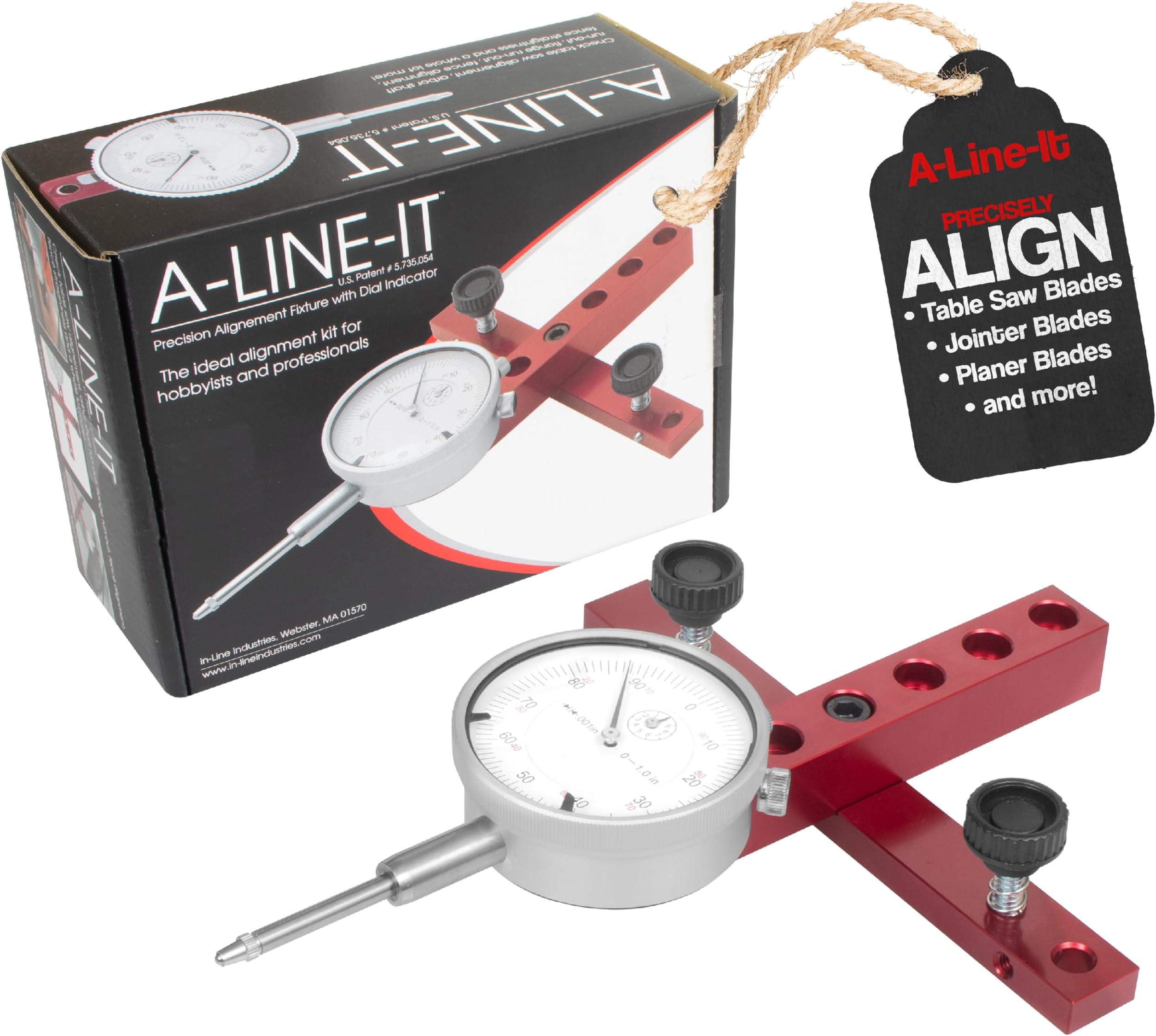
The A Line It Basic is a precision calibration tool designed for hobbyists and small shops, featuring a 1" capacity dial indicator with .001" increments and a self-adjusting Smart Bar that fits most table saw miter slots. It streamlines alignment tasks across table saws, jointers, planers, and bandsaws, ensuring accurate blade and fence positioning for superior woodworking results.


| ASIN | B001B0TNCO |
| Batteries Included? | No |
| Batteries Required? | No |
| Best Sellers Rank | #95,517 in Industrial & Scientific ( See Top 100 in Industrial & Scientific ) #60 in Dial Indicators |
| Customer Reviews | 4.5 4.5 out of 5 stars (633) |
| Date First Available | June 12, 2008 |
| Included Components | A-Line-It Deluxe System |
| Is Discontinued By Manufacturer | No |
| Item Package Quantity | 1 |
| Item Weight | 1.08 pounds |
| Item model number | 13 |
| Manufacturer | Peachtree Woodworking Supply |
| Part Number | 3157 |
| Product Dimensions | 7.2 x 5.1 x 3 inches |
| Size | A-Line-It |
S**E
Accurate, repeatable, works great
I purchased this gauge to set up my new Sawstop. Some of the reviews had me worried and thinking that maybe I needed a much more expensive tool, but this has turned out to be a great. It was highly repeatable, and seems well made. Easy to use. Was able to get my Sawstop to within .002", and could have gotten even more accurate but that seemed to be the tolerance of the Sawstop blade I was measuring against. Afterwards I checked it out against my old Bosch table saw... The blade was pretty accurate but the fence was horrible... up to .045" off depending on where the far end of the fence decided to grab when I locked it down. I can see that to use my Bosch for woodworking, I'd need to set the fence with a square every time. After two thumb injuries that were fortunately recoverable, I decided I'd pushed my luck far enough and bought the Sawstop. Thanks in part to this tool and because of the new saw, I can now make accurate cuts with much less fiddling.
R**R
Good tool
Worked very well
M**N
There is some variability, so precision is certainly not to 1/1000ths of an inch
I ordered the $149 kit that allows one to check out saw blade alignment to miter groove, fence alignment to miter groove, drill press arbor as well as saw motor arbor run out. I had previously done this by feel and sight (using the miter groove, my miter, and a stick fixed to the miter). When I used the alignment it tool, my blade was off by 7/1000 inch. Since this analog micrometer gadget can show distances as small as 1/1000 " I was hoping to improve on the 7/1000 figure. I have a Sears Craftsman contractors saw, and an after market Vega pro fence. I use the PALS system to adjust the saw trundle, and was using a new ridge carbide blade to help align my saw blade. Even after tightening the trundle bolts and re-measuring distances, it was rare for me to get the same distance. I would say there was a 1/1000" variation when measuring the same distances. In addition, there are adjusting screws in the bar to ensure a tight fit in the miter groove. The screws can loosen between making several measurements, so you always have to check If there is any "slop" or play when the bar sits in the miter groove. Same process was repeated for measuring the distance from miter groove to fence. It did take many repeated measurements to convince myself that I was within 1/1000 " difference between the front and back of the fence. Part of the problem, I suspect is that I don't have an expensive cabinet saw, which may make adjusting the fence or sawblade more difficult: I'm just speculating, and maybe if I did try to use this tool with an expensive cabinet saw my experience would be a happier one. That being said, I'm still happy with this purchase and am now quite sure that my saw is in a better state than before. As to the tool itself, Jerry Cole has produced a very hi quality appearing tool. The tool came packaged in foam padding, with places for each of the parts. There were adequate instructions on how to use this as well as a DVD. I did not view the DVD. I might be tempted to purchase another analog digital micrometer gauge, but the one that came with this kit suits my needs for the time being.
G**F
Great for use on the bandsaw to ensure consistent resaw
I have a Laguna 18BX bandsaw, and use a 1.25" resaw king carbide tipped blade for resaw work. I've noticed that over time the fence will go out of alignment, and when I try to resaw, I'll have issues if I don't properly align the fence to prevent any drift. I often resaw at the maximum height of 16 inches, so any blade drift compounds problems, especially on a long board that I'm resawing. I used to just use a square and set the fence that way, but this dial gauge is purpose built for this kind of alignment, and it made checking for parallel quick and easy. The only thing I have to account for is the actual deflection of the fence from sideways pressure since I also use a bow resaw featherboard with the 10 inch extension to apply lateral force to hold the wood firmly against the fence, and this causes the fence to deflect away from the blade at the rear. This is no fault of this dial indicator though, and something that I just need to account for when I'm using the dial indicator to set the fence properly. This wasn't the cheapest option, but it does feel well built and consistent. It was easy to assemble and figure out how to use and adjust the miter bar. Everything tightens down with confidence too, which is nice. Overall, I'm very pleased, and am glad to have it on hand!
A**D
Versatile and accurate
Very handy indeed. It works perfectly on several pieces of equipment such as: tables saws, drill presses, jointers, planers, band saws, and more. The deluxe kit is worth the price over the regular kit since it has all the pieces you need to calibrate most machines in the woodshop. After much research, I selected this tool for its versatility to be used on many different types of equipment. Not only can it be used for several different tools, but it can take several different types of measurements where other similar tools fall short. To give you an idea of how versatile this tool is, you can do the following measurements with it plus more (as shown in the included CD): Table Saw: 1. Blade to table alignment 2. Fence alignment 3. Arbor runout 4. Table wing level Drill Press: 1. Bit runout 2. Table alignment: left-to-right and front-to-back 3. Table deflection 4. Quill travel to post alignment (can't be done on very large drill presses except radial drill presses) I also wanted a dial for measurements instead of digital. Most low cost (meaning non-scientific) digital calibration devises don't measure to a small enough scale for truly accurate measurements. Digital seems cool and modern, but if you are going spend less than $700 on one, then dials are more accurate. The analog dial is very precise and allows you to see the tinniest of deflections that a digital scale won't show. This item also comes with a CD which clearly explains how to set it up and use it with many types of equipment. This item should come in a better box. However, I don't use this item much after my machines were properly set up with it. I now only need it when I do planer and jointer blade changes every three or four months, change my drill press table angle, or buy a new piece of equipment. Since I am a woodworker, I will just make a box later when the old one wears out. I'm not keen on similar items that use magnets to hold the measurement device to the equipment. They are not as flexible to use on as many different machines, your table surface has to be perfectly flat to prevent rocking, and they are harder and heavier to use on equipment which are not made of iron or steel. Just to be clear on my credibility for this rating: I am a furniture maker and worked in an industrial woodshop for several years. I managed it, taught safety classes, and maintained the machines. I have calibrated lots of machines many times over on old machines that were not built to be easily adjusted, and also worked on a few newer ones when manufacturers started to ease the pain on machine owners by engineering easier adjustment options. Having this tool in that shop would have saved me many hours each month and we could have made better cuts for our projects.
B**Z
Another step towards perfection
Before I bought my table saw, I thought it worked like this: you turn it on; you run a board through the blade; you turn it off. Then I bought a saw on craigslist (however it's spelled). It came with an Incra LS rip fence and router table. What the heck is that for? Soon, I was browsing back-issues of Shopnotes, reading about tenoning jigs, crosscut sleds and tapering jigs. So much to learn! And then one day, I read an article about tuning up your table saw. Huh? You could tune it? To what? A-440? Of course not. But the blade, I discovered, must be parallel to the miter slots, and the 90° stop position should align the blade exactly 90° to the table top. Was my saw in tune? I had to read up on banging something called a "trunion" with a hammer and a block of wood to parallel-ize the blade to the miter slot. Was my leg being pulled? Nope, that is the tried-and-true method. So, how to tell when I could stop beating on my saw? How will I know the blade is parallel to the miter slot? That's where the A-Line-It enters the shop. It rides in the miter slot and positions a dial gauge against the saw blade. Mark a spot on the blade, between the teeth, and rotate to the front of the saw. Put the stem of the dial gauge on the dot and zero the dial. Then rotate the blade towards the rear of the saw and move the A-Line-It so the stem of the dial gauge is again on the dot. If the reading is zero, congratulations! The beatings can stop! But if the dial does not read zero, well, it's back to the hammer for you. So, I banged and checked the front and rear positions. I banged and checked the front and rear positions again. I banged and checked the front and rear positions over and over, until they were as close to the zero as possible. I gingerly tightened the bolts holding the trunion and watched the dial. It changed slightly, and then went back to zero as I tightened one side and then the other. I slipped my new Incra miter gauge in the slot, laid down a block of 2 by 4, powered up the beast and ran the wood through the blade. Then I rotated one piece 180° and slid it up against the fresh cut. No gaps! No burn marks! I do not look forward to re-aligning my saw, using a hammer and block of wood. There is something called a P.A.L.S kit which supposedly makes the aligning process almost trivial, but I cannot speak to that yet. No matter what, the A-Line-It tool helped me put a song in my saw! The miter bars are machined aluminum, and vertically adjustable, so they should fit any depth of slot. Plus, there are spring-loaded bearings on the side of the miter bar to prevent slop. The included dial gauge is accurate to .001" (1/1000 of an inch!) which seem like way too much precision for my style of woodworking, but hey, if my saw is aligned to those tolerances, then everything I cut is better, right? Right! And for that reason alone, you should consider buying this tool. It isn't cheap, but you can save $20 if you have your own dial gauge.
A**R
Must have
This is fairly easy to set up as long as you follow the directions and have a little experience with calibration. I use it for my budget table saw because it vibrates so much and is cheap, it is often out of whack. It’s worth the money to be able to spend a few minutes on blade alignment and now that I have it set up, it slides right into my miter slot and I can even check my fence quickly. For me, it’s easy to read and dial in necessary alignments.
H**N
Works great, Simple setup
Works great, was able to align both the table and fence quickly. Make sure that you adjust the two screws to tighten the guide bar in the slot, if that's at all loose, then you'll get false readings
Trustpilot
4 days ago
2 months ago