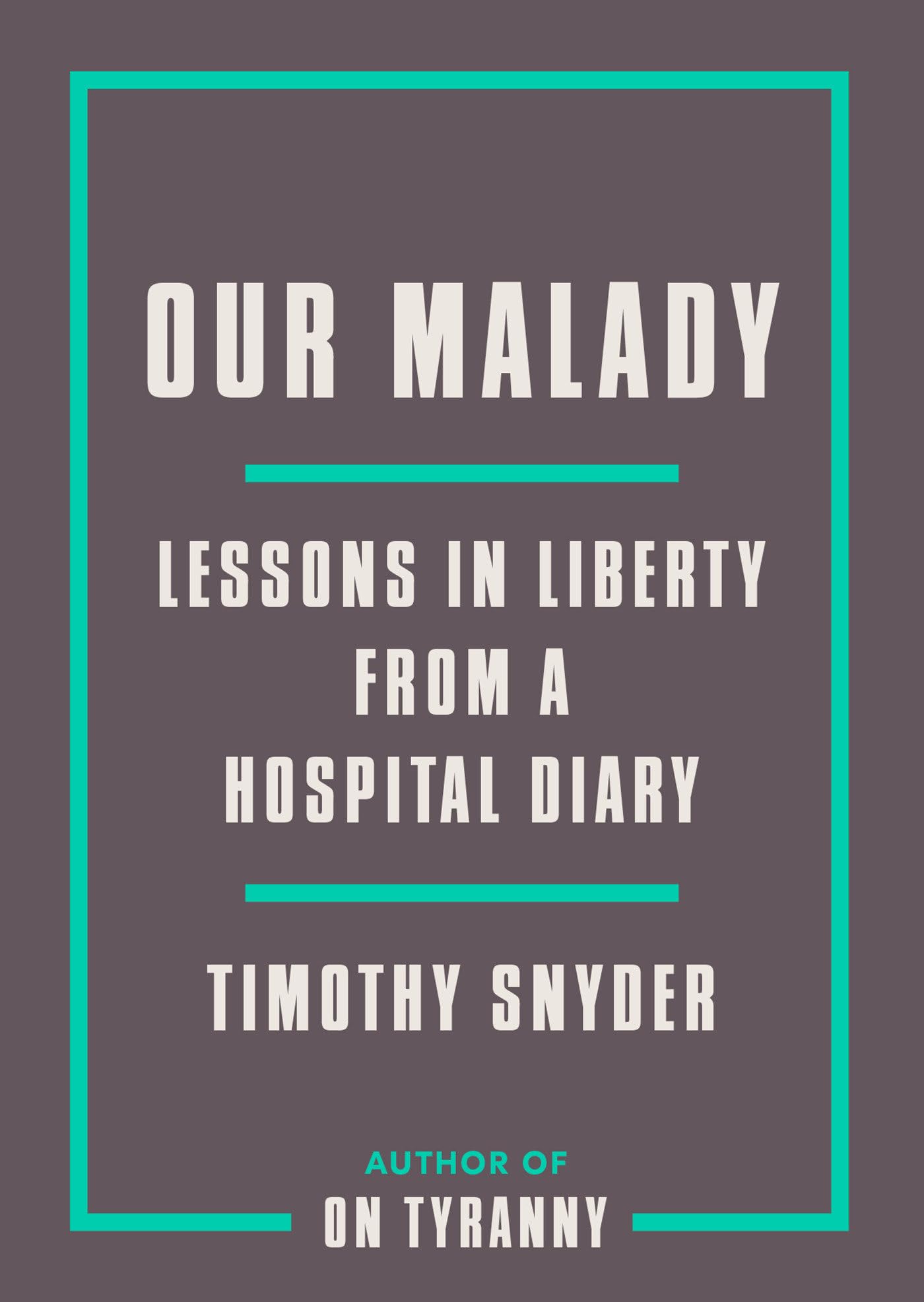
Our Malady: Lessons in Liberty from a Hospital Diary [Snyder, Timothy] on desertcart.com. *FREE* shipping on qualifying offers. Our Malady: Lessons in Liberty from a Hospital Diary Review: A brilliant and radical reconceptualization of the Illness Memoir. A must read. - This is an extraordinary book. One that needs to be read. Discussed. And acted upon. Part illness memoir, part cultural manifesto. But what distinguishes it from prior memoirs or manifestos that consider the experience of being ill in America is its deep resonance with our present politico-cultural moment, when the fraying fabric of our two-century plus experiment in republican democracy is at risk of being irreparably torn asunder. Most illness memoirs – be they about depression, cancer, heart disease, the invisible wounds of war, or any other malady that disrupts and perhaps inexorably alters one’s life course, and in turn, the courses of our loved ones as well – focus predominantly on a single patient’s experience -- be those experiences positive or negative, the treatment heroic or horrific, and the meaning of the experience illustrative, either in some exemplary or admonitory fashion. Despite different authors, different maladies, different experiences, and different outcomes, the narrative arcs of such memoirs typically follow a similar trajectory – eliciting along the way tears of joy, tears of sadness; faith in or contempt for how medicine is practiced in the United States today; and cause us to think, “There but for the grace of G-d ...” Snyder’s analysis casts aside these time-worn conventions and the myriad cliches endemic to the genre. What he offers in its place is a radical reconceptualization of how we might think about the experience of a patient, not just with a personal malady that requires the type of interventions that only a hospital setting can provide, but more tellingly what it means to experience that personal malady within the broader and perhaps more terrifying context of a simultaneous and increasingly lethal cultural malady as well. That is to say, the experience of being ill in a society that is itself sick and suffering. And because of that sickness and suffering, not only our health, the health of our loved ones, the health of those less fortunate than ourselves but also our freedom and their freedom is at risk. Lest anyone doubt this analysis, consider just one fact. When Snyder first fell ill in December 2019, there was not yet a single diagnosed case of Covid-19 in the world (as the first known case would only be established later in the month). But since then, the virus has taken the lives of approximately 1,000,000 Americans, the vast majority of whom, had they resided in virtually any other advanced industrialized nation would still be here with us to day. So while ostensibly a book about a man who goes from one hospital to another to another. Each time being subjected to innumerable errors, mistaken diagnoses, communication lapses, failures to follow protocols, mindless adherence to protocols, counterproductive duplicative procedures, and most frighteningly, a realistic possibility of losing his life, leaving his wife a widow, his children fatherless, all because of a failure to diagnose and treat what had begun as little more than a mere infection. But shocking as it, and while it could easily stand on its own, this harrowing tale is not what the book is about. Not at all. Snyder’s near death experience is not so much a cautionary tale but an extended metaphor – one that suggests, just as no one can really be free until everyone is free, so too, no one can be taken care of until everyone is taken care of. That what, at first blush, we might consider little more than single person’s experience in a life-threatening situation (that should never have become a life-threatening) is not merely a cautionary tale, a warning, or even a call to arms to get our healthcare house in order. But something much bigger. Much more alarming. That we ignore not only at our own peril, but at the peril of our nation and culture. Snyder’s experience, he readily acknowledges, is just one of thousands of similar episodes that take place each and every day in hospitals across the United States (and elsewhere, he concedes). The product, on the one hand, of commercial medicine inexorably marching in goose-step to its logical extreme – where profits not patients – are the driving force, indeed, to mix metaphors, the raison d'être of the healthcare business. Where patients are widgets to be processed. Not people to be cared for. But medicine is just one of several symptoms that comprise our national malady. A malady that steals our freedoms. That make our lives more risky, more chaotic, more uncertain, more anxious than they need to be given the productive capacity of advanced industrialized societies to provide for these basic necessities that are considered the birth right of virtually every child born in the West and much of the Far East today. A malady that confuses rights, to which we are entitled, with privileges and benefits that our employers may, or is increasingly the case, may not, provide. Health insurance, not a right. Paid parental leave, not a right. Safe, high quality childcare, not a right. Paid vacation, not a right. Affordable public transportation, not a right. Affordable (or free) post-secondary education, not a right. A viable pension after a lifetime of work, not a right. Absent such rights, we are not free. Absent such freedom, we live in an increasingly chaotic and unsettled world whose soil offers fertile ground for unfreedom. For autocracy. For fascism. Review: At the crossroads of history and personal diary - Stunning book by a prominent historian. Drawing on his own medical ordeals, Snyder manages to fold in profound thoughts on U.S. healthcare with reflexions on democratic values, love of family, and the sheer meaning of life. A lovely little book that goes straight to the point and comes direct from the heart. Thoroughly enjoyable. I came across the book by chance (heard it mentioned in a podcast) and have since given it to several friends.


| Best Sellers Rank | #603,818 in Books ( See Top 100 in Books ) #412 in Civics & Citizenship (Books) #715 in Health Care Delivery (Books) #4,473 in Sociology Reference |
| Customer Reviews | 4.7 out of 5 stars 1,206 Reviews |
E**N
A brilliant and radical reconceptualization of the Illness Memoir. A must read.
This is an extraordinary book. One that needs to be read. Discussed. And acted upon. Part illness memoir, part cultural manifesto. But what distinguishes it from prior memoirs or manifestos that consider the experience of being ill in America is its deep resonance with our present politico-cultural moment, when the fraying fabric of our two-century plus experiment in republican democracy is at risk of being irreparably torn asunder. Most illness memoirs – be they about depression, cancer, heart disease, the invisible wounds of war, or any other malady that disrupts and perhaps inexorably alters one’s life course, and in turn, the courses of our loved ones as well – focus predominantly on a single patient’s experience -- be those experiences positive or negative, the treatment heroic or horrific, and the meaning of the experience illustrative, either in some exemplary or admonitory fashion. Despite different authors, different maladies, different experiences, and different outcomes, the narrative arcs of such memoirs typically follow a similar trajectory – eliciting along the way tears of joy, tears of sadness; faith in or contempt for how medicine is practiced in the United States today; and cause us to think, “There but for the grace of G-d ...” Snyder’s analysis casts aside these time-worn conventions and the myriad cliches endemic to the genre. What he offers in its place is a radical reconceptualization of how we might think about the experience of a patient, not just with a personal malady that requires the type of interventions that only a hospital setting can provide, but more tellingly what it means to experience that personal malady within the broader and perhaps more terrifying context of a simultaneous and increasingly lethal cultural malady as well. That is to say, the experience of being ill in a society that is itself sick and suffering. And because of that sickness and suffering, not only our health, the health of our loved ones, the health of those less fortunate than ourselves but also our freedom and their freedom is at risk. Lest anyone doubt this analysis, consider just one fact. When Snyder first fell ill in December 2019, there was not yet a single diagnosed case of Covid-19 in the world (as the first known case would only be established later in the month). But since then, the virus has taken the lives of approximately 1,000,000 Americans, the vast majority of whom, had they resided in virtually any other advanced industrialized nation would still be here with us to day. So while ostensibly a book about a man who goes from one hospital to another to another. Each time being subjected to innumerable errors, mistaken diagnoses, communication lapses, failures to follow protocols, mindless adherence to protocols, counterproductive duplicative procedures, and most frighteningly, a realistic possibility of losing his life, leaving his wife a widow, his children fatherless, all because of a failure to diagnose and treat what had begun as little more than a mere infection. But shocking as it, and while it could easily stand on its own, this harrowing tale is not what the book is about. Not at all. Snyder’s near death experience is not so much a cautionary tale but an extended metaphor – one that suggests, just as no one can really be free until everyone is free, so too, no one can be taken care of until everyone is taken care of. That what, at first blush, we might consider little more than single person’s experience in a life-threatening situation (that should never have become a life-threatening) is not merely a cautionary tale, a warning, or even a call to arms to get our healthcare house in order. But something much bigger. Much more alarming. That we ignore not only at our own peril, but at the peril of our nation and culture. Snyder’s experience, he readily acknowledges, is just one of thousands of similar episodes that take place each and every day in hospitals across the United States (and elsewhere, he concedes). The product, on the one hand, of commercial medicine inexorably marching in goose-step to its logical extreme – where profits not patients – are the driving force, indeed, to mix metaphors, the raison d'être of the healthcare business. Where patients are widgets to be processed. Not people to be cared for. But medicine is just one of several symptoms that comprise our national malady. A malady that steals our freedoms. That make our lives more risky, more chaotic, more uncertain, more anxious than they need to be given the productive capacity of advanced industrialized societies to provide for these basic necessities that are considered the birth right of virtually every child born in the West and much of the Far East today. A malady that confuses rights, to which we are entitled, with privileges and benefits that our employers may, or is increasingly the case, may not, provide. Health insurance, not a right. Paid parental leave, not a right. Safe, high quality childcare, not a right. Paid vacation, not a right. Affordable public transportation, not a right. Affordable (or free) post-secondary education, not a right. A viable pension after a lifetime of work, not a right. Absent such rights, we are not free. Absent such freedom, we live in an increasingly chaotic and unsettled world whose soil offers fertile ground for unfreedom. For autocracy. For fascism.
D**G
At the crossroads of history and personal diary
Stunning book by a prominent historian. Drawing on his own medical ordeals, Snyder manages to fold in profound thoughts on U.S. healthcare with reflexions on democratic values, love of family, and the sheer meaning of life. A lovely little book that goes straight to the point and comes direct from the heart. Thoroughly enjoyable. I came across the book by chance (heard it mentioned in a podcast) and have since given it to several friends.
R**E
Timely, Incisive, and Deeply Moving.
Our Malady deftly twines scholarly research and dry facts with emotional rage and a primal demand for relief. It manages to be both deeply researched and deeply personal while also being written and published in less than a year. Timely, incisive, and moving. I was not expecting a book on American healthcare from my favorite scholar of European history and the Holocaust. I am glad it exists, as it throws into sharp contrast the problems of our country. Some problems I had not known of, some I had not realized the scale of, and some existed in ways I had never realized or even considered possible. Absolutely necessary reading.
T**K
Healthcare is a right
Excellent little book that argues healthcare is a human right. Snyder offers a unique perspective because this book comes after his almost dying. I gave the book 4 stars because I wanted more of a philosophical case of how health care is needed for us to be more free.
H**R
Most memoirs about illness and survival are one person's story. Timothy Snyder's story is much more.
Bev Veals, a three-time cancer survivor in North Carolina recently feared she could no longer afford her health care. She reached out to her Senator, Thom Tillis, for help, and when she got scorn, she recorded her phone calls with one of his staffers. BEV VEALS: “You’re saying that, if you can’t afford it, you don’t get to have it, and that includes health care?” STAFFER: “Yeah, just like if I want to go to the store and buy a new dress shirt. If I can’t afford that dress shirt, I don’t get to get it.” BEV VEALS: “But health care is something that people need, especially if they have cancer.” STAFFER: “Well, you got to find a way to get it.” I read that interchange when I was taking a break from Timothy Snyder’s short (146 pocket-sized pages) “Our Malady: Lessons in Liberty from a Hospital Diary.” “Our Malady” isn’t a book Snyder intended to write. "Late at night in Munich on December 3, 2019, I was admitted to a hospital with abdominal pain and then released the next morning. In Connecticut, on December 15, I was admitted to the hospital for an appendectomy and released after less than twenty-four hours. In Florida on vacation, on December 23, I was admitted to the hospital for tingling and numbness in my hands and feet but released the following day. Then I began to feel worse, with a headache and growing fatigue." "When I stood before the lectern in Munich on December 3, I had appendicitis. That condition was overlooked by German doctors. My appendix burst, and my liver became infected. At the time of my appendectomy, the doctors in New Haven had noted a lesion in my liver but had neglected to treat it, or examine it again, or order another test, or even mention it to me. I was discharged from the hospital the day after that surgery, December 16, with too few antibiotics and no information about that second infection. When I was admitted to the hospital in Florida on December 23 with tingling and numbness in my limbs, I had not known to tell the doctors about my liver. Again, I was discharged after a day." "In the emergency room in New Haven on December 29, everyone dismissed the possibility that my condition had to do with my appendix or my recent surgery. It seemed unthinkable to the doctors in New Haven that their colleagues had done something wrong. This sort of clan thinking is an elementary error, the kind we all make under stress." Seventeen hours later, surgeons operated on his liver. He developed sepsis. It wasn’t treated. He almost died. He left the hospital “with nine new holes in me: three from the appendectomy, three for liver drains, two from spinal taps, and one in my arm for the tube that channeled the antibiotics I inject.” This isn’t your garden variety personal memoir: how I almost died, how I managed to survive. Snyder is a Yale professor of History at the top of the first tier. He can speak and write French, German, Polish, and Ukrainian, and read Czech, Slovak, Russian, and Belarusian. He has a cast a steady eye on the political and personal histories of the darkest period of the 20th century. Even in the shadow of his own death, he takes notes. And what he concludes is the reason to read this book: it’s not just about him. “My own malaise has meaning only insofar as it helps me understand our broader malady I remember places where I should not have been, things that should not have happened, not to me nor to anyone else, and I want to make sense of them.” The sense he makes is about a totally backward health care system. “Our malady “is physical illness and the political evil that surrounds it.” He does not say “evil” carelessly. "Our system of commercial medicine, dominated by private insurance, regional groups of private hospitals, and other powerful interests, looks more and more like a numbers racket. We would like to think we have health care that incidentally involves some wealth transfer; what we actually have is wealth transfer that incidentally involves some health care. If birth is not safe, and is less safe for some than for others, then something is wrong. If more money is extracted from young adults for health care, but they are less well than older generations, something is wrong. If the people who used to believe in the country are killing themselves, something is wrong. The purpose of medicine is not to squeeze maximum profits from sick bodies during short lives but to enable health and freedom during long ones." The idea that dividing people, making some sub-human by denying them health care, connects this book to “On Tyranny” — and to the Nazis. “[People like] Trump want people staggered by suffering, and so they oppose health care. Pain is their politics; their propaganda is a death trap.” Make no mistake, this is a political book. "America is supposed to be about freedom, but illness and fear render us less free…. The word freedom is hypocritical when spoken by the people who create the conditions that leave us sick and powerless. If our federal government and our commercial medicine make us unhealthy, they are making us unfree…. Rather than pursuing happiness as individuals, we are together creating a collective of pain." Health care as a shirt you can’t afford, health care that serves only corporate profit — Snyder forces those of us who can afford the shirt to consider how badly it fits, how expensive it is for what we get. But health care managed by doctors for the benefit of their patients — something like that happens in other countries. How can it happen here? Put a stake in the heart of it. Timothy Snyder makes that case.
J**T
Pleased with purchase
Book arrived quickly and in excellent condition.
G**K
Gripping!
I just happened to catch Prof Snyder on the Eleventh Hour with Brian Williams & I was immediately moved to download his book, “Our Malady” that delves into our American Health Care System. The book is eminently readable yet grippingly profound. Interestingly the author says that “America is supposed to be about freedom, but illness & fear make us less free.” Likewise, “We would like to think we have health care that incidentally involves some wealth transfer; what we actually have is wealth transfer that incidentally involves some health care.” Prof Snyder’s very personal recollections of his dire hospitalization stirs so many memories of witnessing care that fell short. I remember the days he speaks about so clearly for sad events in my own life.
P**O
Great read. Poignant, heartfelt. A call for action.
Fast read, this is the naked truth of the American Medical system. Through his experience we get a vivid narrative navigating a sad and broken system. His words are charged with emotion, anger and solace. After reading this book I will be a better doctor and never succumb to the apathy that I see everyday in medicine.
Trustpilot
1 month ago
4 days ago