


Desertcart purchases this item on your behalf and handles shipping, customs, and support to Netherlands.
๐ฉบ Take control of your heart healthโbecause your future deserves precision today!
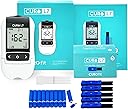
The CURO-L7 is a professional-grade, all-in-one blood cholesterol testing kit designed for both home and clinical use. It includes a reliable test device, 5 test strips, lancets, and an EziTube rod, all in a compact, travel-friendly package. With easy-to-follow instructions, video support, and real customer service, it empowers users to monitor cholesterol levels accurately and conveniently anytime, anywhere.



| Customer Reviews | 3.2 out of 5 stars 381 Reviews |
T**O
Lipid Panel in less than 5 minutes!
The Curo L7 was a very advance monitoring tool for both Glucose and Lipid panel. As time went by the glucose analyzer was surpass by other products that let you control the diabetes and insulin better furthermore the glucose strips are not available any more, however the lipid profiles is excellent so is what I use this kit for I have seen many negative comments for this product here in Amazon and I wonder IF some of them are users errors. I will give you some tips that help me to get excellent results. 1. Be sure that the test strip expiration date is OK. 2. The Curo L7 device is already pre-calibrated so if the device works well the numbers should be reliable. 3. First do the Initial setup of the device: User Manual page #14. Ignore "Mode change" in page 22 because when you insert the blue code chip it will default to Lipid Mode what is what you want (Be sure the analyzer is OFF when you insert the code chip) 4. Second check if the device is working well without errors. Use the plastic strip test that comes with the kit. Page #43 of the User Manual 5. Blood sampling is tricky because you need far more blood than the small drops that you use for glucose test. Also the lancet provided can not be reset. Have another lancet ready jic or even better have one of the lancet that you use for glucose testing ready in case you need to stick another finger. You do not need to fill the tube to the mark in one time, you can get another drop and complete the filling. 5. The EZ tubing is a plastic pipette with one end close with a bulb so be sure you grab the tube not the bulb and place the tip on the sampling window and then very slowly squeeze the bulb between thumb and index to drop the blood. This is key, be patient and do it slowly until the "window' port is cover with blood. User Manual #31. 6. Do the test in a flat surface where the device is lying flat. 7. Be sure the EZ tube does not roll if you accidentally touch it with the finger. I have a small piece of packing foam where I made a grove so the EZ tube can not roll. 8. Wash your hands with regular soap and let it dry well ++. If you want you can use alcohol pad also be sure the finger is dry. Test can be affected if you do not follow these precautions. 9. The Lipid Test Strips comes with a insert with some extra info, worth to read it. Hope you get the optimal numbers as describe in the User Manual page # 37. I have a couple of questions and I sent an e-mail to support and they were answered the following day which is excellent. In summary this is a great pro kit to get the lipid panel.
A**R
The test strips only worked 1 of 5 times. E1 codes & shut down
It worked as advertised when I received it 2 months ago but has not since then despite very carefully following the exact same instructions I did the 1st time. The tester gave me an E1 code for 4 of 5 test strips they sent with it, & they were nowhere near expiration. I used all the test strips (as the book suggests) & can't get any more in time for what I bought this tester for. When I called during the hours specified nobody answered the phone for days & there is no answer machine. My email was not responded to. When someone eventually answered the phone they seemed to be trying to dial out. At first they implied I did not follow the directions properly after I them very carefully following both sets of instructions the 1st time & every time since then. The test strips failed 4 out of 5 times with an E1 code Then they told me to take a video of me performing a test & seemed confused when I explained I cannot do that because I followed the instructions & used all the test strips they sent with it. They refused to send me some more test strips, & even if they did I would not get them in time for what I bought the tester for. It worked fine when I received it (the results were in the ballpark of the professional labs I got about an hour before) but all the rest of the test strips failed with an E1 code even though I very carefully followed the exact same instructions I did for the first successful test. I also tried installing new name brand batteries, reset the tester, & did the setup process all over again, but still got an E1 code followed by a tester shut down. Curofit now says I must send the tester to them for "inspection", but I told them I did not have the time left to do that before what I bought the tester for, so it is a completely useless waste of my time & money
B**A
Read the reviews with instructions/video
Accurate and fast results! And easy-if you read the reviews/videos first! After reading the reviews, I was nervous about messing this up and wasting money. However, I read the reviews that list step-by-step instructions and, most importantly, watched the video posted in one review. After that, it was easy. Without watching the video, though, I would not have been able to draw enough blood. I am a Type 1 Diabetic, and finger sticks do not bother me at all, but what would have confused me is how much blood has to pool on the fingertip for the pipette to work. I am used to glucose test strips which will suck up tiny amounts of blood, but the pipette only works if you have squeezed out a small pool of blood (and stops working while there is still blood on the fingertip). I guess there has to be some depth to the blood pool. So, I had to prick, milk the blood out, use the pipette to suck up the blood, put the pipette down (with the end pointing up), and then start the pricking process over again several times. But I noticed that in the video, and it was no problem. I was a bit worried because there is such a variance in how much I bleed when I lance my finger. So, just to be sure, I placed my hands in a sink of hot water while standing and leaning over them. I could feel my hands swelling, and sure enough, I bled well. (I still had to stick myself 4-5 times because, as mentioned previously, the pipette does not seem able to suck up all the blood on a finger.) Just to be safe, drink a lot of water in the hours before you test! Also, I have seen many lancets over the years, but nothing like what came in this package. I am still not sure if they are supposed to work on their own or if they are supposed to attach to some device that was not included. So, I just used my regular diabetic lancets. This could be why I had to do it several times (maybe the included lances go deeper), but really, finger sticking with a diabetic lancet is easy and next to painless, so it didn't really matter to me if I had to do it a few extra times. I assume my results are accurate because they are similar to my lab results from 6 weeks ago but slightly improved, which makes sense as I have been eating better. I am excited to have a way to test my cholesterol more frequently so that I can determine if the changes I am making are helping at all.
S**.
defective meter
box arrive beat up like maybe the meter had been returned before. Lancets were not in their assigned box. TC was absurdly low and all other lipid readings were too low to measure. Only tried once because it does require a lot of blood as others have mentioned. Great idea too bad this does not work. I don't know if I got unlucky with a bad meter that just keeps getting repackaged after returns and sent to more people or if this product is just junk. I am returning the product.
T**V
What does this mean?
Today I got a reading for TC, TG, and HDL, but then for the next values of LDL, LDL/HDL, TG/HDL, non-HDL the screen read as in the picture. It looks like 0 - 8 but with the bottom bar cut off. So I am not sure what it really is. There is nothing in the instruction book explaining this. This machine was working great the first few times, but now I notice that the collection tube tends to get stuck or slow in accepting the blood at the half way point. So that means it's a struggle to fill up to the fill line. I worry that if the fill process slows down too much that it might be creating a clog at the start of the collection tube. Some times there is a tiny bubble in the tube. So I just wonder if I failed to get a complete reading because of there not being enough blood? I did fill to the fill line, and when I deposited the blood on the strip, it beeped and told me to close the lid. I figured that meant it got the right amount of blood. So what is this all about? I've been trying to run hot water on my hands and swing my arms a few times prior to poking my finger in an attempt to get the blood to flow faster. Still I see the collection tube getting sort of clogged at the tip. It wastes tubes if I have start all over because a given tube won't accept enough blood. Other than that issue, I like the ease of use of the machine itself and the fact that one can get readings for TC, TG, HDL, and LDL. It feels like a good quality machine, but I feel that collection tube needs to be improved. UPDATE I have been getting the hang of it. I squeeze my finger to get a big blood drop, collect that, then keep on repeating. I notice that when I tilt the collection tube upright that's when an air bubble can form so it's best to keep it level and only tilt slightly when putting the tube at the blood drop. Once an air bubble forms there is danger of a clot forming in the tube and then it's possible that the blood gets sticky in the tube and won't come out. I wish we could by extra tubes for when mistakes happen.
G**W
Follow Curo-7 published instructions especially the blood sample prep video
Initially I was not following the startup video for blood sampling and was considering sending the unit back. Talked with a Curo agent, followed exact procedure and that changed the outcome to positive. Make sure you use their auto lance to establish fast enough blood flow for the collection tube capillary draw. Never use the bulb on the tube until ready to deposit blood drawn into test strip. Test strip needs to be mounted in place before depositing blood sample. Deposit blood sample into test strip using gentle continuous pressure on the bulb. Close the monitor lid to block light since the final measurement is photometric (monitoring color changes of three reagent spots then computes test values). I cross checked the measurements by taking a fasting sample 30 minutes before going to a hospital blood lab for a draw and complete lipid panel. The results of the CURO-7 were within 5% of the hospital. As an analytical chemist and ChemE, that is spot on. I also tried a few other kits that had much lower cost for replacement test strips. Results were all over the place. Also, could not get test to test to reproduce measurements from strip to strip. In some cases other units were +- 50%. So Curo-7 with $10/test is defined in practice as the one to use. Since I can not tolerate statins, I use plant sterols daily and Bergamot caps plus extra fiber to keep blood lipids down. Seeing total cholesterol at 185 the other day was a joy. By using clinical nutrients to help do the job, I must monitor weekly to insure that blood lipids are not trending out of bounds. Keeping a lid on sugar intake does make a difference. Again, watch their videos, follow their procedure exactly, and you should have reliable outcomes. My mistake was using a standard blood glucose lance that produced blood too slowly for the sample tube and clotting in the tube can occur invalidating that blood draw tube. Provided lance produces good blood flow so sample collection should be done in 10 seconds. This is my experience as a professional and the opinions provided are for informational purposes only. Furthermore, I have no commercial interest in this company... just looking for something that worked reliably. About to order another box of 10 test strips, the fourth box.
R**Y
Not Accurate, Too Many Test Failures and Wasted Sample Strips
When it works, its not accurate, but is at least useful to gauge a trend of rising vs. falling HDL/LDL levels over time. It is very unpredictable whether a test will return usable numbers, else failed "N/A" and "Lo" results, which wastes expensive test strips and costs another finger-stick. We've had several days with three failed tests in a row (before we give up to try again next week). Sometimes a test will actually work out great, but this is so unpredictable and random. The test-procedure documentation is very poorly written and missing obvious steps (such as "turn the unit on"). As an engineer/tech-writer, I am aware how important it is to write for a wide variety of readers and to be very clear with every step, in the proper order. MANY users have reported problems deciphering and following the vague and misdirecting test procedures. I really wanted to like this system- delaying writing this review for several months, but it continues to disappoint, expensively... There is no need to use spoons or other strange rituals to gather the required blood. Instead run your arm/hand under warm water for about a minute then use the proper 21G/2.5mm lancet that comes with the test kit. We find this allows us to gather enough blood for the Curo and a diabetic-style glucose meter from the same finger-stick.
J**R
Questionable accuracy, but useful for monitoring trends in your lipid profile
First of all, contrary to many reviews here, the blood sample required for this meter isn't excessive or difficult to draw. Yes, it uses substantially more than your typical glucometer, but not "spoonfuls." The key to success is to use a 21ga lancet, which are included with the meter, not the smaller 31ga types which are common with diabetics. The 21ga types look intimidating, yes, but they are only slightly more painful than smaller ones, and used properly, they will ensure that you can get an adequate sample. Power on the meter with the door closed, place a test strip in the slot, and open the door when prompted. Once you've pricked your finger and squeezed out a large blob, allow the Ezi-tube to draw the blood by capillary action -- meaning, do not squeeze the bulb to suck the blood up. The tube will draw up blood only to the black line (where you need to be), and then it will draw no more. You can have the tube in any position, but it's probably easiest to lay it on a flat surface so you can use both hands to apply the sample. Apply all of the blood in the tube to the window on the test strip. It appears to help avoid errors if you poke and prod at the window a little while you apply the sample. Then close the door and pray. Within about 30 seconds, it should start counting down from 3 minutes, after which the meter will display your results. Now, having said all of that, the meter is actually error-prone, inaccurate, and somewhat inconsistent. Out of 8 attempts, I got an E-2 (inadequate blood sample) error 4 times, despite using the proper & exact amount of blood each time. That's $40 in wasted strips. To verify accuracy, I brought the meter with me to a Quest appointment, and ran a test with it right before they drew my blood for a lipid profile. The meter read 11% lower than Quest for total cholesterol, 6% lower for HDL, a whopping 25% lower for LDL, and 13% lower for triglycerides. To verify consistency, I ran two tests back-to-back. The only significant variation was in triglycerides, which was off by 8% between the two tests. Unfortunately, monitoring triglycerides is why I bought the meter. UPDATE 04/25/26: After four months of using this meter, I'm finding it more and more useful for keeping track of trends in my lipid profile. I'm still confident that it is not as accurate or consistent as a legitimate profile from a lab, but it has been very helpful in monitoring obvious reductions in cholesterol and triglycerides.
Trustpilot
1 month ago
2 months ago