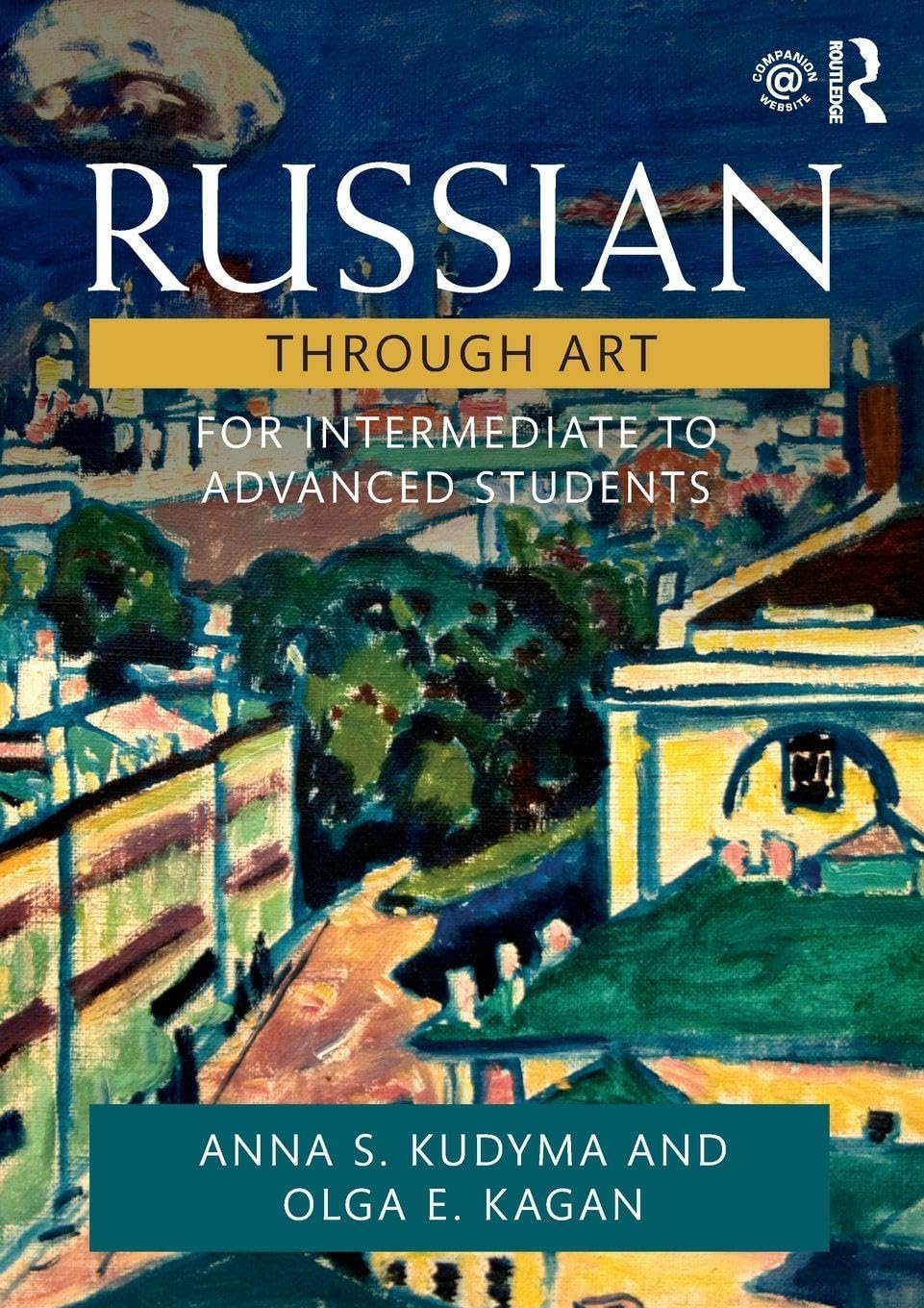
Russian Through Art
Product ID: 213520235
Desertcart purchases this item on your behalf and handles shipping, customs, and support to Netherlands.
desertcart.com: Russian Through Art: 9781138400276: Kudyma, Anna S., Kagan, Olga E.: Books Review: An outstanding and reasonably priced culturally immersive language program with a companion website - This is a review of Russian Through Art: For Intermediate to Advanced Students (2019) by Anna S. Kudyma and Olga E. Kagan and the UCLA’s online resources that accompany the text. (There is no need to enroll in UCLA to access the companion website; see the copyright page for the website address where you will find registration instructions.) I am saddened to note that co-author Olga E. Kagan passed away before this book was published. Russian Through Art seeks to enhance students’ cultural knowledge while developing speaking, reading, listening, and writing skills - in other words, “culturally immersive language learning.” The first of the six chapters and supporting online material discusses major Russian museums and collections. Subsequent chapters cover painting, architecture, music, ballet, opera, and theater. Russian literature and music are universally admired, but for reasons I don’t understand, Russian visual art and artists have not so much been written out of “Western canon” as never written in in the first place. Laurie Schneider Adams’ A History of Western Art, for example - at 640 pages and at an extortionate price of $163.79 on desertcart - only manages a one-page mention of a Russian painter, the pioneer of abstract painting Vassily Kandinsky. Russian Through Art, on the other hand, opens the door to Russia’s extraordinary range of romantic, realist, and avant-guard painters and paintings. Studying on my own, I obviously couldn’t complete the exercises that required an instructor and/or classmates; but, free of the demands to “keep up with the class,” I could dive deeper into many of the topics, like by watching a series of eighteen 30-minute programs on YouTube about a 19th-century group of realist painters called The Wanderers/The Itinerants (Передвижники). Try doing that with a full course load! Russian Through Art is a language textbook, not an exhaustive survey of the field. That said, I was surprised to see no mention of Russian iconography as a “visual art.” Aside from the central role of icons in religious services, their use of “inverse perspective” is distinctly Russian. So, too, the chants and choral songs of Russian church services and Russian folk music (e.g., Bulat Okudzhava) might have been touched on when discussing Russian music - it’s more than operas and symphonies! Perhaps something could be added about these as “supplemental” items on the Russian Through Art online material. On the other hand, I was happy to see no mention of sculptor Zurab Tsereteli, whose kitsch monument to Peter the Great (or is it Christopher Columbus?), unaccountably planted on the banks of the Moscow River, was always good for a laugh, even on the gloomiest days, when I lived in Moscow. The modular design of Russian Through Art makes it accessible to students with different skill levels and interests. Each of the six chapters kicks off with a 5-11 minute lecture by Elena Skudskaia of the Russian Museum in Saint Petersburg. Ms. Skudskaia delivers these lectures with clear articulation and at a reasonable pace; transcripts of her talks are available on the website. The material and tasks that follow grow increasingly challenging, with authentic video clips (no transcripts), denser reading passages, and oral and written exercises. For the more advanced student, there are plenty of suggestions for presentational speaking, with Ms. Skudskaia’s lectures providing models of speech organization (opening and closing statements) as well as practice with dates and numbers. In my experience, the “presentation” is the most dreaded part of an oral exam; this program offers plenty of connective devices, fillers, and subject matter to practice with. desertcart’s Look Inside! feature gives a sample sufficient to give a prospective student an idea as to the complexity of the text. At a minimum, I’d think a student would need to have completed two years of college-level Russian to get started; the more, the better, of course. There is little practice with grammatical forms (formation of relative clauses, recognition of present/past, active/passive participles). While there is no answer key, the exercises aren’t particularly difficult, either. The authors estimate that the student (presumably 3rd-year) would increase their active vocabulary by 600-650 items; this seems about right. So: Five out of five stars for Russian Through Art: For Intermediate to Advanced Students. And a tip of the hat to UCLA’s teaching staff and the late Olga E. Kagan, who, despite the precipitous decline in enrollment in Russian language programs, continue to contribute to outstanding and reasonably priced printed and online language learning materials. A partial list from beginner to advanced would include Beginner’s Russian with Interactive Online Workbook (in my view, the best introductory text for the autodidact); V Puti: Russian Grammar in Context; Russian: From Intermediate to Advanced; Cinema for Russian Conversation (two volumes); and Advanced Russian through History. All of these treat Russian language and culture and students of Russian language and culture with the respect and professionalism they deserve. When I first studied Russian nearly 40 years ago, I recall reading about people happy to be sent to Siberia to work as crane operators. What an improvement and how lucky is today’s student! Review: Instruction based on non-existent website. - This is a wonderful scholarly work and original and effective language learning approach. Unfortunately however it is based on access to a website which no longer exists. Very frustrating!


| Best Sellers Rank | #546,467 in Books ( See Top 100 in Books ) #1,538 in Foreign Language Instruction (Books) #40,829 in Arts & Photography (Books) |
| Customer Reviews | 3.9 3.9 out of 5 stars (17) |
| Dimensions | 6.85 x 0.6 x 9.69 inches |
| Edition | 1st |
| ISBN-10 | 1138400270 |
| ISBN-13 | 978-1138400276 |
| Item Weight | 1.18 pounds |
| Language | English |
| Print length | 266 pages |
| Publication date | July 23, 2018 |
| Publisher | Routledge |
P**R
An outstanding and reasonably priced culturally immersive language program with a companion website
This is a review of Russian Through Art: For Intermediate to Advanced Students (2019) by Anna S. Kudyma and Olga E. Kagan and the UCLA’s online resources that accompany the text. (There is no need to enroll in UCLA to access the companion website; see the copyright page for the website address where you will find registration instructions.) I am saddened to note that co-author Olga E. Kagan passed away before this book was published. Russian Through Art seeks to enhance students’ cultural knowledge while developing speaking, reading, listening, and writing skills - in other words, “culturally immersive language learning.” The first of the six chapters and supporting online material discusses major Russian museums and collections. Subsequent chapters cover painting, architecture, music, ballet, opera, and theater. Russian literature and music are universally admired, but for reasons I don’t understand, Russian visual art and artists have not so much been written out of “Western canon” as never written in in the first place. Laurie Schneider Adams’ A History of Western Art, for example - at 640 pages and at an extortionate price of $163.79 on Amazon - only manages a one-page mention of a Russian painter, the pioneer of abstract painting Vassily Kandinsky. Russian Through Art, on the other hand, opens the door to Russia’s extraordinary range of romantic, realist, and avant-guard painters and paintings. Studying on my own, I obviously couldn’t complete the exercises that required an instructor and/or classmates; but, free of the demands to “keep up with the class,” I could dive deeper into many of the topics, like by watching a series of eighteen 30-minute programs on YouTube about a 19th-century group of realist painters called The Wanderers/The Itinerants (Передвижники). Try doing that with a full course load! Russian Through Art is a language textbook, not an exhaustive survey of the field. That said, I was surprised to see no mention of Russian iconography as a “visual art.” Aside from the central role of icons in religious services, their use of “inverse perspective” is distinctly Russian. So, too, the chants and choral songs of Russian church services and Russian folk music (e.g., Bulat Okudzhava) might have been touched on when discussing Russian music - it’s more than operas and symphonies! Perhaps something could be added about these as “supplemental” items on the Russian Through Art online material. On the other hand, I was happy to see no mention of sculptor Zurab Tsereteli, whose kitsch monument to Peter the Great (or is it Christopher Columbus?), unaccountably planted on the banks of the Moscow River, was always good for a laugh, even on the gloomiest days, when I lived in Moscow. The modular design of Russian Through Art makes it accessible to students with different skill levels and interests. Each of the six chapters kicks off with a 5-11 minute lecture by Elena Skudskaia of the Russian Museum in Saint Petersburg. Ms. Skudskaia delivers these lectures with clear articulation and at a reasonable pace; transcripts of her talks are available on the website. The material and tasks that follow grow increasingly challenging, with authentic video clips (no transcripts), denser reading passages, and oral and written exercises. For the more advanced student, there are plenty of suggestions for presentational speaking, with Ms. Skudskaia’s lectures providing models of speech organization (opening and closing statements) as well as practice with dates and numbers. In my experience, the “presentation” is the most dreaded part of an oral exam; this program offers plenty of connective devices, fillers, and subject matter to practice with. Amazon’s Look Inside! feature gives a sample sufficient to give a prospective student an idea as to the complexity of the text. At a minimum, I’d think a student would need to have completed two years of college-level Russian to get started; the more, the better, of course. There is little practice with grammatical forms (formation of relative clauses, recognition of present/past, active/passive participles). While there is no answer key, the exercises aren’t particularly difficult, either. The authors estimate that the student (presumably 3rd-year) would increase their active vocabulary by 600-650 items; this seems about right. So: Five out of five stars for Russian Through Art: For Intermediate to Advanced Students. And a tip of the hat to UCLA’s teaching staff and the late Olga E. Kagan, who, despite the precipitous decline in enrollment in Russian language programs, continue to contribute to outstanding and reasonably priced printed and online language learning materials. A partial list from beginner to advanced would include Beginner’s Russian with Interactive Online Workbook (in my view, the best introductory text for the autodidact); V Puti: Russian Grammar in Context; Russian: From Intermediate to Advanced; Cinema for Russian Conversation (two volumes); and Advanced Russian through History. All of these treat Russian language and culture and students of Russian language and culture with the respect and professionalism they deserve. When I first studied Russian nearly 40 years ago, I recall reading about people happy to be sent to Siberia to work as crane operators. What an improvement and how lucky is today’s student!
S**E
Instruction based on non-existent website.
This is a wonderful scholarly work and original and effective language learning approach. Unfortunately however it is based on access to a website which no longer exists. Very frustrating!
S**M
Great textbook for third or fourth year Russian
Contrary to what the other reviews have said, the accompanying website with the audio is in fact available. The instructions for access are in the book.
H**S
The link for online reference does not exist
The book promises online reference material (audio and videos), but it is not available. The link shows that the material is decommisioned. disappointed.
C**5
The lectures are not available
It seems that the lectures are only accessible if you are enrolled in the author's university course. They are audio-only and not in the book. Very weird...
L**N
I previously gave this book one star, due to the fact that I couldn't find the multimedia online. However, I emailed the publisher, who replied to me promptly with a link that seems to work. I felt it only fair to update my review in the light of this. I've taken one star off because of the difficulty I had in sorting this out, and also because the book does seem to me to be overpriced. However, on the plus side, it's lovely to find such a book that teaches Russian in such an interesting way. It's a refreshing change from all the usual books that go over all the familiar hackneyed topics. I wish more publishers would produce similar books.
Trustpilot
3 days ago
3 weeks ago