🦟 Outsmart mosquitoes before they outsmart you!
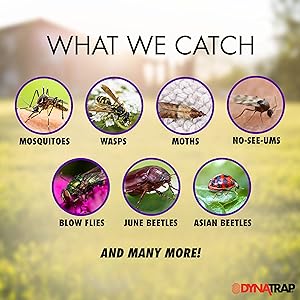
The DynaTrap DT1050-AZSR is a sophisticated mosquito and flying insect trap designed for continuous, all-weather use. Utilizing a 3-way system of UV light, TiO2 coating, and a whisper-quiet fan, it effectively attracts and traps mosquitoes, flies, wasps, and more across a half-acre area. Its sleek black design fits seamlessly into any indoor or outdoor setting, providing a discreet yet powerful alternative to traditional bug zappers.




| Best Sellers Rank | #36,381 in Patio, Lawn & Garden ( See Top 100 in Patio, Lawn & Garden ) #843 in Pest Control Traps |
| Brand | DynaTrap |
| Color | Black Decora |
| Customer Reviews | 3.9 out of 5 stars 8,943 Reviews |
| Is Electric | Yes |
| Number of Pieces | 1 |
| Product Dimensions | 11"L x 11"W x 15"H |
| Style | ½ Acre Black Décora Trap |
I**9
An Excellent Second Line of Defense for Mosquitoes.
Summary: Read the product literature; works as advertised and directed. Place away from common gathering areas and start early in the year. A bit of background: I live in Zone 8a (Dallas, TX) and the summers here are hot and, at time, uncomfortably humid. My particular neighborhood was built over wetlands a half-century ago. Because of that, there's ample ground for mosquitoes to live and reproduce. My body reacts very poorly to mosquitoes; I tend to develop welts that get bright, bright red and take a week or two to heal properly. Often, during summer evenings, I'm limited to staying indoors unless I decide to douse myself in pure DEET. Not wanting to harm a declining bee population, I employed a multi-layer approach to controlling the mosquito population to reclaim my summers. First, I set traps along the perimeter of my property (about 1/3 acre) in some Home Depot buckets with bacillus thuringiensis subspecies israelensis pellets (BTI) (just water and some pellets). I set these out as soon as the last freeze passed. I change out the buckets about every 3 weeks, or after a big rain. I also put pellets down into the catch basins of my property's drains. This way, any water flowing out of the drains will be treated with the BTI and the mosquito reproductive cycle interrupted. Any standing water around my property also gets BTI treatment every 3 weeks. Next, this is where the Dynatrap comes in. I setup the Dynatrap at the corner of my property, about 100 feet away from our patio, where we congregate or spend most of our time outside. I set up the trap about two weeks after the last freeze. This was around the time the soil temps reach 55F and I fertilized our yard. I included a small octenol lure in the basin of the trap to boost its effectiveness. Once setup, I left the Dynatrap running 24/7. I think this is where people get hung up. In order for the product to work, it has to constantly run. It serves as a "good enough" bait target when humans aren't around. Think of it this way: if you're driving from Austin to Dallas and want to eat BBQ, you'll stop at the Rudy's in Waco and it's fine. But if you're in Austin or Dallas, you're either getting Franklin or Pecan Lodge. The Dynatrap is the Waco Rudy's. When there's no humans (Franklin or Pecan Lodge), then the Dynatrap works in attracting mosquitoes. However, if you're around, you're a better snack than the Dynatrap. This is why it's so important to 1) put the Dynatrap in a part of your yard you do not frequent and 2) leave it running 24/7. After emptying the trap for the first time, I noticed about 3 dozen mosquitoes. While it doesn't sound like a lot, it means these 3 dozen early-season mosquitoes do not have a chance to reproduce and make hundreds, maybe thousands, more. Also, if you take away places they can reproduce (with the BTI traps and pellets), it drastically cuts down their ability to reproduce effectively. I change the octenol lure every 3 weeks, in conjunction with me applying more BTI pellets to my drains and standing water traps. In addition to the BTI treatments and Dynatrap, my last line of defense is a repellent. I spray a mosquito barrier (99% garlic juice) around the perimeter of my property every 2-3 weeks depending on the amount of rain we receive. This seems to sir them up pretty good and chase them away. So far, so good. I'm not expecting complete mosquito elimination, and neither should you. Anyone knocking this product because they plugged it in and got a bite a day later is setting unrealistic expectations and not reading the product directions. The instructions specifically say you need to wait 42 days. However, I am expecting a reduction in the amount of bites I get on a warm June evening. Also, I'm not expecting the Dynatrap to be the end-all, be-all solution to mosquito control. Mosquito control requires vigilance and consistency. I'll need to treat standing water all around my property until the first freeze. I also know my mileage may vary if my neighbors don't do their part. However, with BTI, the Dynatrap, and mosquito repellants, I think I stand a fighting chance at enjoying my summers outside not doused in DEET. UPDATE 7/30/21. We’ve been using the Dynatrap all spring and summer. We had an extraordinarily wet spring into mid summer, causing an explosion of mosquitoes in the area—but not in our back yard. To be clear: we still have some mosquitoes around and we still use bug spray, fog, and other preventative measures, but there’s a noticeable drop in mosquitoes when we’d otherwise be swarmed. We still change out the octenol lure every 3 weeks, use garlic juice around the perimeter, and wear bug spray. I think the Dynatrap works pretty well. I’ll report again at the end of the season. In sum: -Read the directions. -Read the directions, seriously. -Place away from where you gather, leave running 24/7. -Use a lure to maximize effectiveness. -Start early in the season. -Consider using other controls techniques to maximize mosquitogeddon.
S**U
Zaps all kinds of bugs
Definitely attracts all kinds of bugs during the night! Been bitten so many times by mosquitoes and found spiders and other night crawlers hanging about in my house. But the DynaTrap definitely was a game changer. All I had to do was connect the bottom piece with the top piece, plug against a wall outlet and twist the top to turn it on. It all took under 5 minutes to install and on a daily basis, I see over 10 mosquitoes and other bugs sitting at the bottom. The only thing it won't capture are big bugs that can't fit in the gaps where I found a big locus just hanging out. It is quite noisy because of the fan so either you want to keep it outside or another room. Also it doesn't capture flies or at least ones in my house. But one piece of advice when opening the bottom to cleanup is do it outside away from your house as there might be a few bugs that are still alive.
P**T
Didn't catch CO2 attracted biting Canyon Flies in Southern California (Fannia Benjamini)
Didn't work, but why? I live in Southern California around Malibu. We have a small amount of mosquitoes, essentially not a problem. The problem we have is with the Canyon Fly (Fannia Benjamini). In the professional article below it is said that they are hard to control, but that they are attracted to CO2, which is why I bought this bug trap. Sadly, the trap caught none of these pests. They were in my ear, biting my neck, and generally swarming me with the bug trap empty within feet of me. Perhaps the manufacturer has an explanation for why this species that is supposedly attracted to CO2 won't enter their trap? Are they genius flies? Did they read "DynaTrap" on the device and warn all of their friends? Money was NOT well spent on this thing. What a disappointment. CANYON FLY Canyon flies (Fannia benjamini complex) are an emerging urban pest in California. These are native flies that have existed in western North America for a very long time. There are seven related fly species within this complex, which collectively are called "canyon flies" due to their geographic association with natural canyons, particularly those within coastal and inland mountain ranges where oak trees dominate the landscape. While distantly related to the other Fannia flies mentioned above, these flies do not appear to develop in animal feces or fermenting green waste. Our best guess at present is that these native flies develop on moist decaying plant matter or leaf litter. However, one canyon fly species (F. conspicua) has become quite problematic in Southern California in recent years following the introduction of an exotic succulent ground cover plant called red apple (Aptenia cordifolia) which was first introduced into the United States in the mid-1980’s and is now widely planted in hillside communities for erosion control and fire protection. The decaying understory of red apple has proven to be an excellent developmental site for this fly species and canyon fly numbers can become incredibly problematic in communities where this plant is common. Adult canyon flies are similar in size to the little house fly but can be distinguished from other flies by their three-spotted abdomen and yellow coloration at the base of their antennae. Like other Fannia flies, canyon flies are not tolerant of high temperatures and adult numbers tend to peak from late spring through early summer, with a second peak in late fall. Their daily activity is also restricted by temperature with activity generally limited to the cooler morning and evening hours during these seasonal periods of peak abundance. The life cycle of canyon flies is similar to other Fannia flies, and the larvae have the same general morphology—flattened body shape with fleshy spines. Damage Canyon flies feed on the body secretions of animals, such as tears, mucus, sweat, and blood from open wounds. Their persistent attempts to land upon the face and body of the host can result in considerable nuisance to humans. While they cannot bite or make a wound to feed upon blood, they do have small prestomal teeth on their mouthparts which they can use to scrape at mucous membranes around the eyes of animals to encourage production of tears or other eye secretions. These flies have been associated with the transmission of an eye worm to cattle. Management of Canyon Flies Adult canyon flies are very difficult to manage. Because these flies feed on animals, they are attracted to several odors associated with animals including carbon dioxide (CO2), a component of animal breath. Traps baited with carbon dioxide will readily capture at least one species of canyon fly (F. conspicua), but removal of these flies using CO2 traps has not proven sufficient to reduce their nuisance. The only successful strategy identified to date for management of these flies is removal of the red apple plant that serves as the developmental site for F. conspicua. For other canyon fly species that do not develop in red apple, there are no management strategies that have proven to be particularly successful. Application of insecticide by fogging vegetation bordering a residence has given some short term relief, but this type of management strategy is not recommended as it impacts many beneficial and benign insect species and typically only provides some management of canyon flies for a few days.
D**A
Good With a Few Major Flaws
I’ve had this thing running in my yard for about two months at this point. I’ve got it placed at an appropriate distance and it catches A TON of bugs. But unfortunately the light bulbs (I was using the ones that came with it not any off brand) burn out FAST. They say they’ll last four months. Mine have lasted about half that time. So okay no worries I have to change light bulbs every couple of months. BUT HERE’S THE PROBLEM this thing is designed in a way so you have to undo multiple screws just to change a light bulb that burns out frequently. It’s far from a dealbreaker, but it seems like it would’ve been possible to design it to fit longer lasting bulbs or remove the screws to change bulbs more easily. Still it’s way less of a pain than bug bites so I’d recommend the thing. TLDR: Great bug killer with annoying design quirks
S**N
It works!!!
Every year I always have some mosquitos but this year it was TERRIBLE! There were SWARMS of them and they were really aggressive. I couldn't be outside even briefly without being bitten. I was desperate. I was a little skeptical of this product due to some of the reviews, but frankly I HAD TO do something so I gave it a try. Within only a few days (!) the mosquitos were almost entirely gone and have stayed away. I don't see the mosquitos in the trap (it's almost all moths), so I don't know if they're being disintegrated by the fan that sucks them down or if they crumble into little tiny pieces when they die or what. All I know is this has really REALLY worked for me. As I mentioned the bugs in the trap are almost all moths with a few other bugs mixed in. I'm not seeing any bees (honey or bumble) which is a relief. It attracts chafer beetles (aka june bugs) which are unfortunately too fat to get inside the trap, but at least they gather around and then the raccoons come by and snack on some of them, so indirectly the trap helps reduce the population of those bugs too!
K**N
Works good but hard to replace bulb
I have owned another Dynatrap product in the past. Our bug problem is small flies that can overwhelm our back deck. The trap works very well for us but you need to LEAVE IT ON 24/7. It gathers in the bugs over time, not immediately. The old trap lasted us for 10 years, changing the bulb every season and putting it in the garage after bug season ended. This new trap is as effective as the old one but has some serious design flaws. First off the bulb worked for two weeks then stopped. I've emailed Dynatrap and hopefully they will send a replacement bulb. I had an unused bulb from the previous trap and put that in and putting it back together was very difficult. Putting the unit back together after removing & replacing old bulb is very challenging. Screw to hold retaining clip is deep in the housing and my average sized hands really don't fit inside that housing. Then getting the screw to thread is challenging and since they chose to use a non-magnetic screw you can't just put it on the screwdriver and thread it in. I tried long needle nosed pliers but could not hold it. Seriously, Dynatrap, did you not consider this at the design stage? If I'm doing something wrong please let me know and I'll happily admit fault and change my review but I thought I was following the instructions. Works great, looks fine, replacing bulbs very difficult.
C**N
DT1260-TUN is a poor design, but DynaTrap customer service guided me to a better one!
WHY I CHANGED FROM ONE STAR TO FIVE STARS -- After reading my review complaining about the DT1260-TUN, DynaTrap's customer service department suggested that I instead try the "DynaTrap 3" model DT1100-TN19. I did try it, and can say with delight that the model DT1100-TN19 has many design improvements. You can put the DT1100-TN19 on a patio table, hang it from a hook or mount it with the included wall bracket. There is also an optional "trap hanger / shepherd's hook" that you can stick into the ground. The DT1100-TN19 is much easier to operate and maintain than the DT1260-TUN. Even so, HEED THIS ADVICE:: As soon are your DT1100-TN19 arrives, TEST THE TINY SCREW THAT GIVES YOU ACCESS TO THE BULB to make sure that you will be able to remove this screw when the bulb wears out in four months. On my DT1100-TN19, this critical screw was jammed in so tight that I stripped the Philips head of that screw and also stripped the tip of the little Philips screwdriver that was supplied by DynaTrap. [DynaTrap seems to have a manufacturing problem with overly-tightened screws; see the original review below.] I eventually forced open the bulb housing and was able to remove the naughty little screw (it obviously had been damaged during assembly at the factory). I replaced the bad screw with a screw from my toolbox. If you are not handy, this issue might cause you to return the DT1100-TN19 to the manufacturer, so you should test this important screw right away. As for me, I am very happy now with my DT1100-TN19 and the DynaTrap customer service department! ORIGINAL REVIEW OF THE DT1260-TUN -- The user is instructed to replace the bulb every four months, so I figured I would teach myself how to do it before I put it outside on the patio. To replace the bulb, as well as to do a thorough cleaning, you have to unscrew two bolts that hold a metal harness that goes around the unit. The harness holds the bug-catcher to the pole. Getting the two harness bolts back in place after cleaning or bulb replacement) is difficult -- it is hard to get the holes to line up, and I eventually was only able to re-install one of the bolts. Now that we have the harness removed, we are told to "remove the four screws securing the fan housing to the light housing." There are no instructions regarding the location of these four screws. I discovered that they are Philips-head screws at the bottom of the unit, almost impossible to see because they are so tiny and deeply recessed in the black plastic unit. They were also screwed in so tightly at the factory that I had to put a Vise-Grip on the screwdriver in order to get enough leverage to loosen them. They easily fall out of the unit and if you are on your patio or deck, good luck finding them! Having removed the tiny screws, you can then separate the fan unit from the bulb unit for cleaning and bulb replacement. The bulb itself is far inside the unit, and affixed with another tiny screw deep in the housing; removal/replacement is going to be a challenge. Be warned: This unit does not kill the bugs that it catches; they starve to death eventually.. The instructions admit that the not-yet-starved bugs may fly out when you empty the trap and sure enough, they do! Users are told to quickly dump the contents into a trash bag and hope you are not stung by any not-yet-dead yellowjackets. The solution: Spray the collection bin with insecticide before you unscrew it.
G**.
Excellent and quiet
Why did you pick this product vs others?: We chose this particular item over similar ones due to the great reviews and the report of how quiet it was. We have a wonderful front porch we like to sit on in the evening and early morning to have a hot drink and listen to the birds, watch the dog play and just relax. The mosquitoes here in Alabama are serious and just would not leave us alone. We were sick of covering ourselves with stinky bug spray and then needing a shower right after, so, we decided to try this trap. There are so many things we like about this product. It looks really nice, not like a bug trap at all. It’s well made and was simple to set up and get running. Basically plug it in and let it do its thing. Keep it plugged in 24 hours a day as instructed for it to work. It draws in the flying bugs and they suffocate/dehydrate inside, then you just open it up and dump them out. Close it back up again and you’re ready to go. It makes no noise except the sound of the bugs hitting the sides when they get caught inside which was music to our ears. Does it get rid of 100% of the mosquitoes? No. Did we expect it to? No. But, we went from only being able to stand our porch for 5 minutes before being literally covered in bites to sitting outside for hours with maybe one or two bites. WOW! What a huge difference. I imagine even those couple will be eliminated over time as the population decreases. I so stress that you have to keep it on 24 hours a day. Great value for our money and we highly recommend this product. We’re planning to get another one for the backyard once we put in our patio.
Trustpilot
1 month ago
3 weeks ago