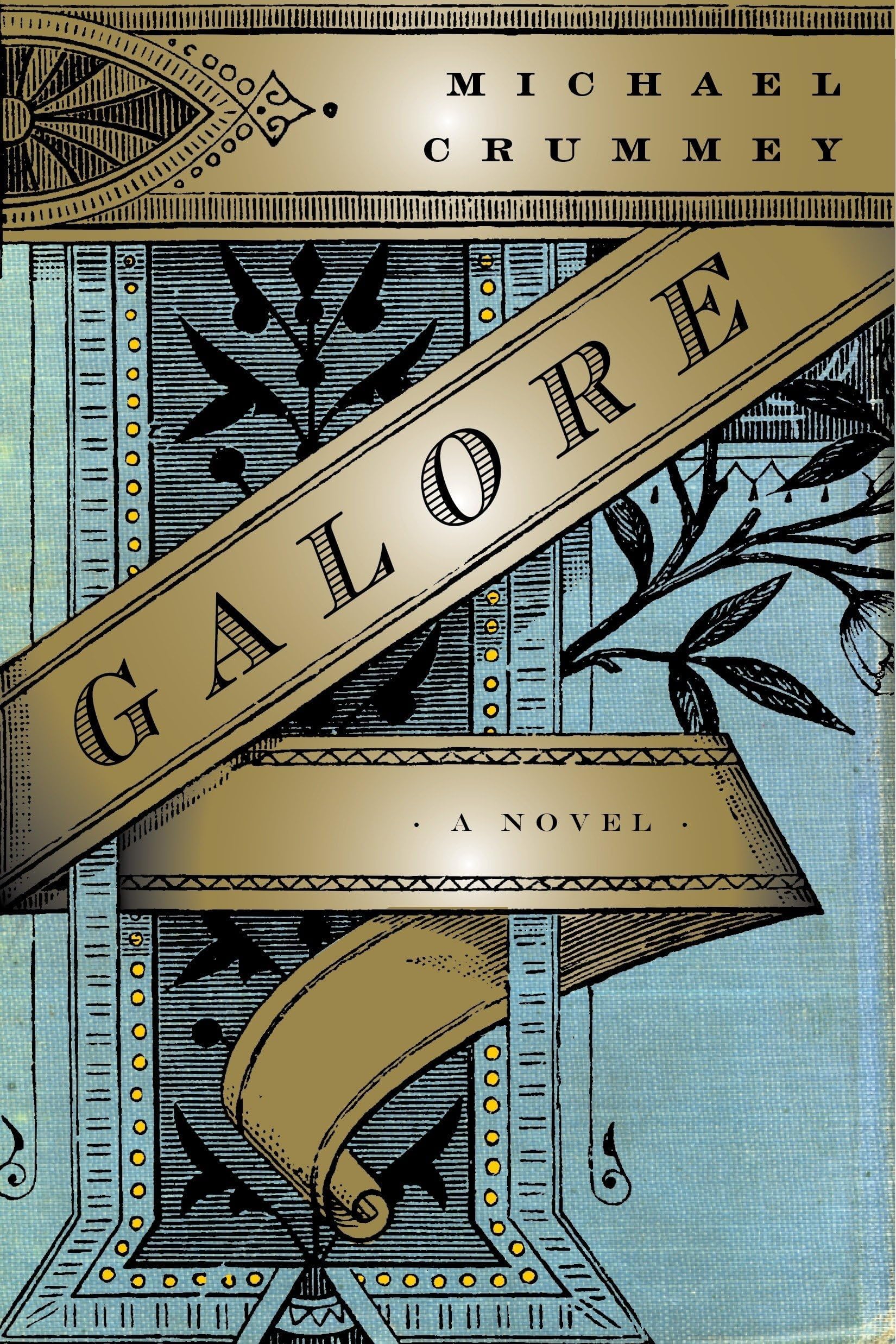
Galore: A Novel
Product ID: 19645382
Desertcart purchases this item on your behalf and handles shipping, customs, and support to Netherlands.
desertcart.com: Galore: A Novel: 9781590514344: Crummey, Michael: Books Review: A superb historical novel - This novel is the second by this author set in Newfoundland in its formative years. Galore begins in the mid nineteenth century and ends just after World War I. The story focuses on the saga of two main families, one headed by a woman known only as Devine’s Widow, and the other headed by King-me Sellers, so named for his love of winning at checkers. Their families are intertwined by love and hate, business and pleasure, and the subsistence existence thanks in part to the historical period and to Sellers’s meanness. A seminal event in the book is the beaching of a whale. Life is hard and the whale seems like a gift from God. The fishermen wait patiently for the whale to die. As soon as it does, the fishing folk cut into it. One slice in particular opens the fish and a human arm and head fall out. Terrified, they fishermen back away. Devine’s Widow finishes the job and pulls out a man who soon turns out to be alive. He is an albino who never speaks. His life becomes entwined with that of the Devine family, and after a few pages it seems the most natural thing in the world that a live human being should emerge from a whale. The novel is replete with rich characters engaged in unimaginable struggles against the elements as they make a living of sorts from the sea. In their isolation and hardship, their personalities unfold and the details of their daily lives sometimes triggered momentous events. Crummey has immersed himself in the language and way of life of the early settlers of Newfoundland, their struggles with church leaders sent from overseas who have no clue to the environment they are working in, the early missionaries who defy church authorities to stay with their beloved land and people, and the men who drag the poor folk into the modern world. A doctor who arrives from Connecticut because he loves the outdoor life and can’t stand the idea of living in a city holds the outsider’s perspective until we realize he ultimately becomes one of the villagers, adopting much of their vision of the world while maintaining his perspective as a man of science. The book is beautifully written and crafted, and I never once wondered how many pages were left until I neared the end, and then I wanted the book to go on and on and on. Highly recommended. Review: A Great Beginning Peters Out - Galore indeed! Michael Crummey pours out his magical, ribald fiction like a bumper catch on the deck of a trawler: proliferating, pungent, and alive. His setting is the isolated fishing community of Paradise Deep, somewhere on the Newfoundland coast in the first half of the nineteenth century. It is a hard life, the seamen dependent on uncertain harvests to tide them through long and cruel winters, holing up in rough wooden tilts. Births are frequent; deaths more frequent still. Marriages (or at least couplings) occur sometimes for love, but often out of desperation or animal need, and in one case to keep an innocent man from the gallows -- for authority is a flexible thing in these parts. If this wild sprawl of a book is about any one thing, it is about the forces that hold a primitive community together or tear it apart. Official law resides in the person of the magistrate and principal landowner King-Me Sellers, (so called for his prowess at checkers). He heads the English Protestant community; the other half of the population are Irish-speaking Catholics. Neither group has a church. The Catholics benefit from the occasional blessings of Father Phelan, an itinerant priest whose lust for life is by no means confined by vows of temperance or chastity. The Protestants make do with services held by Jabez Trim, owner of the only Bible in the place, a partially-destroyed specimen salvaged from a shipwreck. But folk superstition is at least as powerful as religion. This is a village whose true sacraments are celebrated at a sacred tree, where masked mummers make licensed havoc at Christmas, and where the regular appearance of a recent ghost is accepted as a matter of course. In many ways, the real power is held by the Widow Devine, an aged Irish medicine woman (or witch, depending on your point of view). She will pass most of her powers to her granddaughter, Mary Tryphena, who will wield a similar but less dominant force in the second part of the book. As in Jane Urquhart's magnificent AWAY , a book of greater discipline but similar scope, the action begins mysteriously with an apparently dead man being pulled from the sea, or in this case cut like Jonah from the belly of a beached whale. Unnaturally pale, fishily pungent, and totally mute, the inhabitants shun and fear him -- only to treat him like a prophet when he reveals the talismanic ability of drawing shoals of fish to his boat. Crummey will end almost a century later with another reference to the story of Jonah and the whale, but this second book-end only shows how the novel has disintegrated in between. Paradoxically so, because most of the new forces that arrive have at least the outward aim of organization: an Anglican minister and proper Catholic priest whose charge will be to separate their communities from one another, a new scion of the Sellers family who will force most of the fishermen into his debt, crooked politicians elected to the Newfoundland Assembly, a union organizer, fiery yet flawed. But the mystic soul of the village has mostly gone, glimpsed only in fitful traces as the descendants of Widow Devine move into the sixth generation. After a while, as the characters proliferate, you care less and less about their lives as individuals. Perhaps this was Crummey's point? A sad one, if so -- but that first part is magnificent.
| Best Sellers Rank | #1,528,999 in Books ( See Top 100 in Books ) #657 in Multigenerational Fiction (Books) #5,532 in Family Saga Fiction #23,648 in Literary Fiction (Books) |
| Customer Reviews | 4.1 out of 5 stars 503 Reviews |
S**W
A superb historical novel
This novel is the second by this author set in Newfoundland in its formative years. Galore begins in the mid nineteenth century and ends just after World War I. The story focuses on the saga of two main families, one headed by a woman known only as Devine’s Widow, and the other headed by King-me Sellers, so named for his love of winning at checkers. Their families are intertwined by love and hate, business and pleasure, and the subsistence existence thanks in part to the historical period and to Sellers’s meanness. A seminal event in the book is the beaching of a whale. Life is hard and the whale seems like a gift from God. The fishermen wait patiently for the whale to die. As soon as it does, the fishing folk cut into it. One slice in particular opens the fish and a human arm and head fall out. Terrified, they fishermen back away. Devine’s Widow finishes the job and pulls out a man who soon turns out to be alive. He is an albino who never speaks. His life becomes entwined with that of the Devine family, and after a few pages it seems the most natural thing in the world that a live human being should emerge from a whale. The novel is replete with rich characters engaged in unimaginable struggles against the elements as they make a living of sorts from the sea. In their isolation and hardship, their personalities unfold and the details of their daily lives sometimes triggered momentous events. Crummey has immersed himself in the language and way of life of the early settlers of Newfoundland, their struggles with church leaders sent from overseas who have no clue to the environment they are working in, the early missionaries who defy church authorities to stay with their beloved land and people, and the men who drag the poor folk into the modern world. A doctor who arrives from Connecticut because he loves the outdoor life and can’t stand the idea of living in a city holds the outsider’s perspective until we realize he ultimately becomes one of the villagers, adopting much of their vision of the world while maintaining his perspective as a man of science. The book is beautifully written and crafted, and I never once wondered how many pages were left until I neared the end, and then I wanted the book to go on and on and on. Highly recommended.
R**E
A Great Beginning Peters Out
Galore indeed! Michael Crummey pours out his magical, ribald fiction like a bumper catch on the deck of a trawler: proliferating, pungent, and alive. His setting is the isolated fishing community of Paradise Deep, somewhere on the Newfoundland coast in the first half of the nineteenth century. It is a hard life, the seamen dependent on uncertain harvests to tide them through long and cruel winters, holing up in rough wooden tilts. Births are frequent; deaths more frequent still. Marriages (or at least couplings) occur sometimes for love, but often out of desperation or animal need, and in one case to keep an innocent man from the gallows -- for authority is a flexible thing in these parts. If this wild sprawl of a book is about any one thing, it is about the forces that hold a primitive community together or tear it apart. Official law resides in the person of the magistrate and principal landowner King-Me Sellers, (so called for his prowess at checkers). He heads the English Protestant community; the other half of the population are Irish-speaking Catholics. Neither group has a church. The Catholics benefit from the occasional blessings of Father Phelan, an itinerant priest whose lust for life is by no means confined by vows of temperance or chastity. The Protestants make do with services held by Jabez Trim, owner of the only Bible in the place, a partially-destroyed specimen salvaged from a shipwreck. But folk superstition is at least as powerful as religion. This is a village whose true sacraments are celebrated at a sacred tree, where masked mummers make licensed havoc at Christmas, and where the regular appearance of a recent ghost is accepted as a matter of course. In many ways, the real power is held by the Widow Devine, an aged Irish medicine woman (or witch, depending on your point of view). She will pass most of her powers to her granddaughter, Mary Tryphena, who will wield a similar but less dominant force in the second part of the book. As in Jane Urquhart's magnificent AWAY , a book of greater discipline but similar scope, the action begins mysteriously with an apparently dead man being pulled from the sea, or in this case cut like Jonah from the belly of a beached whale. Unnaturally pale, fishily pungent, and totally mute, the inhabitants shun and fear him -- only to treat him like a prophet when he reveals the talismanic ability of drawing shoals of fish to his boat. Crummey will end almost a century later with another reference to the story of Jonah and the whale, but this second book-end only shows how the novel has disintegrated in between. Paradoxically so, because most of the new forces that arrive have at least the outward aim of organization: an Anglican minister and proper Catholic priest whose charge will be to separate their communities from one another, a new scion of the Sellers family who will force most of the fishermen into his debt, crooked politicians elected to the Newfoundland Assembly, a union organizer, fiery yet flawed. But the mystic soul of the village has mostly gone, glimpsed only in fitful traces as the descendants of Widow Devine move into the sixth generation. After a while, as the characters proliferate, you care less and less about their lives as individuals. Perhaps this was Crummey's point? A sad one, if so -- but that first part is magnificent.
R**E
dirty seawater pouring from the gash they opened
"The white underbelly was exposed where the carcass keeled to one side, the stomach's membrane floating free in the shallows...dirty seawater pouring from the gash they opened, a crest of blood, a school of undigested capelin and herring, and then the head appeared..." Michael Crummey has, in his novel Galore (Doubleday, 2009) created a cast of characters too real to be fictitious. Then, just to show his hand at legerdemain, he throws into the mix a man cut from the belly of whale and another who dies only to reappear falling through the roof of his ex-wife's house. Indeed, Mr. Crummey, what sort of voyage are we on?! It is a voyage of discovery, as all should be. Galore is another of Crummey's historical Newfoundland narratives full of families, fish, and fantasy woven into a rich fabric whose threads tie the reader to the land and its inhabitants. At times lyrical, at others matter of fact in the description of the islanders' poverty and want and their altogether tragic circumstances, Galore is a tale of lives lived, of a place and a time and of love and loss. Galore’s tales are told from the perspective of people who live in the ‘real’ world but who experience a different reality from the one we call objective. The ghost in Galore is not a fantasy or superstition, but a manifestation of the reality of people who believe in and have "real" experiences of Mr. Gallery; people who walk along the Tolt Road with him, and sit at the hearth with him and discuss what is to be done -- him dead all those years. Then there is the Widow Devine -- "Her Christian name passed out of use in the decades after her husband was buried and only a handful could even remember what it was" -- who seems invested with supernatural powers. Granted, we see nothing explicit to convince us that she is responsible for the cures or the curses attributed to her, but there are too many 'coincidences.' Most of Newfoundland was settled almost exclusively by people from a small corner of south-eastern Ireland and another small corner of south-western England. They universally lead a mean existence but despite their common deprivations, manage to retain their religious affiliations and animosities. They may be in the same boat literally and figuratively, but when the fog rolls in and the wind howls like a banshee, and the Grand Banks seem haunted more by the spirits of the dead than by the cod upon which these mendicants of nature depend, then the fishermen pray to their own god, and once back on shore, they build their own churches and burn down their neighbors'. What makes Crummey's novels about Newfoundlanders (he has written three) so compelling is his clear connection to the land and its people, and his obvious empathy, even distress, in seeing their deprivations, and the depredations visited upon them by both man and nature. Those mean circumstances continue to this day; the cod is gone, and "now the once" the oil will be gone, too. And the people of Newfoundland will be back where they started. Just as the characters and their stories are in this captivating novel.
B**S
Winding History, Very Good Storytelling
This book is very hard to categorize, but it may best be described as a folkloric historical account of two families on Newfoundland, with a healthy dose of religion thrown in. More a collection of stories than a novel, this is a book that you will enjoy reading even if you aren't exactly sure why. It starts off with the unlikely tale of a man being cut from the belly of a whale, and gets stranger from there. Things I liked: * Great Humor * Excellent Storytelling. Like discovering a book of long lost mythology. * The interplay of the different religions was interesting. * The tracing of family history through 5 generations was fascinating. * The setting. You will feel the wet and the cold as you read this book. Things I disliked: * Many of the characters, especially the women, seemed too much alike. * Dragged in the last couple of chapters, though the ending made up for it. * It was very good storytelling, but too many loose ends feel unresolved. * Too much sex. Though never really graphic, sex is used as a weapon by many characters in the book. This tale of family history and the sins of the previous generations haunting the current ones will make you laugh and think at the same time. History and family rarely change much even as the years pass, and this book provides a small glimpse unchanging human nature. Recommended.
M**T
Slow Moving Saga of Intertwined Families
There has been much glory written regarding Galore's epic tale. The premise grabbed me when I began reading. Set in a small Newfoundland fishing town, Crummey brings us a story that begins when a strange albino man is cut from the belly of a beached whale. He is barely alive but survives despite his stench, which drives most of the villagers away from him. He is named Judah and his advent transforms their fishing triumphs and eventual intrusion of religion. The narrative appears to be about families. Galore focuses on the Sellers and Devine families who live in the adjacent towns of Gut and Paradise Deep. Crummey takes us through their history of feuds, haggles and sometimes their concern for each other. Deceitfulness and misfortune abound but many of these events with their characters were given brief and inconsiderate treatment, I admit to becoming confused; he introduced characters that I thought were in the story but later were under a different pretext. The novel needed a central hero or protagonist embroiled in a defined conflict. When I thought the author was enhancing an anecdote with a sense of purpose, he launched into another event of another character. I don't need to read novels with much action, but this book became entrenched in a complex and intricate family tree with too many twists and turns. The novel is loaded with suffering, nameless characters, hardships and prosperity. I did feel that I moved along with some of the characters but, oh, ever so slowly. I was not riveted, unfortunately. He is a wonderful writer, but this story was too convoluted.
M**K
What a ride
Galore starts with the birth of a mute, nearly-albino-white alien from a beached whale, and ends with...well, I won't tell how it ends, but the ending does give you an idea of how the first guy got in the whale in the first place. While this alien is white as an albino, his most defining characteristic is his muteness. There's a reason for it: "Death and life are in the power of the tongue...and they that love it shall eat of the fruit," as the Book of Proverbs goes. This alien knows stuff, but given the reaction of the community whose response to him ranges from homicidal to near worship when they believe he's responsible for good fishing, you'd never know it, until the end that is. In the interest of full disclosure, he wreaks of fish, too. You'll need your reading incisors for this one. Lots to tear into. Galore presents us with a cosmology that is imperfect at best, corrupt at its worst. Only rarely do the good characters populating these pages put aside their differences to live in harmony. In that, it should remind you of places other than Newfoundland. The book is a complex layering of dichotomies, especially the bountiful sea, and the less generous earth. Women, of course, are pitted against the men, and especially one family line's women know powers that are beyond the grasp of the men. But even the most accomplished of the women find their powers flawed. Individual characters are twinned with others, sometimes spinning off into the gravitational pull of yet more characters. Two influences came to mind while reading this: 100 Years of Solitude, and the Gnostics. Like the Gnostics, this world is seen as an imperfect and corrupt creation. The masculine is subordinate to the feminine. The sea occupies central places in both cosmologies. The alien holds the key to regaining a more perfect order. At times, Galore is a hoot. But mostly this is a thoughtful read. Don't get me wrong, if all you're after is a good story, this is one. But if you want something a little more transcendent, Galore can set the wheels a spinnin'. If the notion of reading folk tales from Newfoundland doesn't thrill you, not to worry. If I hadn't seen the author mentioning that folk tales were his inspiration, I'd never have known. He has woven his materials into a work that stands on its own merits. I'll be rereading this one.
T**K
A multi-generational pastorale set in the cold Canadian....
...province of Newfoundland. The book chronicles the fates of several families living in in the late 1800's and continuing on almost to the middle of the twentieth century. Husbands and wives beget children, sometimes those children die, sometimes they live but the families carry on. In this unforgiving environment, where most are dependent on the fickle ocean for their livelihood, how do they manage to continue when they are without food at times? The author deftly explores just what type of person lived, and even flourished, in this environment. But understand, no one person or family flourishes for long. Maybe not in this generation, but in generations to come, the sins of the fathers and mothers will definitely be repeated on their children....and sometimes their great-great grandchildren. This is one of the authors many talents: at times I counted four generations of one or more families unfolding. Similarly the author is very successful when describing the careful divisions evident throughout: the haves vs. the have-nots; the suppliers vs. the demanders; the religious vs. the pagan element; the Irish Protestant vs. the Irish Catholic. And all these divisions are at play almost at equal length. And the author doesn't shy away from adding more layers to the story, as when organized labor makes it's way to the shores. When a mysterious stranger appears on their shores, appearing in quite dramatic fashion, is he a harbinger of good fortune as some fishermen believe him to be? Or is he a mute outsider, a witness to all the calamity and harsh times to come? Or is he a religious savant? No easy answers here, only more questions. This is one of the most difficult novels to write: a sage, funny, sad and totally absorbing epic with many different stories, covering a specific period of time, but whose themes transcend their harsh climate. I hope more novels are in the works from this talented young author....
K**L
"
I predicted the ending from the moment Mary T. told Abel she had been waiting for him all her life and yet I was still profoundly moved when it came. The book often describes miserable, bleak circumstances and yet is speckled with beautifully poignant phrases and moments throughout. I loved being pulled through the generations and branches of the Devine family and seeing character traits passed along through the women. I loved the beautiful clues throughout the story. The small mention that Esther had the face of Mary T. and how that became suddenly significant as I reflect on the end of the story. I promise I am not giving away the ending, but if you are having trouble getting through some of the bleak parts or feeling like there is no climax coming, just push on. Its truly grand. Crummey, you are brilliant. Favorite quotes: I know you hates me, the old woman said. Lizzie laughed then-Yes, Missus. I surely do. -That's all right, maid. Its means you'll always carry me with you. -My mind wanders, Absalom said. -Its all the legs I have left. -Don't you have the slightest concern for your soul, Missus? - I don't remember being born, she said, and I won't remember dying. -Ester, he said, but she placed a finger against his lips. She said, Never tell a woman you love her, Abel. He stared, his eyes filming over with tears. -It will always sound like a lie, she said. -Better you let a woman figure it out for herself. --- Also, the most poignant moment, which I can't say with out spoiling it, but if you have read the book you'll know why this quote is so strong: -Absalom, she said. --Its Mary Tryphena. --- Ok, this was probably a really nerdy review, but I am telling you the book is just golden and I hope to read more from Crummey in the future. Do yourself a favor and read this book.
Trustpilot
1 day ago
3 weeks ago