
DOWNLOAD THE APP


Customer Services
Copyright © 2025 Desertcart Holdings Limited
DOWNLOAD THE APP

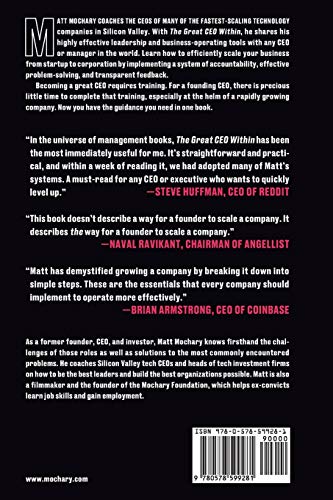


The Great CEO Within: The Tactical Guide to Company Building [Mochary, Matt, Maccaw, Alex, Talavera, Misha] on desertcart.com. *FREE* shipping on qualifying offers. The Great CEO Within: The Tactical Guide to Company Building Review: This book isn't just for CEOs - I’m not even a CEO. I’m a personal-development enthusiast and martial arts school owner. And this one book changed my life because it is valuable for everyone who isn’t a CEO. What I mean is: If your profession is ____ and you struggle to work with _____, this book is for you. Fill in the blank. If you’re a nurse and you struggle with doctors/computers/administration/patients, read this book. If you’re an architect or assistant football coach or actor, read this book. By outlining the bigger picture of the roles and formation of a company, each person can better understand their own role and how it fits into the bigger picture of the organization. Imagine if each person can understand their own role how the CEO sees it and then acts on it. My business is martial arts – my job is to clear the path for my employees and students to succeed. And I need everyone motivated and on the same page: the instructors, the program directors, the part-time instructors, other partner karate schools. All with different roles and personalities. It’s incredible how much the book relates. I use the templates in the book to get and give feedback, to write out internal processes, and ensure we are actually solving the pain point of our “clients” (parents needing help with focus, self-control, confidence etc. for their kids). The biggest thing is this book is cracking the disconnect between roles – the book accomplishes getting engineers to understand sales people and vice versa. It simply explains the purpose of each and the common pitfalls and interconnections among workers and the result is a broader, bigger vision of the company’s mission. Our instructors do need to understand the enrollment process and our “sales” people need to understand what value our students will get. The other thing that makes this book different is what I believe is the author’s Zone 4 – his perception of the emotional connection in business roles. He navigates the sterile underbelly of business formation and financial processes with valuing people, maximizing their abilities and creating a tier of support. And it’s not “fake” motivational speaking. It’s logical considerations to get people to be better workers by liking their job, recognizing their co-workers strengths, and acknowledging the value of other people’s jobs in the same industry. In summary: this book is a chokehold on problems, strikes hard and kicks ass. I typically read about one business book a month and a business podcast a day and now I’m carrying around this one book with my laptop so I can keep referring to it. I am actually having my staff of 15 martial arts people read it to help in their individual roles. As a martial arts franchise owner, I got to get a lot better with this book. Karate people are notoriously bad at business and if a tactical guide to a tech business can help us, it can help anyone. Not quite at the billion dollar improvement yet, but I'm happy with the month over month results. Review: Sound tactical steps, backed by theory and experience. - Business building is an ambiguous exercise. In The Great CEO Within, Matt shines an overpowered spotlight in the fog of war that is scaling a company. Daily decisions and actions by the CEO shape the eventual outcome of the company. Therefore, Matt addresses the Individual first (CEO) and then by the Group (the company), the flow is intuitive. As a CEO, you will likely encounter the issues addressed in this book. It's also more than likely you have theorised on how to solve the problems then got stuck at implementing the solution. The Great CEO Within will help you bridge these gaps with practical, prescriptive steps to your theory. The advice provided exerts the same practicality to the legendary High Output Management (HOM), and I hold HOM in high regard. I highly recommend the book to any company builders.
| Best Sellers Rank | #27,510 in Books ( See Top 100 in Books ) #22 in Business & Organizational Learning #222 in Leadership & Motivation |
| Customer Reviews | 4.5 4.5 out of 5 stars (1,266) |
| Dimensions | 6 x 0.43 x 9 inches |
| ISBN-10 | 0578599287 |
| ISBN-13 | 978-0578599281 |
| Item Weight | 9.8 ounces |
| Language | English |
| Print length | 202 pages |
| Publication date | December 5, 2019 |
| Publisher | Mochary Films |
R**R
This book isn't just for CEOs
I’m not even a CEO. I’m a personal-development enthusiast and martial arts school owner. And this one book changed my life because it is valuable for everyone who isn’t a CEO. What I mean is: If your profession is ____ and you struggle to work with _____, this book is for you. Fill in the blank. If you’re a nurse and you struggle with doctors/computers/administration/patients, read this book. If you’re an architect or assistant football coach or actor, read this book. By outlining the bigger picture of the roles and formation of a company, each person can better understand their own role and how it fits into the bigger picture of the organization. Imagine if each person can understand their own role how the CEO sees it and then acts on it. My business is martial arts – my job is to clear the path for my employees and students to succeed. And I need everyone motivated and on the same page: the instructors, the program directors, the part-time instructors, other partner karate schools. All with different roles and personalities. It’s incredible how much the book relates. I use the templates in the book to get and give feedback, to write out internal processes, and ensure we are actually solving the pain point of our “clients” (parents needing help with focus, self-control, confidence etc. for their kids). The biggest thing is this book is cracking the disconnect between roles – the book accomplishes getting engineers to understand sales people and vice versa. It simply explains the purpose of each and the common pitfalls and interconnections among workers and the result is a broader, bigger vision of the company’s mission. Our instructors do need to understand the enrollment process and our “sales” people need to understand what value our students will get. The other thing that makes this book different is what I believe is the author’s Zone 4 – his perception of the emotional connection in business roles. He navigates the sterile underbelly of business formation and financial processes with valuing people, maximizing their abilities and creating a tier of support. And it’s not “fake” motivational speaking. It’s logical considerations to get people to be better workers by liking their job, recognizing their co-workers strengths, and acknowledging the value of other people’s jobs in the same industry. In summary: this book is a chokehold on problems, strikes hard and kicks ass. I typically read about one business book a month and a business podcast a day and now I’m carrying around this one book with my laptop so I can keep referring to it. I am actually having my staff of 15 martial arts people read it to help in their individual roles. As a martial arts franchise owner, I got to get a lot better with this book. Karate people are notoriously bad at business and if a tactical guide to a tech business can help us, it can help anyone. Not quite at the billion dollar improvement yet, but I'm happy with the month over month results.
I**N
Sound tactical steps, backed by theory and experience.
Business building is an ambiguous exercise. In The Great CEO Within, Matt shines an overpowered spotlight in the fog of war that is scaling a company. Daily decisions and actions by the CEO shape the eventual outcome of the company. Therefore, Matt addresses the Individual first (CEO) and then by the Group (the company), the flow is intuitive. As a CEO, you will likely encounter the issues addressed in this book. It's also more than likely you have theorised on how to solve the problems then got stuck at implementing the solution. The Great CEO Within will help you bridge these gaps with practical, prescriptive steps to your theory. The advice provided exerts the same practicality to the legendary High Output Management (HOM), and I hold HOM in high regard. I highly recommend the book to any company builders.
B**O
Ignoring this book would be akin to neglecting your duties as a Founder/CEO
The Great CEO Within provides a comprehensive overview of the many areas of life and business one needs to consider and improve to be successful as an entrepreneur. It starts with the basics – with a strong focus on personal habits and characteristics – but goes a lot further than the usual “tips and tricks” with practical recommendations and specific methodologies that are easy to understand and implement. As an entrepreneur with over 6 years’ experience, I found myself re-visiting a lot of basic behaviours and noticeably improving aspects of my daily performance as a result. Mochary summarises key learnings from a wide variety of business book authors and formulates them into implementable steps. He also makes it easy for the reader to highlight gaps in one’s understanding and performance and recommends the most appropriate books to turn to for more detailed reading on the relevant topics. Some of his suggestions are counter-intuitive or even in conflict with advice you might have read or received elsewhere, but he does a convincing job of substantiating his recommendations despite the obvious effort to keep the book compact and concise. As one example, Mochary suggests that 50/50 partnerships sound nice, but that the risk and problems resulting from a stalemate in decision-making outweighs any potential upside. This makes sense, though I have heard the opposite argument – a favourite of Raymond Ackerman (a successful businessman and entrepreneur whom most South Africans will be familiar with) - who championed the virtues of “true (50/50) partnership”. While there is very little advice in the startup space based on longitudinal or academic studies, these recommendations are based on Mochary’s extensive experience as a serial CEO who has worked with thousands of startups and reflect obviously deep insights and understanding. For new entrepreneurs – the practices of “GTD”, “Inbox Zero” and ‘top goal focus’ are critical and clearly game changes in how one operates on a day-to-day basis. If you are unfamiliar with these practices, or if you simply have not yet managed to master them – read this book immediately. For me, the most introspection-invoking section was the chapter on the ‘Energy Audit’. It helped me clarify some major considerations in my current business and provided the confirmation I required to take definitive action. That insight alone in conjunction with the “zones of competence / incompetence framework” - provided enough value to justify the time and money spent on the book for me personally. One or two sections of the book were clearly targeted towards a US audience which left me searching for comparisons and wondering if the advice could be equally applied in my situation (in South Africa). The investment recommendations provide one example – a suggested portfolio of US treasuries and equities probably inaccessible to most South Africans. I was also a bit surprised that the author did not suggest any precautions against the vulnerability of fiat currencies or consider alternative investments such as physical gold and silver or even Bitcoin / crypto. The numbers used also jerk you quickly out of “let’s get started mode” to “aim freaking high” – with the stated aim, early on in the book, being to build a business with revenue of $ 100 M. Psychologically most people can only realistically imagine earning 50% more than what they have access to right now and this seemed like a bit of a moonshot for me (with a new business at around $ 3 - $3.5 M USD per annum). The obvious result was that I found some ideas in this book that were immediately implementable and valuable to my business as well as others that I needed to put into storage – knowing that they will be invaluable resources in the future. One aspect of the book I really appreciated was the recommendation of specific tools and apps. These include tools for managing one’s personal wealth as well as all aspects of one’s business. As a result, we have tried a few and (so far) adopted Monday.com in our business. A significant section of the book is based on ideas from the Conscious Leadership Group (https://conscious.is/). The ideas summarised here are all useful to think about and consider introducing to some degree, but I felt that a more balanced overview of experiments and experiences might be required to implement successfully. Concepts of appreciation, play and empathy for example felt like they needed to come with a warning as to when the pursuit of these ideals goes too far and could begin to impact negatively. The conflict resolution process is something I will definitely try when appropriate but the injunction that the “more powerful person in the conflict” should express a will to reconcile with the “less powerful person” or be fired, seemed to disregard certain extreme situations – especially difficult to communicate ones such as scenarios outlined in “Snakes in Suits” by Babiak and Hare which outlines the masochisms of corporate psychopaths. The book is packed with practical operational advice for scaling up including the types of people to hire – from where and at what stage of your business. As someone with a strong Product Management background, I really appreciated Mochary’s understanding of the space which is often presented in a confused way in startup books. The clear explanation of the importance of an independent ‘Product’ function outside of Sales, Marketing and Engineering is something I feel many startups – as well as large corporates – fail to understand much to their own detriment. Some of his practical suggestions were completely new to me and certainly avenues that I plan to investigate further. A wide range of additional topics are covered including how to hire lawyers, allocating titles, setting and managing KPIs/OKRs, when to raise money and how to remunerate early hires. Overall, an extremely useful read. Obviously not everything in this book will be immediately relevant to any one entrepreneur as it covers aspects of your business for consideration from, let’s say $1M to $ 100 M per annum but I can almost guarantee that anyone with a business in this range will take away at least three key ideas, tools, practices or methodologies that will significantly improve your business. It’s an easy read and would be almost silly to deprive your business of this input.
R**Z
Uma leitura importante para guiar gestores experientes em momentos de duvida e dificuldade, mas também pode ser uma abertura de porta para interessados pelo tema. Recomendo
O**R
The Great CEO Within is an absolute game-changer for anyone serious about leading a company to success. The book lays out practical, tactical steps to build a thriving organization, making it just as valuable for first-time founders as it is for experienced executives. Each chapter is concise yet packed with actionable advice—from structuring teams and setting priorities, to developing a growth mindset and a healthy organizational culture. What’s more, the real-world examples and frameworks provided are easy to follow, so you can quickly apply them to your own business. If you’re looking for a clear, hands-on guide to bolster your leadership skills and drive your company forward, this book should be at the top of your reading list.
R**E
Short book with quick useful lessons that gives condensed advise instead of wasting your time
J**A
A book that values time by being clear and to the point is rare. So is practical advice that you can immediately put into practice. This book has both.
A**A
.
Trustpilot
2 weeks ago
1 month ago