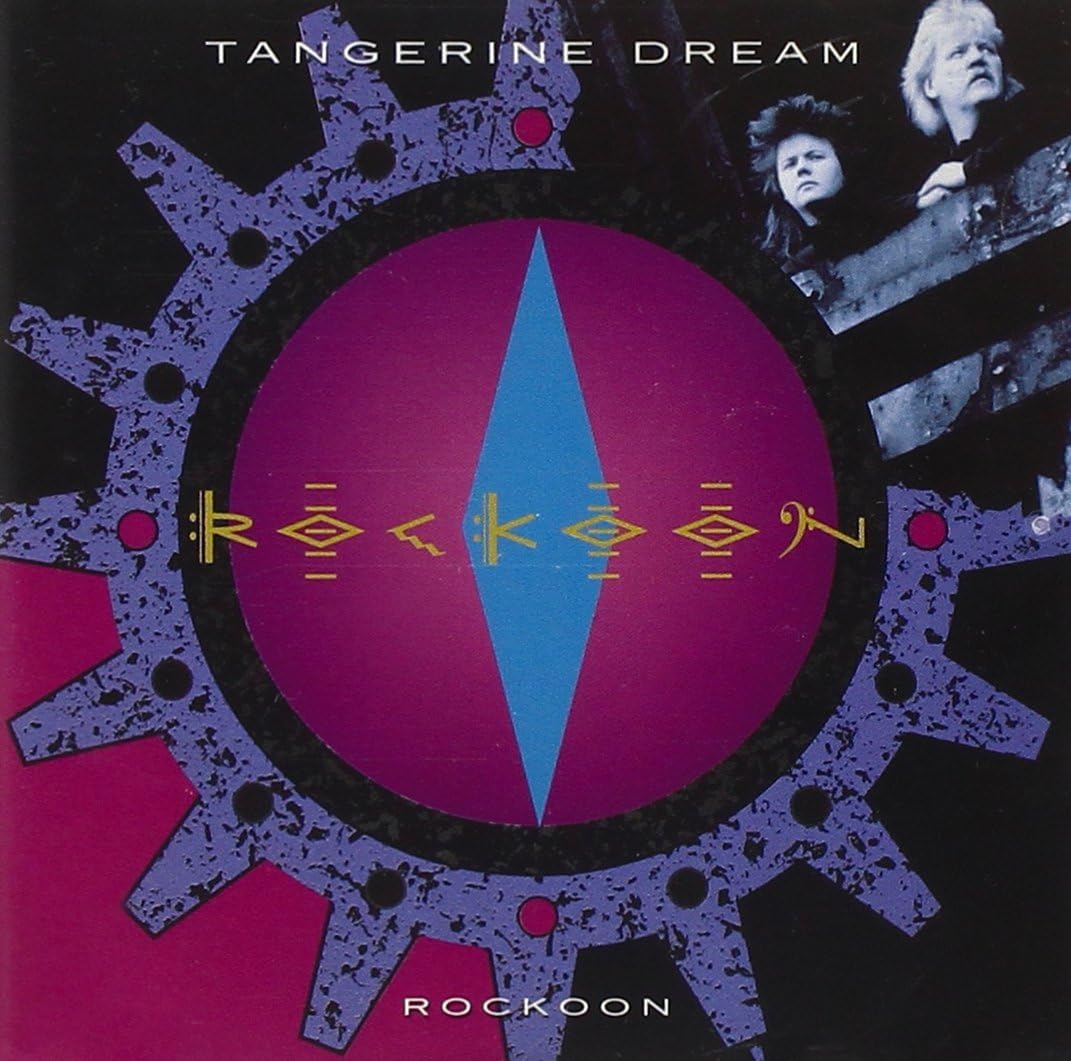
Rockoon
Product ID: 177449467
Tangerine Dream - Rockoon - CD
A**R
Four Stars
very good
R**R
Good for what it is (3.5 stars)
Some say that ever since the mid-1960s birth of “rock music”, studio technology has been the invisible member of every rock band. If you want to listen to composed music, listen to classical; to improvised music, to jazz; and to earthy, or “ethnic”, music, to folk; but if you want to hear the latest in studio technology and what it can do (even for bands that can’t play), listen to “rock”. The first decade of rock bands (1966-1976) often tried improvising and/or composing, but they were not much good at either. In the wake of the “punk rock holocaust” of this “progressive” streak, electronic music began to take centre stage. If Kraftwerk set the mould for electro-pop rhythmic tracks for pop-chart singles c.1977-1978, fellow Germans Tangerine Dream had already set a mould for electronic-a albums.Initially an improvising unit (their “progressive” roots) on analog synthesisers (an experimental time when they claimed to have no idea what they were actually doing) and then a composition-orientated unit on digital synthesisers, Tangerine Dream’s ten-year output on Virgin Records (1973-1983) and four-year output on the much smaller Jive Electro record label (1984-1987) was fairly well regarded before they disappeared completely off the “rock music map”. Where did they go? First (1988-1992) to a Californian “new age music” record label (Private Records, founded by ex-band member Peter Baumann); second, to another Californian label (Miramar Records, 1992-1996) and, finally, doing internet-only sales with their own Vienna-based label (Eastgate Records, 1998-2015). Very little of this later music is well known—often for a good reason. Tangerine Dream became a TV and film-soundtrack composing unit for “made for TV” programmes that were forgotten as soon as they were broadcast (or perhaps even before then) and often featured equally forgettable soundtracks. This focus also influenced their more regular, USA-released, albums. On the three albums for Private Records (Optical Race, Lily on the Beach & Melrose) and for Miramar Records (Turning of the Tides, Tyranny of Beauty, Goblin’s Club), saxophones & guitars, with synthesisers as harmonic background, became the focus, so although they had been known as an “electronic music band”, this was no longer the essence of Tangerine Dream (the use of bland programmed beats notwithstanding). This album “Rockoon” (1992) is a little different, however, and if not typical of Tangerine Dream is nevertheless good for what it is.The studio-technology production on this album is that of a “1980s industrial sound” akin to Jan Hammer’s instrumental music for the Miami Vice TV show (a commission that Tangerine Dream nearly won in 1984). If one likes the combination of metallic-sounding drums, electric guitar (or keyboards imitating guitars) for musical texture & sequencers/synthesisers as a musical base, you will probably like the sound of this album. What makes it stand up well enough is that compositionally it works as an album with a distinct style. There are no catchy tunes in the Hammer mould, but the style of composing is akin to later Tangerine Dream at their best with the inclusion also of some of their distinctive synthesiser sounds framed during the “Logos/Poland” (early-1980s) era.I would even say this album is “surprisingly good” considering the weakness of the “Dream’s” albums c.1988-c.1996, which have been regurgitated as compilations (the Electronic Journey boxset) and remixed or re-recorded in an ultra-bland ‘Robert Miles Dreamland’ fashion (Dream Mixes, Tang-go) but remixing a pile of junk leaves one with nothing more than a remixed pile of junk.The late Edgar Froese (1944-2015), the band’s founder and leader, has since gone on a White Eagle to ‘the great gig in the sky’ or Logos, crossing the Rubycon into the Hyperborea, perhaps to meet the Phaedra to play a game of Tangram, or if he made his Exit into the big sleep through the hades gate he is perhaps playing an Encore in the Stratosfear. Whatever the case, he left behind him a massive catalogue of synthesiser music. If the ten early albums on Virgin Records are an obvious place to hear Tangerine Dream, selecting highlights from the other ninety-plus records that were mostly self-released & frequently ‘more of the same’ (‘the dream is always the same’) is no easy task. In this listener’s experience, particular albums rather than tunes are the way to find some highlights (which is perhaps not surprising because this band did not do singles).In terms of Tangerine Dream’s discography, I would say that along with the electro-pop orientated Le Parc (1985), Rockoon is perhaps the most notable “pop/rock” album they did after leaving Virgin Records in 1983, although it is certainly not, in terms of trends in “industrial electronica” (Autechre etc.), ultra-new in terms of studio or sound technology (“no rock-music-fraternity brownie points there”). In terms of their discography during the 1990s, I would say their other album that stands out as an electronic music album would be Mars Polaris (1999), while in their discography since then, an electronic-music standout may be the Angel of the West Window/Island of the Fay/Finnegan’s Wake trilogy in 2011, which sees the band utilise their trademark sequencer sound pretty well. For a slightly more symphonic or orchestral sound, the Jeanne D’Arc soundtrack (2008) is not bad, while it is worth noting that none of the later Tangerine Dream albums took the Virgin Records-era form of twenty-minute long suites (a medley-style abandoned after the 1987 Livemiles album).
N**Y
Likeable, Not Loveable
TD's 1992 studio album featured just Edgar Froese and his son Jerome with contributors on guitar, flute, saxophone and macubaha (?). Here we have another album of fifty-plus minutes of mostly short and snappy pieces.The opening track is certainly no-nonsense rock-orientated with its extensive guitar solo. Guitar solos grace many of the tracks that follow too. By the fifth track one senses a blandness with a lack of distinctiveness between pieces, but then, in `Spanish Love', the mood changes to a less strident and more subtle feel. The guitar-focussed rock tracks return later. By now, the group were firmly imprisoned within the digital-rock straightjacket.The album is short on melody and hook-lines, as if composed by computer. These are likeable, not loveable tracks: hence the four stars. Indeed, in my opinion, there had not been a five-star TD track up to then since `The Song of the Whale' on the `Underwater Sunlight' album. For `Rockoon', I cannot recommend a particular track as an introduction to the album, though the title track might serve as a guide. The track titles do not inspire either: `Penguin Reference' anyone? They appear to be mere tags to hang the songs upon.Fed up with the lack of inspiration, it is noticeable that I gave up on TD at this point and purchased no more of their CDs. I have now only recently started to explore their catalogue since 1992.
D**G
Great Album
Another TD success with this album. Well done TD yet again. This is well worth adding to your collection if you are a fan.
O**N
Five Stars
good
K**1
Five Stars
All O.K.
M**J
think twice
1 Big City Dwarves 6:002 Red Roadster 8:303 Touchwood 4:344 Graffiti Street 5:045 Funky Atlanta 4:006 Spanish Love 5:407 Lifted Veil 3:308 Penguin Reference 4:459 Body Corporate 3:4010 Rockoon 7:2111 Girls On Broadway 4:44
Trustpilot
4 days ago
2 weeks ago