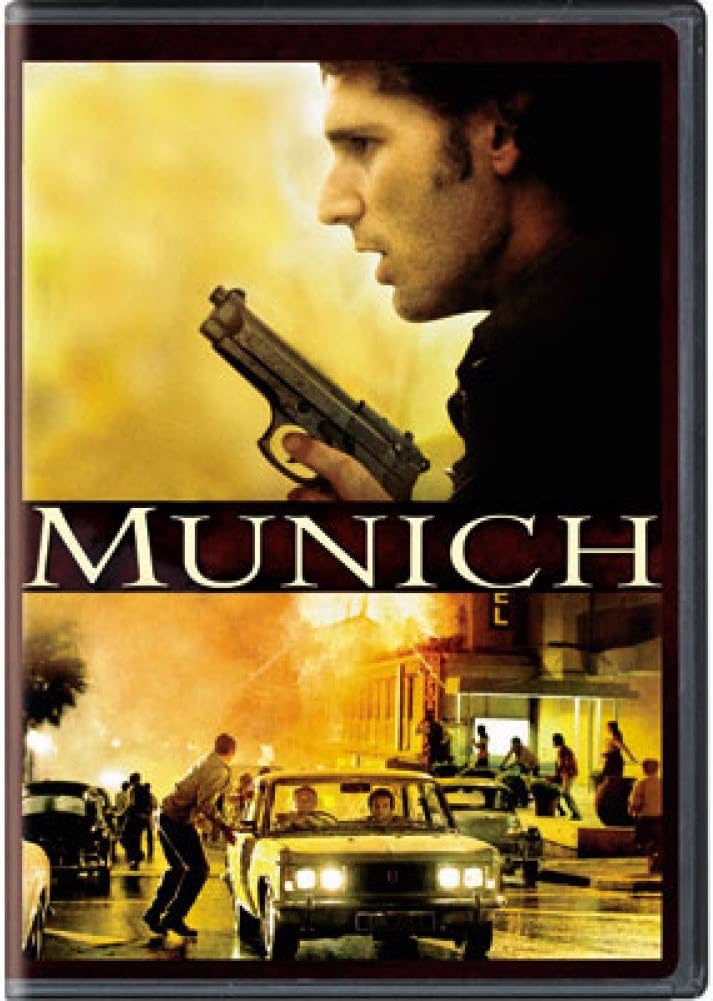
Munich
Product ID: 17230888
Buy anything from 5,000+ international stores. One checkout price. No surprise fees. Join 2M+ shoppers on Desertcart.
Desertcart purchases this item on your behalf and handles shipping, customs, and support to Netherlands.
Inspired by real events, Munich reveals the intense story of the secret Israeli squad assigned to track down and assassinate the 11 Palestinians believed to have planned the 1972 Munich massacre of 11 Israeli athletes—and the personal toll this mission of revenge takes on the team and the man who led it. Hailed as "tremendously exciting" (Peter Travers, Rolling Stone), Steven Spielberg's explosive suspense thriller garnered five Academy Award® nominations, including Best Picture and Best Director. Review: Historically important but quite intense - Much like Schindler’s list, this is a must-see movie about what happened at the 1972 Munich Olympics. I remember watching a lot of the newscasts regarding this event and those newscasts were used in the movie. The quality of the film was excellent! The subject matter is very intense and one of those movies which can only be viewed once in a while without allowing it to get one depressed or pessimistic about life and its fairness. Don’t know why the movie makers added the part about the female assassin who was, in retribution for a killing which she made, shot to death, naked, in her dwelling; apparently, this event never happened. The reality of the movie was a story which did not need embellishing. Review: A good remake of the movie "Sword of Gideon". - If you haven't seen the movie, "Sword of Gideon", find it and rent it or buy the DVD. Munich is a remake of that superb gritty film. The difference is the modern cinematic effects. Sword of Gideon is far more gritty than this version; however, this version does hit these true events very well but there's more artistic drama in this version whereas in Sword of Gideon gets right to the point.
| Customer Reviews | 4.6 out of 5 stars 4,795 Reviews |
G**A
Historically important but quite intense
Much like Schindler’s list, this is a must-see movie about what happened at the 1972 Munich Olympics. I remember watching a lot of the newscasts regarding this event and those newscasts were used in the movie. The quality of the film was excellent! The subject matter is very intense and one of those movies which can only be viewed once in a while without allowing it to get one depressed or pessimistic about life and its fairness. Don’t know why the movie makers added the part about the female assassin who was, in retribution for a killing which she made, shot to death, naked, in her dwelling; apparently, this event never happened. The reality of the movie was a story which did not need embellishing.
G**H
A good remake of the movie "Sword of Gideon".
If you haven't seen the movie, "Sword of Gideon", find it and rent it or buy the DVD. Munich is a remake of that superb gritty film. The difference is the modern cinematic effects. Sword of Gideon is far more gritty than this version; however, this version does hit these true events very well but there's more artistic drama in this version whereas in Sword of Gideon gets right to the point.
T**R
Wonderful story,brilliant directing
One of Spielberg's finest ...
L**O
Spielberg's "Munich" is more dialectical than rhetorical or cinematic
One of the greatest ironies of international politics in the wake of World War II is that you can make an argument that the most fascist nation on the face of the planet is the state of Israel. This will strike most people as an oxymoronic claim because they will associate fascism with Nazi Germany, which means the Holocaust and the attempted extermination of every Jew in Europe. But as a political ideology that existed outside Hitler's Third Reich such as Mussolini's Italy, Franco's Spain, and Peron's Argentina, fascism had a specific dynamic that viewed life as an ongoing "struggle" for "order." Mussolini was always proclaiming a struggle for wheat or whatnot, and we all know about his ability to get the trains to run on time. This dynamic stands in remarked contrast to the Whig-Liberal dynamic of "liberty" and "property," but if you recall the Cold War then you can appreciate how fascist elements worked there way in American politics as well. In Israel, where everybody considers themself to be soldiers, life is indeed such a struggle more so than any other nation you can name. The argument that in its struggle to survive the state of Israel has become more like its enemy than it would wish to be in a better world is at the core of Steven Spielberg's "Munich." The massacre of the Israeli athletes at the 1972 Olympics in Munich is presented as the opening act on the modern age of terrorism, and you do not need the camera's final shot to show the World Trade Center in the distance to know that this drama is still ongoing. Ultimately, the film is not about what happened at Munich but how the Israeli government responded. There is no small degree of symbolism in which some athletes innocently help the Palestinian members of Black September into the Olympic village. Actually footage of the coverage of the hostage drama, including Jim McCay's unforgettable announcement to the world that "they're all gone" is mixed with shots of what the terrorists are doing. But the actual deaths of the terrorists and their hostages comes later in the film, as the main character keeps recalling the events as justification for what he has to do and later for what he has done. Fulfilling the injunction of an eye for an eye in the Torah, the Israeli government comes up with a list of eleven Palestinians to die for the eleven Israelis murdered in Munich. Avner (Eric Bana), a former bodyguard to Prime Minister Golda Meir (Lynn Cohen) is made the leader of a secret and unofficial group that will track down the Palestinians and kill them. His only link to the government is Ephraim (Geoffrey Rush), who will make sure there is enough money to get the job done. Working with Avner are Hans (Hanns Zischler), who can forge necessary documents, Steve (Daniel Craig), who is always eager to pull the trigger, Robert (Mathieu Kassovitz), who has gone from making toys to building bombs, and Carl (Ciaran Hinds), who cleans up the evidence and who is the only member of the group to question what they are doing. We question because like the characters in the film we have to take at face value that these men need to be killed. But the first has translated "The Arabian Nights" into Italian. The second asks the world to note how many Palestinians have been killed by Israelis since Munich. They are not the terrorists, but they do share their ethnicity and perhaps their politics. But what about a man kissing his daughter goodbye makes him a terrorist? Avner gets information about where to find his targets from Louis (Mathieu Amalric), a Frenchman who could be connected to anybody from the C.I.A. to Mossad for all Avner knows. Meanwhile, as Avner and his men cross more names off of their list Black September is escalating its attacks, and there comes a point at which the hunters become the hunted, not that this stops them from pushing on with their missions. "Munich" is inspired by real events rather than an attempt to document what the Israelis did in response to the Olympic massacre. What I know about the true history is that they succeeded in killing many of their targets, who may or may not have been directly involved in Munich. The screenplay by Tony Kushner and Eric Roth, based on the book "Vengeance" by George Jonas, goes out of its way to make the attendant ironies of this endeavor palatable. While they use the same weapons in an effort to terrorize the terrorists, what separates Avner's group from their targets is their avoidance of collateral damage, which becomes impossible. But the pivotal scene in the film becomes not an assassination attempt but an moment of black comedy when Avner's team is forced by circumstances to share a safe house with a group of PLO members. Avner has a conversation with a man who is clearly himself as a Palestenian, doing what he is doing in the hope for a home. Devoid of specific reference to ethnicity or religion, the words could be said (and have been said) by those on both sides. I am reminded of Lincoln's words during his Second Inaugural where he observed that both sides had prayed to the same God, because Arabs and Israelis do not believe that they pray to the same God. Each believes God has promised this dispute territory to them and them along, and the difference between these mirror beliefs that makes us think it will never be resolved in anything other than blood and death is that each holds that there God IS God. The judgment of Spielberg and this film is that the path taken by Avren and his men did not make things better. It is pointed out that those who replaced the dead escalated the violence and the Twin Towers remind us where this road has taken us without an end in sight. The great tragedy could well be that there is no end and suggesting that a particular course of action has made things worse is not a retroactive argument for having done nothing. What is happening could well be as foreordained as any Greek tragedy and those who feel "Munich" attacks them are projecting what they know in their souls onto what they see on the screen.
C**4
Good
Good movie
D**R
an avenger's tears
It is poignantly fitting that the man who directed Schindler's List should book-end that tale of Jewish pain with MUNICH, a film that tells another side of this people's struggle to survive in a period when the Jews have a state and the ability to answer with something more than simple suffering. Spielberg claims that the good storyteller exercises 'empathy in every single direction', a project that raises howls whenever it is applied to the Israel-Arab conflict. Or, as this film styles it with historical accuracy, the Israeli-Palestinian dispute over the same dry grove of the fathers' olive trees. Supported by star turns from Eric Bana, Moshe Ivgy, and Michael Lonsdale and a haunting sequence in which Lynn Cohen plays an anguished Golda Meir - forced to the conclusion that 'every civilization finds it necessary to negotiate compromises with its own values' - Spielberg's MUNICH manages to focus on the human drama played out by the soul of avengers everywhere. In the wake of the massacre of eleven Israeli athletes at the 1972 Munich Olympics, Bana's Avner is drafted as the unlikely lead agent of Meir's decision to prove that Israel must 'forget peace for now ... we have to show them that we are strong.' Avner carries out his role with taciturn determination, yet his eyes go moister and home calls the more compellingly as he scratches names off the list of eleven Palestinians who must be eliminated in order to show just how costly it is to mess with Israel. That 'family matters' is an affirmation of relative priorities kept by all parties in this film is a theme that Spielberg returns to at measured intervals. In the meantime, Avner and his team of avengers find themselves increasingly struggling with 'the mice inside your skull'. Resolution comes in the end through family itself. But it is a resolution that leaves stained, limping men, not the 'neat, durable men' whom Prime Minister Meir confesses to admiring in the film's early minutes. This is a film that must be seen by those who care about those conflicts that are fought in memory of the fathers, not least the one that still rages and promises to rage on in a small slice of land just to the east of the Mediterranean Sea. Spielberg has told the tale with astonishing evenness, though it is possible that this conclusion can only be reached from the more or less comfortable distance of this reviewer. Empathy - even that which the director claims to have exercised 'from ever single angle' - hardly seems a virtue to the true-to-life antagonists of this particular conflict. For some considerable time more, blood will continue to flow in the name of the fathers. Avengers who rise up to even the score will themselves come to know the salt of their own tears, and trudge home to find comfort in family.
G**Y
Masterpiece of spy noir
This Spielberg reflection on vengeance was nominated for five Oscars, including Best Picture and Best Director. Even with that, it seems an under-heralded masterpiece, and ready to be rediscovered and reevaluated. It is every bit as violent and stylish as a Scorcese flick, and more morally complex. Mossad hitmen out to kill Palestinian political leaders living in Europe. Spielberg, a full fledged humanist, provides a complex, compelling story of never-ending violence.
T**F
TV mini-series was just as good
There was a mini-series that told the story of this historical tragedy a few decades ago, which, as I recall, had better character development. This was a disappointment for me, and I was expecting a lot more from Spielberg.
Trustpilot
3 days ago
2 weeks ago