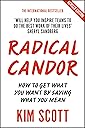

Desertcart purchases this item on your behalf and handles shipping, customs, and support to Netherlands.
🚀 Lead Boldly, Connect Deeply: Radical Candor for Next-Level Management
Radical Candor: Fully Revised and Updated Edition is a top-ranked bestseller offering a practical, experience-driven guide to effective management. Authored by Kim Scott, a former Google and Apple leader, this book teaches managers how to balance direct feedback with genuine care to inspire teams and drive success. Featuring new content and proven frameworks, it’s essential for professionals aiming to elevate workplace relationships and performance.


| Best Sellers Rank | 1,010 in Books ( See Top 100 in Books ) 5 in Business Careers (Books) 13 in Business Life (Books) 40 in Words, Language & Grammar (Books) |
| Customer Reviews | 4.4 out of 5 stars 9,766 Reviews |
N**S
Really good book for managers
I recommend this book to all the managers, it is so good! It helps you and your teams become stronger
J**H
Radically logical
Let me start by saying that if you work for a company the contents of this book are invaluable. But it's also highly useful for everyone to use in any aspect of life. It gives a useful and easy to apply quadrant framework on how to approach communication of feedback. This quadrant diagram alone is earth shatteringly useful, particularly if you work in an organisation which has developed a blame culture. The edition I read also has bonus chapters with additional information on performance management Vs developmental chats which again was incredibly useful. However, in the spirit of caring personally and challenging directly, it loses a star because I felt that the contents of the book could have been better organised to allow busy managers to refer back to it more easily. It felt like I was listening to myself speaking about how to improve things where I work, and one of the things I'm working on is trying to be more concise and focussed with my guidance and make the resources I share able to be more easily used for reference. I genuinely believe that Radical Candor is the solution to so many problems where I work, and my passion for what I can clearly see leads me off on tangents when I talk about it in ways which, although highly relevant to me sometimes leave others a bit lost and confused. The challenge will be getting those in power in my company to see the benefits of Radical Candor instead of being ruinously empathetic or worse, manipulatively insincere. The reason I love reading self development books is I find they live on longer after the back cover has been closed through the application of the ideas they contain, but sometimes that can be difficult. A more logical structure would make sure this book will be used as a living success manual and won't be consigned to the shelves to gather dust. I've highlighted the hell out of my copy to make sure I can keep it alive. Life changing stuff.
M**M
I wish I had read this at the start of my career.
As soon as I opened this book, the idea exploded in my head. I quickly realised what type I was and discovered my failings. Fortunately, this book tells you how to put things right. I wish I had read this at the start of my career.
A**R
Radical Candor
Great book would definitely recommend.
O**Z
Clear, practical and human
This is one of those business books that stays useful long after you’ve finished it. It’s direct without being harsh, and practical without turning people into problems to manage. The idea that stayed with me most is the distinction between “rock stars” and “superstars”. Not everyone wants to climb endlessly or be the loudest voice in the room. Some people want to do excellent work, grow steadily, and be valued for consistency and judgement. That reframed how I think about performance, ambition, and fairness at work. The strength of the book is how grounded it is in real conversations. Feedback feels less like a performance and more like something you do because you respect people and want working relationships to hold up under pressure. It’s especially useful if you care about being honest without being careless, and supportive without avoiding difficult truths. I found myself reflecting on my own habits as much as on how I lead or work with others. A thoughtful, practical read that manages to be both challenging and kind.
M**R
Everyone should read this book, but it could be a lot better.
I was recommended Radical Candor as a more contemporary take on Marshall B. Rosenberg’s Nonviolent Communication, but I think it also works as a more up‑to‑date reference for much of the material covered in What Did You Say? The Art of Giving and Receiving Feedback by Charles N. Seashore, Edith Whitfield Seashore, and Gerald M. Weinberg. It even overlaps with, and offers a different angle on the One Minute Manager series by Ken Blanchard. I learnt a few new things which I think will be really useful. I especially liked “Care personally, challenge directly”, encouraging feedback from your team early on, the discussion of why boss is the proper term and the three questions you should ask your team to understand them and where they want to be. I’m already using the terms Rock Star and Super Stars as a result of reading Radical Candour. I didn’t like the strong emphasis on 121s, especially the frequency and the perceived importance. To me this is plain wrong and should be replaced with building strong, high communication relationships. Interestingly, these are also encouraged by the book. The afterward and extra chapter in the edition I read were sloppy. They rehashed or expanded what was already in the previous chapters and, I suspect, was a way of adding more material without having to revisit the entire book. It would be good to see a future edition completely revised. At the same time, it could be shortened as there is more of it than there needs to be. I originally bought the paperback, but the text is so small I had to revert to the kindle version, which meant I didn’t get the best versions of the diagrams. Everyone should read this book, but it could be a lot better.
J**N
Good to know what you know
Got this for the wife who likes this sort of thing, she and I have a different approach to dealing with staff and colleagues, and she is a strong believer in sharing the journey. Frequently she would read sections out for us to discuss, it didn't take me long to realise she was adopting a new approach on me... Having read the book myself now, or at least skimmed through various bits it tells me what I already know, and have put into practise over the last 25 years or so in business. I can sum it up as follows..... be clear, be direct, be as open as you can, and keep the message/direction short...... thst last bit for those who stop listening or reading after the first sentence after they go off into la la land in their heads. One thing though if anyone could guide me to a product that can help twenty somethings in the workplace to not be so fragile and to understand not everything in work needs to be broken down, dissected and discussed at length I would appreciate it, apparently my desire to use electricity or a sharp point stick is not appreciated.
K**D
A practical reminder that honest conversations are part of good leadership
Kim Scott’s central idea in Radical Candor is simple but powerful. The best leaders care personally about their people while also challenging them directly when something needs to change. The book explores how many workplaces drift into the safer alternatives. Leaders avoid difficult conversations, soften feedback too much, or allow problems to continue because they would rather not create discomfort. Scott makes a convincing case that these actions ultimately do more harm than good. What makes the book particularly useful is the number of real examples and practical situations that bring the concept to life. The message is clear. Honest feedback, delivered with genuine care, builds stronger teams and healthier organisations. For anyone responsible for leading people, Radical Candor offers a valuable reminder that kindness and honesty are not opposites. In good leadership, they should exist together. A thoughtful and very practical leadership read.
D**O
Gran libro
Lo compré para un regalo. A la persona le ha encantado. Vale la pena comprar pasta dura, viene de gran calidad
N**P
super ok
ok
C**O
Great book for lead and management
The book is packed with actionable advice on how to build a culture of open feedback, handle praise and criticism effectively, and drive results without losing your humanity. It bridges the gap between being a rigid authoritarian and a pushover, making it an essential read for anyone managing teams or working in leadership.
H**N
Plenty of insights - very worthwhile
Really interesting insights into managing teams. Some of the examples are a little specific to be scalable to all situations, but very helpful all the same. First time in a while I've highlighted sections in a book to revisit!
C**A
Relentless focus on ones on ones combined with a fearless disposition of sharing some of Google's, Apple's –among others– manage
On this book Kim Scott was able to piece together everything she has learned about business into a complete and cohesive model on how to manage based on three pillars: to care personally; to confront directly; to practice all sorts of 1:1s. I intensively study management practices, but it wasn't until last year that I had management experience with more than five direct reports. In 2016 I started a company in which I had 20 direct reports. I tried what I now know is called a "Ruinous Empathy" approach. I thought that just caring and showing that to employees would bring open conversations to the table. Interesting thing is that people loved me, but soon things started getting out of control. That's when I started an "Obnoxious Agression" approach, fired some of them and stopped caring so much ( now I know I share great part of responsibility for what happened there). As you may have noticed both approaches lack a delicate kind of balance. That is the balance Kim Scott tries so hard to achieve with her method and I can understand perfectly why. Here you'll find insightful quotations from world's leaders sharing their beliefs. Moreover, you'll often find phrases on the following format: "you might think you don't have the time to___, but ___" . That means the model here presented requires an intensive focus on people. You'll need skills, time and dedication for it to work out. I can not state if it works, but it is definitely a north to follow and seems to be doing really good to me. It reminded me of the transformative experience it was reading Carol Dweck's Mindset. Let me help you grasp what this book is really about with more concrete terms. Here, you will read about: Hiring: getting to know the candidate behind the mask as much as possible in a short period of time. Firing: doing what is best for the employee, not the company. Giving/Receiving Feedbacks How to deal with biases, corporate structure, trust, openness, humility. Putting people on the right jobs: Are the hungry for growth or for improving on what they do now? Meetings: Establishing structured meetings with clear purposes, facilitating meetings, setting it out on a corporate agenda. . Dig further (Some of the books that Radical Candor reminded me):: On conversation: Crucial Conversations: Tools for Talking When Stakes Are High- Kerry Patterson On meetings: Moments of Impact: How to Design Strategic Conversations That Accelerate Change- Chris Ertel ; Death by Meeting: A Leadership Fable about Solving the Most Painful; Problem in Business- Patrick Lencioni ; Sprint: How to Solve Big Problems and Test New Ideas in Just Five Days - Jake Knapp On Productivity: Scrum - Jeff Sutherland Getting Buy in: Buy-In: Saving Your Good Idea from Getting Shot Down On Change Management: Leading Change -John .P Kotter. Humble Conversations Creativity - Ed Catmull
Trustpilot
3 weeks ago
3 days ago