Some deliveries may take a little longer than usual due to regional shipping conditions.
DOWNLOAD THE APP


Customer Services
Copyright © 2025 Desertcart Holdings Limited
DOWNLOAD THE APP
Full description not available
C**T
Winning SCRABBLE Strategy from a World Champion
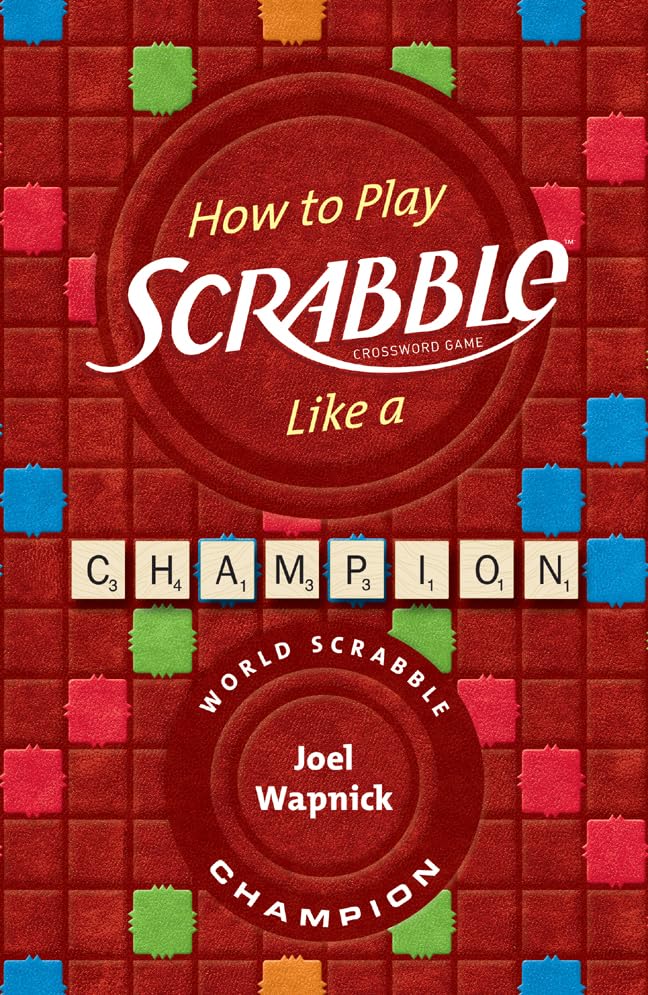
How to Play SCRABBLE® Like a Championby Joel WapnickFor many years Joel Wapnick's The Champion's Strategy for Winning at SCRABBLE® Brand Crossword Game, published in 1986, was considered one of the finest guides to SCRABBLE® strategy. Out of print for several years, copies of the book could be found online sometimes; however, the book was somewhat dated and did not include word updates dating as far back as 1991.Now Wapnick, a great SCRABBLE® player who has been World Champion, National Champion, and National Canadian Champion, has updated and added to that earlier book to present a book that no serious tournament SCRABBLE® player should be without. The book not only covers basics of strategy and tournament play, it explains the detailed analysis experts use in determining their moves and preparing for tournaments.For an intermediate player hoping to move up, Wapnick shares his methods for learning words and improving play. He provides a terrific explanation of how using Quackle ([...]) can help in selecting the optimal plays. At the back of the book he includes a chapter of 40 "Cool Plays," which illustrate excellent finds that are not always the most obvious, and brilliant plays that are truly breathtaking.Wapnick, who also is an expert pianist, shows readers the elegance of great SCRABBLE® strategy, using examples that demonstrate the imagination and creativity the game offers.Part 1, "The Nature of the Game," provides a basic summary of the game, tournament rules, and the important game tools: words. Wapnick touches briefly on the differences between casual and tournament play, as well as between the tournament game in North American and that played in other countries.Part 2, "How to Play the Game," is the meat of the book. Beginning with a description of the various ways to score points in SCRABBLE® (opening plays, hooks, inside plays, and extensions), Wapnick introduces strategy by having the reader look for hooks for bingos, then stretches into the world of setting up plays, weighing situational advantages of scoring versus rack balancing, and exploring why certain plays are more likely to result in a win than others. The extensive chapter on strategy introduces the formula valuation = score + leave, which teaches readers how to calculate valuation based on assigning point values to each letter and evaluating certain letter combinations that offer strong or weak synergy. Examples illustrate how important this rule can be in determining what moves to make. Wapnick also explains how and when to exchange tiles, pass a turn, play defensively, and/or take a risk. He shows ways, too, that your opponent's play may indicate what's on his/her rack.The section on setups is outstanding, with examples from top players showing brilliant strategy at its best. Wapnick also gives examples of well-played endgames.Wapnick shares with readers his successful method for memorizing words, plus he outlines some of the pitfalls to avoid when at the tournament. Getting a good night's sleep and eating well can help Scrabblers as well as athletes!Chapter 8, "Annotated Games," presents eight amazing games played by some of the top experts in the world, including Dave Wiegand, Brian Cappelleto, Adam Logan, Joey Mallick, Carl Johnson, Jason Katz-Brown, Evan Berofsky, Noah Walton, Lloyd Mills, John Luebkemann, Robin Pollock Daniel, Rod MacNeil, and Wapnick himself. This is a fascinating way to learn. Cover the answer with a sheet of paper, make your best move (on an actual board, as Wapnick suggests), and then see what the expert did--and whether Wapnick agrees. It's like being in the heads of three experts: the players and Wapnick. I'd expected a barrage of obscure words; not so. Usually the plays were ones a 1200ish player could find, but often wouldn't. I was humbled by this chapter into realizing that I play too fast, and don't look hard enough for the best play. I finished the chapter with an enormous respect for the players whose games were chosen.I cannot recommend this book more highly.Cornelia Guest is a tournament director and School SCRABBLE® coach. She is the publisher of the monthly e-magazine The Last Word ([...]).
J**W
Is that in the Official Scrabble Player's Dictionary (OSPD)?
I am a casual SCRABBLE player, and thought I'd pick up a few tips to improve my game by reading this book. This book is a comprehensive look at the game and what it takes to be a serious player. For example, one must know lots of words in the OSPD and one does not make a play to maximize the number of points on a particular turn; rather one plays to maximize the expected value of the play, and that expected value is a combination of the points realized from the play and what can be made using letters left in the tray (after the letter replacements are drawn). This is some heady stuff. The implications are wide: the serious player should be familiar with lists of letter combinations that have poor "playability" and hence should not be left in the tray, advice is given on how many points to expect from using an S, a Q or a blank. How were these 'expected values' determined?", you ask.. well there's a SCRABBLE simulator called Quackle you can download and run yourself. Quackle (is that in the OSPD?) is free-ware and is an excellent SCRABBLE program; for me, worth the price of the book alone! I recommend this book to anyone who is serious about SCRABBLE.
D**R
SCRABBLE GUIDE
I gave this ★★★★ instead of ★★★★★ because the blow by blow descriptions of his gaming experieces bored me. It doesn't matter to me who made any particular move as much as the fact the move was made. Presentation, presentation, presentation. This is however, chocked full of valuable strategies, tournament preparation, + a concise sample of a scrabble dictionary. Everthing you wanted to know about Scrabble but were afraid to ask. This book includes multiple diagrams w/coordinated moves. This read requires some patience to get through it. Not something I would want to read in one sitting. Having your scrabble board @ the ready will make it easier to understand as opposed to trying to follow along w/the small diagrams. I dare say it may even make for a more interesting read.
G**N
Great insight into playing the game at a high level
My first exposure to Scrabble strategy was through Joe Edley's Everything Scrabble book. Mr. Wapnick's book delves into some similar territory in the earlier sections. It's unavoidable to begin a book like with this with expository material but he has a fresh take on it and it's peppered with details/anecdotes from his own playing career.I feel the book shines when pointing out the amount of "scheming" that goes on in a game among experts. Shining the light on this "meta-strategy" (inferring whether or not your opp has a letter or whether (s)he thinks you do, etc) pays for itself alone. After all, it is a book about playing at the highest level.P.S. Giving a book a one-star rating based on the typeface is a lousy thing to do. If you had a problem reading the book, correct your prescription.
S**N
Not for me
If you're preparing to be in a national tournament this might be of value.But if you're at that level you probably know a lot of this. I am at best a "good" family player and most of this went over my head. His advice to read and re-read the 84,000 entry official list is as mind-boggling as my trying out to be a pro football player having never played even in high school which was not that recent. That being said there are some generalizations one could benefit from if you're willing to dive in and endure the other 99%. Bottom line - if you never hope to play in a national tournament then get a life and avoid this book.
Trustpilot
1 month ago
3 weeks ago