

Desert Online General Trading LLC
Dubai, United Arab Emirates
Desert Online General Trading LLC
Dubai, United Arab Emirates
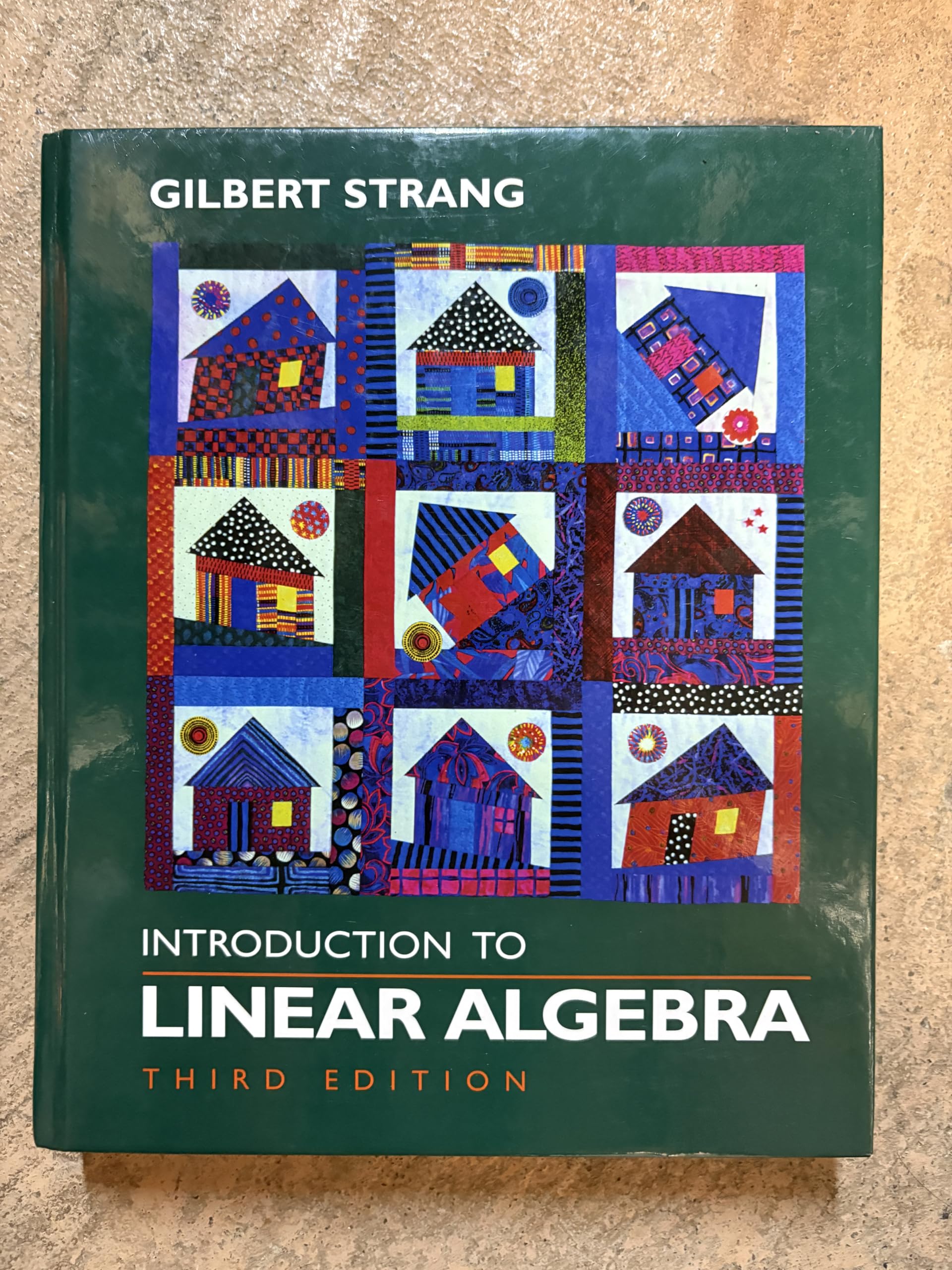


Full description not available
W**D
The engineer's classic.
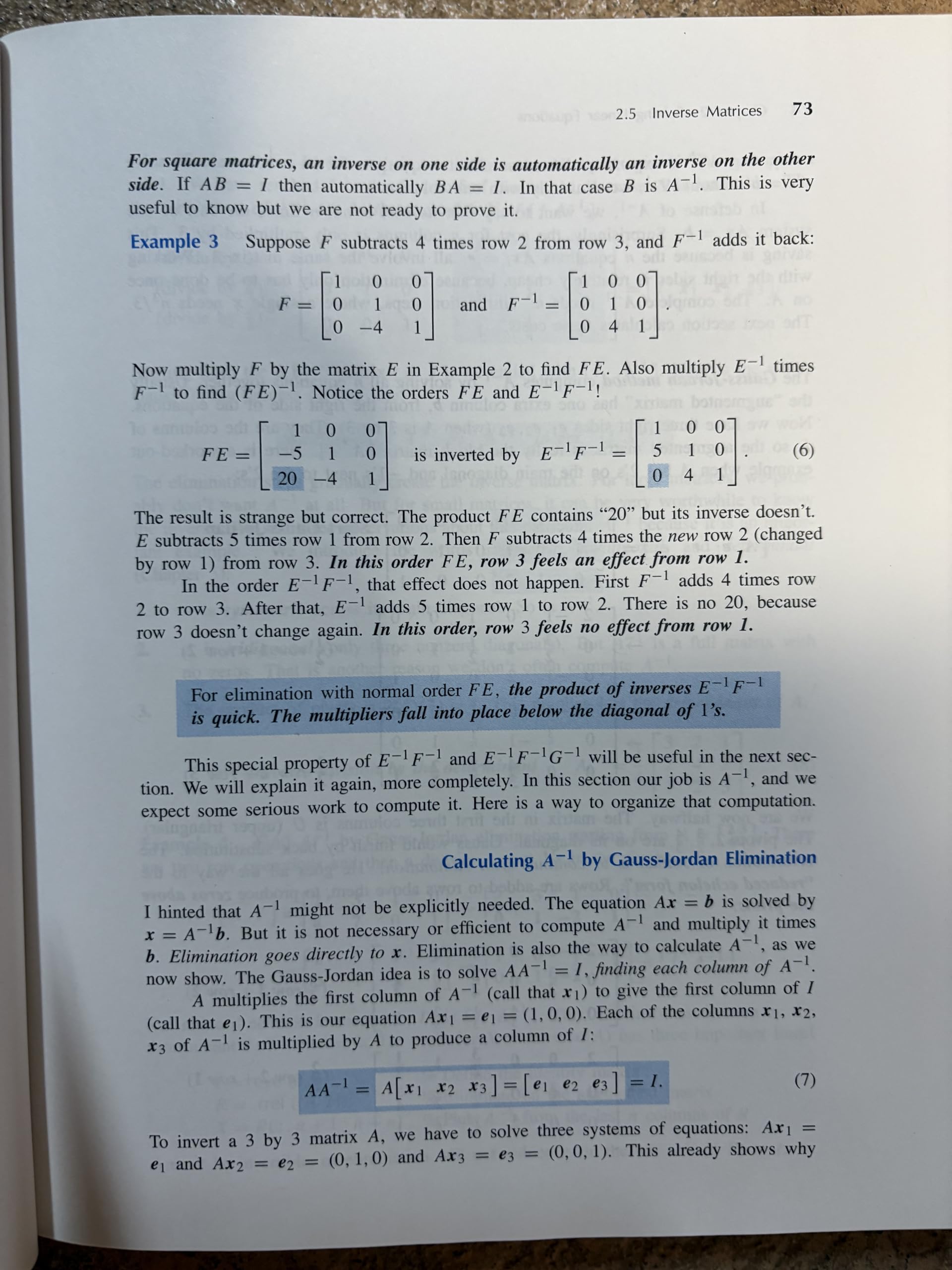
People say that mathematical truths never change, and that's true enough. New concepts, applications, and techniques keep emerging, though, so math teaching needs to keep up with the times. Strang has done an outstanding job of keeping this book current and relevant.It's not a mathematician's math book - this is aimed at people who need results and needs computational techniques more than they need crystalline theorems. That's why it's so helpful to see applications like Markov models, Kirchoff's laws, and Google's analyses of the web. It's also helpful to see examples worked in Mathematica and MATLAB, the tools of choice for desktop exploration of numerical systems. It's startlingly easy to come up with a 100x100 system of equations, and just nuts to try to solve it by hand.Strang assumes some amount of calculus in this book, something that other books on linear algebra sometimes skip. That raises the bar for the readership, but also opens up topics like change-of-basis in function space, including Fourier analysis. It also allows differential equations to be addressed as linear systems. Even without calculus, though, a reader is exposed to the singular value decompostion, QR and other matrix decompositions, and considerations in performing the computations. I found a few oddities, such as the description of a matrix's condition number. That has great physical meaning when it's taken as the ratio of the matrix's highest and lowest eigenvalues, but Strang gives a definition that I found less intuitive.Such oddities are rare, though. Even though this book covers many topics, its emphasis is on clear and applicable presentation. I recommend this to anyone studying linear algebra or who, like me, has to brush up on basics not used in many years.//wiredweird
R**I
Gil Strang is the best instructor of this subject ever.
Nothing more to say, perfect book.
D**S
I personally still love reading textbooks and Prof
This book contains everything you need to know to start advanced studies of Linear Algebra and its applications (which are too numerous to list).Although I am skeptical of the textbook medium as a modern way for people to learn going into the future, I personally still love reading textbooks and Prof. Strang does a great job of cutting to the chase. If supplemented by his MIT OpenCourseware videos and interactive applications for the computer, you will learn in no time. Check out the Linear Algebra Modules Project (LAMP) book for interactive learning. Use iPython instead of Maple.I also recommend Strang's (free) Calculus book.
R**B
The standard.
MIT author, good for advanced high schoolers for a college mid level course.
C**N
Good textbook still to read
I am pretty sure it is a great book yet to read
V**R
A nice undergrad introduction to linear algebra
A nice undergrad introduction to linear algebra. I've already recommended this to a friend's son, who is studying mechanical engineering.
B**N
Five Stars
Better than s3x
B**R
poorly written text
The author seem to forget that this is a higher mathematics course. His over-exciting (lots of exclamation marks) habit is annoying at best and distracting at worst. The book reads like a novel which I think is very immature for a higher mathematics text. If the student doesn't already know what the sigma symbol means, then maybe this isn't the class for them. Such juvenile definitions only added to the distraction. The book goes off tangent continuosly because the author is too eager to make students see the supposed beauty of Linear Algebra.
Trustpilot
1 month ago
1 month ago