Desertcart purchases this item on your behalf and handles shipping, customs, and support to Netherlands.
๐ง Clamp, Connect, Conquer: Power Your Measurements Like a Pro!
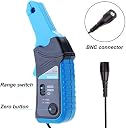
The Hantek CC-65 is a versatile AC/DC current clamp designed for professional electronics measurement. Featuring a 65A max current range and 20kHz bandwidth, it enables precise current waveform analysis via BNC connection to oscilloscopes or direct current data capture through banana plugs to multimeters. Its permalloy and hall element sensor technology ensures linear and reliable current-to-voltage conversion, making it ideal for power circuit diagnostics, motor drives, and power electronics troubleshooting. Compact and lightweight, itโs a must-have tool for engineers demanding accuracy and flexibility.


| ASIN | B06W2KFZLW |
| Batteries Required? | No |
| Batteries included? | No |
| Best Sellers Rank | 206,557 in Business, Industry & Science ( See Top 100 in Business, Industry & Science ) 4,033 in Electrical Testing |
| Colour | Black, Blue |
| Customer Reviews | 4.5 4.5 out of 5 stars (499) |
| Date First Available | 6 May 2013 |
| Item Package Quantity | 1 |
| Item Weight | 184 g |
| Item model number | CC-65 |
| Manufacturer | HATTRICK |
| Part Number | CC-65_N |
| Power Source | Battery Powered |
| Product Dimensions | 19.51 x 3.3 x 7.01 cm; 184 g |
| Shape | rectangle |
| Style | Modern |
M**L
Decent current probe, great price, terrible power switch
When I first got my new current probe out of the box, I thought it was dead. Plugged the 9v battery (Not Included) into the back, plugged it into my DSO, switched it on, and... nothing. No lights. No change in the level when I hit 'zero', no readings when I clamped it onto the Vin line on my project. Except sometimes when I wiggled the switch just the right way, pressed down on it, the green 'Power' light would flicker for a second. I gave it a little shake, and I could hear a little rattle. I took the hazardous step of opening the back to see what was going on, and the problem was immediately apparent. Instead of using a discrete 3-position dptt switch, there's a hacky little arrangement that's prone to failure if you look at it funny. The plastic switch wiper has a pair of ductile little pieces of bent copper which are retained solely by compression between the wiper and the PCB underneath, and as they slide back and forth they make or break connections between tinned pads on the PCB. I suspect that pressing down too hard on the switch can bend them out of shape and let them fall out of place. It was a fiddly little fix bending them back into shape and lining everything up so it didn't fall apart again when I closed it back up, but it seems to work well enough as a current probe now. Sensitivity is acceptable at 100mv/A. I haven't had time to formally assess the accuracy and frequency response, but it seems to work reasonably at the low frequencies and currents I was using today.
K**R
Great item
Very happy with this product and it works perfectly.
J**U
Value of money
Super
O**.
Genial
Muy buen funcionamiento
G**V
Not sure about accuracy, but it transmits the signal
I have only made one experiment, but I am happy with the result. Captured on the scope is a single TIG weld pulse. The current was set to 40A; The probe registered about 37A. I don't know how well the source is calibrated, so can't blame either the probe or the source for the inaccuracy, but the result is pretty good for what I want to do -- I need it to calibrate the spot timer and to understand the waveforms in different weld modes. The bandwidth is more than good enough for that. The time scale shown is 2ms/div; the claimed bandwidth of more than 20kHz looks credible. I actually saw a very well-defined trace of ignition current; it looked like a decaying sine wave with a frequency far above 20kHz. Part of it is seen as the bright blob at the start of the pulse; the front was not captured with this trigger setting and the tail of the ignition waveform washed out in the flood beam while I reached for the camera. I was not too concerned with ignition, so I didn't bother capturing it, but I know I can at least see the first harmonic and pulse enevelope of ignition current, should I ever need to observe it.
A**R
Reasonable quality for price
Used for electronic testing
Trustpilot
1 month ago
1 week ago