Some deliveries may take a little longer than usual due to regional shipping conditions.

DOWNLOAD THE APP


Customer Services
Copyright © 2025 Desertcart Holdings Limited
DOWNLOAD THE APP
Full description not available
B**S
Outstanding Resource on the Parables
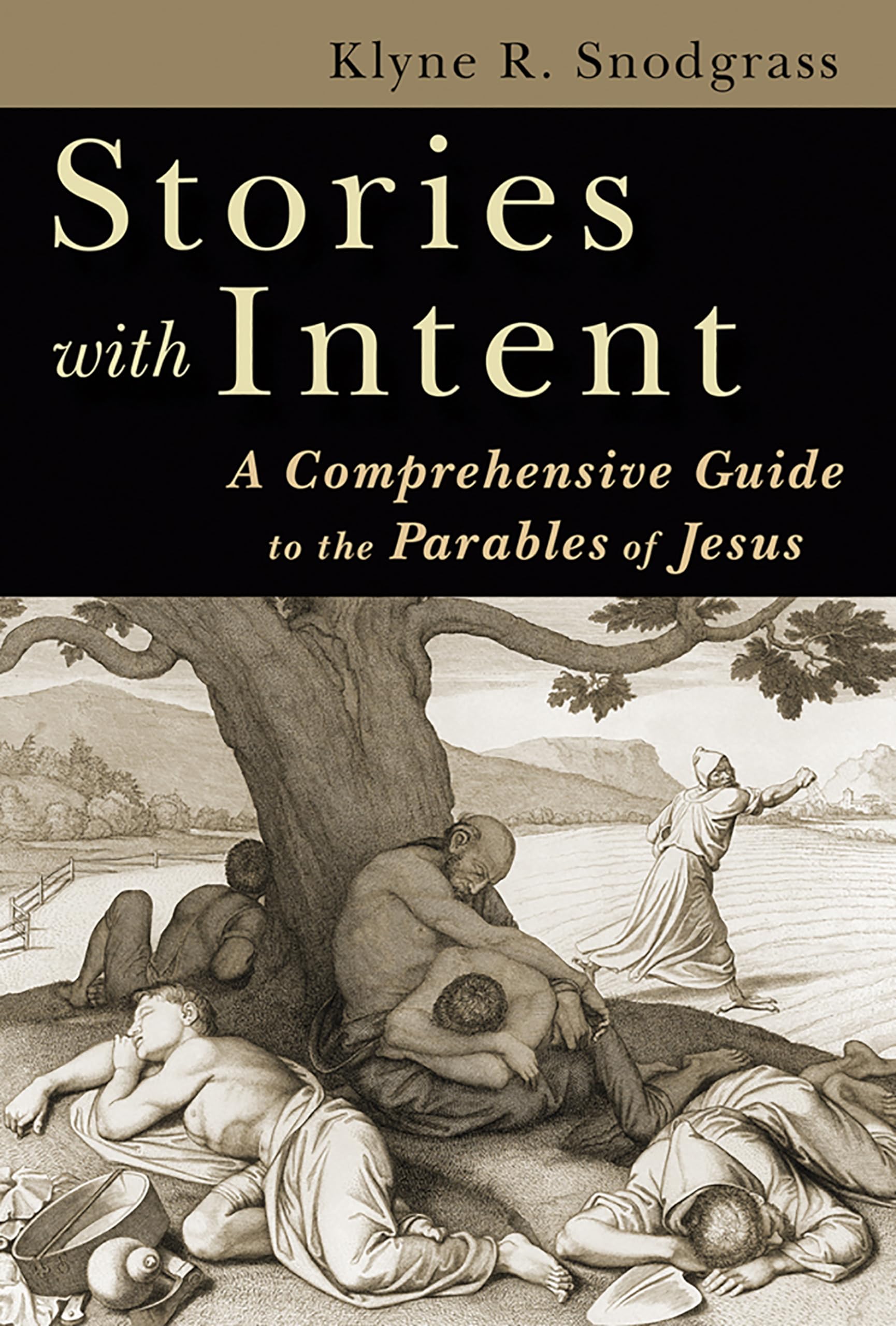
Since I'm now preaching a short series on The Parables of Jesus, I recently purchased and started reading Klyne Snodgrass's Stories with Intent: A Comprehensive Guide to the Parables of Jesus. Comprehensive it is. This book is 846 pages long (though over 300 pages of this are bibliography and notes)! But though it is comprehensive, it is written with preachers in mind. As Snodgrass admits in his preface, "This is unapologetically and quite consciously a selfishly motivated book. This is what I want when preparing to teach or preach on the parables" (p. xi). It's what I want, too, and I'm glad Snodgrass gave in to his selfish ambition!Snodgrass begins, of course, with an "Introduction to the Parables of Jesus," in which he covers (these are the subheadings): Necessary History; What is a Parable?; How Should Parables Be Classified?; What about Allegory?; Characteristics of Jesus' Parables; Distribution of the Parables; How Should Parables Be Interpreted?; and NT Criticism - Assumptions and Hesitations, Method and Procedure.He lists eleven characteristics of Jesus' parables: 1. Jesus' parables are first of all brief, even terse. 2. Parables are marked by simplicity and symmetry. 3. Jesus' parables focus mostly on humans. 4. The parables are fictional descriptions taken from everyday life. 5. Parables are engaging. 6. Since they frequently seek to reorient thought and behavior . . . parables often contain elements of reversal. 7. With their intent to bring about response and elements like reversal, the crucial matter of parables is usually at the end, which functions something like the punch line of a joke. 8. Parables are told into a context. This distinguishes the parables from Aesop's fables, which are stand alone morality tales. Jesus' parables, in contrast, are "not general storeis with universal truths" but "are addressed to quite specific contexts in the ministry of Jesus." 9. Jesus' parables are theocentric. 10. Parables frequently allude to OT texts. 11. Most parables appear in larger collections of parables.And, in discussing how to interpret the parables, Snodgrass offers the following principles: 1. Analyze each parable thoroughly. 2. Listen to the parable without presupposition as to its form or meaning. 3. Remember that Jesus' parables were oral instruments in a largely oral culture. 4. If we are after the intent of Jesus, we must seek to hear a parable as Jesus' Palestinian hearers would have heard it. 5. Note how each parable and its redactional shaping fit with the purpose and plan of each Evangelist. 6. Determine specifically the function of the story in the teaching of Jesus. 7. Interpret what is given, not what is omitted. Any attempt to interpret a parable based on what is not there is almost certainly wrong. 8. Do not impose real time on parable time. 9. Pay particular attention to the rule of end stress. 10. Note where the teaching of the parables intersects with the teaching of Jesus elsewhere. 11. Determine the theological intent and significance of each parable.Some of these principles, admittedly, need a bit more explanation and fleshing out than I am choosing to do in this review, but many of the principles are self-evident. This list at least gives you an idea of how Snodgrass approaches the task of interpretation.The next section covers Parables in the Ancient World, looking specifically at parables in the Old Testament, Early Jewish Writings, Greco-Roman Writings, The Early Church, and Later Jewish Writings. After that, Snodgrass jumps in to the actual parables themselves, dividing thirty-two parables into nine sections. These sections are entitled: * Grace and Responsibility * Parables of Lostness * The Parable of the Sower and the Purpose of Parables * Parables of the Present Kingdom in Matthew 13, Mark 4, and Luke 13 * Parables Specifically about Israel * Parables about Discipleship * Parables about Money * Parables concerning God and Prayer, and * Parables of Future EschatologyAs Snodgrass takes up each parable, he discusses the parable type, raises issues requiring attention, looks at helpful primary source material, does a comparison of the different accounts of the parable in the gospels, discusses textual issues worth noting, highlights helpful cultural information, then gives an explanation of the parable, talks about adapting the parable for our own context, and suggests further reading (as if he were not comprehensive enough for most people!). This really is a well organized book, designed to function more like a manual for ongoing reference, than to read straight through (which I'm not doing).Finally, the book ends with an epilogue, six appendices, over one hundred pages of notes and almost fifty pages of bibliography, and then two indices. I expect to use this book not only in my current sermon series, but for many years to come and heartily recommend it to others.
E**I
Probably the New Standard for the Next 20 Years
Klyne Snodgrass has done this decade and maybe the next two the favor of condensing 35 years of teaching the Parables of Jesus into "just" 800 pages or so, in Stories with Intent: A Comprehensive Guide to the Parables of Jesus.This is the book almost every seminary graduate will wish he or she had had when studying the parables. I do, and I wish I had had it the past 40 years. There are classics on the Parables, to be sure, such as the one by Jeremias The Parables of Jesus 3rd revised edition (simplified in his Rediscovering the Parables ), but none were as comprehensive as this one.Two features make Stories with Intent remarkably easy to read. First, all the chapters on the parables themselves follow the same basic outline, but it is the vertical white space that makes the outline stand out and the discussion particularly easy to follow. Secondly, all the advanced discussion is in the end notes, so that the reader who needs to follow up can and the reader who prefers not to can just keep reading.In addition, the chapters on the parables themselves end with a section called "Adapting the Parable" (just before "For Further Reading)." The former describes the significance of the parable for today, in somewhat wider ways than mere "application," though that it included, too. Often Snodgrass makes a pithy remark--almost a wisdom saying in its own right--to end that section. For example, "Once again, the note of joy, as an essential feature of the kingdom, cannot be neglected. Where joy is absent, the kingdom is absent" (concluding "The Lost Coin").One of the most unusual features of the book is that, for each parable discussed, it sets Jesus' parables in the context of the ancient world by prominently citing or paraphrasing parables or similar sayings from the Old Testament, Graeco-Roman authors, early and later Jewish/Rabbinic sources, and early Christian writers. For example, introducing the background of The Lost Coin, he cites Dio Chrysostom complaining that people who pay no attention to time and money still become distressed at losing 1 drachma [1 day's wage for a male laborer, 2 days' wage for a woman, he tells us later].I recommend that you read the first two chapters first before dipping into the chapters on individual parables, so that you will understand his approach and some technical terms that keep coming up in the later chapters, for example, "nimshal" (Hebrew or Aramaic for "explanatory interpretation"), defined early in the book and used fairly often later on (but with no subject index, ... well, hard to find its meaning presented).One interpretive principle he stated resonated with me: "... the realization that introductions such as 'The kingdom is like a man' (or a woman or seed, etc.) do not compare the kingdom to the characters or objects but to the whole process of the narration. ... We will see over and over that the whole narrated process in in view, not just the first item mentioned" (p. 29).If you are looking for the best book available on the Parables of Jesus and you have the skill to use it, this is it. You don't need a seminary degree to understand it, but there are times when it would make it easier for you. For most readers, it is like a gold mine, but they will have to dig a little to use it. Finally, you will want your Bible at hand and open to follow up on the passages he cites and, for sure, to read the parables under discussion.
W**E
The best book on the parables
This is the best and most comprehensive survey of the parables of Jesus. I got it cheap on Kindle and at a bargain price it's a must-have for any Bible student. It's a preacher's resource but not the kind of book that supplies you with ready-made sermon material - it still takes work and application.The author's line is pretty conservative, but I'm less impressed by the author's use of the non-canonical Gospel of Thomas which is given direct comparison with the canonical Gospels.
R**R
Exhaustive and exhausting treatment of Jesus' parables
This book could easily be subtitled 'Everything you wanted to know about the parables but were afraid to ask - and then some'. Snodgrass thoroughly reviews the ancient background to parables and proposes a complex classification that is more subtle than the allegory/non-allegory debate. His stance is conservative but not fundamentalist, and interacts with a broad range of scholarly perspectives.He then proceeds to exegete every text he considers to be a parable in the Gospels. To take one example, he takes twenty-four pages to cover the Parable of the Talents/Minas, and just two or three of those are a direct exegesis of Matthew's version that is usable in sermon preparation.So it may not be the book you are looking for if you want quick inspirational thoughts for a sermon, but if you are willing to be stretched I believe this is capable of becoming the new standard text in English on the parables.
J**M
A most interesting and rather unusual book, very informative ...
A most interesting and rather unusual book, very informative and well worth reading. It is quite different in its concept from the former interpretations of parables
F**K
And then some...
Incredibly comprehensive, covering all Jesus' parables, with plenty of insight and depth.It deals with each parable in turn, from its wording and meaning, how it fits together, what may be original, what it may have been based on, to eventually its meaning.It's this last area that misses the 5th star for me, as a preacher I could have done with some more thought to application. There are other commentaries for this of course.I read about this on theologian Scot McKnight's blog and have not been disappointed.
A**R
Good work for parables
A good book for preaching ideas it explains the parables in everyday language
Trustpilot
2 days ago
3 weeks ago