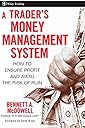

Desertcart purchases this item on your behalf and handles shipping, customs, and support to Netherlands.
๐ฐ Elevate Your Trading Game: Profit Smartly, Trade Wisely!
A Trader's Money Management System is an essential guide designed for traders seeking to enhance their financial acumen. This comprehensive resource provides proven strategies for maximizing profits while minimizing risks, ensuring that you navigate the trading landscape with confidence and expertise.
| Best Sellers Rank | #1,410,586 in Books ( See Top 100 in Books ) #310 in Risk Management (Books) #11,114 in Personal Finance (Books) #13,983 in Business & Finance |
| Customer Reviews | 4.0 out of 5 stars 125 Reviews |
S**S
Must have for traders for proper risk management
If you are serious about being a profitable stock trader then this book belongs on your top shelf. I have been trading stocks successfully for five years and have read over 100 books on the subject and put this in the top five for useful information. This book spells out each step very simply and clearly for money management,so that you can instantly know, step by step and formula by formula what you need to do so that risk is minimized and the probability of success is maximized. The six types of risk to manage in trading are covered in detail: 1. Trade risk 2. Market risk 3. Margin risk 4. Liquidity risk 5. Overnight risk 6. Volatility risk Your long term success will depend on your ability to control these variables to make your risk of ruin almost zero. "The markets are the ultimate university of finance and sometimes the tuition is on par with Harvard, Columbia, or Yale". This book will take you through exercises to identify your strengths and weaknesses as a trader and show you where improvement is needed. It will also give you questions to answer to grade yourself on where your personality is on the spectrum for taking on risk and also your level of discipline. This book contains a wealth of useful work sheets that enable you to track your trading statistics daily, weekly, monthly, and yearly. You should have at least 25 trades for a system, then check the statistics for that sample. The book suggests the key stats will be: the win ratio, payoff ratio, commission ratio, largest winning trade, largest losing trade, average winning trade, average losing trade, largest % of draw down, average of draw down, total % of profit/loss. These stats are crucial in determining where adjustments need to be made for greater success. While and average amount of risk is 2% of equity on each trade, your amount of risk could be adjusted higher or lower based on your win rate. If you are a fan of Alexander Elder's work then this book will fit in great with his methods. There is no greater book on money and risk management on the market that I know of. Don't go back in the market with out reading it and implementing the record keeping and risk control tactics it teaches.
R**R
Helpful Insight into Money Management and Trading Discipline
For the past two years, I traded in my IRA using a variety of approaches recommended by different trading gurus and authors. I've tried everything from so-called "PhD level" training by a major brokerage firm, subscribing to dozens of trading services, and several specialized ETF trading "colleges" by so called trading experts and fund managers. The experiences ranged from dissappointing to a waste of time and money. In the process, I've picked up a few trading skills, but not to the level I expected for over $40,000 invested in my training. The one thing I have learned is to trust in myself and not listen to the hype you get from these so called "gurus". I've read parts of a lot of books on trading and never completed any of them. They either were too technical or too difficult to follow and never really presented a strategy I felt comfortable to implement on my own. An area in which most books gloss over or fail to stress, is in the use stops and an effective money management system. A few will go so far as to discourage using stops. Most will make reference to needing to adhere to good money management techniques, but fail to go into detail on how to do this. After reading Bennett McDowell's "A Trader's Money Management System" and "The Art of Trading" The ART of Trading: Combining the Science of Technical Analysis with the Art of Reality-Based Trading (Wiley Trading) , I finally have the confidence and knowledge to start 2010 with a trading plan and strategy for success. I learned how and why to use stops. Not just the importance of stops, but the actual logic behind them. Having lost a lot of money in trades gone bad, I now understand why I should never enter a trade without a good stop in place. By using stops on every trade, I will avoid catastrophic losses and drawdowns. I also learned how the ART System can help me identify entries and exits before placing the trade and how to precisely calculate my trade size in shares or contracts to maximize my reward/risk ratio. By using the ART system to correctly identify "entries and exits", I will have the confidence to place my trades without fear of losing big. I also have a new sense of committment I've been missing in my trading. I plan to paper trade for a few months to master these new skills before risking real money. By incorporating the ART System into my trading strategy, and using a carefully crafted Money Management plan for my future trading, I feel my future as a trader will greatly improve. His books are easy reads and use a lot of examples to help the reader understand the "why" and "how" of what is being discussed. Thank you, Bennett for helping to enlighten all traders on these very important aspects of trading.
M**N
An Organized Approach
I found A Trader's Money Management System extremely valuable and informative. In this book Bennett McDowell divides money management into five parts: The Psychology of Risk Control, Stop-Loss Exits, Trade Size, Record Keeping and Design Your Own Plan. In the Psychology of Risk Control section he discusses the need for a plan of risk control then presents ways of uncovering your psychological makeup which either aid or hinder your trading. Then he outlines a systematic approach to turning your weaknesses into strengths on the way to a trader's mindset. In the Stop-Loss Exit section Mr. McDowell makes a case for stop-losses and gives rules and their uses in different market conditions. The Trade Size section was fascinating, perhaps because I am a math major. Here he explains the tables and formulas for determining the amount of capital to risk, the trade size to achieve this and the probabilities for risk-of-ruin based on your personal success ratios. The Record Keeping Section explains the use of ledgers and score cards to track your trades and analyze your success rates which is vital to becoming a master trader. Finally in Design Your Own Plan Mr. McDowell puts it all together with a step-by-step checklist and personal questionnaire to help you design a realistic and workable plan that you can implement on a regular basis. This book is well written and concise. I highly recommend it for all levels of traders.
D**.
A truly useful starting point for trading success
Like many other aspiring traders, I started by focusing on trading systems that promised high rates of return. While these may have worked well for others, my lack of understanding and discipline regarding risk management, trading mindset and record keeping was more than enough to sabotage my trading them successfully. It's this dilemma that Bennett McDowell addresses with this book, and he does it in a way that skips fancy approaches in favor of a simple, time-tested set of tools that even a novice trader can understand and put to immediate use. Well worth the cost, especially for beginners, and almost certain to spare you both unnecessary losses and loads of frustration.
A**R
A Must-Have for EVERY Trader!
All traders attempt to discover the "Holy Grail" at some point in their trading careers. Most traders lose all their capital (money) in this quest. The truth is - there is NO HOLY GRAIL! Every trader loses on a percentage of their trades. The key is: lose as little as possible on your losers and win as much as possible on your winners, which is easier said than done, I know. Bennett McDowell's "A Trader's Money Management System" is a thoughtful and precision-based approach to maintaining a firm grasp on your trading track record. This is accomplished through a detailed and process of documenting every trade and being totally honest with yourself about your trading as you review your trading results. Bennett's writing is accessible and, most important, makes sense! His system is simple and he has gone the extra mile and created an amazing software package called the Trader's Assistant that takes everything he teaches in the book to a whole new level. If you're serious about trading successfully, you NEED this book!
R**B
Good Book on Money Managment that covers the Basics
I enjoyed McDowell's writing style. It was a quick read and easy to understand. I would recommend this book to anyone who wants a "basic" understanding of risk psychology, methods and procedures. I only gave the book (3) stars because the author makes a general explanation of important concepts and then sights other books to read for a more thorough understanding. It was enough to get my lips wet, but left me thirsty for a better understanding. I now have to refer to other sources. Bottom line: Good book for the basics.
J**H
Dissappointing
John T Morris' 2-star review sums it up nicely. I'd read that as well before making a buy decision. The gist of the book is that if you're brand new to trading, barely finished highschool math, and have not done much reading on trading yet, this book might be useful, otherwise probably not. For the record, I am not an experienced trader, I'm an aspiring student, and this was way below my level -- way below. It would serve as a nice survey/intro to other books, but I didn't feel it stood on it's own very well. The gist of the book can be summed up quick: - bet no more than 2% unless you know what you're doing - use stops - buy my other book - go spend money on my website To tweak how much you should wager, he refers the reader to Money Management Strategies for Future Traders (Balsara) and Beyond Technical Analysis 2nd (Chande). This book doesn't really stand on it's own without those tables the author says are in Money Management Strategies. The author has a section on Psychology, but tries to do way too much, and just comes up really short, especially when compared to most other books that try to cover trading psychology. The book is only 150 pages, less blank pages at the start of most chapters (14) and sections (5), full page examples of filling out queue cards (16), uses moderately large font, and then has the normal charts and formulas of a trading book. There's really very little actual content when it's left over, especially when the author keeps saying "trade only 2 percent" followed by a 1/5 page "Important Note" saying go look at chapter 9 for an exception to the rule. That important note is repeated ad nauseum. This book is a survey of other works, stitched together from other works that reads like a late night infomercial. (I'd probably have given this book a 2-star review, the extra star being for the templates and record keeping system which appears to be not bad, but the Author has given himself a 5-star review which I find to be in bad taste. After reading the book and some of the 5-star reviews, I would question the authenticity of the other reviews.)
E**R
The greatest book on money and risk management!
This is the greatest book on money and risk management! Money Management is one of the most important aspects of trading, but it is a complex and boring subject. Mr.McDowell makes some of these complex concepts (like the risk-of-ruin tables) and formulas easy to understand and interesting. You don't need a Ph D in mathematics to implement them. This book has elevated my level of awareness of the importance of integrating trading strategies with good money management. The next big thing this book provides is "The Trader's Assistant Record Keeping System". Good and accurate record keeping are vital to any successful business. Appendix B of this book provides all the forms you need for your trading business. This one alone is worth more than the price of this book. Also, the services from the home office are excellent. Jean returned my call promptly (even on a Friday afternoon) and she is very friendly and helpful. Thanks Jean, you are great! Now, I am going to order Mr. McDowell's other book: "The ART of Trading".
N**H
Good book,
Nice book for risk... management for beginners and experienced trader's also ..must read.
D**N
Very important book.
First step in any trading system is to learn how to keep your money safe. Second step is to learn how to trade successfully.
B**E
Basic, clear and readily usable information
Money management is one critical component of trading. Through this book I learned its basic concepts in an easy language and in way that make such concepts immediately implementable. I also discovered that I was naturally/instinctively applying most of these concepts but lacked an organised system to be able to review and analyse performance. An essential read for every novice trader and possibly still worth for more experienced ones. 4/5 stars just due the continuous reminding of the tools available for sale by Bennet's company. Personally I find the continuous reminders a bit annoying and I would have preferred to see these tools advertised once only somewhere key in the book instead of reading about them every other page.
V**H
With it
Good book worth to pay for 3-5 year experience trader
Trustpilot
1 month ago
1 month ago