We remain fully operational. Our teams are working around the clock to ensure your deliveries continue safely.

DOWNLOAD THE APP


Customer Services
Copyright © 2025 Desertcart Holdings Limited
DOWNLOAD THE APP
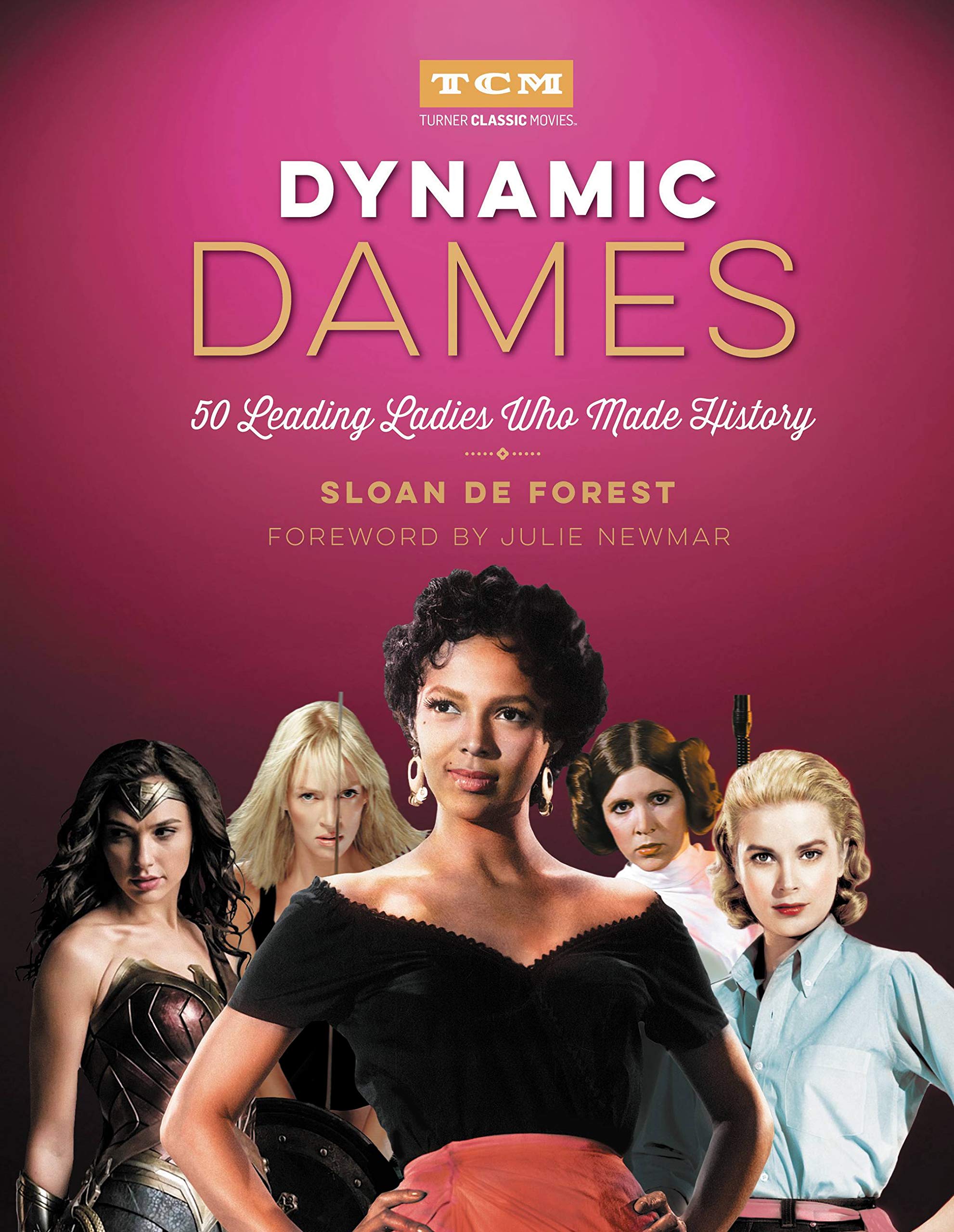
Dynamic Dames: 50 Leading Ladies Who Made History (Turner Classic Movies) - Kindle edition by De Forest, Sloan, Turner Classic Movies, Newmar, Julie. Download it once and read it on your Kindle device, PC, phones or tablets. Use features like bookmarks, note taking and highlighting while reading Dynamic Dames: 50 Leading Ladies Who Made History (Turner Classic Movies). Review: Sloan De Forest has crafted a valuable book for cinephiles…and others - Turner Classic Movies has produced a series of lovely books for cinephiles. One released year before last is Dynamic Dames: 50 Leading Ladies Who Made History by Sloan De Forest, who, if I might be forgiven, is a quite a dynamic dame herself. This book is well put up and enjoys careful attention to its “production values,” to use a cinematic term, which is evident first upon examination of the lovely cover. Arrayed across the bottom half of the cover are overlapping images of five women making it appear that they were photographed at the same time. Tellingly enough, the dominant central image is of the stunningly beautiful Dorothy Dandridge, whose acting and singing talent did not spare her from a double dose of discrimination for being a woman and one of color in the androcentric, bigoted film capital of the US. Dandridge is joined by a quartet of strong, even super-heroic women, each arresting in her own way, including Gal Gadot, Uma Thurman, Carrie Fisher, and Grace Kelly. The back cover features another four fabulous ladies, including Bette Davis, Pam Greer, Elizabeth Taylor, and Emma Watson. The subtitle of the book lets us know what we can anticipate, i.e., 50 Leading Ladies Who Made History. So, the author chose 50 female actors who she deemed to have been the best representative of the eight categories she chose to highlight in the book. The eight categories are Pre-Code Bad Girls, Reel Role Models, Big Bad Mamas, Fatal Femmes, Ladies Who Laugh, Women of Mystery, Strong Survivors, and Superheroines. In each of these categories, Ms. De Forest has chosen an array of films from several decades, usually beginning with the 1930s or 1940s and extending into later decades, in some cases, the immediate past decade. The first category of Pre-Code Bad Girls necessarily explores films made before the Motion Picture Production Code took effect and left Hollywood bereft of the ability to explore really juicy themes of what “bad girls” can accomplish. The final category is similarly limited in coverage, ranging from films featuring superheroines released in the latter portion of the 1970s to one released in 2017. The Motion Picture Production Code came into effect in mid-1934 when the watchdog group thought it necessary to protect the American movie-going public from seeing on the screen what it otherwise could see any given day on the streets of the places where the theaters were found. So, the section on the Pre-Code era covers films released necessarily in 1934 or before. The first of these “bad girl” films was also pre-sound, the 1926 zinger Mantrap starring Clara Bow as “Alverna.” This chapter establishes the format used throughout the book. Each chapter features a full-page photograph of the featured actress. Then, the text begins on the facing page, invariably engagingly written so as to place the film in the context of the period in which it was released. That text generally occupies two or three pages on which also are placed two or three photos featuring the lady in question and perhaps her costars and/or directors. Somewhere on these pages is a quote from the character played in the film being featured. Each chapter then ends with a section entitled “Did You Know?” in which De Forest highlights a little-known fact. The remaining Pre-Code films the author includes feature the work of Norma Shearer (The Divorcée, 1930), Bette Davis (Ex-Lady, 1933), Barbara Stanwyck (Baby Face, 1933), Mae West (I’m No Angel, 1933), and Josephine Baker (Zouzou, 1934). Among other reasons, these early films are interesting because they show how filmmakers could features stories of tough women making life difficult for men while dealing with some always popular pursuits such as adultery, sex without marriage, and getting ahead by going to bed. The eight categories feature from five to eight actresses chosen by De Forest to exemplify the category. The first set, the Pre-Code Bad Girls, consists of the six ladies noted above, some finishing up careers, some beginning what would be long careers, some pursuing short-lived film careers. Mae West was perhaps the archetypal “bad girl,” who was wont to opine that “it’s not the men in your life that counts, it’s the life in your men. Can you imagine trying to keep up with her? The next set of nine films, Reel Role Models, feature actresses playing real women in films released from 1933 to 2018. My personal favorites among these films are the 1933 Queen Christina with Greta Garbo in the title role, Natalie Wood in the 1962 Gypsy Rose Lee as the famous ecdysist, Meryl Streep in the 1985 Out of Africa as the author Karen Blixen, and Salma Hayek in the 2002 Frida as the famous Mexican artist. This is not to discount the worth of the other five films, including the one I have not yet seen (Colette, from 2018). The third set of films comprises five so-called “Big Bad Mamas.” As the title suggests, the films deal with women who take to task men ranging from a ghost in 1947’s The Ghost and Mrs. Muir, through an inexperienced young lad in 1967’s The Graduate, to lots of male soldiers in 1960’s Two Women and, finally, a cyborg in 1984 and 1991’s two Terminator franchise entries. The next set of five films includes those De Forest picked to represent the type of women described as the “Fatal Femmes.” These ladies are tough women that the author notes “are hazardous to your health,” meaning male health. The introductory pages for this section feature a. photograph of one of the most stunning women to ever grace films, i.e., Dorothy Dandridge, in her role as “Carmen Jones” in the filmization of the original stage version. Unfortunately, Miss Dandridge did not follow the advice of her character, as quoted by the author, i.e., “Maybe you ain’t got the message yet, but Carmen’s one gal nobody puts on a leash. No man’s gonna tell me when I can come and go. I gotta be free or I don’t stay at all.” She should have told Otto Preminger that. Another outstanding choice in this section is Witness for the Prosecution, the 1958 film that gave Marlene Dietrich a choice role, actually two roles, opposite Charles Laughton and Tyrone Power. Although her presence on the screen in that film was limited, her performance was a powerful one that merits rewatching. The next six films are grouped into a section entitled “Ladies Who Laugh.” Ms. De Forest chose as her lead-in the wonderful performance of Rosalind Russell in the fast-paced His Girl Friday, famous for its mile-a-minute overlapping dialogue. Ms. Russell as Hildy Johnson easily keeps pace with an equally talkative Cary Grant. Another favorite of mine is Adam’s Rib starring Katharine Hepburn alongside her beloved Spencer Tracy, a powerhouse acting couple that gave us many memorable performances beyond this one. The hits just keep on coming with an all-time Disney favorite of mine, “Mary Poppins.” After a long period of absorption with Disney’s film production from my youth on forward, in 1964 his company produced the marvelous film that showcased the incomparable talents of Julie Andrews and her co-star Dick Van Dyke. Naturally, once heard, no one forgets how to say “supercalifragilisticexpialidocious.” The next section is entitled “Women of Mystery” and includes another six films released from 1934 to 1991. Several of my favorites are presented here, including The Thin Man, with Myrna Loy as Nora Charles in the first of that series of six mystery films that starred she and her co-star William Powell based on the Dashiell Hammett detective novels. This film and its sequels must have done wonders for the popularity of the martini. Another choice for this section is an interesting one, that of Nancy Drew…Detective that starred teen-aged Bonita Granville. As people my age probably know, this film and its sequels were developed from the series of mysteries for teenagers written by a number of authors all using the pseudonym Carolyn Keene beginning in 1930. Although I never became interested in these novels while growing up, I certainly did enjoy other such series for teenagers that were published by the Whitman Publishing Company in Racine, Wisconsin. Another favorite discussed in this section is the 1944 film Gaslight, which starred the luminous Ingrid Bergman as the woman being gaslighted by her husband, played by Charles Boyer in an uncharacteristic role. Yes, it is from this film that we now have the term gaslighting to describe a form of psychological manipulation of a person or people so as to make them question their own reality. This term has taken on a new-found currency in the political realm in recent years. This section finishes up with treatments of two other of my favorite films, one the Grace Kelly starrer Rear Window and the multi-award-winning The Silence of the Lambs with Jodie Foster in the lead role. Rear Window also starred Jimmy Stewart in a role allowing him to “rest on his…u-m-m-m…laurels,” while enjoying a voyeuristic investigation of a possible homicide. Jodie Foster played Clarice Starling against Anthony Hopkins in the role of a lifetime as the cannibalistic serial killer Hannibal Lecter. This film is well-known as one of only three films ever made to win the five “big” Oscars, i.e., best picture, best actor, best actress, best director, and best adapted screenplay. “Strong Survivors” is a section of six films starring women playing stalwart females who “stick it out to the bitter end.” Included is the popular-to-this-day examination of the war-torn South Gone with The Wind, one of the remarkable series of films that made 1939 the most famous of the Hollywood years. This film gave the coveted role of Scarlett O’Hara to the English actress Vivien Leigh, who played against the actor born to play Rhett Butler, Clark Gable. Scarlett is the one who taught us about survival and optimism, with the final line of the movie, “Tomorrow is another day.” De Forest also chose to include highlights of Sigourney Weaver in Alien and Aliens, Whoopi Goldberg in The Color Purple, Geena Davis and Susan Sarandon in Thelma & Louise, Angela Bassett in What’s Love Got to Do with It, and Jennifer Lawrence in The Hunger Games films. The final section of the book presents six films examining the exploits of several super-heroines. She begins with Carrie Fisher in the Star Wars series, which also spotlighted the young Harrison Ford. She was essentially the only female in an otherwise testosterone-laden male cast of heroes and villains. Next up is Zhang Ziyi, featured in Crouching Tiger, Hidden Dragon, which also starred the spectacular Michelle Yeoh. These two ladies are able to kick some serious butt, aided by the magical sword, the Green Destiny. Then comes Emma Watson as the teen-aged witch in the Harry Potter films, based on the immensely popular series of novels by J. K. Rowling, the world’s first billionaire book author. This section concludes with reviews of the sword-wielding Uma Thurman in Kill Bill, volumes i and ii, Charlize Theron in Mad Max: Fury Road, and last, but certainly not least, Gal Gadot in the perfectly-fitted role as Wonder Woman. Oh, boy, you bet. Ms. De Forest does an amazing job in this wonderful book to demonstrate that women are the equal of men in the most important ways…and oftentimes just better at the things that really matter in life. If you are like me, a man who is an unabashed fan of women, all women, then you will want to read this book and thereafter place it in a special nook on the bookshelf for further examination as needed. If you are a woman, then you will find women just like yourself portraying other strong-willed, capable, and whole women. You, too, should do yourself a favor and read this book, but it is really we men who need to be reminded how poverty-stricken we would be without the gift of women in our lives. Review: Enjoyable - Liked reading not only about the characters in various films, but about the actresses who portrayed them, their own lives and attitudes.
| ASIN | B07K6JPJ3D |
| Accessibility | Learn more |
| Best Sellers Rank | #1,091,579 in Kindle Store ( See Top 100 in Kindle Store ) #244 in Video Guides & Reviews #323 in Movie & Video Guides & Reviews #964 in Movie & Video History & Criticism |
| Customer Reviews | 4.6 4.6 out of 5 stars (150) |
| Edition | Illustrated |
| Enhanced typesetting | Enabled |
| File size | 108.9 MB |
| ISBN-13 | 978-0762465507 |
| Language | English |
| Page Flip | Enabled |
| Part of series | Turner Classic Movies |
| Print length | 247 pages |
| Publication date | July 2, 2019 |
| Publisher | Running Press Adult |
| Screen Reader | Supported |
| Word Wise | Enabled |
| X-Ray | Enabled |
L**N
Sloan De Forest has crafted a valuable book for cinephiles…and others
Turner Classic Movies has produced a series of lovely books for cinephiles. One released year before last is Dynamic Dames: 50 Leading Ladies Who Made History by Sloan De Forest, who, if I might be forgiven, is a quite a dynamic dame herself. This book is well put up and enjoys careful attention to its “production values,” to use a cinematic term, which is evident first upon examination of the lovely cover. Arrayed across the bottom half of the cover are overlapping images of five women making it appear that they were photographed at the same time. Tellingly enough, the dominant central image is of the stunningly beautiful Dorothy Dandridge, whose acting and singing talent did not spare her from a double dose of discrimination for being a woman and one of color in the androcentric, bigoted film capital of the US. Dandridge is joined by a quartet of strong, even super-heroic women, each arresting in her own way, including Gal Gadot, Uma Thurman, Carrie Fisher, and Grace Kelly. The back cover features another four fabulous ladies, including Bette Davis, Pam Greer, Elizabeth Taylor, and Emma Watson. The subtitle of the book lets us know what we can anticipate, i.e., 50 Leading Ladies Who Made History. So, the author chose 50 female actors who she deemed to have been the best representative of the eight categories she chose to highlight in the book. The eight categories are Pre-Code Bad Girls, Reel Role Models, Big Bad Mamas, Fatal Femmes, Ladies Who Laugh, Women of Mystery, Strong Survivors, and Superheroines. In each of these categories, Ms. De Forest has chosen an array of films from several decades, usually beginning with the 1930s or 1940s and extending into later decades, in some cases, the immediate past decade. The first category of Pre-Code Bad Girls necessarily explores films made before the Motion Picture Production Code took effect and left Hollywood bereft of the ability to explore really juicy themes of what “bad girls” can accomplish. The final category is similarly limited in coverage, ranging from films featuring superheroines released in the latter portion of the 1970s to one released in 2017. The Motion Picture Production Code came into effect in mid-1934 when the watchdog group thought it necessary to protect the American movie-going public from seeing on the screen what it otherwise could see any given day on the streets of the places where the theaters were found. So, the section on the Pre-Code era covers films released necessarily in 1934 or before. The first of these “bad girl” films was also pre-sound, the 1926 zinger Mantrap starring Clara Bow as “Alverna.” This chapter establishes the format used throughout the book. Each chapter features a full-page photograph of the featured actress. Then, the text begins on the facing page, invariably engagingly written so as to place the film in the context of the period in which it was released. That text generally occupies two or three pages on which also are placed two or three photos featuring the lady in question and perhaps her costars and/or directors. Somewhere on these pages is a quote from the character played in the film being featured. Each chapter then ends with a section entitled “Did You Know?” in which De Forest highlights a little-known fact. The remaining Pre-Code films the author includes feature the work of Norma Shearer (The Divorcée, 1930), Bette Davis (Ex-Lady, 1933), Barbara Stanwyck (Baby Face, 1933), Mae West (I’m No Angel, 1933), and Josephine Baker (Zouzou, 1934). Among other reasons, these early films are interesting because they show how filmmakers could features stories of tough women making life difficult for men while dealing with some always popular pursuits such as adultery, sex without marriage, and getting ahead by going to bed. The eight categories feature from five to eight actresses chosen by De Forest to exemplify the category. The first set, the Pre-Code Bad Girls, consists of the six ladies noted above, some finishing up careers, some beginning what would be long careers, some pursuing short-lived film careers. Mae West was perhaps the archetypal “bad girl,” who was wont to opine that “it’s not the men in your life that counts, it’s the life in your men. Can you imagine trying to keep up with her? The next set of nine films, Reel Role Models, feature actresses playing real women in films released from 1933 to 2018. My personal favorites among these films are the 1933 Queen Christina with Greta Garbo in the title role, Natalie Wood in the 1962 Gypsy Rose Lee as the famous ecdysist, Meryl Streep in the 1985 Out of Africa as the author Karen Blixen, and Salma Hayek in the 2002 Frida as the famous Mexican artist. This is not to discount the worth of the other five films, including the one I have not yet seen (Colette, from 2018). The third set of films comprises five so-called “Big Bad Mamas.” As the title suggests, the films deal with women who take to task men ranging from a ghost in 1947’s The Ghost and Mrs. Muir, through an inexperienced young lad in 1967’s The Graduate, to lots of male soldiers in 1960’s Two Women and, finally, a cyborg in 1984 and 1991’s two Terminator franchise entries. The next set of five films includes those De Forest picked to represent the type of women described as the “Fatal Femmes.” These ladies are tough women that the author notes “are hazardous to your health,” meaning male health. The introductory pages for this section feature a. photograph of one of the most stunning women to ever grace films, i.e., Dorothy Dandridge, in her role as “Carmen Jones” in the filmization of the original stage version. Unfortunately, Miss Dandridge did not follow the advice of her character, as quoted by the author, i.e., “Maybe you ain’t got the message yet, but Carmen’s one gal nobody puts on a leash. No man’s gonna tell me when I can come and go. I gotta be free or I don’t stay at all.” She should have told Otto Preminger that. Another outstanding choice in this section is Witness for the Prosecution, the 1958 film that gave Marlene Dietrich a choice role, actually two roles, opposite Charles Laughton and Tyrone Power. Although her presence on the screen in that film was limited, her performance was a powerful one that merits rewatching. The next six films are grouped into a section entitled “Ladies Who Laugh.” Ms. De Forest chose as her lead-in the wonderful performance of Rosalind Russell in the fast-paced His Girl Friday, famous for its mile-a-minute overlapping dialogue. Ms. Russell as Hildy Johnson easily keeps pace with an equally talkative Cary Grant. Another favorite of mine is Adam’s Rib starring Katharine Hepburn alongside her beloved Spencer Tracy, a powerhouse acting couple that gave us many memorable performances beyond this one. The hits just keep on coming with an all-time Disney favorite of mine, “Mary Poppins.” After a long period of absorption with Disney’s film production from my youth on forward, in 1964 his company produced the marvelous film that showcased the incomparable talents of Julie Andrews and her co-star Dick Van Dyke. Naturally, once heard, no one forgets how to say “supercalifragilisticexpialidocious.” The next section is entitled “Women of Mystery” and includes another six films released from 1934 to 1991. Several of my favorites are presented here, including The Thin Man, with Myrna Loy as Nora Charles in the first of that series of six mystery films that starred she and her co-star William Powell based on the Dashiell Hammett detective novels. This film and its sequels must have done wonders for the popularity of the martini. Another choice for this section is an interesting one, that of Nancy Drew…Detective that starred teen-aged Bonita Granville. As people my age probably know, this film and its sequels were developed from the series of mysteries for teenagers written by a number of authors all using the pseudonym Carolyn Keene beginning in 1930. Although I never became interested in these novels while growing up, I certainly did enjoy other such series for teenagers that were published by the Whitman Publishing Company in Racine, Wisconsin. Another favorite discussed in this section is the 1944 film Gaslight, which starred the luminous Ingrid Bergman as the woman being gaslighted by her husband, played by Charles Boyer in an uncharacteristic role. Yes, it is from this film that we now have the term gaslighting to describe a form of psychological manipulation of a person or people so as to make them question their own reality. This term has taken on a new-found currency in the political realm in recent years. This section finishes up with treatments of two other of my favorite films, one the Grace Kelly starrer Rear Window and the multi-award-winning The Silence of the Lambs with Jodie Foster in the lead role. Rear Window also starred Jimmy Stewart in a role allowing him to “rest on his…u-m-m-m…laurels,” while enjoying a voyeuristic investigation of a possible homicide. Jodie Foster played Clarice Starling against Anthony Hopkins in the role of a lifetime as the cannibalistic serial killer Hannibal Lecter. This film is well-known as one of only three films ever made to win the five “big” Oscars, i.e., best picture, best actor, best actress, best director, and best adapted screenplay. “Strong Survivors” is a section of six films starring women playing stalwart females who “stick it out to the bitter end.” Included is the popular-to-this-day examination of the war-torn South Gone with The Wind, one of the remarkable series of films that made 1939 the most famous of the Hollywood years. This film gave the coveted role of Scarlett O’Hara to the English actress Vivien Leigh, who played against the actor born to play Rhett Butler, Clark Gable. Scarlett is the one who taught us about survival and optimism, with the final line of the movie, “Tomorrow is another day.” De Forest also chose to include highlights of Sigourney Weaver in Alien and Aliens, Whoopi Goldberg in The Color Purple, Geena Davis and Susan Sarandon in Thelma & Louise, Angela Bassett in What’s Love Got to Do with It, and Jennifer Lawrence in The Hunger Games films. The final section of the book presents six films examining the exploits of several super-heroines. She begins with Carrie Fisher in the Star Wars series, which also spotlighted the young Harrison Ford. She was essentially the only female in an otherwise testosterone-laden male cast of heroes and villains. Next up is Zhang Ziyi, featured in Crouching Tiger, Hidden Dragon, which also starred the spectacular Michelle Yeoh. These two ladies are able to kick some serious butt, aided by the magical sword, the Green Destiny. Then comes Emma Watson as the teen-aged witch in the Harry Potter films, based on the immensely popular series of novels by J. K. Rowling, the world’s first billionaire book author. This section concludes with reviews of the sword-wielding Uma Thurman in Kill Bill, volumes i and ii, Charlize Theron in Mad Max: Fury Road, and last, but certainly not least, Gal Gadot in the perfectly-fitted role as Wonder Woman. Oh, boy, you bet. Ms. De Forest does an amazing job in this wonderful book to demonstrate that women are the equal of men in the most important ways…and oftentimes just better at the things that really matter in life. If you are like me, a man who is an unabashed fan of women, all women, then you will want to read this book and thereafter place it in a special nook on the bookshelf for further examination as needed. If you are a woman, then you will find women just like yourself portraying other strong-willed, capable, and whole women. You, too, should do yourself a favor and read this book, but it is really we men who need to be reminded how poverty-stricken we would be without the gift of women in our lives.
K**T
Enjoyable
Liked reading not only about the characters in various films, but about the actresses who portrayed them, their own lives and attitudes.
R**S
Goodreads
a good read of i!potent strong female actresses,. Easy to read although I wish it was more completed worth reading good read
R**G
My Mother, My Daughter and the Love of Acting
I have not read the book, but it was the perfect gift for my adult daughter as she continues to act, audition and study her first love - even while having a successful professional career as a recruiter/staffer. So timely in that she now is also teaching the art of acting to other aspirants.
J**S
Greatness
Great book! I’m honored to say I grew up with Sloan De Forest! She’s a total sweetheart and an all around cool chick! MC Lively Eagles (She knows what this means)
C**T
Top-quality all the way through
I can't find anything bad to say about the book or its contents . If you are a movie fan , you will love the pictures and the stories . The choice of women in this book was also well thought and put together.
R**T
A Must Have Book For Any Film Buff
Excellent book filled with excellent stories of great actresses both past and present. Great big to add to any library.
A**R
Good Read
I love this book. Awesome source of knowledge and a must have for movie buffs.
J**E
Nice book that covered a lot of famous women and was quite enjoyable to read.
L**E
This was a gift request for Christmas. I am sure it will be fully enjoyed!
M**W
This is a very well written book! Very gorgeous pictures too! Some of the actresses featured are Audrey Hepburn, Bette Davis, Gal Gadot, Sigourney Weaver, Melanie Griffith and many more. A must have for sure!
Trustpilot
2 weeks ago
3 weeks ago