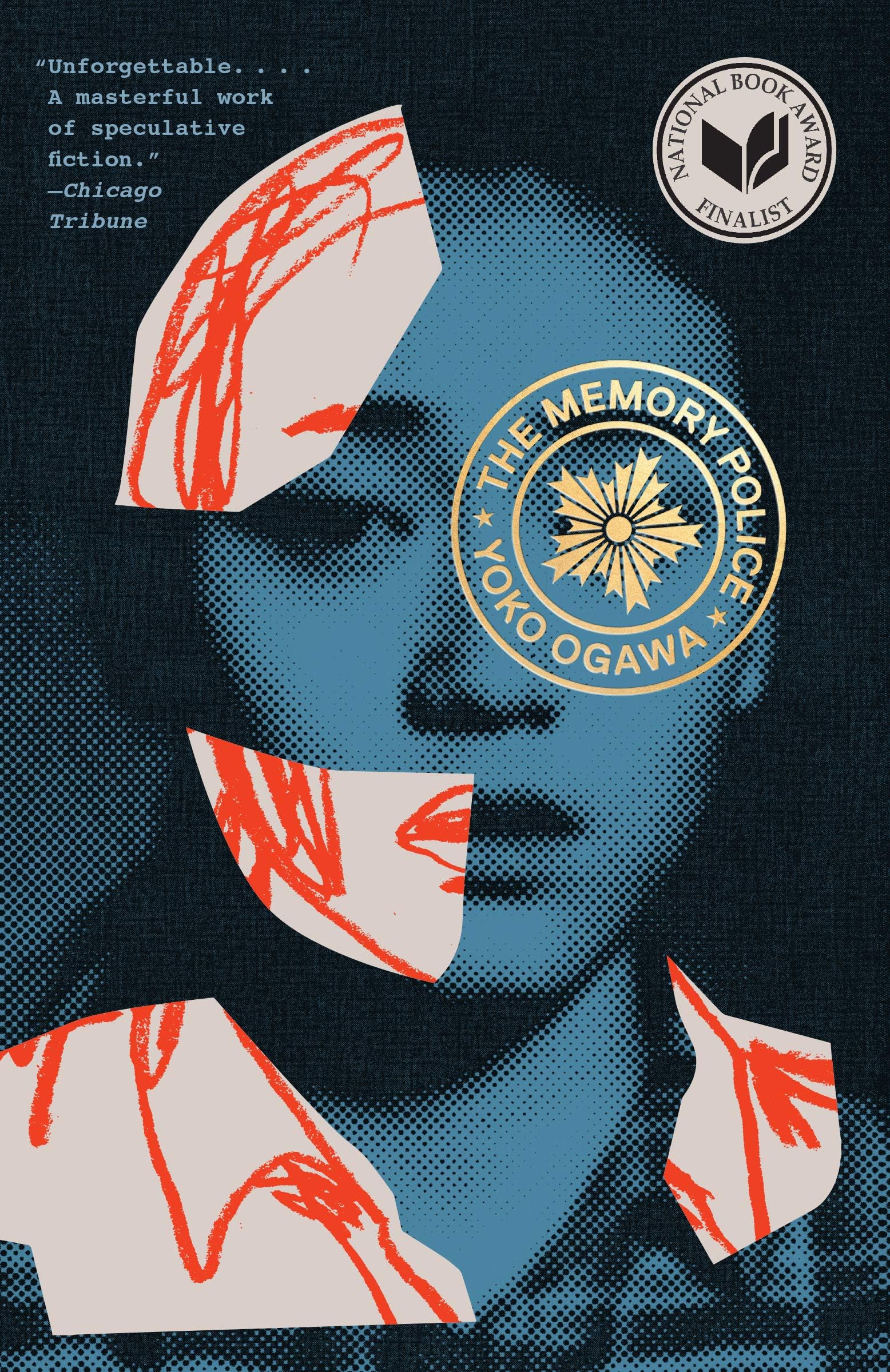
The Memory Police: A Novel
Product ID: 119472968
Finalist for the International Booker Prize and the National Book Award A haunting Orwellian novel about the terrors of state surveillance, from the acclaimed author of The Housekeeper and the Professor . On an unnamed island, objects are disappearing: first hats, then ribbons, birds, roses. . . . Most of the inhabitants are oblivious to these changes, while those few able to recall the lost objects live in fear of the draconian Memory Police, who are committed to ensuring that what has disappeared remains forgotten. When a young writer discovers that her editor is in danger, she concocts a plan to hide him beneath her floorboards, and together they cling to her writing as the last way of preserving the past. Powerful and provocative, The Memory Police is a stunning novel about the trauma of loss. ONE OF THE BEST BOOKS OF THE YEAR THE NEW YORK TIMES * THE WASHINGTON POST * TIME * CHICAGO TRIBUNE * T HE GUARDIAN * ESQUIRE * THE DALLAS MORNING NEWS * FINANCIAL TIMES * LIBRARY JOURNAL * THE A.V. CLUB * KIRKUS REVIEWS * LITERARY HUB American Book Award winner Review: A Beautiful, Poignant, Brilliant, Strange, Captivating, and Terrifying Tale - Yoko Ogawa’s “The Memory Police” blends dystopian fiction, science fiction, and magical realism into a mesmerizing exploration of memory and identity. This beautifully written tale is simultaneously poignant, brilliant, strange, captivating, and terrifying. The novel takes place on an unnamed island where objects periodically “disappear”—not just from people’s memories, but physically as well. The Memory Police systematically remove items, even books, from society, ensuring these items cannot trigger remembrance. What makes this premise so chilling is the totalitarian enforcement of forgetting—a true Orwellian tale of government control and authoritarian rule. As these disappearances accumulate, Ogawa shows how every aspect of our lives, down to the smallest objects, anchors our sense of reality and personal history. Something vanishes every day, erasing little pieces of people’s lives. Most island inhabitants forget these items immediately, going about their lives as if nothing has changed. But some remember—and these individuals live in constant danger, hunted by the Memory Police who enforce the disappearances. The novel had me asking profound questions: What happens to identity when both physical objects and memories are stolen? What do people become under such oppressive control? And what happens to those captured by the Memory Police, never to return? These mysteries kept me intrigued and engaged throughout. Under constant government surveillance, island residents attempt to maintain normalcy in an increasingly abnormal world. The protagonist’s struggle, alongside those who still remember, creates a tension that builds toward an ending that continued to haunt me long after finishing the last page. I devoured “The Memory Police” in nearly one sitting, captivated by its eerie atmosphere and philosophical depth. The novel’s peculiar beauty lies in how it lingers in the mind, raising questions about memory, authoritarianism, and what remains when our connections to the physical world are forcibly severed. Any book that keeps me questioning and reflecting long after the story ends is, in my estimation, truly exceptional. Review: A cozy book that reminds you to not forget - Speculative science fiction that's light on science. Just like I like them. This is very reminiscent of Kazuo Ishiguori's take on science fiction (Never Let Me Go and Clara and the Sun), where the story is more about people and exploring concepts related to the human condition than it is about a deep dive into technology. It's not a cautionary tale in the traditional sense with sci-fi. But it is a cautionary tale. We follow a very small cast of character (only one of them named) through their day-to-day lives on a remote island that is plagued by objects "disappearing." They don't visually disappear. They disappear from comprehension. This concept reinforces the themes of the novel, which I'll let you discover on your own, but it's one that I appreciated. This story doesn't hit you over the head with plot. The plot is pretty thin, in fact. But I was fine with that because the setting and the characters are ones I wanted to spend time with. Some people might find this boring for the above reason. It's not going to take you by the hand and pull you through an elaborate plot with twists and turns. In fact, most of the plot beats don't end up the way you expect, which is a good thing in my opinion. While I did grasp some of the things Ogawa was exploring, some of them didn't seem to add up in my mind. That doesn't mean they aren't there. Since this book was written in Japanese and translated into English, we know that much of what she explores is rooted in Eastern culture. Maybe she was pulling from Eastern concepts, or maybe she wasn't. Despite its minor flaws, I really enjoyed this book. It's a good one to read on a rainy or overcast day, since it's full of that kind of atmosphere. At least for me.
| Best Sellers Rank | #21,036 in Kindle Store ( See Top 100 in Kindle Store ) #62 in Dystopian Fiction (Books) #114 in Mystery, Thriller & Suspense Literary Fiction #169 in Dystopian Science Fiction (Kindle Store) |
E**B
A Beautiful, Poignant, Brilliant, Strange, Captivating, and Terrifying Tale
Yoko Ogawa’s “The Memory Police” blends dystopian fiction, science fiction, and magical realism into a mesmerizing exploration of memory and identity. This beautifully written tale is simultaneously poignant, brilliant, strange, captivating, and terrifying. The novel takes place on an unnamed island where objects periodically “disappear”—not just from people’s memories, but physically as well. The Memory Police systematically remove items, even books, from society, ensuring these items cannot trigger remembrance. What makes this premise so chilling is the totalitarian enforcement of forgetting—a true Orwellian tale of government control and authoritarian rule. As these disappearances accumulate, Ogawa shows how every aspect of our lives, down to the smallest objects, anchors our sense of reality and personal history. Something vanishes every day, erasing little pieces of people’s lives. Most island inhabitants forget these items immediately, going about their lives as if nothing has changed. But some remember—and these individuals live in constant danger, hunted by the Memory Police who enforce the disappearances. The novel had me asking profound questions: What happens to identity when both physical objects and memories are stolen? What do people become under such oppressive control? And what happens to those captured by the Memory Police, never to return? These mysteries kept me intrigued and engaged throughout. Under constant government surveillance, island residents attempt to maintain normalcy in an increasingly abnormal world. The protagonist’s struggle, alongside those who still remember, creates a tension that builds toward an ending that continued to haunt me long after finishing the last page. I devoured “The Memory Police” in nearly one sitting, captivated by its eerie atmosphere and philosophical depth. The novel’s peculiar beauty lies in how it lingers in the mind, raising questions about memory, authoritarianism, and what remains when our connections to the physical world are forcibly severed. Any book that keeps me questioning and reflecting long after the story ends is, in my estimation, truly exceptional.
J**N
A cozy book that reminds you to not forget
Speculative science fiction that's light on science. Just like I like them. This is very reminiscent of Kazuo Ishiguori's take on science fiction (Never Let Me Go and Clara and the Sun), where the story is more about people and exploring concepts related to the human condition than it is about a deep dive into technology. It's not a cautionary tale in the traditional sense with sci-fi. But it is a cautionary tale. We follow a very small cast of character (only one of them named) through their day-to-day lives on a remote island that is plagued by objects "disappearing." They don't visually disappear. They disappear from comprehension. This concept reinforces the themes of the novel, which I'll let you discover on your own, but it's one that I appreciated. This story doesn't hit you over the head with plot. The plot is pretty thin, in fact. But I was fine with that because the setting and the characters are ones I wanted to spend time with. Some people might find this boring for the above reason. It's not going to take you by the hand and pull you through an elaborate plot with twists and turns. In fact, most of the plot beats don't end up the way you expect, which is a good thing in my opinion. While I did grasp some of the things Ogawa was exploring, some of them didn't seem to add up in my mind. That doesn't mean they aren't there. Since this book was written in Japanese and translated into English, we know that much of what she explores is rooted in Eastern culture. Maybe she was pulling from Eastern concepts, or maybe she wasn't. Despite its minor flaws, I really enjoyed this book. It's a good one to read on a rainy or overcast day, since it's full of that kind of atmosphere. At least for me.
K**L
The Truncheon of Forgetting; the Hand of Remembering
On a nameless island in a nameless sea, people just periodically forget important things in their lives. Emeralds, perfume, photographs. No, the items themselves never disappear; but sweeping, population-wide amnesia strips the items of meaning in human brains. Our protagonist, a writer, simply takes these disappearances for granted. But some people remember, and their memory is a threat to the island’s deeply bureaucratic social order. Novelist, essayist, and science journalist Yōko Ogawa is persistently prolific in her native Japanese, but her works have only trickled into English translation. This book, first published in 1994, has only newly appeared in English, rendered by her most frequent translator, Stephen Snyder. Having read one previous Ogawa novel, I awaited this one with great anticipation. Then, sadly, I made a good-faith attempt to read it. Our protagonist makes her living writing literary novels. (Hmmm.) She writes about people having realistic experiences, which she attempts to analyze, or at least make romantic for the reading populace. But around her, as playing cards and roses and birds become meaningless artifacts which most people remember distantly, if at all, the range of realistic experiences is becoming painfully circumscribed. She struggles to muster ideas and make a living. A flippant comment forces a realization on our protagonist: her beloved editor doesn’t forget when everybody else does. Our protagonist realizes this makes him a target for the Memory Police, whose ham-fisted but consistently polite raids quietly remove anybody who remembers what the social order deems forgotten. Unique knowledge, or an informed understanding of history, makes people dangerous to life on the island. You might notice something missing from this synopsis: proper nouns. There’s my first problem with this book. My previous Ogawa experience, her novel "The Housekeeper and the Professor," used this expressionistic vagueness to its advantage. But that novel was less than half the size of this one, with far fewer characters, set in a favorably genericized Japanese university city. This larger, busier novel needs some names just to keep the ensemble organized. The novelist decides to protect her editor by building a secret annex inside her house. To survive the Memory Police, the editor will have to live inside a tiny basement cube with minimal light, occasional food, and a prison-style toilet. This description combines the most non-specific elements of the Freudian id and Anne Frank’s notorious squat. The product seems both impractical, and artificially constrained. Meanwhile, the Memory Police stage periodic raids throughout the island, but apparently disappear between times. Our protagonist cycles the city with only momentary twinges of discomfort. This form of intrusive fascism seems uniquely Japanese, in that no matter how meddlesome, destructive, or scary their actions, their behavior is still polite, simply part of a background of social conformity that everyone accepts as necessary and normal. Even when members of the novelist’s network, actively complicit in her efforts to preserve her editor from kidnapping, get seized by the Memory Police, they simply accept this as preordained. Ah well, they seemingly say, such is the price of stability. Even knowing they’re breaking the law, harboring a fugitive, and keeping him alive through Rube Goldberg-like schemes, they seem largely unperturbed by the ubiquity of the polite fascist state. Brief reminder, this novel debuted in 1994, during the long hangover from Japan’s hypercharged 1980s economy. As Japan’s industrial state pulled its claws in and waited to see what happened next, people simply accepted their high accrued debts and diminished lifestyles. Japanese capitalism has, for decades, rewarded hard work and self-abnegation, creating that icon of post-boom malaise, the sararīman. Sticking your neck out isn’t considered heroic in Japan. Therefore, I assume Ogawa’s parable of enforced technocratic blandness must’ve made sense to its intended audience. But that context has gotten lost. A quarter-century later, across the Pacific, the story just feels curiously low-stakes. The Memory Police’s atrocities don’t seem to elicit an emotional response, even from those who perpetrate them. This isn’t helped by the dreamlike lack of specificity; I cared more about Ogawa’s contradictory geography than her characters. This saddens me. Having enjoyed Ogawa’s writing in the past, my inability to connect with her characters or plot this time around feels disappointing. Ogawa tells us something catastrophic is at stake in her story, but she holds everyone at arm’s length, discussing them with the courteous emotional detachment of an after-church picnic. I care more deeply about my inability to care, than I do about the novel. I expected so much, but sadly, I feel so little.
L**N
A Haunting Exploration of Loss
This is a beautifully crafted, thought-provoking novel that you certainly won't forget. Ogawa's narrative delves deep into the themes of identity, repression, and the fragility of memory, with lyrical and evocative writing which paints vivid images of a society losing its connection to the past --- and themselves. The characters are compelling and nuanced, particularly the unnamed narrator who grapples with her own memories and the oppressive forces around her. What struck me most was how the story resonates with real-world issues—what happens when we forget our history, and the ways in which memory shapes who we are. It’s a poignant reminder of the importance of remembering, even in the face of loss. This is a must read: I highly recommend!
F**Y
Elegant, But Kafkaesque, Dystopian, Will Not Appeal to Every Modern American Reader
I agree with another reviewer. I can’t read other reviews as I type this, so I can’t say which review, this novel in some ways of “Never Let Me Go”. I actually chose this novel because I thought it might replicate the reading experience of that novel. There is a strange allegorical, Kafkaesque feel to both novels. However I liked “Never Let Me Go” more than this novel. This novel never actually made any sense to me and if there is a point, or lesson, it is lost on me. Outside of some of the elegant, if simple style of writing I never really became enthralled with the novel. Of course this may be simply due to my lack of artistic taste. There are times I enjoy some Haiku poetry but not as a steady diet. There were times that this seemed to be Haiku novel. Thank you…
A**Y
Great quality and story but a lil slow in middle
This is a great book but I would say it’s a little bit slow in the middle but I am very glad I read it! 4/5 stars for the book but 5/5 quality
Q**N
1984
Its an okay book not too great for me its very similar to 1984
M**I
A good written fiction. Not dystopian. Think Boris Vian in "L'Écume des jours".
A good written fiction. I would not call it dystopian or compare it to Zamyatin, Huxley or Orwell. It is a different genre, and I think it owns this in part by being very Japanese. Modern Japanese. Kafkian at moments, yes, but the closest I could come is Boris Vian, in his "L'Écume des jours". Here memory is shrinking as there the room was, and the world is much less human society in general and much more narrow circle of people around one's place of dwelling. Well placed on an island which could equally well be a generations spaceship. Memory police fail to show they are not robots. The question of disappearing photographs somehow struck me strongest, I was later looking around the room, trying to imagine such thing. A Fritzlian inter-story is also very Japanese, a bit of E. Jelinek there! A good read.
H**A
Love it
It is actually great ,twisted storyline
H**H
very original
a haunting dystopian tale from the nineties, by an interesting japanese writer
S**A
A Japanese take on totalitarian erasure
I enjoy dystopian novels, and I also love discovering Japanese authors, so for those two reasons, I picked up The Memory Police by Yōko Ogawa. The story intrigued me right away — it’s set on an unnamed island where objects begin to “disappear.” But these aren’t just physical disappearances; they vanish from memory too. Birds, perfume, photographs, hats — once something is declared gone, it becomes meaningless. The island’s residents forget what the object even was. The Memory Police enforce this forgetting, ensuring all remaining traces are destroyed, and punishing those who resist or remember. The unnamed narrator is a young novelist who continues to write even as the world around her slowly erodes. When she discovers that her editor, R, still remembers the disappeared things, she hides him in a secret room in her home to protect him. I won’t say much more about the plot — I think it’s better experienced than explained. I noticed that around 70% of reviews give it four stars or higher, while about 30% rate it lower. I can understand both sides. As for me, I appreciated the themes: the slow erosion of freedom and identity, the effects of individual and collective amnesia, the systematic erasure of culture and society and how memory preserves meaning and love. It’s a quiet kind of dystopia, more emotional than action-driven. Some say the pacing is slow — and it is — but I think it works. Totalitarianism doesn’t always arrive with a bang; it creeps in quietly, and that’s the kind of tension this story captures. The translation reads well, and the writing builds the necessary atmosphere that draws us into the world that the narrator lives in. Overall, I found it enjoyable and also unsettling too — if enjoyed is the right word for something so dystopian. 5/5 for me
M**I
prescient and contemporary
It took me almost 2 years to appreciate the insight and prescience of Ogawa Yoko in this story. My first impression was, 'Oh, another version of 1984, Fahrenheit 451, and etc. in a setting of Anne Frank's Diary'. Then, the extraordinarily coercive measures enforced by a number of governments during the pandemic and the subsequent conflicts on a global scale made this seemingly an out-of-touch dystopian story more imminent one to which I can heartily relate. It is a surprise that young Ogawa created this poignant story almost three decades ago when the western world was immersed in a state of euphoria celebrating an open and free society, audaciously declaring 'the End of History' and before the arrival of such words as algorithm, digital ID, disinformation, and virtual reality to average citizens minds. What would happen to your own existence, if your cognitive world is forcibly infiltrated and manipulated by uncontrollable forces? We are now witnessing the answers unfolding in digital sphere when quite a few dissident voices are being banned/cancelled from the platforms for, among other reasons, challenging official narratives. They simply cease to exist in the matrix. With their archives too being taken down, there remains no trace of the very existence in digital world and thereby in minds of other people as well. What else could be more an appropriate title than 'Memory Police' in this age of online censorship? A touch of forlornness of 'Never Let Me Go' by Kazuo Ishiguro and helplessness of 'Snow' by Orhan Pamuk. To me, however, this Ogawa's work reflects more philosophical and insightful than those of two Nobel laureates. A monotonous style and slow development of the story may deter non-Japanese readers. I recommend prospective readers to read patiently to the last page.
I**O
Muito bom! A luta contra o esquecimento
Escrito no mesmo estilo calmo, pausado e profundamente lírico de seus outros romances, A Polícia da Memória se passa em uma ilha sem nome dominada por uma polícia secreta que em muito lembra a “Companhia” de José J. Veiga, responsável pelos sumiços de objetos como mapas, rosas, barcos, caixinhas de música, frutas, etc. Esses sumiços, completamente arbitrários e insólitos em sua escolha e execução, já se tornaram parte da rotina dos habitantes da ilha, os quais, ao acordarem e perceberem que um novo objeto desapareceu, se livram deles o mais rápido possível, ajudando os objetivos da polícia. Assim que os objetos são completamente destruídos, todos não demoram para se esquecer de que um dia sequer existiram, e com isso não são capazes de sofrer suas perdas, seguindo suas rotinas diárias sem perceber o que mudou. Porém, há os que não conseguem esquecer, que preservam a memória dos objetos desaparecidos, e por conta disso são perseguidos pela polícia, precisando viver na clandestinidade, em esconderijos ou fingindo não lembrar. A narrativa de A Polícia da Memória acompanha uma romancista cuja mãe foi levada pela polícia e que, após presenciar a truculência com que a polícia busca e sequestra os que conseguem se lembrar, passa a tentar preservar não apenas as pessoas, mas também as memórias que vão desaparecendo ou sendo desaparecidas. Por lidar com a imaginação e o registro do mundo ao seu redor, o ato da escrita toma um papel muito mais central nessa ilha, e não demora para, também, ser visto como uma ameaça pela polícia secreta. Apesar de publicado originalmente no Japão em 1994, A Polícia da Memória somente chegou ao Oeste a partir de 2019, após ser traduzido para o inglês e chamar a atenção da crítica, ficando entre os finalistas do prestigiado International Booker Prize de 2020. E não é de se surpreender que, neste estranho mundo pandêmico da pós-verdade, a leitura do romance de Yoko Ogawa ganha significados e interpretações profundas e inquietantes. Resenha completa aqui: https://porcoespinho.com.br/livros/a-policia-da-memoria-de-yoko-ogawa-nos-alerta-para-os-perigos-do-esquecimento/
Trustpilot
2 months ago
4 days ago