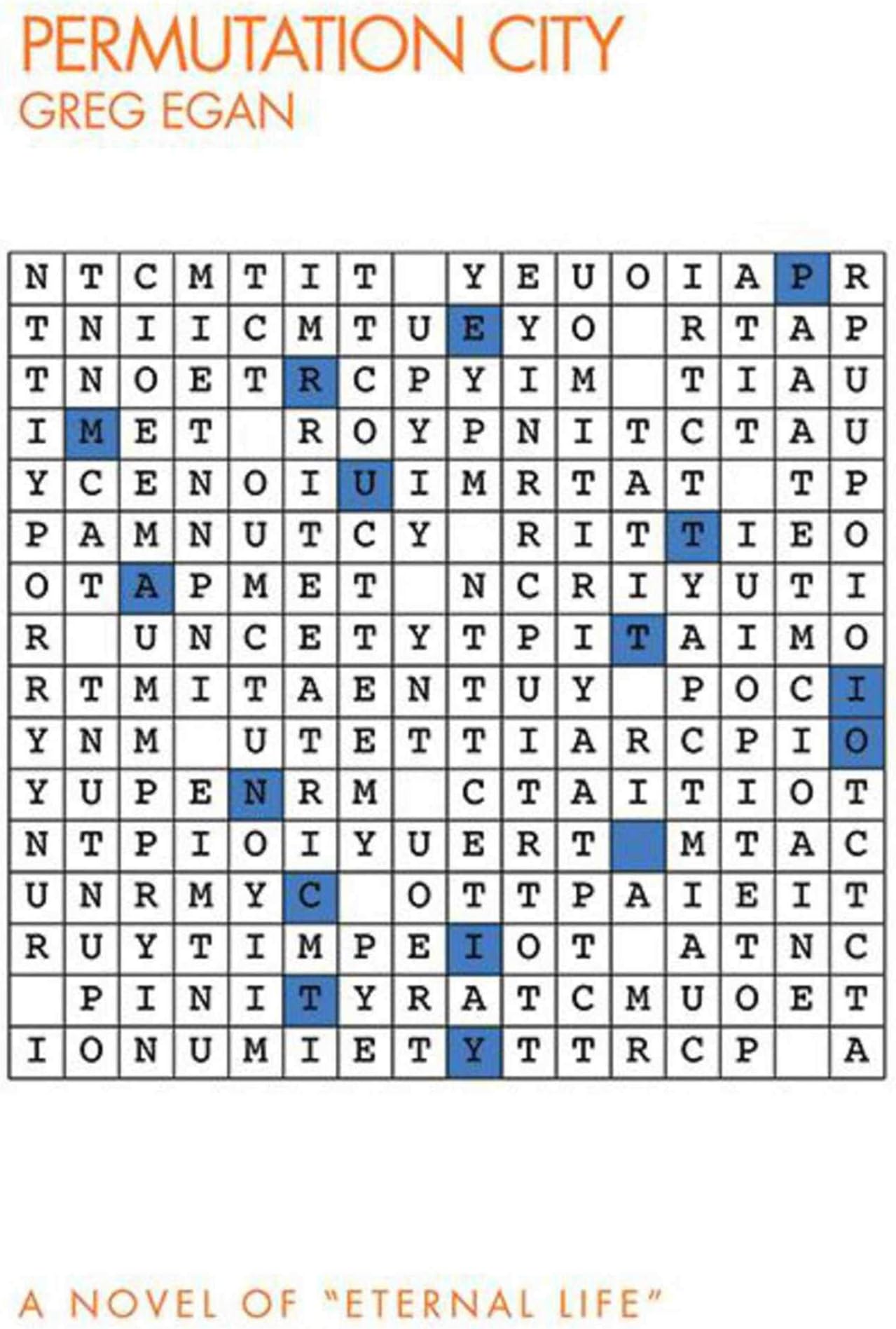
Permutation City: A Novel
Product ID: 11043184
Buy anything from 5,000+ international stores. One checkout price. No surprise fees. Join 2M+ shoppers on Desertcart.
Desertcart purchases this item on your behalf and handles shipping, customs, and support to Netherlands.
“Egan is determined to make sense of everything – to understand the whole world as an intelligible, rational, material (and finally manipulable) realm – even if it means abandoning comfortable and comforting illusions. This is fundamental to the whole project of SF and it’s why Egan’s Best – and his Rest – is worth any number of looks. — Locus What happens when your digital self overpowers your physical self? A life in Permutation City is unlike any life to which you’re accustomed. You have Eternal Life, the power to live forever. Immortality is a real thing, just not the thing you’d expect. Life is just electronic code. You have been digitized, scanned, and downloaded into a virtual reality program. A Copy of a Copy. For Paul Durham, he keeps making Copies of himself, but the issue is that his Copies keep changing their minds and shutting themselves down. You also have Maria Deluca, who is nothing but an Autoverse addict. She spends every waking minute with the cellular automaton known as the Autoverse, a world that lives by the mathematical “laws of physics.” Paul makes Maria an offer to design and drop a seed into the Autoverse that will allow her to indulge in her obsession. There is, however, one catch: you can no longer terminate, bail out, and remove yourself. You will never be your normal flesh-and-blood life again. The question then becomes: Is this what she really wants? Is this what we really want? From the brilliant mind of Greg Egan, Permutation City , first published in 1994, comes a world of wonder that makes you ask if you are you, or is the Copy of you the real you? Skyhorse Publishing, under our Night Shade and Talos imprints, is proud to publish a broad range of titles for readers interested in science fiction (space opera, time travel, hard SF, alien invasion, near-future dystopia), fantasy (grimdark, sword and sorcery, contemporary urban fantasy, steampunk, alternative history), and horror (zombies, vampires, and the occult and supernatural), and much more. While not every title we publish becomes a New York Times bestseller, a national bestseller, or a Hugo or Nebula award-winner, we are committed to publishing quality books from a diverse group of authors. Review: True hard science fiction - With human science and technology reaching such miraculous levels, it has become increasingly rare to find a true hard science fiction author. It seems like most authors have abandoned even the attempt at writing science fiction when it seems like all limits to possibilities will be removed. We find sciency fantasy close enough because who's to say that it's not possible? Anyway, this is an excellent hard science fiction book. It was enjoyable to experience again the joy of exploration that good science fiction always brought to me. Review: A solid addition to any hard sci-fi fan's library - Just reading the back flap of this book doesn't even really begin to describe the depth of the concepts presented in this story. While the material subjects in Permutation City are firmly planted in sci-fi, it also puts concepts such as what it means to "be" human both objectively and subjectively at the forefront. Whether you are an ardent fan of computer science, biology, physics, or even philosophy, this book will elicit some kind of respect from you for its depth in those regards. This book does lean heavily into both hard science and fiction, but quite honestly it takes the concepts so far that that distinctions between the two are trivial. What this book ISN'T is a flashy science fiction romp with action and adrenaline for just for the sake of excitement. What we DO have is a deeply thought provoking series of events and perspectives that challenge how evolving technology can redefine or completely do away with our current concepts of humanity. My only real cons are that Greg goes to such lengths to explain and take you to each of his thought points and conclusions, that the actual "story" is relatively light. Now, if you enjoy staying in those thoughts and sort of letting them gestate, this won't be much of a problem. If however, these thoughts don't resonate with you, you might find yourself waiting for the next "thing" to happen. Sort of on the other end of that, I felt that the conclusion of the book was a bit hasty. When considering the effort that went into making sure that the reader has bought and understood the rules of the world, the end felt a tad rushed and unearned. It's not to say that it's bad by any means, it just felt as if SOMETHING that fit a more typical sci fi ending had to happen just for the sake of it, rather than the story logically leading there. The fact that this book was written in 1994 blew my mind, as many of the technologies mentioned seem like logical progressions of things that have only become common in the past 10 or so years, so the foresight alone is incredible. All in all this book is a must read for any hard science fiction fan. While not perfect, enough love and attention clearly went into it to add it to your collection
| Best Sellers Rank | #43,675 in Books ( See Top 100 in Books ) #136 in Hard Science Fiction (Books) #415 in Post-Apocalyptic Science Fiction (Books) #1,621 in Science Fiction Adventures |
| Customer Reviews | 4.2 out of 5 stars 2,509 Reviews |
S**K
True hard science fiction
With human science and technology reaching such miraculous levels, it has become increasingly rare to find a true hard science fiction author. It seems like most authors have abandoned even the attempt at writing science fiction when it seems like all limits to possibilities will be removed. We find sciency fantasy close enough because who's to say that it's not possible? Anyway, this is an excellent hard science fiction book. It was enjoyable to experience again the joy of exploration that good science fiction always brought to me.
J**Y
A solid addition to any hard sci-fi fan's library
Just reading the back flap of this book doesn't even really begin to describe the depth of the concepts presented in this story. While the material subjects in Permutation City are firmly planted in sci-fi, it also puts concepts such as what it means to "be" human both objectively and subjectively at the forefront. Whether you are an ardent fan of computer science, biology, physics, or even philosophy, this book will elicit some kind of respect from you for its depth in those regards. This book does lean heavily into both hard science and fiction, but quite honestly it takes the concepts so far that that distinctions between the two are trivial. What this book ISN'T is a flashy science fiction romp with action and adrenaline for just for the sake of excitement. What we DO have is a deeply thought provoking series of events and perspectives that challenge how evolving technology can redefine or completely do away with our current concepts of humanity. My only real cons are that Greg goes to such lengths to explain and take you to each of his thought points and conclusions, that the actual "story" is relatively light. Now, if you enjoy staying in those thoughts and sort of letting them gestate, this won't be much of a problem. If however, these thoughts don't resonate with you, you might find yourself waiting for the next "thing" to happen. Sort of on the other end of that, I felt that the conclusion of the book was a bit hasty. When considering the effort that went into making sure that the reader has bought and understood the rules of the world, the end felt a tad rushed and unearned. It's not to say that it's bad by any means, it just felt as if SOMETHING that fit a more typical sci fi ending had to happen just for the sake of it, rather than the story logically leading there. The fact that this book was written in 1994 blew my mind, as many of the technologies mentioned seem like logical progressions of things that have only become common in the past 10 or so years, so the foresight alone is incredible. All in all this book is a must read for any hard science fiction fan. While not perfect, enough love and attention clearly went into it to add it to your collection
A**R
Speculative sci-fi at its best
Very well written, speculative/philosophical sci-fi. I don't feel like writing a long review, but all of Greg Egan's works will make you think. Some people find Egan's books to be hard reads, and indeed the author has even suggested that people take notes when reading some of his works. This is probably the best book he's written IMHO. The premise of this is mind-blowing, and without offering spoilers, this is an entirely new twist on first-contact with a sentient species, (among many other concepts) and Egan writes so well about virtual reality, you end up hoping that if we ever achieve this level of VR, that his works will be used as a guidebook to implementation. It's also an exploration of what consciousness may mean. Some say Egan doesn't develop his characters very well. And I somewhat agree. But he uses his characters more to help illustrate the ideas in his books than to be the primary focus. It helps to have a technical background and basic understanding of computer science IMHO to fully appreciate this book. You also probably won't get a full appreciation for all of the ideas without rereading it a couple of times.
S**N
Some fascinating concepts marred by annoying characters and pointless plot threads
I went into this one with such high hopes, it had a very strong beginning and the overall concept is mind-bendingly awesome. Once I hit about the halfway mark I started losing interest fast, but mostly due to the terrible characters. Maria Deluca might be the most annoying character ever created from a pen and not in a “love to hate them” type of way. None of the characters feel developed at all, they are simply there for exposition. Paul plays the super levelheaded character and Maria plays the snippy skeptic. A whole lot of this book is dedicated to Maria never believing in Paul and being an absolute pain in the backside about it, even when faced with direct evidence contrary to her views in any given situation and despite Paul never really giving a strong reason to doubt him. He pays her handsomely and is very upfront, but page after page after page she dunks on him the entire time, doubting everything and being a sarcastic preachy pain. I grew so tired of this schtick that I nearly DNF’d the book. There are a few parallel plot lines going on and really none of them make much of a difference. The entire Kate and Peer thread could have been axed. This whole thing should have been a fun 80 page short story. It would have been way more fun if the whole Kate and Peer plot was completely gutted, the whole Thomas Riemann line was gutted and Maria was along for the journey and together with Paul they could have been a fun dynamic duo. Being skeptical is fine, but SO MANY pages, oh so many pages are simply her complaining to Paul. Gut all of that - it becomes incredibly tedious and annoying. If you read the plot summary on Fandom then you will see how little Kate, Peer, and Riemann matter (I don’t even think Riemann is mentioned in the whole summary despite him having an entire thread in the book). The plot summary on Fandom is more fun than the actual book. I really struggled with rating this novel. It’s not 1-star because the whole Elysium and Autoverse concept is awesome, the whole uploading a copy of your consciousness into a super cloud computer with limited power that runs on a sort of exchange where you’re paying for and competing for precious processing time is super cool and I like how the virtual worlds are approximations (efficiency matters!). I love the questions this book brings forth, like what does it really mean to be *you*? Even if a perfect representation of you is copied and digitized then is it still you? If it is, then is it still you when you make changes to yourself? If you can run a simple routine to forget something painful in your past then are you losing a part of yourself by doing such? There are a lot of really interesting questions raised in this book! But then again, as I have already harped on, this book should have been a romp and not a chore. I grew so tired of the characters and so tired of the exposition, for its few really high points this book sure does have a lot of lows. It’s a 350 page book that feels like 600. 3 stars feels a little generous because I was annoyed through a majority of this book, but 2 seems a bit low because I will be pondering over some of the really awesome concepts for a long time to come. In the end I give it an optimistic 2.5 (rounded up to 3).
I**D
Deep first-person exploration
A better analysis of the nature of consciousness and simulation than I've seen elsewhere. He explores a great many angles and does go in some very interesting directions... though the most interesting stuff is based on some fairly arbitrary assumptions, which didn't seem necessary given how well grounded most of the conceptual content was. Some sequences involving deliberate self-modification are especially well written and should be of interest to anyone thinking about transhumanism (or Buddhism for that matter). The proposed insect behavior is super interesting, like an even better version of Vinge's "Tines". I wish he'd gone in more depth on that. Very egocentric narrative throughout, basically zero consideration of society and culture. I can't say it's a fun read, it's like stepping into a bleak cold abyss.
A**R
Hard sci-fi that actually earns the label
Egan is in a league of his own when it comes to ideas-driven sci-fi. Permutation City takes simulation theory, identity, and consciousness and pushes them further than most. I’ve gifted this to a few people who like writers like Ted Chiang or Peter Watts and it always lands. One of my favorites.
D**H
Egan at his best
I have all Egan's book in paper and just had to re-purchase this Kindle version. It's a highlight book for me. Full of excellent ideas and strong emotion. Although the main characters seem a little bit forced, the flow of the novel is brilliant and the ending is beautiful in an odd way. This book works on so many levels. It's the standout among Egan's novels for me. The saddest thing is comparing this novel to his latest work "Zendegi". Perhaps Egan has stopped trying, or perhaps with success comes complacency. Permutation City is a masterpiece of speculative and predictive science-fiction; but Zendegi is one of the most plodding, dull, unimaginative pieces of predictable diatribe I've ever had the misfortune to start reading. Greg, what happened? Get back to your brilliant roots!
J**C
Mind blowing
This was an interesting read. I almost needed to keep notes of what some of the technologies were. An exercise for the mind.
A**E
Psychedelische Sci-Fi
Abgehobene Handlung, deren Logik für mich leider nicht immer ganz stimmig war. 5 Sterne dafür, dass sich jemand so etwas ausdenken kann.
F**R
And four times...
This book never ages. I ve read it the first time 15 years ago. And the story will still be a shock in 15 years more.
S**S
This book will blow your mind if you can finish it.
Greg Egan is well known for being one of the best 'ideas men' in Sci-Fi, and this book is one of the best examples of that. This is not an easy book to read. There are references to mathematical concepts you'll need a maths degree to fully understand, but they aren't crucial to the story and can be ignored where necessary. The characters are often fairly shallow or perhaps better described as only as deep as the story requires, but they're not the point. Much like Socrates in the works of Plato the characters only exist to better illustrate the concepts Egan is interested in exploring. Ultimately this book leads you step by step into a breathtakingly mind-blowing argument about the nature of consciousness. Definitely something anyone interested in SF should read.
B**S
Life Beyond Life Beyond Life
I struggled to get into this book, which happens to me from time to time so I tend to keep on reading, rather than give up. I’m really glad I kept on with it because I love this book. Maybe I’m not smart enough to get everything they were trying to say, and while I really do like knowing the intentions or meanings an author wanted to convey, I believe what’s important is how it makes an impact on the reader. I honestly don’t know how to describe this book, it has so many layers and brought out so many emotions in me. It was a great story and a great adventure. Really glad my friend recommended this to me.
K**様
A great read
I would recommend this book to someone who likes to think about the theory behind science-fiction novels. Those who are interested in philosophy might also find it interesting. (e.g., Those who enjoyed philosohy lectures on death, such as online open yale course PHIL 176, might find this book interesting) As a story, the reader might find the first half of the book more than the second half. (Although the second part is important in that it poses important questions, and makes you think.)
Trustpilot
2 weeks ago
3 weeks ago