We remain fully operational. Our teams are working around the clock to ensure your deliveries continue safely.

DOWNLOAD DE APP


Klantenservice
Copyright © 2025 Desertcart Holdings Limited
DOWNLOAD DE APP
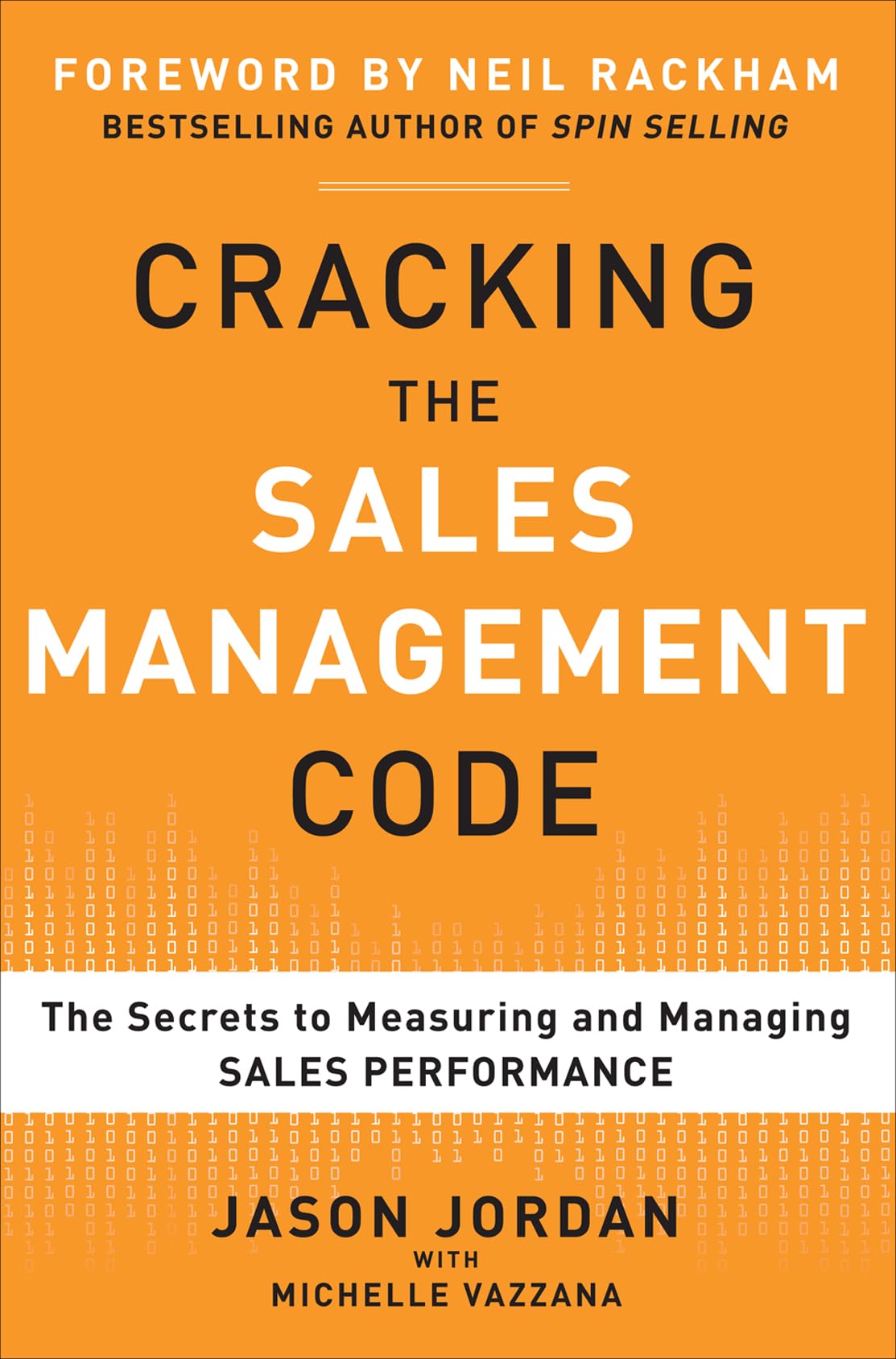
Cracking the Sales Management Code: The Secrets to Measuring and Managing Sales Performance [JORDAN] on desertcart.com. *FREE* shipping on qualifying offers. Cracking the Sales Management Code: The Secrets to Measuring and Managing Sales Performance Review: Crack the Code | Grow Your Company - I read a lot of books. It used to be about 50 a year, but now I read a lot more summaries and fewer full books, cover to cover. I especially read books about business, sales, training, organization development and performance improvement. I say that as a precursor to my statement that Jason Jordan and Michelle Vazzana's book, "Cracking The Sales Management Code" is one I read cover to cover recently and it is currently one of my top three choices for books on sales management and sales performance improvement. Frankly, I wish I had written it. I could cite endless examples why, and will share a few, but the primary reason is the message they deliver about the under-developed yet critical sales function ("under-developed" is my term, meaning that the management model and business practices haven't evolved and matured to the degree that other disciplines have), and the largely overlooked and mismanaged role of frontline sales manager. It mirrors much of my own experiences over the past 25 years and I often found myself nodding my head or cheering to myself at many parts of the book. Think those are some strong statements? Ask yourself these questions: - What criteria is used in most organizations for promotion from sales rep to sales manager? (Most often, it's great sales results with the very best sales reps being promoted into roles for which they don't have the competencies.) - How often do sales managers receive practical, helpful training and reinforcement on how to be a great sales manager? - What training do most sales managers receive on interpreting selection assessments, conducting behavioral interviews, running and judging sales simulations, or utilizing other great hiring/selection methods? - When was the last time you saw sales managers trained on exactly what their reps were being trained on, before the reps were trained? - How do you use sales managers to reinforce and support rep training, to ensure new skills transfer from the learning environment to the real-world? - What training exists to help new sales managers read and diagnose organizational reporting, to understand what activity or skills gaps might exist in their reps/team? - How are most sales managers taught to diagnose the root causes of underperformance, once the reporting highlights an issue, and to close the gap and solve the root cause? - What diagnostic or coaching models are commonly taught to sales managers? And are those same models used in their development as well? Sure, some organizations have great answers to these questions. But let's be honest... many don't. What's odd and sad, is that when you discuss these things around a conference table, everyone always nods their head, like they're great ideas. But so few seem to be executing well to elevate the role of sales manager and drive growth through them. In the book, one of the headings says it very plainly. "It's the Sales Manager, Stupid." Frontline sales managers are the key to real sales performance growth and rep success. Cracking this code, for your organization, is simply vital to maximizing sales efforts. In the rest of the book, the authors take you on the journey they made while cracking the code through their research and work with clients. Their cogent explanation and differentiation between Business Results, Sales Objectives and Sales Activities made me cheer. Their Building Blocks of Control laid the foundation for the oft-cited but rarely-implemented "accountability." Their Troubleshooting Guide is a great job aid/performance support tool to help you keep in all in mind. And the book contains one the best collection of possible sales metrics, organized by type, that I've seen in print. I truly enjoyed this one and recommend it highly. I should also offer that the forward by Neil Rackham, while only a handful of pages, is worth the price of the book, in itself. This is not to diminish the detailed, clear and insightful work of the authors, but Rackham added some great value and clarity, right out of the box. The authors continued that trend, straight to the end. Buy the book and read it. You won't regret it. And use it as the fuel to start a relentless focus on building logical and data-driven methods, systems, processes, resources and tools to develop and support sales management, to drive growth and sales success in your organization. Crack the code, and grow your company. It's the Sales Manager, Stupid. ;-) Review: Great book! - This book was a great read not only because of the information, but because of the layout and wording. The author was straightforward with the information adding on piece by piece every chapter. He thoroughly explained all the terms not too complexly, but also not too simple. The only thing I really found wrong with this book was the fact that it was repetitive. Though this was no problem for me; it made it to where it was an information refresher and I personally liked that. Though this can be a problem for others who do not like this style of writing. Anyone looking to gain a better understanding of sales management should read this book. It not only talks to you about managing a sales force, but more importantly what approaches to take to form a more effective sales force (such as processes and metrics). There are not too many books out there on sales management, so it is definitely nice to have one and people should take advantage of this opportunity to learn more about it.


| Best Sellers Rank | #52,092 in Books ( See Top 100 in Books ) #11 in Leadership Training #79 in Sales & Selling (Books) #113 in Marketing (Books) |
| Customer Reviews | 4.4 4.4 out of 5 stars (682) |
| Dimensions | 6 x 0.81 x 9 inches |
| Edition | 1st |
| ISBN-10 | 0071765735 |
| ISBN-13 | 978-0071765732 |
| Item Weight | 2.31 pounds |
| Language | English |
| Print length | 272 pages |
| Publication date | September 20, 2011 |
| Publisher | McGraw Hill |
M**E
Crack the Code | Grow Your Company
I read a lot of books. It used to be about 50 a year, but now I read a lot more summaries and fewer full books, cover to cover. I especially read books about business, sales, training, organization development and performance improvement. I say that as a precursor to my statement that Jason Jordan and Michelle Vazzana's book, "Cracking The Sales Management Code" is one I read cover to cover recently and it is currently one of my top three choices for books on sales management and sales performance improvement. Frankly, I wish I had written it. I could cite endless examples why, and will share a few, but the primary reason is the message they deliver about the under-developed yet critical sales function ("under-developed" is my term, meaning that the management model and business practices haven't evolved and matured to the degree that other disciplines have), and the largely overlooked and mismanaged role of frontline sales manager. It mirrors much of my own experiences over the past 25 years and I often found myself nodding my head or cheering to myself at many parts of the book. Think those are some strong statements? Ask yourself these questions: - What criteria is used in most organizations for promotion from sales rep to sales manager? (Most often, it's great sales results with the very best sales reps being promoted into roles for which they don't have the competencies.) - How often do sales managers receive practical, helpful training and reinforcement on how to be a great sales manager? - What training do most sales managers receive on interpreting selection assessments, conducting behavioral interviews, running and judging sales simulations, or utilizing other great hiring/selection methods? - When was the last time you saw sales managers trained on exactly what their reps were being trained on, before the reps were trained? - How do you use sales managers to reinforce and support rep training, to ensure new skills transfer from the learning environment to the real-world? - What training exists to help new sales managers read and diagnose organizational reporting, to understand what activity or skills gaps might exist in their reps/team? - How are most sales managers taught to diagnose the root causes of underperformance, once the reporting highlights an issue, and to close the gap and solve the root cause? - What diagnostic or coaching models are commonly taught to sales managers? And are those same models used in their development as well? Sure, some organizations have great answers to these questions. But let's be honest... many don't. What's odd and sad, is that when you discuss these things around a conference table, everyone always nods their head, like they're great ideas. But so few seem to be executing well to elevate the role of sales manager and drive growth through them. In the book, one of the headings says it very plainly. "It's the Sales Manager, Stupid." Frontline sales managers are the key to real sales performance growth and rep success. Cracking this code, for your organization, is simply vital to maximizing sales efforts. In the rest of the book, the authors take you on the journey they made while cracking the code through their research and work with clients. Their cogent explanation and differentiation between Business Results, Sales Objectives and Sales Activities made me cheer. Their Building Blocks of Control laid the foundation for the oft-cited but rarely-implemented "accountability." Their Troubleshooting Guide is a great job aid/performance support tool to help you keep in all in mind. And the book contains one the best collection of possible sales metrics, organized by type, that I've seen in print. I truly enjoyed this one and recommend it highly. I should also offer that the forward by Neil Rackham, while only a handful of pages, is worth the price of the book, in itself. This is not to diminish the detailed, clear and insightful work of the authors, but Rackham added some great value and clarity, right out of the box. The authors continued that trend, straight to the end. Buy the book and read it. You won't regret it. And use it as the fuel to start a relentless focus on building logical and data-driven methods, systems, processes, resources and tools to develop and support sales management, to drive growth and sales success in your organization. Crack the code, and grow your company. It's the Sales Manager, Stupid. ;-)
A**R
Great book!
This book was a great read not only because of the information, but because of the layout and wording. The author was straightforward with the information adding on piece by piece every chapter. He thoroughly explained all the terms not too complexly, but also not too simple. The only thing I really found wrong with this book was the fact that it was repetitive. Though this was no problem for me; it made it to where it was an information refresher and I personally liked that. Though this can be a problem for others who do not like this style of writing. Anyone looking to gain a better understanding of sales management should read this book. It not only talks to you about managing a sales force, but more importantly what approaches to take to form a more effective sales force (such as processes and metrics). There are not too many books out there on sales management, so it is definitely nice to have one and people should take advantage of this opportunity to learn more about it.
S**S
A practical guide full of insights
Nice reading. A very practical book is full of insights regarding the sales management & performance of the sales teams & operations.
J**N
Best sales mgmt book ever!
Step 1: Carefully define the Business Results you want to achieve. Typically: a. Revenue b. Value of weighted pipeline c. Customer satisfaction Step 2: Choose the sales process(es) and associated Sales Objectives most likely to help salespeople in distinct selling roles achieve their desired business results. Processes include: (note: MCO = market coverage objective; SFO=sales force capability objective; CFO = customer focus objective; PFO = product focus objective) 1) Territory management process (when you do not have time to adequately make proactive outbound calls to every prospect and customer in your territory) a) Percentage of market opportunity covered [MCO] b) Percentage of target accounts contacted [MCO] c) Revenue from new customers [CFO] 2) Account management process (when you mainly pursue multiple deals over time with a smaller set of individual customers) a) Percentage of customers called [MCO] b) Revenue growth in existing customers [CFO] c) Customer retention rate [CFO] 3) Opportunity management process (when individual sales are complex and involve multiple calls) a) Deal win/loss ratio [SFO] b) Length of sales cycle [SFO] c) Average deal size [CFO] d) Revenue by product [PFO] 4) Call management: process (to improve the effectiveness of individual customer interactions when individual calls can greatly affect the outcome of the deal) a) Number of meetings held [SFO] 5) Sales force enablement processes a) Time to productivity [MCO] b) Undesirable attrition rate [MCO] c) Sales person skill/competency index [SFO] Step 3: Select the Activities to manage day-to-day to ensure you (directly) meet the chosen objectives: (note: many Activities directly impact multiple Sales Objectives) 1) Territory management (note: usually done by sales operations) a) Number of accounts per rep b) Number of calls made per account per rep 2) Account management a) Account plan usage (remember to involve customers in the process!) b) Number of interactions per account (ex: calls scheduled 120 days before renewal) 3) Opportunity management a) Adherence to opportunity planning process (relatively unused) b) Utilization of proof-of-concept resources such as engineers or executives 4) Call Management a) Call plan usage (relatively unused) – esp. objective, opening, buyer motivation, questions to ask, objections to handle, etc. b) Number of calls logged in CRM 5) Sales force enablement (note: usually done by sales operations) a) Training investment per FTE b) Number of reps per manager c) Frequency and quality of coaching (ex: via periodic surveys of reps) More great insights: 1) Sales success depends on the caliber of first-line managers who should be continuous improvement experts, rigorously tracking progress against the goals they set. They control Activities to help (directly) meet Sales Objectives which in turn drive desirable (but wholly unmanageable) Business Results. Hence, training and enablement are more important for sales managers than they are for salespeople. 2) “The specific sales processes you need in your sales force are determined by the nature of each individual selling role.” “Generally speaking, we see a trend toward sales forces having a greater number of more specialized selling roles. Management long ago began to separate “hunters” from “farmers,” but the number of boxes on the frontline org chart continues to grow. From industry specialists, to product experts, to sellers who serve niche markets, the roles we find in sales forces are becoming more diverse in nature and more narrow in scope. This not only makes the seller’s tasks easier to master, it also reduces the management challenge of hiring, developing, measuring, and compensating complex roles.” 3) “If your salespeople are being asked to do too much, it’s quite possible that they’re really doing too little.” 4) “If you don’t support your desired behavioral changes with new metrics, tools, and skills to reinforce and measure the change, your sales force will quickly revert to its previous state.” 5) “Our own approach to change management can be best described as comprehensively minimalist.” “you must focus your efforts on the critical few Sales Activities that will directly affect your Sales Objectives and Business Results.” 6) “Assign quantitative values to your A-O-Rs.” 7) “Sales force metrics should be reported on a need-to-know basis.”
A**E
“Cracking the Sales Management Code” was valuable to me because it clearly separates what can be monitored from what can be influenced - a key insight for managing sales teams. I also appreciated how it simplifies sales management into clear, actionable steps. As a more rational thinker, I found it especially useful that the book shows how to use numbers not just for tracking, but for building real action plans for the sales force.
V**M
I have studied at least 10 great books on sales from quite a few renowned authors in a very detailed way, 'cracking the sales management code ' has been very special as it has beautifully summarised and cemented what I have learnt and successfully implemented from the other classics on the subject of sales performance, a fantastic step - by - step operational manual to help one understand what aspects can be controlled and what cannot be controlled to achieve the results we desire from our sales efforts, a must read for anyone who wishes to truly understand how to improve sales performance.
ゆ**湯
それなりに成熟した企業でさえ、営業部門では長らく“売ったもん勝ち”という文化が幅を利かせ蔓延ってきた。 それは、よくいえば結果重視ということだろうが、逆手にとって結果さえ出していれば文句はなかろうという不透明さを許容するものでもあった。 実際、他部門から見れば日ごろ営業は何をやっているのかわかりづらい。 営業マンにしてみれば、売れているときは、それでもいいかもしれない。しかし、売れないとき、実際はどんなに頑張っていても「営業は遊んでいるんだろう」と言われてしまう。 この本は以下のことが分かりやすく書かれている。 ・営業活動と販売実績はどのような因果関係にあるのか。 ・何を計測すれば営業がわかるのか。 ・仕事の量と仕事の質(効率性と効果性) ・販売戦略に沿った営業活動とは何か。 ・売上げ以外の営業目標はどのように立てるべきか。 ・定期手にレビューすべきパフォーマンスの項目。など 営業は決して特殊な仕事ではない。 ほかの仕事と同様に、1日でできる仕事量(訪問や電話の件数)には限界がある。 その限界から適正な仕事量を導き出し、そのうちどれだけの仕事量を何に割り当てればいいのか。 その前提となる指標や顧客群の定義は社内で共通に理解されているか。顧客との商談にいたるまで、戦略段階で踏むべきプロセスは何か。 各プロセスの効率をKPI(Key Performance Indicator)として測定するにはどうすればよいのか。 企業は事業戦略を定め、ビジョンを共有し、その達成に必要なプロセスを話し合って決める。 そのプロセスを周知させ、実行できる部隊になるよう人材を教育訓練する。 結果だけでなく、活動の量と質を計測し定期的にレビューする。そこにKPIを用いる。何がうまくいって何がうまくいっていないのか。 狙う成果に直結するドライバーは何か、その状況を示すKPIは何か。この本である程度つかめます。
C**N
Recomendo a leitura deste livro para qualquer pessoa que queira melhorar sua capacidade de gestão de Força de Venda e entender melhor a relação entre atividades de vendas, objetivos do negócio e resultados organizacionais.
C**S
Great book that breaks down each type of sales role and why they’re different. He then gives actionable advice on how to develop those roles based on whatever objectives your company has set out. Very much data driven and systematic in nature but he also simplified it nicely
Trustpilot
1 maand geleden
1 week geleden