We remain fully operational. Our teams are working around the clock to ensure your deliveries continue safely.

DOWNLOAD DE APP


Klantenservice
Copyright © 2025 Desertcart Holdings Limited
DOWNLOAD DE APP
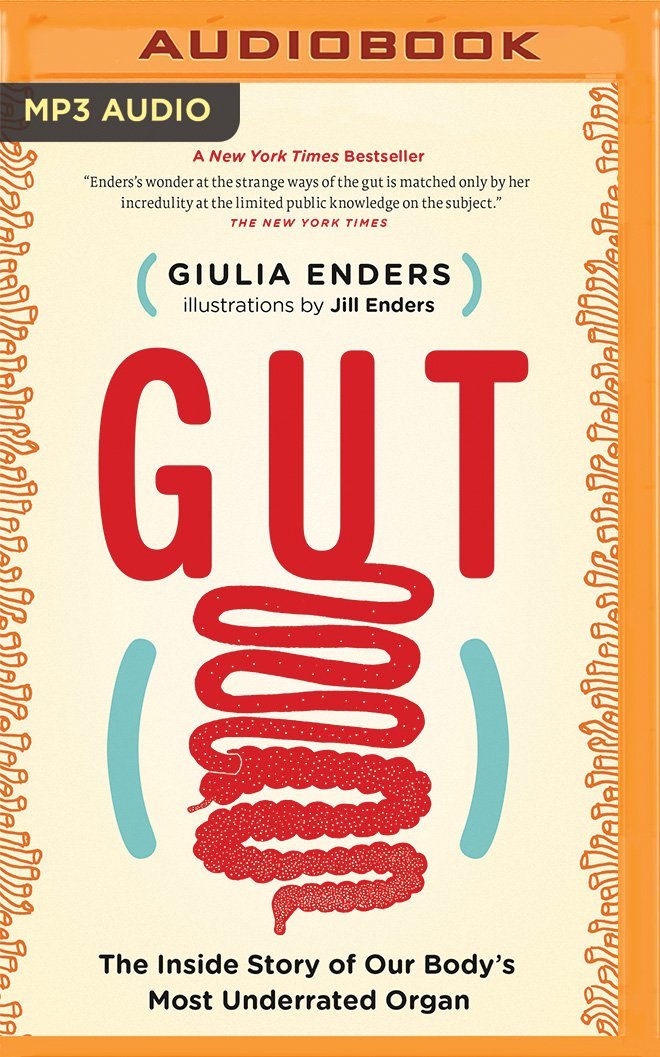
desertcart.com: Gut: 9781522642541: Giulia Enders, Katy Sobey: Books Review: Gut science explained with charm and candor - Do you want to know “a few facts about feces”? Or “how does pooping work”? (And who doesn’t?) If so you’ve come to the right place. Giulia Enders, who is working on her medical doctorate, somehow became fascinated with these questions and many more involving our digestive system. The result is this book which won the 2014 Science Slam prize in Berlin and became an international bestseller. We think of termites and ruminants as having most of their digestion done for them by microbes. But after reading this captivating book it is apparent that we are also totally dependent on our own microbes for digestion. Enders goes so far as to say that “Some scientists now support the theory that our gut microbiota can be considered an organ.” (p. 195) One of the most interesting and charming aspects of this book and part of the reason for its success is the collaborative translation by David Shaw and Giulia Enders herself that owes so much to Enders’ use of idiom and metaphor, both English and German (sometimes in cute mixed translation). Enders, whose English is more than fluent (listen to her on YouTube) has an impish quality to her expression that adds enormously to the fun of reading this book. Perhaps the central idea in the book is that the gut itself has a brain that rivals the one on top of our heads. So the old adage that the brain is the stomach’s slave may be more than just a witticism. Another interesting idea comes in the later chapters dealing with the effects that gut bacteria have on our behavior. Yes, behavior. According to Enders, gut bacteria can send molecular signals to the brain that influence our choice of what foods we eat. Some bacteria want us to eat carbs that they like or foods that are not completely digested until they reach the large intestine where most of our gut bacteria live. Additionally gut bacteria can help us digest well or not so well thereby allowing some people to gain weight on the same diet that other people with different gut bacteria would not gain weight. Enders speaks of our “microbial signature” noting that “Everyone has some outlandish items in their collection that almost no one else will share.” (p. 172) This made me think: maybe these microbial signatures could someday replace fingerprints or iris recognition for identification. Forensically speaking such signatures might be valuable in some cases. Still another idea is that there is some evidence that some bacteria can lower cholesterol levels. (p. 193) It’s obvious that Enders had a lot of fun reading the scientific literature. Take this bit about Toxoplasmata gondii, tiny one-cell organisms that inhabit the guts of cats. (p. 210) Apparently when these organisms get into the digestive system of rats or the rats smell cat urine they cause the rats to seek the company of cats since cats are the definitive hosts for toxoplasmata thereby endangering their little rat lives! Enders dubs this a “feed myself to the cat instinct.” (p. 213) But could it work with larger mammals? Apparently yes. She writes, “The risk of being involved in a traffic accident is higher among toxoplasma carriers, especially when the infection is in the active stage…” (p. 214) Even more fantastic is her analysis suggesting that our immune system produces an enzyme (IDO) to protect us from parasites like toxoplasma, and in doing so produces serotonin. Since serotonin makes us feel better (or more precisely, lack of serotonin makes us feel lethargic) toxoplasma can make us feel better. Toxoplasma can even affect the amygdala making us fearless. (See pages 214-215.) Enders mentions “a thirty-two-year-old woman” who cuts her wrists with a razor blade for the thrill of it. (p. 210) Enders concludes this wonderment with these words which are characteristic of her most interesting metaphorical style: “How can pain have become the hot sauce in the otherwise bland soup of her everyday life?” (p. 214) And here’s a very telling, sad story: some “South Americans” took themselves to the South Pole to have their babies. “The plan was that the babies born there could stake a claim to any oil future reserves as natives of the region. The babies did not survive…The South Pole is so cold and germ-free that the infants simply did not get the bacteria they needed to survive.” (p. 240) There are many references to the journal articles Enders has read but I wish she had provided endnotes so that we could pair the findings in the text with the confirming studies. For example exactly who did the study that showed that people identified as toxoplasma carriers were involved in more traffic accidents that those not carrying the organism? Finally I want to say something about the line drawings in the book done by Giulia’s sister, Jill Enders: weird, but oddly amusing. I got a kick out of the one on the final page in which something, perhaps a gut bacterium, is mooning us. --Dennis Littrell, author of “The World Is Not as We Think It Is” Review: Many good takeaways from this book. - Great book that's easy to understand for everyone. Lots of good information about anatomy and how your body works together with your gut, from your immune system, your brain, emotions and even your mood. There are a lot of takeaways from this informative and funny book. It's based on a lot of scientific studies and cutting edge research. The only reason why I gave it 4 stars is I wish it would go even deeper and go more into details that are even more applicable to daily mysteries like the trending aversion to gluten and how bacteria can help with that. My favorite takeaway though is a shift in perspective on how bacteria needs its own space to propagate and if your gut is filled with the good bacteria bad bacteria has a harder time taking hold and building up its numbers to be harmful.
| Best Sellers Rank | #12,010,809 in Books ( See Top 100 in Books ) #6,084 in Health, Fitness & Dieting (Books) #100,721 in Books on CD |
| Customer Reviews | 4.4 4.4 out of 5 stars (2,786) |
| Dimensions | 6.5 x 0.63 x 5.5 inches |
| Edition | Unabridged |
| ISBN-10 | 1522642544 |
| ISBN-13 | 978-1522642541 |
| Item Weight | 3.5 ounces |
| Language | English |
| Publication date | July 19, 2016 |
| Publisher | Audible Studios on Brilliance Audio |
D**L
Gut science explained with charm and candor
Do you want to know “a few facts about feces”? Or “how does pooping work”? (And who doesn’t?) If so you’ve come to the right place. Giulia Enders, who is working on her medical doctorate, somehow became fascinated with these questions and many more involving our digestive system. The result is this book which won the 2014 Science Slam prize in Berlin and became an international bestseller. We think of termites and ruminants as having most of their digestion done for them by microbes. But after reading this captivating book it is apparent that we are also totally dependent on our own microbes for digestion. Enders goes so far as to say that “Some scientists now support the theory that our gut microbiota can be considered an organ.” (p. 195) One of the most interesting and charming aspects of this book and part of the reason for its success is the collaborative translation by David Shaw and Giulia Enders herself that owes so much to Enders’ use of idiom and metaphor, both English and German (sometimes in cute mixed translation). Enders, whose English is more than fluent (listen to her on YouTube) has an impish quality to her expression that adds enormously to the fun of reading this book. Perhaps the central idea in the book is that the gut itself has a brain that rivals the one on top of our heads. So the old adage that the brain is the stomach’s slave may be more than just a witticism. Another interesting idea comes in the later chapters dealing with the effects that gut bacteria have on our behavior. Yes, behavior. According to Enders, gut bacteria can send molecular signals to the brain that influence our choice of what foods we eat. Some bacteria want us to eat carbs that they like or foods that are not completely digested until they reach the large intestine where most of our gut bacteria live. Additionally gut bacteria can help us digest well or not so well thereby allowing some people to gain weight on the same diet that other people with different gut bacteria would not gain weight. Enders speaks of our “microbial signature” noting that “Everyone has some outlandish items in their collection that almost no one else will share.” (p. 172) This made me think: maybe these microbial signatures could someday replace fingerprints or iris recognition for identification. Forensically speaking such signatures might be valuable in some cases. Still another idea is that there is some evidence that some bacteria can lower cholesterol levels. (p. 193) It’s obvious that Enders had a lot of fun reading the scientific literature. Take this bit about Toxoplasmata gondii, tiny one-cell organisms that inhabit the guts of cats. (p. 210) Apparently when these organisms get into the digestive system of rats or the rats smell cat urine they cause the rats to seek the company of cats since cats are the definitive hosts for toxoplasmata thereby endangering their little rat lives! Enders dubs this a “feed myself to the cat instinct.” (p. 213) But could it work with larger mammals? Apparently yes. She writes, “The risk of being involved in a traffic accident is higher among toxoplasma carriers, especially when the infection is in the active stage…” (p. 214) Even more fantastic is her analysis suggesting that our immune system produces an enzyme (IDO) to protect us from parasites like toxoplasma, and in doing so produces serotonin. Since serotonin makes us feel better (or more precisely, lack of serotonin makes us feel lethargic) toxoplasma can make us feel better. Toxoplasma can even affect the amygdala making us fearless. (See pages 214-215.) Enders mentions “a thirty-two-year-old woman” who cuts her wrists with a razor blade for the thrill of it. (p. 210) Enders concludes this wonderment with these words which are characteristic of her most interesting metaphorical style: “How can pain have become the hot sauce in the otherwise bland soup of her everyday life?” (p. 214) And here’s a very telling, sad story: some “South Americans” took themselves to the South Pole to have their babies. “The plan was that the babies born there could stake a claim to any oil future reserves as natives of the region. The babies did not survive…The South Pole is so cold and germ-free that the infants simply did not get the bacteria they needed to survive.” (p. 240) There are many references to the journal articles Enders has read but I wish she had provided endnotes so that we could pair the findings in the text with the confirming studies. For example exactly who did the study that showed that people identified as toxoplasma carriers were involved in more traffic accidents that those not carrying the organism? Finally I want to say something about the line drawings in the book done by Giulia’s sister, Jill Enders: weird, but oddly amusing. I got a kick out of the one on the final page in which something, perhaps a gut bacterium, is mooning us. --Dennis Littrell, author of “The World Is Not as We Think It Is”
K**O
Many good takeaways from this book.
Great book that's easy to understand for everyone. Lots of good information about anatomy and how your body works together with your gut, from your immune system, your brain, emotions and even your mood. There are a lot of takeaways from this informative and funny book. It's based on a lot of scientific studies and cutting edge research. The only reason why I gave it 4 stars is I wish it would go even deeper and go more into details that are even more applicable to daily mysteries like the trending aversion to gluten and how bacteria can help with that. My favorite takeaway though is a shift in perspective on how bacteria needs its own space to propagate and if your gut is filled with the good bacteria bad bacteria has a harder time taking hold and building up its numbers to be harmful.
A**E
Complex and Life-Changing Research Charmingly Explained. You'll Never Again Eat Without Thinking.
Everybody has a book, or a half dozen, that they can truthfully say have changed their lives. "Gut" is one of them. If you have been delving into the NIH website to decipher the research on IBS, or spend hours on WebMD, trying to understand why you always have a sore throat, or how you manage to catch EVERY cold going around the office, go no further. Read this book before you take another step down the rabit hole of matching your symptoms with rare diseases and conditions only found in Outer Mongolia or the Amazon river basin. Understanding, managing, and healing many common and serious health conditions may start with simply paying attention to what you put in your mouth, how it makes you feel, and what you produce at the other end. We are what we eat. Since I read "Gut," I understand my body, my health, my choices and motivations, even my raison d'etre, from a new and surprising perspective. I have learned that entire civilizations can rise and fall between your breakfast and dinner, along the banks of the great Nile that begins at your lips and flows from your tongue to your anus. Or perhaps the river is the Hudson, because sometimes it flows both ways, floating boatloads of microscopic refugees and opportunists upstream, and frequently pouring vast floods of toxic pollution downstream. For example, I have taken antibiotics three or more times a year for most of my life, for revolving-door bouts of tonsillitis, bronchitis, strep throat, bladder, ear, and sinus infections. Most of my teeth are capped; the rest have mercury amalgam fillings. I have had mono and shingles, whooping cough, influenza B, and West Nile virus. I have researched thousands of pages of health-related books and sites, desperately trying to discern a larger pattern among all of these conditions, getting tested for rheumatoid arthritis, Lyme disease, lupus, and Schoegren's. Ugh! I have been diagnosed with MS, fibromyalgia, IBS, Reynaud's Syndrome, chronic fatigue, depression, cardiac arrhythmia, migraines, cluster headaches, rosacea, chronic sinusitis and acid reflux. (Goodness, what a mess!) After giving up gluten, dairy, refined sugar (mostly), beef and pork, I now eat lots of organic fruits and vegetables; complex starches like brown rice and sweet potatoes; poultry, fish, and ancient grains; and lately, prebiotics, probiotics, and a bucketful of vitamin and mineral supplements, and medicinal mushrooms. My health has improved, but symptoms are still a roller-coaster. Does any of this sound familiar to you? If the answer is "yes," then buy this book! You will discover that you are, quite literally, what you eat. Have you seen Men in Black? Do you remember the locker in Grand Central Station? Agent K left his watch in that locker in the care of tiny beings, whose entire world is that locker. They are odd and charming, and quite sincere in their belief that God is K, a mysterious being who showers them with light whenever he opens the locker door. If you saw the movie, you will appreciate the amusing drawings in "Gut" by the author's sister, depicting all of the strange and wonderful inhabitants of our bodies, going about their daily routines. Having read "Gut," I can't think of my internal community in any other way. In fact, as I tear into a muffin, I hear a tiny chorus of millions of voices shouting, "Praise the Giver of Gluten-free Cake, that we may be fruitful and multiply!" When I bite a juicy apple, I hear, "All hail the Fiber Provider, that we may build our homes and roads!" And when I take probiotics, there are a billion cheers, 'Bless the Righteous One who sends new peoples to tame the wild and barren places, and fight side-by-side with us against our foes!" "Gut" is fun to read, especially if you like regaling your human friends with amazing facts, and when you turn the last page, I bet you'll want to give all your tiny microbiotic friends, even the freeloaders, a reason to cheer, and not despair.
F**)
This is a must for everybody. I was given this book in German a year ago... and bought at least 12 copies to give to all my German speaking family, friends and patients. I asked the German publisher when this might be coming out in English, so I could give to everybody who does not speak English... and here it is. I think I am a bit sad about the title 'Gut'... because in German it is called something like the 'Charming bowls...gut'... It is funny. Written for the 'likes of me' but totally scientific and equally fabulous for scientists. I was stunned to learn... but hang on... I won't tell. Otherwise it is not a surprise anymore when you are reading facts you never knew! I have already bought many English copies... and will buy some more... Much of the British Press got it wrong... again... stressing mainly the German habit of knowing what kind of poos they produce... the thing is... they have different toilets from our English ones...But they never said how amazing all the other facts you probably didn't know about before. As I said: this book is simply a must. It is amazing that someone so young is so brilliant. I wish they'd emphacise this more on everyday news. Instead of always nothing but bad news. There are brilliant youtube films with Giulia Enders... watch.
A**R
I have bought and gifted this book 5 times. Something I think everyone should read and learn. Also a fun read.
D**F
very nice written and understandable. I learned so much from this book.
I**A
Che un libro sull’ intestino possa essere così divertente non l’avrei mai detto e invece si, tra una risata e l’altra si impara veramente come funziona questo nostro organo così importante! Non posso che consigliarlo a chiunque abbia un po’ di interessa a conoscersi dentro 😉
A**E
Tolles, lehrreiches Buch. Spannend zu lesen mit witzigen Illustrationen.
Trustpilot
1 maand geleden
1 maand geleden