We remain fully operational. Our teams are working around the clock to ensure your deliveries continue safely.

DOWNLOAD DE APP


Klantenservice
Copyright © 2025 Desertcart Holdings Limited
DOWNLOAD DE APP
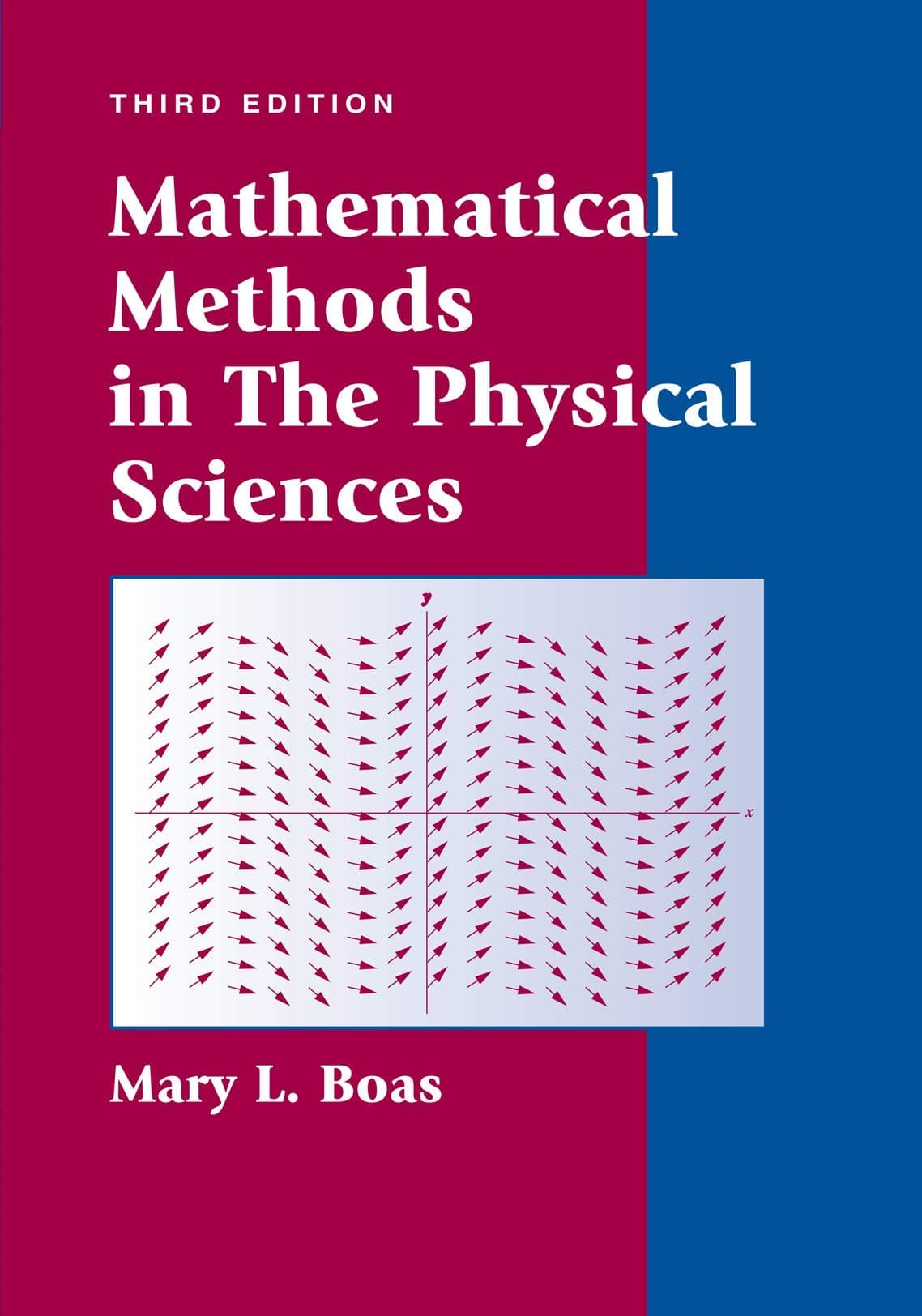
desertcart.in - Buy Mathematical Methods in the Physical Sciences book online at best prices in India on desertcart.in. Read Mathematical Methods in the Physical Sciences book reviews & author details and more at desertcart.in. Free delivery on qualified orders. Review: Its a great Book. I was looking for this book for ... - Its a great Book. I was looking for this book for a long time and now got my hands on it. It is a great for students of both physical sciences and engineering. I use it to teach my engineering students. Some great experience with the international edition. Review: Nice book - I got the used hardcover version for 850 INR. I got a good deal. Very satisfied. The book is simple and nice with good amount of practise exercise.
| ASIN | 0471198269 |
| Best Sellers Rank | #766,433 in Books ( See Top 100 in Books ) #4,056 in Physics (Books) #66,321 in Reference (Books) |
| Customer Reviews | 4.5 4.5 out of 5 stars (288) |
| Dimensions | 18.29 x 3.56 x 25.91 cm |
| Edition | 3rd |
| ISBN-10 | 9780471198260 |
| ISBN-13 | 978-0471198260 |
| Importer | Atlantic Publishers and Distributors (P) Ltd., 7/22, Ansari Road, Darya Ganj, New Delhi - 110002 INDIA, Email – [email protected], Ph – 011-47320500 |
| Item Weight | 1 kg 520 g |
| Language | English |
| Packer | Bookswagon, 2/13 Ansari Road, Daryaganj, New Delhi 110002, [email protected] , 01140159253 |
| Print length | 839 pages |
| Publication date | 22 July 2005 |
| Publisher | Wiley |
P**R
Its a great Book. I was looking for this book for ...
Its a great Book. I was looking for this book for a long time and now got my hands on it. It is a great for students of both physical sciences and engineering. I use it to teach my engineering students. Some great experience with the international edition.
P**I
Nice book
I got the used hardcover version for 850 INR. I got a good deal. Very satisfied. The book is simple and nice with good amount of practise exercise.
A**R
good book
This hard cover is low price.it is helpful for herd cover book reader.I want such low price hard cover book if possible.
A**R
Valuable book
Awesome book... Thanks Mary l boas
A**R
Five Stars
Very good book
H**N
The paper quality and the hardcovers are nice, but some of the pages were printed badly ...
This is what I would call a cheap hardcover. The paper quality and the hardcovers are nice, but some of the pages were printed badly in my copy (see attached images). There was a significant smudging of ink on these pages. That said, the content is excellent and I have absolutely nothing negative to say about it. Boas tells you just what you need to know and as a result, it's easy to read and understandable. Problems are not too difficult, they just test your ability to apply the concepts. This book may not be as comprehensive as, say, Arfken and Weber, but it's easy to get started with this book and it covers almost all you need to know mathematically till your graduate years (at least when it comes to Physics majors).
N**A
Good Book
Its good book for all the physicsist and also useful for mathematics students. It includes all the possible results and derivation of mathematics
P**R
Don't buy it
Book is in good condition but not useful less numericals in the book
G**A
In tegenstelling tot veel andere, zet dit wiskunde boek aan tot lezen en oefenen. Voor wie van wiskunde houdt is dit een waar avontuur en geen wiskunde bijbel met droge opsomming van diverse topics en academische bewijvoering. Sterk aan te raden.
K**T
Let me start off by saying, I have essentially covered every single chapter (with the exception of the multivariable calculus section, I took a separate course on that), and every single section in a 3-quarter mathematical methods course as part of my physics undergraduate requirements. And let me repeat this again, this book will make a man out of you. After you conquer this book, you will be on your way to conquering all undergraduate physics with ease; mathematics will no longer be a problem and the real learning of physics will begin. 1. Infinite Series, Power series: Great coverage of series and series representations of functions. Introduces several methods of determining convergence or divergence and techniques to convert essentially any function into a series as well as determining accuracies in representations. These are invaluable tools to solve difficult and non-analytic functions that show up everywhere in physics. 2. Complex Numbers: A great introduction to complex analysis, starts off slow and easy and picks up the tempo with powers and roots of complex functions. This chapter is missing a discussion on the argument of a function and its meaning and kind of sweeps under the rug a few more technical things that a real complex analysis course would cover but nevertheless well done. 3. Linear Algebra: The linear algebra section is pretty solid as well and it went a bit further than my regular linear algebra course. The placement of planes and lines is a bit awkward and doesn't really deal with matrices in the sense that you don't need to write out matrices but still an appropriate spot. It is missing some discussion on abstract vector spaces and doesn't delve too deep into the theoretical side of things; a mild discussion of group theory ends the chapter. 4. Partial Differentiation: (No comment - did not cover) 5. Multiple Integrals; Applications of Integration: (No comment - did not cover) 6. Vector Analysis (No comment - did not cover) 7. Fourier Series and Transform: A great section to learn about fourier series, usually special series are left out of real analysis courses (or covered only slightly) but in physics we use these a lot. You learn how to represent oscillatory systems as a superposition of waves, that is a series, which is a really neat idea, at least to me. My only complaint is that the fourier transform is only limited to one section and I think it's a bit more important and deserves a more in depth discussion. 8. Ordinary Differential Equations: The bread and butter of physics. No matter what you do in physics you'll always encounter ODE's. Even if you have never seen them you might be surprised to learn that a simple equation such as F = ma is, in fact, a differential equation. It gives you the tools you need to solve the problems you will encounter and gives you discussions on how to solve special cases that occur frequently in physics. It ends with Laplace transforms (related to Fourier transforms), convolution, dirac-delta functions (mathematicians cringe at our use of the term function here), and greens functions which are a bit more advanced topics but great introduction and are definitely worth looking at. 9. Calculus of Variations: The most important principle you take out of variations is the principle of least action. Once you start doing big boy physics you'll be calculation Lagrangians and Hamiltonians to easily solve for systems. Definitely a good mathematical approach to variations and something that will be essential throughout physics. 10. Tensor Analysis: I didn't really cover most of the chapter, and what I did cover was in such a short amount of time that I can't possibly write a review without being biased. All I have to say though, is that for those General Relativity lovers, this is going to be your best friend. 11. Special Functions: As the chapter title itself says, these are just formulas and quick derivations for a variety of special functions that are everywhere in physics. You don't necessarily need to study these in great detail as they only help you solve integrals, but they are of some theoretical interest. Definitely a must read chapter. 12. Series Solutions of Differential Equations; Legendre, Bessel, Hermite, and Laguerre Functions: Solutions to partial differential equations everywhere, and I mean everywhere. Chapter 12 and 13 go hand in hand, first you learn the math stuff in chapter 12 without really knowing it's purpose and then jump into chapter 13 and find out these are solutions to partial differential equations. Just like ODE's, these are essential and found everywhere in physics. This chapter is very meaty and full of solutions to differential equations and chances are, if you ever run into a differential equation in your undergrad career the solutions are here. 13. Partial Differential Equations See chapter 12 summary, they go hand in hand. 14. Functions of a Complex Variable I still think this is an odd location for the second part of a complex analysis course, ideally I would have preferred right after chapter 2 or possibly 3 but nevertheless a good coverage and sum of complex analysis. You learn how to solve some really nasty integrals in a really trivial way using complex analysis. 15. Probability and Statistics Arguably the worst of all chapters, at least in my opinion. The notation convention Boas uses isn't the most intuitive or the most frequently used and the explanation to some of the probability problems are not really helpful. Some are more naturally talented in probability, I however, am not thus found this chapter to be really annoying and confusing. Still, something worth knowing and if it works for you then let it be. Overall this is a book I will be using for years and will keep coming back for years. It's not exactly mathematics and it's not exactly physics it fits that missing link between the two and helps clarify topics in advanced mathematics that will be useful in all undergraduate physics. I'm glad I went through this book and having seen these things at least once, even if I didn't understand it fully initially, definitely helped give me the courage to tackle my undergraduate physics courses. I recommend it to every physics student.
D**N
Una arma letal
J**Z
El libro llegó en excelentes condiciones. Tiene muy buen contenido y me encanta como aborda los temas. Estoy muy satisfecho. Lo recomiendo ampliamente.
J**1
I am a first year Physics undergraduate at Imperial College and this book covers all the major topics in a clear and concise way. To see a full list of everything covered go to the 'search inside this book' link below its image. The book starts each topic from the basics, so don't worry about being thrown in at the deep end having forgotten stuff. But also don't be put off thinking it wastes time on the basics, it doesn't. There are a lot of question and answers on all the topics as you go along so you can check your understanding, and worked examples too. I would say it is best for physics and I would double check with the course teacher/lecturer for biology or chemistry as it is not cheap. For me, it was the perfect choice!
Trustpilot
1 week geleden
2 dagen geleden