We remain fully operational. Our teams are working around the clock to ensure your deliveries continue safely.

DOWNLOAD DE APP


Klantenservice
Copyright © 2025 Desertcart Holdings Limited
DOWNLOAD DE APP
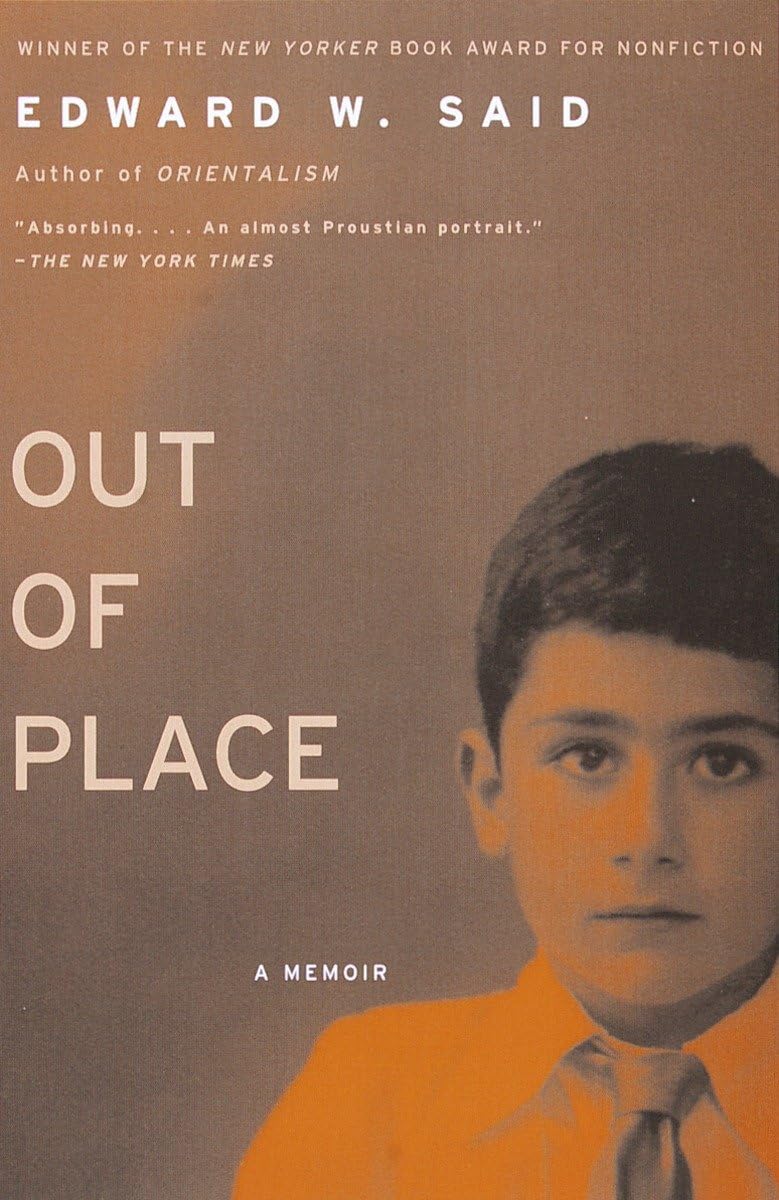
Buy Out of Place: A Memoir by Said, Edward W. online on desertcart.ae at best prices. ✓ Fast and free shipping ✓ free returns ✓ cash on delivery available on eligible purchase. Review: the most beautifully written memoir I have read - This is one of the most compelling memoirs. So beautifully written that you don't want to put it down. Review: Great read - Highly recommended
| ASIN | 0679730672 |
| Best Sellers Rank | #10,755 in Books ( See Top 100 in Books ) #14 in Biographies of Philosophers & Social Scientists #18 in Biographies of Authors |
| Customer reviews | 4.5 4.5 out of 5 stars (116) |
| Dimensions | 13.21 x 1.78 x 20.32 cm |
| Edition | Illustrated |
| ISBN-10 | 9780679730675 |
| ISBN-13 | 978-0679730675 |
| Item weight | 318 g |
| Language | English |
| Print length | 336 pages |
| Publication date | 12 September 2000 |
| Publisher | Vintage |
A**H
the most beautifully written memoir I have read
This is one of the most compelling memoirs. So beautifully written that you don't want to put it down.
S**I
Great read
Highly recommended
A**R
Excellent book to read
タ**丸
昨年惜しまれつつ亡くなったエドワード・サイード教授。 私も同教授の数々の著書を読んで、学ぶところ大です。 この本は、パレスチナ人の中に生まれながら「エドワード」と名づけられ、自らのアイデンティティーを求めてさまよい続けた人の物語です。 ただ、一つだけはっきりさせておかねばならないのは、彼の人生は典型的なパレスチナ人の人生とはあまりにもかけ離れている、ということです。 簡単に言えば、多くのパレスチナ人がイスラエルに追放され、難民キャンプで肩を寄せ合い暮らしていた頃、「エドワード」は「ハーバードの修士課程中」の「夏休み」に、「ギリシャ」を旅行していたわけです。 それ自体は悪い事ではないのですが、そういった人でなければパレスチナ人の「語り部」にはなれない、(難民は生きるのに精一杯で勉強したり本を書いたりする暇も余裕もない)というのが、実はパレスチナ人の本当の悲劇なのかもしれません。
D**D
Worth Reading
N**Y
I had never read Said and fell in love with him, and this book. His insights into the world of The Other -- a world I've inhabited basically forever -- are brilliant and poignant. Half-way through the book, I learned Said had died, which made me very sad, since I'd wanted to write to him.
A**R
This is a remarkable work of a truly fascinating man. Much of the memoir is dedicated to Edward Said's relationship with his mother and father. Said recounts the history of his father, a Palestinian, who went to America and possibly fought for it in the First World War. The father Wadie, later returned to Palestine and then moved on to Cairo to establish a great business success. The father comes across very typical Middle Eastern conservative authority figure with a rather peculiar but very strong American patriotism. Said's mother, comes across as a truly fascinating woman; a Palestinian Lebanese Christian, who possessed a great passion for music, literature and original thought. In the tradition of the Middle Eastern mothers she had a large presence in the lives of her children. She was an original woman, who felt comfortable amongst the many different cultures of the middle east, yet held on to her views, which at times were at odds with her environment. Said tells of the huge influence his mother had over him during her life and even after her death. The story of the mother's search for a passport, a nationality, her dislike of life in America, her eventual death in America are beautifully told by Said. The mother's early conversion to Nasser's cause is mentioned, it even alienated the mother from her Lebanese family, but Said never tells us where it led. I loved Said's self analysis relating his behavior to his mother: "...I seem to have absorbed her worries, her tireless concern for details, her inability ever to be calm, her way of constantly interrupting herself, preventing a continuous flow of attention or concentration on anything." Said is capable of very vivid language indeed. The school life of Said in Cairo is fascinating. He attended English Colonial schools, American and Egyptian schools in Cairo and eventually moved on to Massachusetts, Princeton and Harvard. Much of his pre college school life was problematic, at times there is too much dwelling and self-pity but it is largely interesting. On a week trip, with his mother, that for some not clearly explained reason left him indifferent to Egyptian Monuments, he says " ....I was relieved of the pressure and the continual anxiety of not getting anything right." The "out of place" theme is repeated throughout the book, at times very eloquently told, " ...the habit of always being dressed differently from the natives, any natives." I do however find it remarkable that Said does not also seem to see how well he did apparently fit everywhere outside of his early Colonial school. In fact, from his stories at the American School in Cairo, Princeton, Harvard and mostly Victoria College in Cairo, you often see a fairly popular kid with many friends. I laughed out loud at the part describing his episode of revisiting Victoria College in 1989. He bribed his way in to show his family his old classroom, and later got thrown out by a woman wearing an "Islamic-style dress". Said proceeds to describe Victoria College in 89 as a "privileged Islamic sanctuary" that expelled him twice. The fact that the first time he got expelled was due to punching a kid and sending him to the hospital for a week and the second through trespassing both by his own admission does not seem to matter, in both cases, to him it was discrimination. Victoria College is a million miles away from being an Egyptian Islamic sanctuary, with a mixed high school. Said's self pity and righteousness is a times reminiscent of the Maggie Thatcher memoir, well no, not 10% as bad but it does detract a bit from the book. There is one thing I hated about the book. Where is part two? Edward Said gives you so much detail about his early pre political life. I read this book, because I often find myself at odds with Edward Said's political views, I wanted to know more about the man. I thoroughly enjoyed "Out of Place" but it has not satisfied my desire to understand his viewpoint. I often thought that he simply fails to understand Egyptians and Egyptian attitudes but had no idea how much time he actually lived there. This is a great book, very enjoyable and full of reflection. I gave it 4 stars only because as much as I loved it I could not bring myself to give it an identical rating to Leila Ahmed's Border Passage.
Trustpilot
1 maand geleden
2 weken geleden