We remain fully operational. Our teams are working around the clock to ensure your deliveries continue safely.

DOWNLOAD DE APP


Klantenservice
Copyright © 2025 Desertcart Holdings Limited
DOWNLOAD DE APP
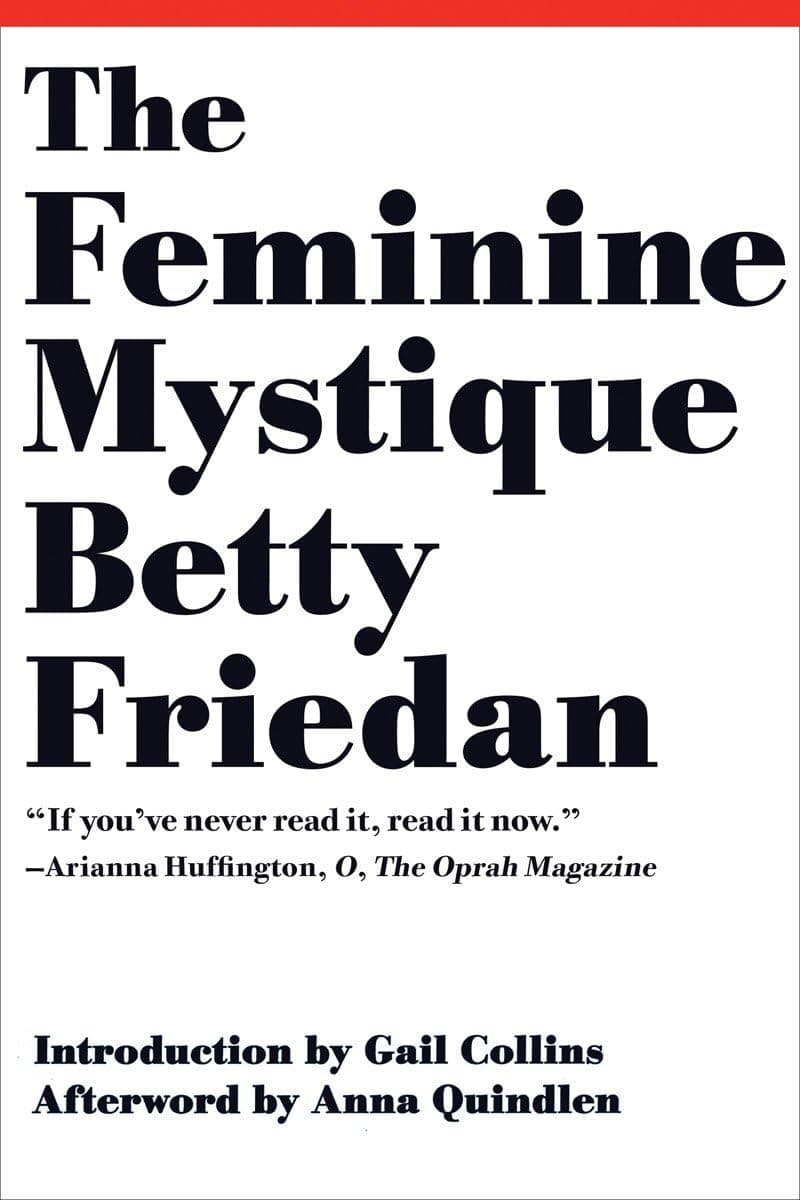
📖 Unlock the power of change—because true fulfillment breaks all molds.
The Feminine Mystique by Betty Friedan is a seminal feminist text that exposed the limitations imposed on women in post-war America, sparking a movement toward gender equality. Ranked top 5 in Feminist Theory and praised for its enduring relevance, this used copy in good condition offers a compelling exploration of societal roles, mental health, and systemic barriers that still resonate with today’s leaders and changemakers.
| Best Sellers Rank | #14,412 in Books ( See Top 100 in Books ) #5 in Feminist Theory (Books) #7 in Sociology of Marriage & Family (Books) #8 in General Gender Studies |
| Customer Reviews | 4.6 out of 5 stars 2,127 Reviews |
L**R
Era defining feminist manifesto
The clear, forceful, and inspirational words that document the means of repression of women that came to fruition in the post-war era of the 1940s and 1950s. Friedan’s work stands out today as a clear historical record of what was and what could be again and should never be. Certainly, women’s right to lead a fulfilling and happy life like any man, continues to be a battleground in many parts of the world, but the progress sparked by Friedan and her subsequent work pushed the battle line in the right direction. The book outlines the post-war societal enshrinement of the “feminine mystique", an image of women that perpetuated the idea that true fulfillment for women could only be found through their dedication to housework, marriage, and raising children. Friedan argues that this limited point of view was the root cause of the rise of depression, related forms of mental illness, and substance abuse in women and that placing limits on any segment of society was holding back that society as a whole. Structurally, she places the blame on capitalistic exploitation of women’s desire to find fulfillment in a role that was sexualized and intellectually limited, on religion for perpetuating a structure that keeps women in a servant role, and on a legal structure that allows corporations to make hiring and salary distinctions purely on gender. That’s just a sample - there’s so much more. The work is not done. The feminine mystique persists today, and though lessened in potency, still holds many women back from becoming the most fulfilled versions of themselves. I read The Bell Jar ahead of reading this book to sample the brilliance and beauty of Sylvia Plath’s writing and to witness a woman crushed by the injustice inflicted on women during the postwar era. The combination of these books read back to back brings home the tragedy that befell a generation of women who were shackled by the trappings of the feminine mystique.
A**N
A surprisingly relevant classic
Beautifully written and insightful, The Feminine Mystique is also surprisingly relevant 60 years after it was published. Betty Friedan’s exasperation with women being treated as if “biology were destiny” will feel very contemporary when, for example, a debate about abolishing no-fault divorce is brought up in the news. Each chapter can be read mostly on its own. Some of the discussion will feel dated (such as her critique of Freudian psychoanalysis). But most of it will feel alive and kicking today. She is writing at the peak of the baby boom and sees it as a mixed blessing. Man this is a great book.
C**D
A classic and a must read
A classic, and a must read for every feminist! I bought this book for a book club. I bought the actual book and also the audiobook read by Parker Posey. It was interesting to discuss what has changed and what rights we are still fighting for.
A**R
The Book that Rescued Women
In the Feminine Mystique, Betty Friedan put a spotlight on the hidden, yet immense problems women faced during the 1950’s. Her work propelled the stagnant women’s rights movement into its second wave and helped women reclaim some equality. Despite focusing on the seemingly small problems of middle class white women, the legacy of the book has paved the way for more universal movements towards equality. Readers interested in the history of women’s rights and the progress that has been made should pick up a copy. Friedan does a great job explaining the context of her writing to contemporary and modern readers. She makes a compelling case that the status of women initially improved during World War II, but then reverted as men returned from the fight. Her perspective is quite unique. As a magazine writer she’s able to show the changing opinion of society vocalized through the media. By counting the number of magazine articles that portray women as empowered individuals, Friedan is able to quantify this ideological shift. In this context Friedan pointed out that something was wrong. She recognized that women lived in a tiny sphere of influence and led unfulfilling lives. She argued that “we can no longer ignore that voice within women that says: ‘I want something more than my husband and my children and my home’”. After the book’s release in 1963 it spent 6 weeks on the New York Time’s best seller list and sold 1.4 million copies. This goes to show how much her message resonated. The book also made me think about the experience of my grandparents in a new way. While the book is progressive in one area, readers should beware of its regrettable comments about homosexuals, mental disease, and concentration camps. Friedan argues that house-wives smother their children with love, preventing them from growing up. This leads to promiscuity and homosexuality, which “is spreading like a murky smog over the American scene”. As well, she brazenly makes the comparison that women “are in as much danger as the millions who walked to their own death in the concentration camps”. This argument only made me contrast the relatively small plight of women with the immense inhumanity of the holocaust. Finally, she implies that schizophrenia and autism in children are the result of mothers over accommodating their kids. These passages are not worth reading. Despite the book’s flaws and age, it’s still significant today. Women’s equality has advanced greatly in the last half century, yet they still face similar challenges. Jobs with the highest proportion of female workers are still nurses, school teachers, social workers and other traditional roles according to U.S. DOL 2010 figures. The arguments of the Feminist Mystique are still valid. Buy this book if you’d like to better understand how the role of women has evolved and continues to change.
D**.
Can't put this book down!
Currently reading. Can't put this book down!
S**Y
One of those books you can’t put down
I am a boomer. I distinctly remember in the 60’s standing up in class and responding Scientist to the question in class as to what career I wanted and being told by my teacher that wasn’t possible. I was informed by her that women could be teachers, nurses, secretaries or stewardesses (but only if they were pretty and single) Poor dear. She was a product of this mindset. Fortunately I didn’t listen to her and I had the support of parents who reinforced the idea that women are just as intelligent as men. I recommend this book for the generations that came after us so that they can understand the mindset of our generation and the previous generations and understand just what we went through to get where we are today.
S**Y
Mind Blowing
When I first heard about this book I was immediately intrigued. I couldn't wait to read it and see how far women have come. Imagine my surprise when the author seemed to be describing the present day instead of a distant past. I couldn't believe how relevant a book from the 1960's is today. Betty Friedan describes a generation of women who were manipulated into thinking that motherhood and housewifery is the be all and end all for women. She explained that in the 50's and 60's women defined themselves solely through their children and husbands instead of developing an identity of their own. Women were seen as childlike with limited capabilities and, thus, education for females was dismissed as unnecessary. However, many women were unsatisfied with their only career choice as wife and mother. They were desperate for a sense of meaning and true identity. Some attempted to fill this void by using sexual promiscuity, focusing on their appearance, and/ or buying an endless amount of material things for their homes. This is still true for a lot of women today. Friedan thinks that women tried to elevate the status of housework and child rearing by obsessing over natural child birth, breast feeding, and homemade bread and clothes. Mothers became so over involved in the lives of their offspring that the kids could hardly develop into independent human beings. Researchers later found that children are actually happier, and develop better, when the mother has a career, or other purpose besides her children. Unfortunately, women seem to be falling into the same trap again. The media seems to be telling them, once again, that unless they give up everything and turn into helicopter-parents, their children are doomed for failure. It almost seems as if there is a second wave of this back- to-the- home trend. I see many women that are so preoccupied with their children that it appears as if they are trying to live their lives through them. Just think about shows like Toddlers& Tiaras- is it really the dream of those little girls to be presented like a show pony for the adults? I have to admit, there have been times when I, too, have thought about how idyllic it would be to have a big family, prepare all their organic food at home, and even (gasp!) home school the children. But after reading this book, there is no way that I will ever give up my education and career. Defining yourself through your children and husband is simply not the way to live a fulfilling life. This book may have been a bit dated and repetitive at times, but obviously our generation hasn't gotten the message yet, and it can't hurt to hear it more than once. In my opinion, they should really make this work required reading in high school. It's very powerful.
T**L
Glad I read it
This is one of those books that I've been saying I was going to read. I know I'm 50 years late, but hey, I was born in the 70s. Still the sections on Freud & Margaret Mead are slow and tough to get through. The book was slow reading for me. Probably because it isn't as relevant today. But it does make me appreciate where we are today as women and as a society. I still see some of what Betty Friedan pointed out and so there is still some room to grow. I particularly like the end when she wrote about taking the next step to global women's rights and acknowledged the position of modern men. All and all, a good read.
Trustpilot
5 dagen geleden
3 weken geleden