
DOWNLOAD DE APP


Klantenservice
Copyright © 2025 Desertcart Holdings Limited
DOWNLOAD DE APP
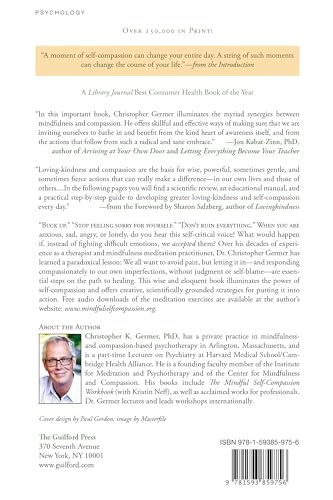


The Mindful Path to Self-Compassion: Freeing Yourself from Destructive Thoughts and Emotions: 8581102034442: Medicine & Health Science Books @ desertcart.com Review: So good that I keep buying it - because I always end up giving it away. - I won't go into a description of this book, because there are plenty of reviews that do that. What I will say is that as a psychology professor and psychotherapist, I have a few "go-to" books - books that I constantly have to replace because I end up giving them out to students or loaning them to clients. For couples, for example, it's Notarius & Markman's "We Can Work It Out." For people that need to work on mindfulness and learning to relate compassionately with themselves, this excellent book is it. I finally bought it on kindle as well just to have a copy that I could count on being able to get my hands on! Probably my favorite part about this book is the way that it uses mindfulness as a vehicle for the development of self-compassion, such that as readers move through the book, they develop both of these capacities. I can see it not appealing to some - it might be too psychological for those who prefer Thich Nhat Hahn, or not empirical enough for psychology professionals looking for empirically-validated treatment approaches supported by dozens of clinical trials...but for those who want a readable, sensitive path that is rooted in both spirituality and psychology, it is a tremendous resource. Highly recommended. Review: Sometimes life is tough - Germer outlines the mindfulness path to self-compassion ("freeing yourself from destructive thoughts and emotions"). He admits early in the book that "life is tough", and goes on to discuss acceptance of inevitable emotional pain and suffering, letting life be easy, moment-to-moment awareness, the importance of breathing and being aware of our breathing, caring for ourselves (easy to forget) and caring for others, and loving-kindness meditation. He suggests that when something bad happens to us, we tend to have three unfortunate reactions: self-criticism (put myself down), self-isolation (avoiding others), and self-absorption or focusing only on myself (been there to all three). The components of self-compassion on the other hand direct us in exactly the opposite directions. He also discusses personal vulnerabilities or "tender spots" that characterize many people and that can kick in when times are rough. Self-compassion is most likely to occur if we recognize and manage these vulnerabilities. Further, he outlines his conceptualization of "personality types" (based on anecdotal evidence rather than scientific research), and discusses ways that awareness of one's personality type can enhance self-compassion. The "personality types" include: Caregiver, Intellectual, Perfectionist, Individualist, Survivor, Workhorse, Butterfly, Outsider, Floater, Moralist, and Extravert and Introvert. As just one example, the "moralist" tends to get really upset when people behave badly, and they apply strict moral codes to themselves as well. To develop self-compassion and serenity, the moralist needs to lighten up. I was pretty impressed with German's book.



| ASIN | 1593859759 |
| Best Sellers Rank | #60,421 in Books ( See Top 100 in Books ) #41 in Social Work (Books) #357 in Meditation (Books) #395 in Happiness Self-Help |
| Customer Reviews | 4.6 4.6 out of 5 stars (1,074) |
| Dimensions | 5.91 x 0.79 x 9.06 inches |
| Edition | 1st |
| ISBN-10 | 9781593859756 |
| ISBN-13 | 978-1593859756 |
| Item Weight | 2.31 pounds |
| Language | English |
| Print length | 306 pages |
| Publication date | April 29, 2009 |
| Publisher | The Guilford Press |
R**S
So good that I keep buying it - because I always end up giving it away.
I won't go into a description of this book, because there are plenty of reviews that do that. What I will say is that as a psychology professor and psychotherapist, I have a few "go-to" books - books that I constantly have to replace because I end up giving them out to students or loaning them to clients. For couples, for example, it's Notarius & Markman's "We Can Work It Out." For people that need to work on mindfulness and learning to relate compassionately with themselves, this excellent book is it. I finally bought it on kindle as well just to have a copy that I could count on being able to get my hands on! Probably my favorite part about this book is the way that it uses mindfulness as a vehicle for the development of self-compassion, such that as readers move through the book, they develop both of these capacities. I can see it not appealing to some - it might be too psychological for those who prefer Thich Nhat Hahn, or not empirical enough for psychology professionals looking for empirically-validated treatment approaches supported by dozens of clinical trials...but for those who want a readable, sensitive path that is rooted in both spirituality and psychology, it is a tremendous resource. Highly recommended.
D**Y
Sometimes life is tough
Germer outlines the mindfulness path to self-compassion ("freeing yourself from destructive thoughts and emotions"). He admits early in the book that "life is tough", and goes on to discuss acceptance of inevitable emotional pain and suffering, letting life be easy, moment-to-moment awareness, the importance of breathing and being aware of our breathing, caring for ourselves (easy to forget) and caring for others, and loving-kindness meditation. He suggests that when something bad happens to us, we tend to have three unfortunate reactions: self-criticism (put myself down), self-isolation (avoiding others), and self-absorption or focusing only on myself (been there to all three). The components of self-compassion on the other hand direct us in exactly the opposite directions. He also discusses personal vulnerabilities or "tender spots" that characterize many people and that can kick in when times are rough. Self-compassion is most likely to occur if we recognize and manage these vulnerabilities. Further, he outlines his conceptualization of "personality types" (based on anecdotal evidence rather than scientific research), and discusses ways that awareness of one's personality type can enhance self-compassion. The "personality types" include: Caregiver, Intellectual, Perfectionist, Individualist, Survivor, Workhorse, Butterfly, Outsider, Floater, Moralist, and Extravert and Introvert. As just one example, the "moralist" tends to get really upset when people behave badly, and they apply strict moral codes to themselves as well. To develop self-compassion and serenity, the moralist needs to lighten up. I was pretty impressed with German's book.
A**K
Pleasurable read, includes psychological and neurological case studies
I had only recently heard of the concept of "self-compassion" through a blog I stumbled upon last year, and I'm trying to learn more about meditation to deal with chronic neuropathic pain and "self-compassion" as a tool to deal with depression and alcoholism. There are a few people in mind I have when reading this book, myself and others, and I was pleased how the book had a variety of case studies that included not only psychological case studies, but also other experiments and studies involving functional MRIs. The book gives actual "steps" on what you can do to practice mindfulness and self-compassion. It's not preachy, it's not sappy. It's a good how-to book with studies and stories to introduce you to "mindfulness" and self-compassion. I haven't finished reading it (I have a tendency to have several books "in progress" and bounce around according to my mood), but it's an easy read, not overly scientific nor full of medical terminology. It's for the "regular" person seeking practical ways to deal with their depression, pain, ptsd, alcoholism, grief, feelings of failure, or other deadening and self-defeating habits or battles. If you're trying to get through an exhausting mental battle, tired of not being able to function, keep "slipping back" or sick of being on medication, I recommend you read this book for practical ways to help heal yourself and be able to face daily challenges.
W**Y
Contains valuable recipes for living better.
(This review is based on a review I wrote and maintain on my home web site. The definitive version can be found at: [...]. I had reached the point in my personal and professional development where I noticed I was giving a lot of energy to "beating myself up" about stuff -- goals unmet, decisions regretted, actions not taken. It had gotten to the point where I realized a lot of my energy going to waste doing so. After having read, "Mindset" by Carol Dweck, (more on that book in another review) I was actively seeking new ways to set and meet higher expectations for myself in a constructive and supportive way. Christopher Germer's mindfulness and loving kindness meditations turned out to be the right recipes for me. The meditations enabled me to replace my old habits of bringing myself down or catastrophizing failure with new habits of giving myself kindness while I worked, and when I suffered setbacks either from outside circumstance or from my own limitations. Sometimes books about meditation are presented in a framework set by some particular religion. Germer's presentation is simple and factual. Germer uses Budhism, but he keeps religiosity out of it. He focuses on connecting one's self with our fellow human beings in a way that can be comfortably read by people of various faiths, those who are agnostic or those who consider themselves apart from a faith or religious tradition. Anyone who has come from a high pressure professional, personal or family history will find this book a valuable help.
R**E
This book has changed my life. On the outside I was succeeding in life, but in the inside I was numb. I was burned out from the challenges of life, job and difficult persons. It evolved so that I was doing life versus living life. My feelings became a flat line, no deep lows nor highs. It was discouraging to think of reading this recommended book and having another thing to do, to learn. I was advised that this book would actually help me let go of things to do. After reading the book, I realized I was frozen in feelings, did not want to say or do anything that would hurt someone, nor feel hurt myself. This book taught me to feel difficult feelings go through me, label them and let them go, versus freezing the pain trying to stop it from entering further. I learned how the brain and body works with feelings, so I could flow with it. By acknowledging the good and bad feelings as they passed through me, with self loving kindness, I came to understand myself better, to "live" life. One of my favorite books that made a big difference in my life, to experience and enjoy life. Thank you, Rose
L**N
Well written and smart, I really enjoyed this. Helps tie together different therapy and spiritual traditions in a way that makes sense for my love of evidence-based, scientific, universally true stuff.
T**C
Really helps me to change the relationship with my emotions!
R**I
O livro é excelente. Simples, direto, e, principalmente, bem fundamentado. A leitura é prazerosa, e as práticas são valiosas. Recomendo.
H**M
This is an excellent manual on practicing mindfulness with self - compassion to provide relief from emotional suffering. I only wish that I had been aware of both mindfulness & self compassion a long time ago and that easily followed guides like Christopher Germer’s had come to my attention earlier. I have also recently found the teachings of Thay Thich Nhat Hanh both on You Tube & in books to be of immense help.I really hope that anyone suffering from any form of emotional imbalance find these resources to bring the relief that they are providing for me - as long as you are prepared to practice they work.
Trustpilot
1 maand geleden
2 weken geleden