We remain fully operational. Our teams are working around the clock to ensure your deliveries continue safely.

DOWNLOAD DE APP


Klantenservice
Copyright © 2025 Desertcart Holdings Limited
DOWNLOAD DE APP
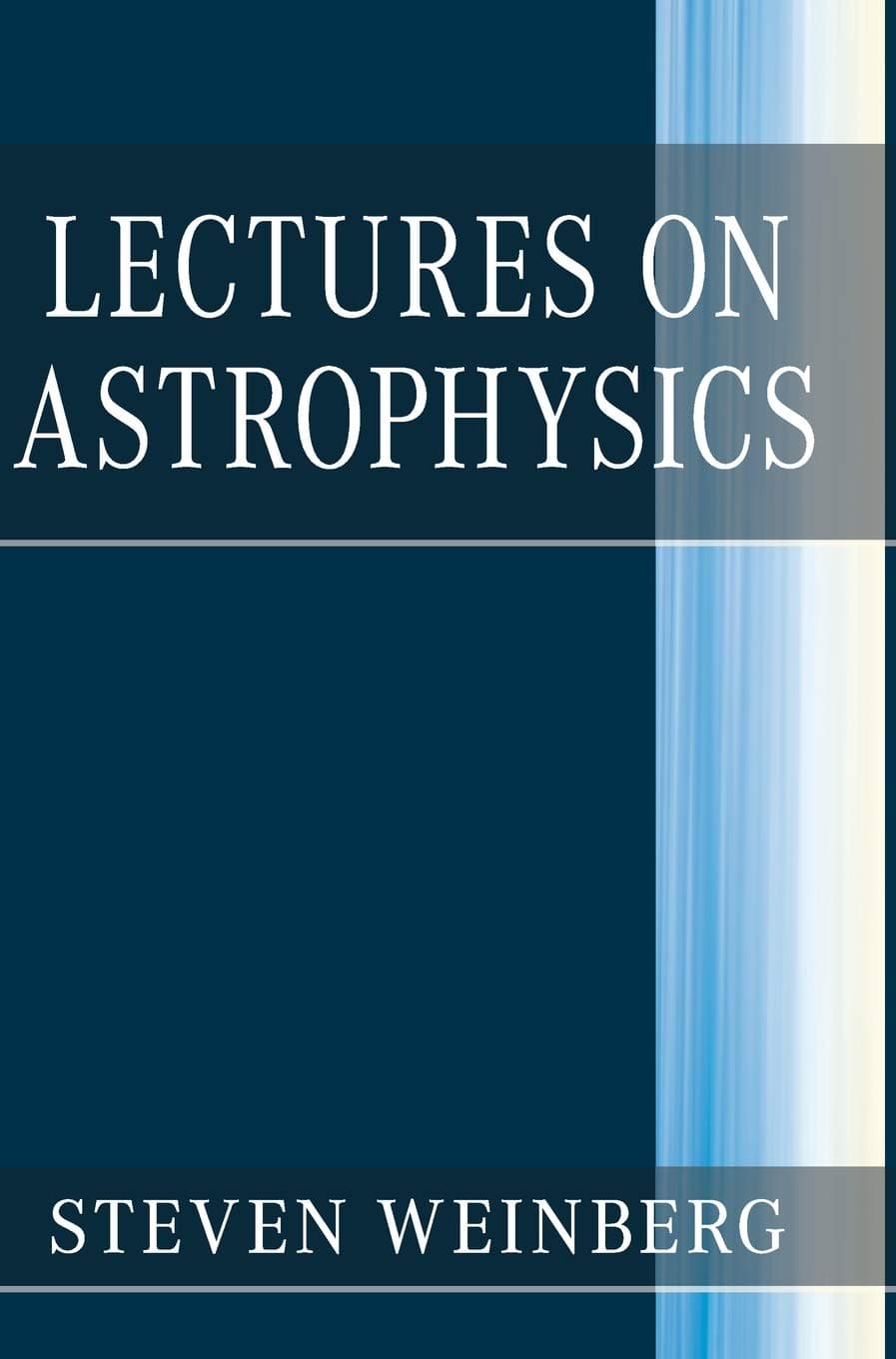
Buy Lectures on Astrophysics on desertcart.com ✓ FREE SHIPPING on qualified orders Review: Steven Weinberg: "...feel some of the excitement." - In Memoriam: Steven Weinberg (May 3, 1933 – July 23, 2021). This is a sad occasion, writing this book review one week after the passing of physicist Steven Weinberg. Having been a lifelong student and admirer of Weinberg, there was no way I was going to ignore his book of lectures on astrophysics. It is dense. It is terse. It is challenging. However, Weinberg does not promise anything that he can not deliver. As is his custom, Weinberg stresses the interplay between theory and experiment, how to arrive at numbers. Interestingly, dimensional analysis is used in various circumstances (pages 42-49). You get a derivation of relativistic equilibrium condition (page 68, also, you are referred to his 1972 tome on General Relativity for alternative derivation). Tools of the trade include the oft-utilized method of "integration-by-parts" and the oft-utilized "power series expansion." I enjoy section #2.1: "how observations are used to find the properties of binary stars." (page 83). You derive inequalities (examples: tidal distortion, page 87, maximum luminosity, page 149 and Schwarz inequality, page 190). You will get a review of gravitational radiation in preparation for a discussion of LIGO (pages 98-104). There is a discussion of HII regions (ionized Hydrogen surrounding stars): it is insightful, lucid and easy to follow (see section #3.2). You will learn something new as you consider effects of viscosity in gas rotating around an axis of symmetry (pages 150-153). A discussion of Galaxies concludes the lectures, recall the Boltzmann equation and Euler equations of hydrodynamics, while learning that "the formalism presented above allows the construction of equilibrium distribution functions for galaxies in clusters and for dark matter." (page 178). A motivation to peruse this book, according to Weinberg, is the opportunity to bring his earlier book up-to-date (1972, Gravitation and Cosmology). Because my personal library holds many of Steven Weinberg's bibliographic references, the lectures were easier to assimilate than they might otherwise have been. There is more here to learn and I intend to learn it: if for no other reason than to pay homage to a brilliant physicist, a fine teacher and a fine human being. He will surely be missed. Review: Very compact and dense! - Not for plebs who want a casual read but are able to engage the material in a technical way. Not like his First Three Minutes but as the book says these are lectures in the best of tradition, think Chandrasekhar, Eddington, Peebles, etc. Very mathematical but the physics is not lost in the masterly crispness of exposition. I found that reading his semi-popular works immensely helps in reading some of the more technical works. Update - It's sad to have lost Steven Weinberg. It feels personal somehow. He was from a generation that sported greats like Feynman, Wheeler, Schwinger, and all the others from the post-war generation. As a Physicist, only a great physicist may comment on his greatness but I do think that he was a great man based on his scientific writings for the public. Richard Dawkins rightly called him 'A real public intellectual in an era where the term intellectual is bandied about'. For me reading his book The First Three Minutes was an eye opener of how great physicists think but also helps convey deep and unintuitive knowledge in a way that's not jargon driven but hits the mark every time. Never one to talk down to his audience, his books are a friend holding your hand. Where he is technical, he implicitly considers you to be fluent in mathematics to follow the scientific argument. To 'Explain the world' will seal Weinberg as not only a physicist of great measure but equally in his immense writing skills to comment on its historical evolution. That's rare. Physics or its History is usually the preserve of specialists in one field or the other but not both as a Physicist and Historian of Science. As a historian, he's in the class of Pais who was like him both but I feel Steven Weinberg was clearly the greater physicist (based on his unification work) and given his breadth and depth of span in this field. I mean the list is like everything!! Particle, Relativity, Cosmology, QM, QFT, Semi-Technical writing. The man was a monster mind in the class of the front-line physicists like Heisenberg, Einstein, Eddington, or Schrodinger
| Best Sellers Rank | #1,443,958 in Books ( See Top 100 in Books ) #334 in Astronomy & Astrophysics #1,361 in Astrophysics & Space Science (Books) |
| Customer Reviews | 4.8 4.8 out of 5 stars (84) |
| Dimensions | 7 x 0.75 x 10 inches |
| Edition | 1st |
| ISBN-10 | 1108415075 |
| ISBN-13 | 978-1108415071 |
| Item Weight | 1.35 pounds |
| Language | English |
| Print length | 226 pages |
| Publication date | January 30, 2020 |
| Publisher | Cambridge University Press |
G**Y
Steven Weinberg: "...feel some of the excitement."
In Memoriam: Steven Weinberg (May 3, 1933 – July 23, 2021). This is a sad occasion, writing this book review one week after the passing of physicist Steven Weinberg. Having been a lifelong student and admirer of Weinberg, there was no way I was going to ignore his book of lectures on astrophysics. It is dense. It is terse. It is challenging. However, Weinberg does not promise anything that he can not deliver. As is his custom, Weinberg stresses the interplay between theory and experiment, how to arrive at numbers. Interestingly, dimensional analysis is used in various circumstances (pages 42-49). You get a derivation of relativistic equilibrium condition (page 68, also, you are referred to his 1972 tome on General Relativity for alternative derivation). Tools of the trade include the oft-utilized method of "integration-by-parts" and the oft-utilized "power series expansion." I enjoy section #2.1: "how observations are used to find the properties of binary stars." (page 83). You derive inequalities (examples: tidal distortion, page 87, maximum luminosity, page 149 and Schwarz inequality, page 190). You will get a review of gravitational radiation in preparation for a discussion of LIGO (pages 98-104). There is a discussion of HII regions (ionized Hydrogen surrounding stars): it is insightful, lucid and easy to follow (see section #3.2). You will learn something new as you consider effects of viscosity in gas rotating around an axis of symmetry (pages 150-153). A discussion of Galaxies concludes the lectures, recall the Boltzmann equation and Euler equations of hydrodynamics, while learning that "the formalism presented above allows the construction of equilibrium distribution functions for galaxies in clusters and for dark matter." (page 178). A motivation to peruse this book, according to Weinberg, is the opportunity to bring his earlier book up-to-date (1972, Gravitation and Cosmology). Because my personal library holds many of Steven Weinberg's bibliographic references, the lectures were easier to assimilate than they might otherwise have been. There is more here to learn and I intend to learn it: if for no other reason than to pay homage to a brilliant physicist, a fine teacher and a fine human being. He will surely be missed.
T**R
Very compact and dense!
Not for plebs who want a casual read but are able to engage the material in a technical way. Not like his First Three Minutes but as the book says these are lectures in the best of tradition, think Chandrasekhar, Eddington, Peebles, etc. Very mathematical but the physics is not lost in the masterly crispness of exposition. I found that reading his semi-popular works immensely helps in reading some of the more technical works. Update - It's sad to have lost Steven Weinberg. It feels personal somehow. He was from a generation that sported greats like Feynman, Wheeler, Schwinger, and all the others from the post-war generation. As a Physicist, only a great physicist may comment on his greatness but I do think that he was a great man based on his scientific writings for the public. Richard Dawkins rightly called him 'A real public intellectual in an era where the term intellectual is bandied about'. For me reading his book The First Three Minutes was an eye opener of how great physicists think but also helps convey deep and unintuitive knowledge in a way that's not jargon driven but hits the mark every time. Never one to talk down to his audience, his books are a friend holding your hand. Where he is technical, he implicitly considers you to be fluent in mathematics to follow the scientific argument. To 'Explain the world' will seal Weinberg as not only a physicist of great measure but equally in his immense writing skills to comment on its historical evolution. That's rare. Physics or its History is usually the preserve of specialists in one field or the other but not both as a Physicist and Historian of Science. As a historian, he's in the class of Pais who was like him both but I feel Steven Weinberg was clearly the greater physicist (based on his unification work) and given his breadth and depth of span in this field. I mean the list is like everything!! Particle, Relativity, Cosmology, QM, QFT, Semi-Technical writing. The man was a monster mind in the class of the front-line physicists like Heisenberg, Einstein, Eddington, or Schrodinger
D**S
good
good
U**T
excellent reference textbook
worth the effort, but requires work and a strong course background at the graduate school level to follow.
S**A
A broad spectrum of astrophysical topics covered in a succinct yet precise manner.
D**O
This book is well worth reading, as is usually the case with Weinberg's books. The chapter about gravitational wave emission from binary sources is a masterpiece. However this is not a primer on astrophysics, this book can be read and enjoyed only by people who are already more than familiar with the subject.
O**N
Recebi ontem. É um livro de excelente estrutura capa dura e excelente impressão.
L**5
Das für ein Buch über Astrophysik mit etwas über 200 Seiten recht schmale Buch ist aus den Notizen einer Vorlesungsreihe entstanden. Damit erhebt es nicht den Anspruch alle wesentlichen Themen der Astrophysik zu behandeln. Wer ein umfassendes Lehrbuch erwartet, sollte eher eins der diesbezüglichen Standardwerke erwerben. In diesem Buch werden aber eine Reihe von sehr interessanten astrophysikalischen Themen einschließlich der Gravitationswellen behandelt. Wer mal das Glück hatte, einen Kurs bei Steven Weinberg zu hören, wird seine präzise, hochkompetente Darstellung hier wiederfinden. Als Kenntnisse sollte der Leser die Mathematik eines viersemestrigen Grundkurses, Grundlagen der Quantenmechanik und der Allgemeinen Relativitätstheorie mitbringen. Damit sollte er der Führung dieses überragenden Theoretischen Physikers beim Streifzug durch die Astrophysik folgen und seine Darstellung genießen können.
A**N
I pre-ordered this book and was really looking forward to reading the latest text from one of the fathers of modern astrophysics. But I’m afraid I was very disappointed. Because many steps and background are omitted the book was just too hard going. I have a physics PhD and have been studying astrophysics for a while - so no problem with the maths or concepts, yet still it was very heavy going. The book wasn’t readable at all. If you think this is going to be a Carroll and Osterlie - it’s not. I’m agréais i really wanted to like it but don’t.
Trustpilot
2 maanden geleden
3 weken geleden