
DOWNLOAD DE APP


Klantenservice
Copyright © 2025 Desertcart Holdings Limited
DOWNLOAD DE APP
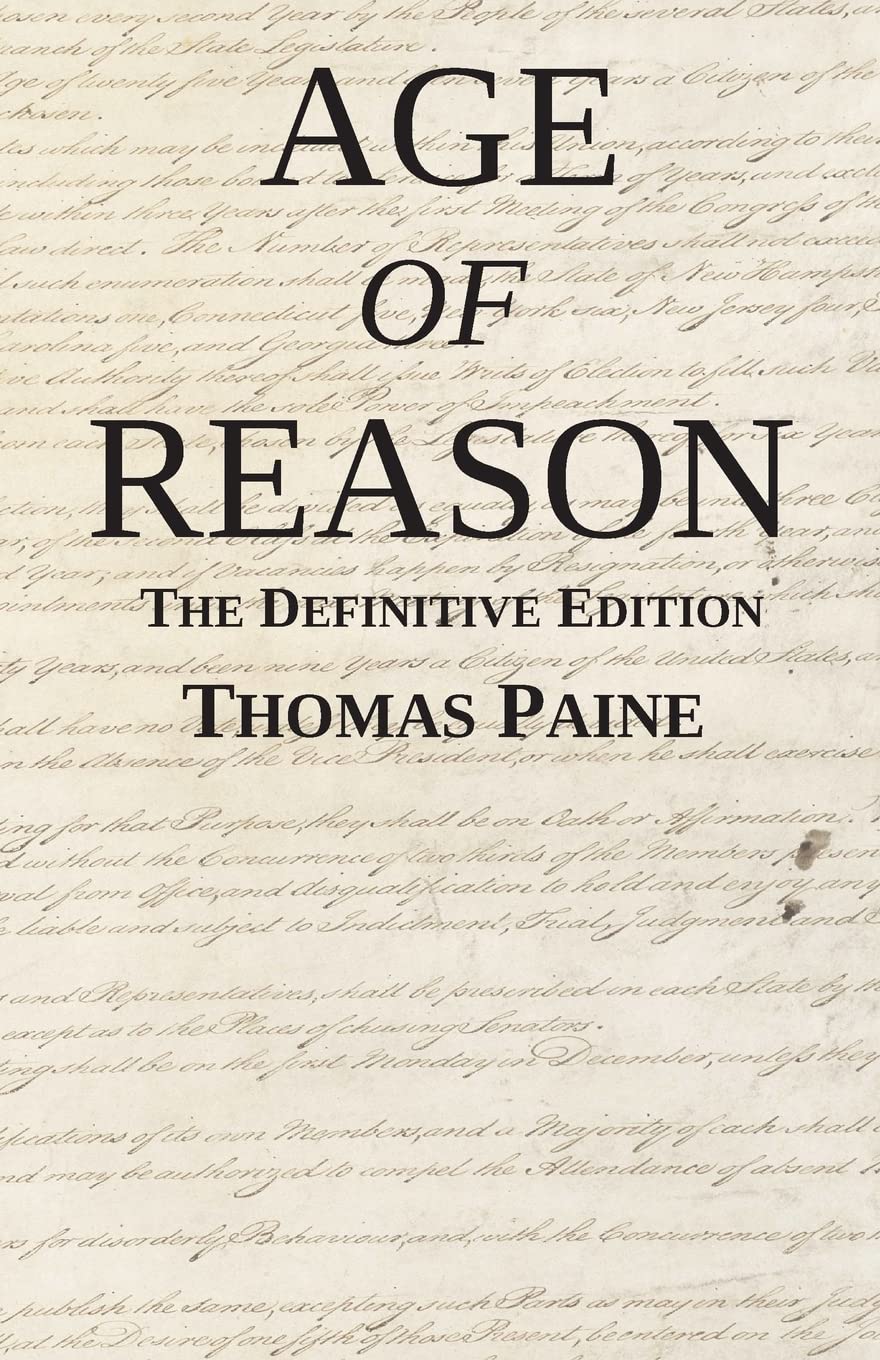
Age of Reason: The Definitive Edition [Paine, Thomas] on desertcart.com. *FREE* shipping on qualifying offers. Age of Reason: The Definitive Edition Review: THOMAS PAINE'S THE AGE OF REASON IS A THEOLOGICAL TOUR DE FORCE! - [NOTE: I am writing this review based on the Michigan Legal Publishing Ltd. first edition, 2014, trade paperback - ("manuscript" cover). This is the full and complete text, containing all three Parts of the AGE OF REASON, including Paine's (sometimes lengthy) footnotes, along with occasional short and helpful editorial/explanatory remarks. This is the edition to buy, in my opinion... easy to read and well laid out.] Thomas Paine's (1737-1809) monumental theological work, the AGE OF REASON (originally published as three unbound pamphlets between 1794 and 1807), is not to be missed. In this fascinating and deeply thought-provoking work Paine passionately devotes himself to two principal themes: 1) the thorough examination and refutation of the purported (but, to Paine, false) prophetic claims found in the Bible's Old and New Testaments concerning Jesus, and the orthodox (though deistically repugnant) notion of there being three co-equal gods: God the Father, God the Son and God the Holy Ghost; and 2) building and promoting a solid case for a nature-centered, deistic understanding of the One, True Creator-God - and the complete rejection of the Bible's "fabulous" (i.e., mythical) and preposterous "plan of salvation" based solely on one's worship of, and faith in, Jesus Christ and his vicarious suffering, death, resurrection and ascension (which Paine repudiates and finds fallacious and abhorrent). With the surgical precision and detailed examination of a rational, science-minded, and intellectual man of his day - and with often scathing, wry, sardonic humor - he exposes and excoriates the entirely fictitious, man-invented Bible, seeing it as a ghoulish and unbelievable collection of "fables, forgeries, falsehoods" - saturated with "abominable absurdities," and utterly insulting to, and unworthy of, his esteemed conception of the One Creator-God as revealed in and by all of Nature. For Paine, the true and only Word of God is the natural world and the created universe. And he has absolutely nothing good to say about clerics and theologians - who spend their lives promulgating "holy" lies and deceits (as found in Scripture) - only in order to maintain their incomes and status ! Based on his scrupulously thorough examination and withering denunciation of Scripture, he advances a high-minded, pure and "hygienic" (my word) conception of his Creator-God ("the Almighty"), and takes delight in eviscerating the perverse and complete heresy (as he sees it) put forward by the Bible and its heinously wicked concepts of original sin/fall of man and the mandated need of salvation through faith in Christ... and the certainty of eternal damnation for all who reject this "gift" - as if love and devotion can be commanded! On the subject of salvation, Paine writes: "... those whose lives have been spent in doing good, and endeavoring to make their fellow mortals happy, for this is the only way in which we can serve God, will be happy hereafter...." Also, Paine wanted to believe in an afterlife: "I consider myself in the hands of my Creator, and that he will dispose of me after this life consistently with his justice and goodness. I leave all these matters to him, as my Creator and friend...." A few Paine quotes from the AGE OF REASON: "HE THAT BELIEVES IN THE STORY OF CHRIST IS AN INFIDEL TO GOD." [Caps in original] "As for myself, I believe in God and not at all in Jesus Christ, nor in the books called the Scriptures." "Readers... put no trust in the Bible." We discover God "by studying the Creator in the immensity and unchangeable order of his creation, and immutability of his law." Considering that Paine lacked the profound advantages and perspectives of modern biblical research and historical criticism attained over the last one-hundred-or-so years, the AGE OF REASON is all the more remarkable. (Paine's principal writings dealing with Deism specifically can be found on pages 152-163 of Part Two and pages 210-226 of Part Three in this edition.) Paine's forceful and convincing writing style, and well-thought-out conclusions, are deeply compelling, and his Deist philosophy - quite popular during his day - condemning standard Christian orthodoxy, dogma and practices are nearly breath-taking in their power, impact and scope. And I give this unique and mind-changing book my highest recommendation. Review: Important book; still relevant hundreds of years later - Mr. Paine made a piece which I believe would benefit readers in middle school, high school, college, and almost everyone for that matter. He apparently succeeded in doing what he set out to do: It is well written thesis of his views of religion(s) and God. He also set up a very readable standard for a deistic (uninvolved) God, natural theology, and moral systems that do not appeal to a God; and he attempted to do so via rational inquiry and evidence to support his claims. I don't think he entirely succeeded, but the man was well ahead of his time. One could even dare say that he was "Enlightened." Due to the witchhunting and superstition of his time, I am surprised that he had the courage to ever write this work, even when he was older. Our modern Richard Dawkins may be correct that there is no way to disprove a deistic God. Yet Thomas Paine made this critique about religion which, even if it is incorrect--and by modern standards, it probably is--it displays a level of eloquence that remains more readable than many other critiques of religion that I have read. Bottom line: It is a damn pleasant read.
| Best Sellers Rank | #80,689 in Books ( See Top 100 in Books ) #160 in U.S. Revolution & Founding History #173 in Religious Philosophy (Books) #269 in History & Theory of Politics |
| Customer Reviews | 4.7 4.7 out of 5 stars (323) |
| Dimensions | 5.5 x 0.63 x 8.5 inches |
| ISBN-10 | 0615983820 |
| ISBN-13 | 978-0615983820 |
| Item Weight | 11.4 ounces |
| Language | English |
| Print length | 250 pages |
| Publication date | March 1, 2014 |
| Publisher | Michigan Legal Publishing Ltd. |
B**H
THOMAS PAINE'S THE AGE OF REASON IS A THEOLOGICAL TOUR DE FORCE!
[NOTE: I am writing this review based on the Michigan Legal Publishing Ltd. first edition, 2014, trade paperback - ("manuscript" cover). This is the full and complete text, containing all three Parts of the AGE OF REASON, including Paine's (sometimes lengthy) footnotes, along with occasional short and helpful editorial/explanatory remarks. This is the edition to buy, in my opinion... easy to read and well laid out.] Thomas Paine's (1737-1809) monumental theological work, the AGE OF REASON (originally published as three unbound pamphlets between 1794 and 1807), is not to be missed. In this fascinating and deeply thought-provoking work Paine passionately devotes himself to two principal themes: 1) the thorough examination and refutation of the purported (but, to Paine, false) prophetic claims found in the Bible's Old and New Testaments concerning Jesus, and the orthodox (though deistically repugnant) notion of there being three co-equal gods: God the Father, God the Son and God the Holy Ghost; and 2) building and promoting a solid case for a nature-centered, deistic understanding of the One, True Creator-God - and the complete rejection of the Bible's "fabulous" (i.e., mythical) and preposterous "plan of salvation" based solely on one's worship of, and faith in, Jesus Christ and his vicarious suffering, death, resurrection and ascension (which Paine repudiates and finds fallacious and abhorrent). With the surgical precision and detailed examination of a rational, science-minded, and intellectual man of his day - and with often scathing, wry, sardonic humor - he exposes and excoriates the entirely fictitious, man-invented Bible, seeing it as a ghoulish and unbelievable collection of "fables, forgeries, falsehoods" - saturated with "abominable absurdities," and utterly insulting to, and unworthy of, his esteemed conception of the One Creator-God as revealed in and by all of Nature. For Paine, the true and only Word of God is the natural world and the created universe. And he has absolutely nothing good to say about clerics and theologians - who spend their lives promulgating "holy" lies and deceits (as found in Scripture) - only in order to maintain their incomes and status ! Based on his scrupulously thorough examination and withering denunciation of Scripture, he advances a high-minded, pure and "hygienic" (my word) conception of his Creator-God ("the Almighty"), and takes delight in eviscerating the perverse and complete heresy (as he sees it) put forward by the Bible and its heinously wicked concepts of original sin/fall of man and the mandated need of salvation through faith in Christ... and the certainty of eternal damnation for all who reject this "gift" - as if love and devotion can be commanded! On the subject of salvation, Paine writes: "... those whose lives have been spent in doing good, and endeavoring to make their fellow mortals happy, for this is the only way in which we can serve God, will be happy hereafter...." Also, Paine wanted to believe in an afterlife: "I consider myself in the hands of my Creator, and that he will dispose of me after this life consistently with his justice and goodness. I leave all these matters to him, as my Creator and friend...." A few Paine quotes from the AGE OF REASON: "HE THAT BELIEVES IN THE STORY OF CHRIST IS AN INFIDEL TO GOD." [Caps in original] "As for myself, I believe in God and not at all in Jesus Christ, nor in the books called the Scriptures." "Readers... put no trust in the Bible." We discover God "by studying the Creator in the immensity and unchangeable order of his creation, and immutability of his law." Considering that Paine lacked the profound advantages and perspectives of modern biblical research and historical criticism attained over the last one-hundred-or-so years, the AGE OF REASON is all the more remarkable. (Paine's principal writings dealing with Deism specifically can be found on pages 152-163 of Part Two and pages 210-226 of Part Three in this edition.) Paine's forceful and convincing writing style, and well-thought-out conclusions, are deeply compelling, and his Deist philosophy - quite popular during his day - condemning standard Christian orthodoxy, dogma and practices are nearly breath-taking in their power, impact and scope. And I give this unique and mind-changing book my highest recommendation.
M**F
Important book; still relevant hundreds of years later
Mr. Paine made a piece which I believe would benefit readers in middle school, high school, college, and almost everyone for that matter. He apparently succeeded in doing what he set out to do: It is well written thesis of his views of religion(s) and God. He also set up a very readable standard for a deistic (uninvolved) God, natural theology, and moral systems that do not appeal to a God; and he attempted to do so via rational inquiry and evidence to support his claims. I don't think he entirely succeeded, but the man was well ahead of his time. One could even dare say that he was "Enlightened." Due to the witchhunting and superstition of his time, I am surprised that he had the courage to ever write this work, even when he was older. Our modern Richard Dawkins may be correct that there is no way to disprove a deistic God. Yet Thomas Paine made this critique about religion which, even if it is incorrect--and by modern standards, it probably is--it displays a level of eloquence that remains more readable than many other critiques of religion that I have read. Bottom line: It is a damn pleasant read.
W**N
Very Informative Book
Good book. Thomas Paine wrote in an intelligible way, so even a person like I can understand. He explains how the Creation is the true Revelation of God, and not a written scripture. He uses reason to get his point across. I highly recommend the book.
B**N
Enlightening, Deep
Best mind-altering criticism, ever. If you can understand His triangle then you can understand creation. in my opinion, and yes someone did ask! 2 Adenomas and lung cancer that I fought off, so I understood his frame and set of minds also not eating and starving to prove I would outlive my oppressor (cancer), and I similarly did.
G**R
Interesting but dated
A very detailed and interesting challenge to traditional religions. All of the contentions and arguments are supported by inconsistencies and conflicts from within the Catholic Bible itself. For one who eschews all formal religion, Paine does what appears to be a huge amount of research and analysis of the bible. What I found to be unnecessary and a tad distasteful is the obvious derision he expresses toward religion. He could have well made his case with less emotion and sarcasm and made it no less effectively. Well reasoned and logical arguments don't necessarily point to truth. If only because of the author's position in history, and the age in which this was written, it is well worth reading. Since "Age of Reason" was published, there has been much new research and ancient documents uncovered that are far more enlightening than just the application of pure reason. For the religious as well as the antagonist, these, too, must be investigated.
J**L
Anybody who has religious leanings should read this book. I could, just about, understand your need to continue with your beliefs but you would not be doing so with academic support from the Bible. This so called book of God is nothing but a tissue of various peoples beliefs that have nothing to do with reality
C**Y
Where has this book been all my life? I have first read it age 85. I rather expected a dry, old fashioned, book. Instead a modern sounding very clearly written debunking of the bible's authenticity and relevance. One tenth of it would have made his points, but the other 90 percent was interesting nevertheless. And the people he knew, Washington, Franklin and so on. And he personally served France during the revolution (and was at risk of the guillotine). Would the American revolution have succeeded without him, would the American church-state separation (now at risk) have happened without him? His science was remarkably modern. But brain function was a mystery to him - only very recently have we begun to understand it. Had he had our modern understanding of evolution would he have abandoned god altogether, or would he have placed the deity before the big bang? We will never know.
D**N
An excellent edition of this controversial text by Tom Paine, this could be 'strong meat' for Christians who don't like having their 'feathers ruffled'. It's easy to see why Paine delayed writing it - and why he was so heavily criticised by many clergymen for doing so. Nevertheless his intentions were honest and - whatever one's own views - one stands in awe of his achievement. Good value for money.
M**N
Excellent. He does go to lengths about Christianity but the overall conclusions apply to the modern world.
G**S
Parts 1-3 increase in difficulty of reading (at least in terms of concentration to assimilate) but worth the effort and the writing style is beautiful and precise. It is a great shame that we appear to have gone backwards since it was written. It should form part of the RE syllabus but I imagine the nuts in SACRE would run screaming for the hills crying 'sacrilege' and 'ban it' without realising they are several centuries too late for that.
Trustpilot
1 week geleden
3 weken geleden