

Desert Online General Trading LLC
Dubai, United Arab Emirates
Desert Online General Trading LLC
Dubai, United Arab Emirates
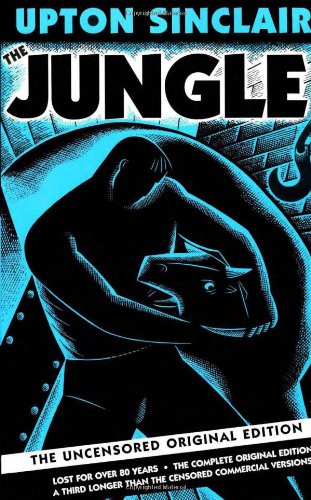
Full description not available
A**S
When was America great?
When asked that question, Donald Trump said that one of those times was the onset of the 20th century with military & industrial expansion. This was when Sinclair wrote this book portraying the harsh conditions & exploited lives of immigrants here. What is great for the wealthy is not necessarily great for the rest of us. This is a powerful story of man's inhumanity to man. No country is great until we deal successfully with that.
T**I
Meh
Stopping at 44% because this is just getting ridiculous. I see now why this novel’s only legacy is the impact it had on meat-packing standards, why Upton said of this novel, “I aimed for the public’s heart and hit it in the stomach,” and also why no one recommends this book to be read.This book starts out a bit rough, as we’re tossed into a rambunctious wedding event with little indication of who anyone is or why we should care about them (it took forever for me to realize who the bride/groom were). After several torturous pages, the actual story begins; the tale of two hearty and lovely country folk who make their way to America at a really bad time for people in abject poverty.And that’s the high point.Over the next half a book, things go from bad to worse, over and over and over again. At halfway in, I’m just over it. I read the summary online and was not surprised to find that things will only get worse for all the characters. Death, drug addiction, imprisonment, disease, etc. So many bad things happen to them, frequently, and in such a methodical order, that the story feels ridiculously forced – killing my immersion.It didn’t help that this book reminds me of A People’s History of the United States, and not in a good way.Like that book’s author, Sinclair is a vocal socialist that wishes to see the capitalist system brought down. Not that I have a problem with this, as everyone is entitled to their opinion, even when it’s wrong; but I do have a problem with propaganda and half-truths. That’s The Jungle in a nutshell.Look, times were bad then. I get it. No worker rights, a buyer-beware market, hordes of poor being taken advantage of by the wealthy few. It’s no wonder so many wanted to burn capitalism to the ground in those days! And Sinclair’s book tells a good half-truth that the unrestrained pursuit of wealth with no human oversight quickly leads humanity into a desolate hellscape the likes of which no one would wish upon their worst enemy.But that being said, did you have to be so damned obvious about it, Sinclair?This novel essentially holds the reader by the throat and screams, “Poverty is slavery! Work is hell! The few prosper at the expense of the many!” which are all arguments I’d gladly sit down and discuss in a level tone, but this novel is just an out-of-reality, literary straw-man.So anyway, I’ll raise a glass of USDA-approved wine to your legacy Sinclair. I have nothing but thanks to give for what you started. However, that being said, The Jungle isn’t all the good.
A**R
Everyone and everything was a commodity
Fifty years later and I re-read this book. I had to read this in high school, but I wasn't mature or studious enough to understand the significance, even though my grandparents were all immigrants. The world of slaughterhouses hasn't changed much in the past 100 years, poverty, and children working to support their family. Both of my parents had to quit school to support their families or starve. You knnw the old expression "what goes around, comes around?" Those days look like they are coming around again.
J**R
Surprisingly does not live up to the hype.
In the fictional story of Jurgis Rudkus and his family and friends there is a compelling story of the struggles of the working man. I could easily understand the struggles and the societal evils of the time. It was easy to feel the pain of the family and those like them . You want them to just catch a break, you feel for them.Anyone would be disgusted by the descriptions of the meat packing processes described by Sinclair, and while I believe it was certainly a disgusting place in the early 20th century, much of what the author claims has been widely disputed.The book starts out compelling and strong but frankly seems to start a downward spiral of holding the reader after halfway through. I found the writing to have become lazy and un-engaging. He seems to quickly wind up the family struggle with quick resolutions. It took the reality of out the story of struggle and it seemed for the sake of brevity he all at once just makes it, not impossible, but so unbelievable that it took some of the impact from the rest of the story.Finally, he goes from this compelling tale straight into trying to sell the concepts of socialism with a lot of verbiage with little substance. It is all pamphlet level politics with no challenge or answers to many questions about this philosophy. The book ends as more of a pithy political rally with the main character as a backdrop and the story just disappears. From my perspective this book is captivating to start but loses all of its power halfway through.It is not surprising that the book rallied people to the cause of food quality standards as opposed to his political message as that was the only compelling part of the book. That this won a Pulitzer is baffling. Perhaps only because it had such a major impact to food quality issues but the writing overall was extremely poor.
B**E
This is 'docudrama' foreseeing the age of television
‘One of the most powerful, provocative, and enduring novels...’ is how Upton Sinclair’s The Jungle is described in its blurb. The first three adjectives could not be more appropriate, but a novel – in my view, - it is not. I may be being pernickety, but a novel contains at least a reasonable balance between character and message. Some may disagree, but I would say that this is 'docudrama' – written in a style foreseeing the television age. Don’t let that put you off, its an amazing piece of work, and if you don’t know anything about Chicago in 1904, the stockyards, the meat industry, fertilizer factories, property rackets, worker exploitation, prostitution, summer hoboing around Kansas, gangsters, teamsters, and socialism, then - I was going to say - you’re in for a treat, but ordeal might be a more apt word as some of the descriptions are stomach-churningly horrifying. Jurgis Rudkus the main character is a Lithuanian, who has emigrated from his mother country bringing with him some family members including his wife-to-be. Most of the family – and some of the children find work in and around the stockyards and meat production works. Conditions are by any human standards – harsh. Its a day-to-day fight for survival, avoiding injury, and all kinds of cheating and corruption by the bosses, and other workers. Sinclair does his best to endow his main character with a personality, but always the reader is seeing him from the outside, while being informed by a powerful authorial voice about the method, manufacture, and misadventure of the surroundings he finds himself in. There are other characters, such as Jurgis’s family members, but there’s no relationship development, just a series of disasters which befall him. My heart was in my mouth at first for the family, who are clearly going to be ripped off, but as I read on I began to realize that there is little hope of prosperity for them anyway, so I should just relax and marvel at the descriptions of mechanized food production. And perhaps this is where the book is clever. In a way, its villain is the ‘evils’ of the capitalist system, which chews at Jurgis as he – pilgrim like – tries to make his way through its unforgiving landscape. It chews him, spits him out, and chews him again. There’s a kind of hope at the end, and one does realize that journalistic literature of this kind did much to improve conditions for workers, and quality of products. There’s a bizarre scene in which Jurgis, destitute as he is for most of the narrative, meets a weak-minded and friendless young toff, worse for drink. He takes Jurgis to his house, a ‘palace’ on Lakeshore Drive and feeds him, until the toff falls asleep and the servants throw Jurgis back out into the freezing winter. The patois of a drunk is rarely successful in literature – as it is difficult to do convincingly in film or theatre – but somehow Sinclair achieves a curious almost James Joyce-like rhythm and texture to the language. The Jungle is not for the faint-hearted!
W**S
A red jungle a heart of darkness in the city
A red jungle, a heart of darkness in the cityA book that will change you, and take you places you never knew existed, a book about the inhumanity of man towards man an animal. A Book that exposed the worst in capitalism and changed laws in the USA. A powerful indictment to greed and abuse for profit.At the same time a demonstration that freedom of speech and expression can change things and will triumph over regimes that oppress the forces of change the fifth state.Human nature is not what we would like it to be; so we need checks and balances like this book or 1984 by Orwell; we need to expose our baser instincts confront them not as if they were the shortcomings of others but our own. This book is a must read, a warning from the past to the present and the future.
B**N
Clive Cussler at his best.
If you are a fan of Clive Cussler this will be high on your list of 'must read next'.The adventures of the Oregon are full of thrills from page 1 until the end. The story and characters are more than believable, to the point that some of them are 'lost in action'. In real life this would be the case.Read on !!
R**S
A novel to remember
Vivid and eye-opening novel concerning the exploitation and grinding poverty of workers in the Chicago meat-packing factories of the 1920s.The book is centred around Jurgis, a jejune Lithuanian immigrant and his travails through this dreadful industry. Even if Sinclair's detailed descriptions of the trade and practises are only half true, it's impossible not to feel indignation and outrage.The prose is superb, and anyone who hasn't yet discovered this novelist will be richly rewarded.
D**K
At the very least, you can appreciate the place labour unions in society
This book caused such a sensation when it was first published at the turn of the 20th century, that it actually sparked legislation from the White House. In short, immigrants arriving from the US are optimistic about the land of opportunity, only to discover that it's full of corruption, degradation, and heartache. Once they start down a certain road, there seems to be very little escape from it -- either death, degradation, or corruption, it seems. The only reason not five stars is because a) Jurgis, the main character, does occasionally bring his bad fortune upon himself, and b) the last chapter or so is a polemic about the promise of Communism as a fix-all. Very interesting about the latter from this side of history, and perhaps helps us understand why extreme socialism would seem an ideal solution to people in that position, but the book just stops with a kind of Communist manifesto and no real resolution.
Trustpilot
1 maand geleden
3 weken geleden