We remain fully operational. Our teams are working around the clock to ensure your deliveries continue safely.

DOWNLOAD DE APP


Klantenservice
Copyright © 2025 Desertcart Holdings Limited
DOWNLOAD DE APP
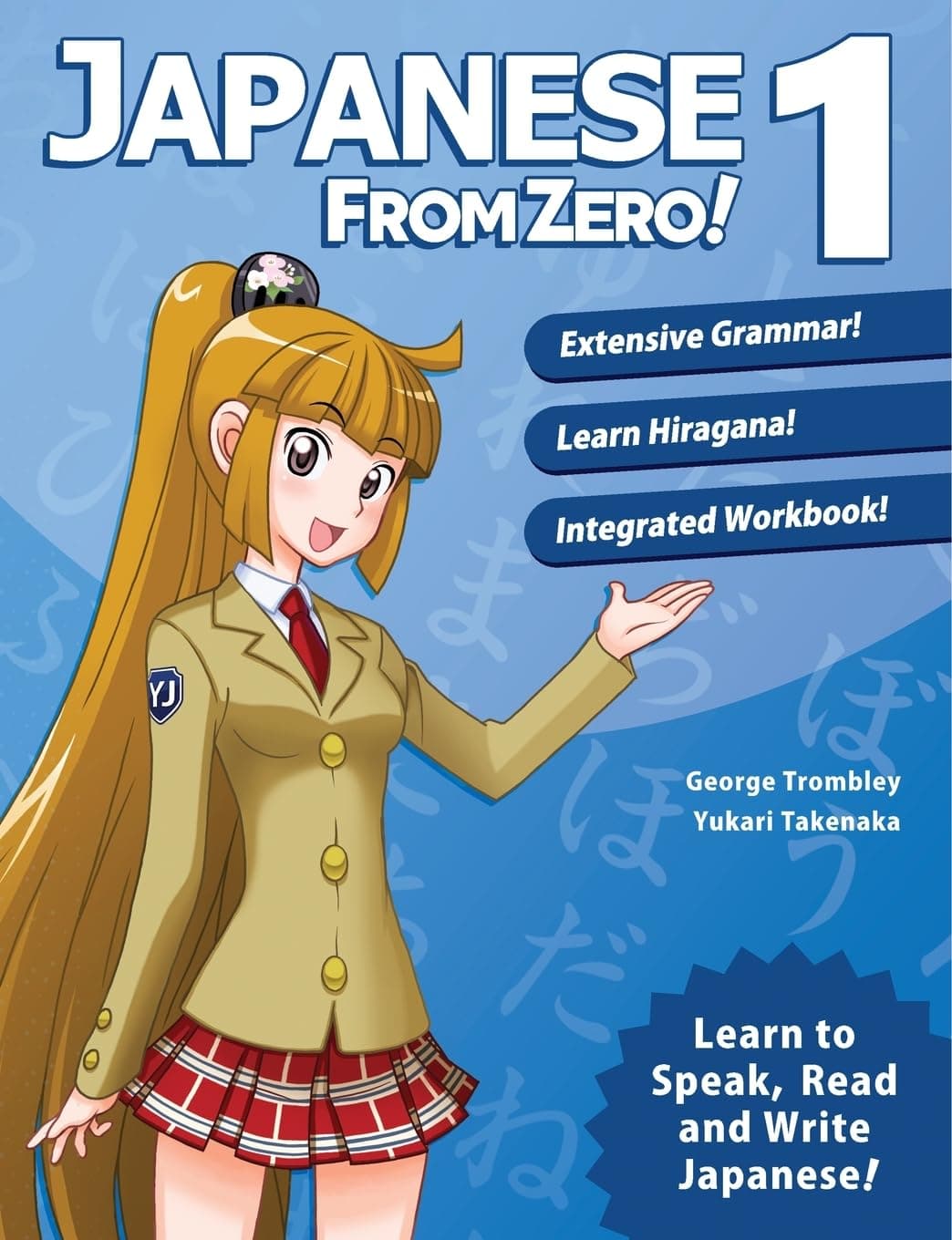
🚀 Unlock Japanese fluency with the most user-friendly guide out there!
Japanese from Zero! 1 is a highly rated, beginner-friendly textbook that combines clear explanations, progressive hiragana learning, and practical cultural insights. With 13 chapters, interactive worksheets, and free online audio by native speakers, it’s designed to build your Japanese skills steadily and confidently—perfect for professionals and students eager to join the global Japanese-speaking community.


| Best Sellers Rank | #9,708 in Books ( See Top 100 in Books ) #3 in Japanese Language Instruction (Books) |
| Book 1 of 5 | Japanese From Zero! |
| Customer Reviews | 4.8 4.8 out of 5 stars (8,318) |
| Dimensions | 7.44 x 0.85 x 9.69 inches |
| Edition | 6th |
| ISBN-10 | 0976998122 |
| ISBN-13 | 978-0976998129 |
| Item Weight | 1.2 pounds |
| Language | English, Japanese |
| Print length | 376 pages |
| Publication date | August 22, 2014 |
| Publisher | Learn From Zero |
C**N
What an AWESOME Way to Begin Learning Japanese!!!
I love Japanese From Zero! JFZ is a good place to start learning, especially if you have no prior knowledge of Japanese and you cannot read or write any of the language (this includes anyone who is currently using romaji). This first book walks you through learning hiragana. By the time you get done with this book, you will know your hiragana front, back and sideways. You may even dream in hiragana. That's how good it is at reinforcing hiragana for you. The information is NOT presented in an overwhelming manner as it can be in a lot of other text books. The lessons are short, which makes it ideal for learning on your own, and being able to pace yourself. You can learn 1 lesson per week or 1 lesson per day. It's totally up to you. The book presents lessons with usable examples. By the time you complete lesson 5, you will know how to say hello, tell someone things that you like or don't like, be able to count, ask who someone is, what things are, ask someone what something is in English, and tell someone what one you want or don't want. You'll learn colors, some animals, etc. So you can say "I have an orange cat named Garfield." "I like to go shopping" "Japanese food is delicious" "That doesn't taste good" "My car is a purple and white Honda" "Sachiko and Toshiyo are my friends" etc lol And that's not even 1/4 the way into the book!!! They present information in a way that allows you to be able to insert whatever you want, instead of using very rigid sentences that can't be altered much. You begin thinking of all the things that you CAN say, which I think is pretty neat. You, of course, learn more as you progress through the series. It's more of a "what you need to know, when you need to know it" kind of book... They don't go into dipthongs and verb conjugation and all that other stuff that you don't really care about. They just say "this is how you say _______." Why people have a problem with that is beyond me. If you really wanted to study dipthongs and that kind of stuff, Japanese From Zero probably isn't for you. If you have a "I can do it" attitude and want a fun, simple way to learn Japanese, (learn how to read/write AND speak) and you don't really care what a dipthong is, then this is the series for you! As you progress through the book, the vocabulary list gets more & more useful, so you can ask people things and have a basic conversation. Enough to maybe start looking for a penpal and discussing things that you enjoy. I like how the book is set up, in that you get your writing practice, you get lots of vocabulary, and you get to learn how to write words that use the kana that you have just learned that are not in your vocabulary list. You get lots & lots of writing practice. There's even "blank" practice pages that you can copy & get more writing practice. The grammar is presented so that it's not overwhelming and make you think "oh my god I can't do this".. the lessons are short & not bogged down with stuff that you don't really need to know to just be able to talk with people. There are tests after each lesson, which are short, and I think that is great, because you can take your test & check the answers in the back of the book (YAY! No separate answer key to buy!) & see how you have done.. It is a nice confidence booster. Your vocabulary is shown in hiragana, katakana (when applicable, ie: with fruit : furuutsu) and kanji (if applicable).. then the meaning of the word is given.. but as you progress, the romaji gets less and less, so eventually you'll be reading hiragana. For things like "furuutsu" that are written in katakana, it's a good way to learn a little katakana while you're at it! In regards to sounds or having a CD... They have sound files on their website. I'm a member of the website AND I have the book. I like using them both. The website tells you how to say things and you get to hear different people say things at their normal talking speed. The forum has a lot of helpful people in it, and George will answer your questions himself. The website has flash games, online flashcards, and all sorts of resources available. They also have free shows you can watch & listen to people speaking Japanese.. This includes people from YouTube, like applemilk1988, Uminekomiami and Kemushichan. They also have their own shows, like Japanese Topics Mania, The George and Keiko Show, The George and Hisashi Show, George in Japan, George vs Chie, The George & Eri show, The YesJapan! Ask A Teacher Show, You SO Crazy Cooking Show and the 3 Guys In Japan Show.. As well as one that's called "The Super Sexy Sayaka Show." You can also transfer your unused credits from YesJapan to JapanFiles & download Japanese music. JapanFiles has a huge selection of music, everything from pop to metal to electronic stuff to jazz and etc.. They even have visual kei bands and some bands have free music videos you can download. So you get lots of stuff to listen to and watch in Japanese. On top of that stuff, the YesJapan forum has a ton of websites where you can get live streaming television shows, anime and etc from Japan for free, as well as online radio shows, and etc. There's LOTS of resources on that website. If joining the website is not your cup of tea.. The Japanese From Zero books are good companions for Rosetta Stone, Pimsleur's Japanese series, the "Let's Learn Japanese" videos & workbooks, LingQ, or anything else you would like to pair them up with, even other books, ie: Making Sense of Japanese: What the Textbooks Don't Tell You or All About Particles: A Handbook of Japanese Function Words . If you get this series, you won't be disappointed. It's simple, fun and really is wonderful!
L**X
Down to earth learning with smooth progression. Best self-study out there
This book is amazing. George Trombley does a great job at explaining concepts. One thing that I appreciate is that he gives you a quick rundown of the formal Japanese (so that you recognize it when it pops up), but then focuses on how you'll most hear / be using it. He also just has a general demeanor of teaching in a down to earth manner. This removes some of the rigid feeling and droll of merely grinding through coursework. He also implements a "progressive" hiragana technique. This is a great idea. As you progress through the chapters, you pick up a new grammar concept, a list of new words, and 5-10 new Hiragana per chapter. The new Hiragana you learn will replace the "romaji" (english alphabet) until you are reading in complete Hiragana. This is a wonderful mechanism for learning as he eases you into everything rather than having massive knowledge dumps which feel discouraging. This book is not filled with a lot of filler and redundant information as other books can be. However, I would appreciate having extra examples or additional explanation of nuances like that you would find on the website / youtube version. For this reason I would highly encourage combining this with their website/youtube channel. Also, I'm a visual learner, so having the visual audio reinforcement really helps me excel. Something that you have to understand as a language student is that learning another language is not a passive activity; it takes hard work, dedication, and immersion. There is no other way to learn another language, so do not pay money to scam artists who will tell you otherwise. I have browsed through other Japanese learning programs like JapanesePod101 (which I don't feel is the best for actually learning Japanese), and have thus far found Japanese From Zero! to be the best there is. This book also does a really good job on worksheets. Again, I would recommend combining this with George Trombley's online resources so you can receive a few more helpful examples, pronunciation, and Japanese nuances. If you are debating between just doing online versus this book, realize that you will miss out on the worksheets which I feel are done better in the book. I definitely think you get a good deal for this as compared to other language learning programs (way better and cheaper than Rosetta Stone if that is on your mind). Is this book perfect? No. For instance, there are a few cases where a new Hiragana which you, as the student, have not learned yet will be slipped into text. It is, in my opinion the best book out there and prefer over Genki. As per my personal recommendation, you should make flashcards of words outside of the books. The books build a fantastic foundation, but you really need to build up your vocab on your own. It's pretty easy to find some word lists out there. However, I would work on those vocab lists after this book or when you are able to use it in a sentence. Learning words is MUCH easier when you can them in a sentence because then you aren't memorizing meaningless scribbles. This book consists of 13 chapters and gives you the basic structure of the Japanese Language. Everyone is different, but I would have a "focused study" a couple hours a day (you need to be practicing your and phrases throughout the day) and was able to get through this book in about a month. After completing it, my vocab was still relatively small, but I could pick out words and phrases people were saying. Certain topics people talked about, I could get the gist of what they were saying. Most topics though, I could only pick out small parts. Also remember that this is just book 1, so don't expect perfect fluency upon its completion. So far I have been very pleased with this book and my progress so far. Learning a language can definitely be daunting, especially when it is something as foreign as an Asian language. This series has definitely kept at bay that anxiety. Sometimes I have to remind myself of how far I've come and the things I do know rather than focusing on what I have yet to learn. George Trombley is very encouraging in his teaching. "Even dust when piled up becomes a mountain" As a little bit of my personal background, I have learned Portuguese as a second language and lived their several years. My experience in learning it was horrible, solely because I did not have anyone take the time to give me that down-to-earth explanation of how Portuguese functioned. I then made a friend who gave me that explanation I desperately needed. At this point in my Portuguese, I understood what people were saying but I could not speak very well myself. This friend transformed my Portuguese within a week so I sounded like a native and I could be considered "fluent". That friend to me in Portuguese is equivalent to how I feel George Trombley is for Japanese. ありがとう ございます
A**R
الكتاب كبير وممتاز ولكن الغلاف معفط للاسف مو مرره جديد
A**E
Recomendado como introducción para el aprendizaje del idioma japonés, tiene muchas actividades, va de lo simple a lo complejo y tiene buena dinámica de inserción de nuevo vocabulario y escritura japonesa progresiva. No es un libro infantil, es más para adolescentes y adultos. Se puede complementar el aprendizaje al avanzar de nivel los libros de niveles posteriores.
I**N
Awesome guide for beginner … go for it !!
A**R
This book is structured for beginner's learning of Japanese. I have learnt how to read Hiragana from this book. And I even understand simple conversation and request.
A**A
Questo è il libro perfetto per chi non ha mai toccato (e dico mai toccato nulla) che sia inerente al giapponese. Il libro parte proprio dal sillabario hiragana (nel secondo il katakana, cioè il sillabario per termini stranieri) su come scrivere ogni singolo carattere, partendo poi con le frasi più basilari ( ad esempio nella prima lezione la presentazione, poi i numeri etc) con tanto di piccole sezioni dedicate a vocaboli ad inizio capitolo (con tanto di scrittura in romaji, hiragana e kanji), grammatica e note culturali per ogni capitolo, passando poi infine agli esercizi (domanda e risposta) e traduzione.Il libro può trarre in inganno le persone adulte dando perscontato che sia un libro adatto solo per bambini per via della copertina ma non è così, il libro spiega in modo molto semplice e chiaro tutta la grammatica e struttura della frase giapponese.Questo è solo il primo libro e per ora ne conta in totale 4, in arrivo forse il quinto. Posso dire che ho il libro della hoepli e il genki (il genki poi costa un botto) e tra questi 3 preferisco proprio japanese from zero, forse perché spiega in maniera meno schematica e monotona rispetto agli altri due, contando anche che questi due libri sono più rivolti ad uno studio scolastico, mentre japanese from zero è rivolto di più verso gli autodidatti. Forse l'unica pecca è che il libro non è proprio adatto ad un neofita (non sono né neofita ma neanche ad un livello intermedio) e trovare le frasi scritte (parlo di frasi, non della singola parola) scritte solo in hiragana può essere un po' fastidioso ma...nulla di grave alla fine.Conosco quasi tutti i kanji a memoria (intendo quelli del libro di Heisig) e vedere solo la versione in hiragana fa quasi sentire l'apprendimento un po' parziale, non del tutto completo.Ad ogni modo è perfetto per qualunque categoria, sia per chi non sa nulla ma anche per chi sa già qualcosa, è sempre un buon strumento per rispolverare la lingua.La cosa che trovo molto carina è la fase progressiva di come i romaji (i nostri caratteri) vengono sostituiti nel tempo dagli hiragana dopo l'apprendimento di alcuni di essi dopo ogni capitolo. Ad esempio, se io trovo la frase -> kuruma desu ka? dopo 2 capitoli diventa kuるma deすか? e poi くるまですか? ed infine con l'aiuto dei kanji inseriti per ogni vocabolo 車ですか?. Altra pecca (ma è soggettiva come cosa) è che il libro è disponibile solo in lingua inglese, quindi non adatto a chi non conosce la lingua.Per chi invece ha dubbi può consultare la versione kindle e farsì lì direttamente un'idea più o meno chiara se acquistarlo o meno. Vi assicuro comunque che il libro è che scritto in un inglese molto semplice e che tutti (o almeno la maggioranza) può benissimo acquistarlo con tutta la serenità possibile, ve lo assicuro :). Ultima cosa che ho dimenticato di citare è che il libro non ha in dotazione il cd, ma credo che per la maggior parte delle persone non sarà un problema per via della diffusione di manga e anime; ma per chi non ha mai avuto a che fare con il giapponese, vi posso rassicurare che la sua fonetica è come quella italiana, per cui non sarà un problema.
Trustpilot
5 dagen geleden
4 dagen geleden