
DOWNLOAD DE APP


Klantenservice
Copyright © 2025 Desertcart Holdings Limited
DOWNLOAD DE APP
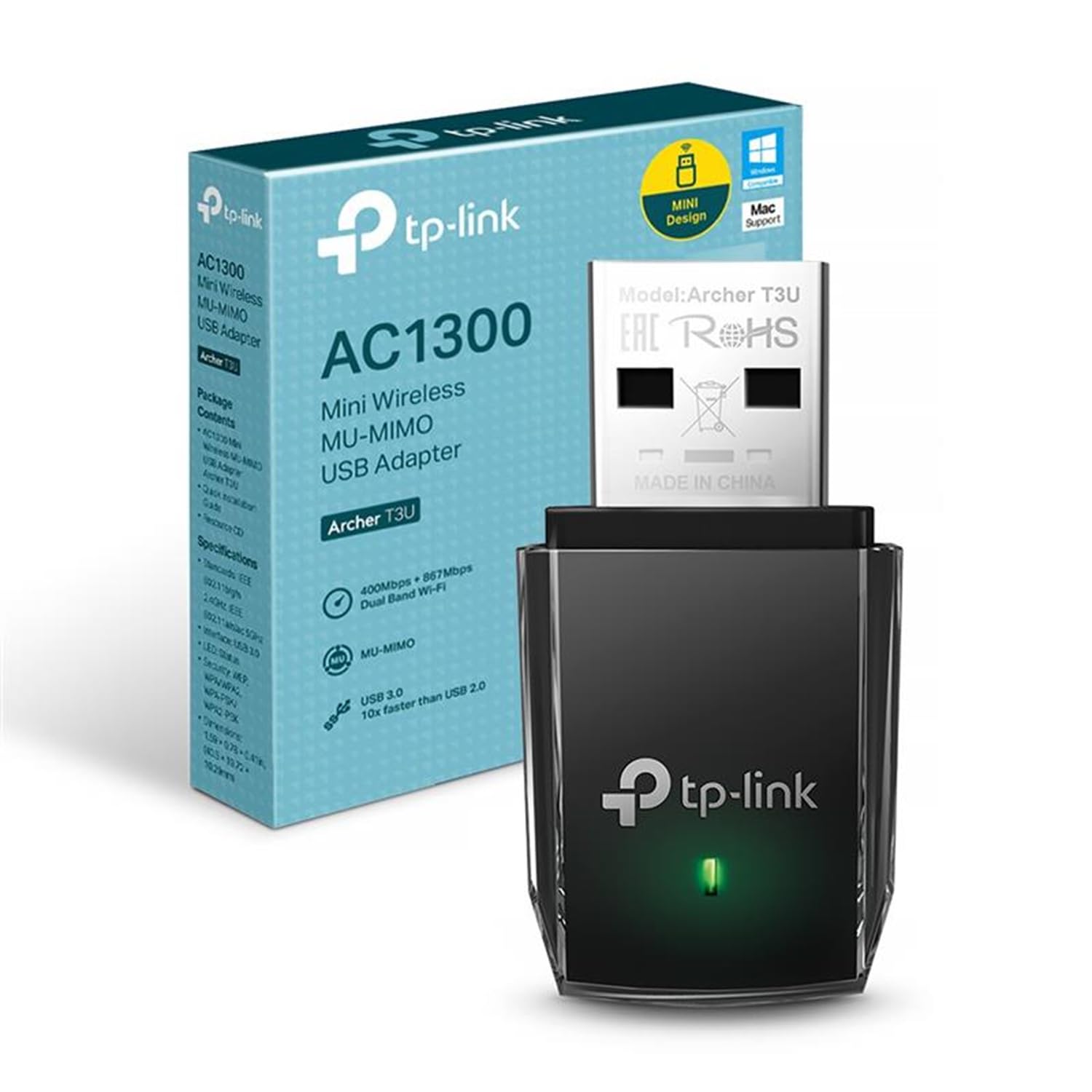


📶 Unlock lightning-fast WiFi anywhere — because buffering is so last decade!
The TP-Link Archer T3U is a high-performance dual-band USB WiFi adapter delivering up to 1300 Mbps speeds via 802.11ac technology. Its compact form factor and 3dBi dual omni-directional antennas ensure stable, wide-range wireless connectivity. Equipped with a SuperSpeed USB 3.0 port, it offers up to 10x faster data transfer than USB 2.0. Compatible across Windows, Mac OS, and Linux, it’s the perfect plug-and-play solution for professionals demanding reliable, high-speed internet on any device.


| ASIN | B07LGMD97Z |
| Are Batteries Included | No |
| Best Sellers Rank | 934 in Computers & Accessories ( See Top 100 in Computers & Accessories ) 12 in USB Computer Network Adapters |
| Brand | TP-Link |
| Colour | Black |
| Customer Reviews | 4.3 4.3 out of 5 stars (119,657) |
| Date First Available | 18 Dec. 2018 |
| Guaranteed software updates until | unknown |
| Item Weight | 60 g |
| Item model number | Archer T3U |
| Manufacturer | TP-Link |
| Operating System | Mac os x, Windows 11/10/8.1/8/7, Linux |
| Product Dimensions | 4.1 x 2 x 1.1 cm; 60 g |
| Series | Archer T3U |
E**N
Compact, Reliable & Easy to Use – Great Little WiFi Adapter!
The TP-Link TL-WN725N USB WiFi adapter works perfectly. It’s incredibly small and discreet but delivers a stable and reliable connection
J**S
Tiny and useful. Working with Debian 7, Windows XP, and Windows 7 64-bit
I bought the TP-LINK TL-WN725N Nano adapter for its wireless N capability as my Asus EeePC 1001P only has wireless b/g built-in and I recently bought a TP-Link TL-WDR3600 N600 Wireless Dual Band Gigabit CABLE Router (2 UBS Ports for Storage Sharing, Media/Print Server, IPv6) . My EeePC runs Windows XP and Debian 7. It turns out that the TP-LINK TL-WN725N comes in two versions, V1 and V2. They look identical but use different wireless chips. If you get a V1 it will work out of the box in any typical Linux based operating system. If you get V2 you will need to build and install a driver module. Luckily this is very easy. You can find some information on the V2 at wikidevi.com/wiki/TP-LINK_TL-WN725N_v2 and download a driver and see install instructions at github.com/lwfinger/rtl8188eu. Building and installing the driver just takes a couple of commands and a few minutes. You need kernel headers installed and make and gcc (and optionally checkinstall). Unpack the driver archive, cd into the directory and run `make all`, then as root or using sudo run 'checkinstall --pkgname=rtl8188eu --pkgversion="1:$(date +%Y%m%d)-git"` if you like checkinstall and `make install` if you prefer not to use it. If using checkinstall that should build a versioned, dated package and install the driver, copy the firmware to the right place and do so such that your OS package manager knows about it so you can uninstall it cleanly, upgrade without issues, or use the driver and firmware package on other computers running the same OS and hardware. Even on my low power EeePC this only took a couple of minutes. Once it was done I reconnected the TP-LINK Nano to a USB port and immediately the device became available in Network Manager and I connected to my N network without any issue. My next task was to try the Nano in Windows XP. The Nano comes with a mini-CD containing Windows drivers and utilities but the EeePC doesn't have a CD drive so I downloaded the same driver pack from the manufacturer's web site and unzipped it. On connecting the Nano to a USB port Windows detects the device and offers to check Windows Update, search for a driver and install one automatically if found. I was interested to see if this convenient feature would succeed so went ahead. It couldn't find a driver but instead hardware wizard hung and had to be force closed via Task manager. Doh! I restarted the "Found New Hardware Wizard" and this time specified where to look. It failed again and again had to be forced closed. Next I used TP-Link's setup utility and selected to install only the driver (no extra software). This worked fine, at which point Windows' "Found New Hardware Wizard" launched itself and got in the bl***y way. Anyway the driver installed successfully and the wireless interface appeared in the system tray and I connected to my N router. Success! It's been a very long time since I connected anything to a Debian PC and found there wasn't a driver or firmware automatically loaded or easily available so at first I was a bit worried I might run into problems. Actually the driver build and install is really easy and quick and didn't take any longer than faffing around with XP's hit and miss new hardware wizard. If you run Windows XP just use the TP-Link setup application and save yourself a few minutes of aggravation or tedium. I believe Windows 7 will manage this all much more competently but haven't tried it myself. The Nano seems fine to me. I like that TP-Link's set up utility allows you to install either the driver only or the driver with TP-Link's utilities. The Nano is very good value and tiny enough that it can stay permanently in place even while my EeePC is in a snug case, and I can now set my wireless router to use N instead of B/G and get better speeds on all clients. edit: I just tried it with a clean install of Windows 7 64-bit. I downloaded the driver from TP-Link, ran the setup and the Nano works perfectly. Whichever operating system I use the Nano reliably connects to my N network at a nominal 150 mbps. I get very good speeds, almost as good as using a wired 100 mbps LAN, so this is great for file transfers and streaming 720p video and similar tasks which had sometimes been slow and frustrating with wireless g.
H**N
Not for everyone :-(
Overall a great product but didn't quite fit for me being a Linux user as it was hard to find a driver that supported wpa3. Works great with personal wifis but not bigger network ones. Sort of my mistake as well not checking the drivers availability in advance as I was mislead by Linux keyword in the title of the product which made me assured that it'd work.
C**S
The little USB stick that turned my WiFi from a donkey into a racehorse
I plugged this tiny gadget in, and suddenly my laptop went from struggling to load emails to streaming HD videos like it had just discovered caffeine. The high-gain antenna looks small but works like a champ—picking up signals from across the house without breaking a sweat. Dual-band means I can hop onto 5GHz for speed or 2.4GHz for range, and both run smoother than my attempts at home DIY. Installation was quick, painless, and didn’t require a degree in computer science. Within minutes, I was browsing, gaming, and video-calling without the usual pixelated “robot voice” interruptions. It’s compact, reliable, and makes any old device feel instantly upgraded. Honestly, this dongle is the WiFi equivalent of giving your tech a strong cup of coffee and a motivational speech. If you’re tired of lag, buffering, or watching that loading wheel spin endlessly, this little stick is a game-changer.
K**T
Very fast wifi speed
Its compatibility with Windows 10/8.1/8/7 and Mac OS 10.15 and earlier ensures broad usability across older and modern systems. The USB 2.0 interface is not the fastest available, but it handles most daily tasks without noticeable lag. The inclusion of MU-MIMO technology enhances throughput and stability when used with compatible routers, while WPA3 security offers peace of mind for more secure connections. What stands out most is the nano design—it’s nearly flush with the USB port, making it perfect for laptops or PCs where space and portability matter. Setup is straightforward, and driver installation is quick for most users. Overall, the Archer T3U Nano offers excellent value for money, delivering strong performance and security in an ultra-small package. It’s a great choice for upgrading older devices or as a travel-friendly wireless solution. Very happy with it :)
L**T
Did what I wanted, no setup needed.
I bought this because my Dell Latitude 5320 had an annoying intermittent problem where Win11 would disable the built-in driver. A [Windows expert] friend of mine once showed me how to bypass it but the steps were not simple and I had already ordered this by then. So the next time it happened, I dug out this gadget, which I had been carrying around in my bag just in case. I looked at the enclosed setup CD and wondered how that was going to be any use to me and then, to my delight, the dongle started working a few seconds after I plugged it in - no setup, it just started working. I was also pleased to see that the laptop recognised it as a WiFi adaptor and just switched to using that but retained all its saved connection details so it connects to whatever router I had already configured using the [now defunct] built-in adaptor without having to reconnect and re-enter WiFi password. The small size means I can leave it plugged in, even when carrying in my case, just need to make sure that end is facing upwards in my rucksack so the dongle doesn't bang on the floor if I put my bag down hard.
A**Y
Uğraşmayın bunu alın yok driver yok yazılım sıkıntısız tak kullan
C**R
Perfekt, köpte en till, r36s och r36max kompatibel med linux gaming hand-held devices
M**C
Reconnu directement par mon PC sans installation aucune. Antenne Wi-Fi plus rapide que le Wi-Fi intégré de mon portable. Surfer sur le net redevient un plaisir notamment au niveau des vidéos.
M**E
The adapter is very small and leaves almost no bulge or footprint on your laptop, went for this because I have a MacBook with a Wi-Fi issue and had to get an external adapter. After trying other models this is the one that worked perfectly for the MacBook and OS version I have. When using you just need to download the Driver and install it (had to use a USB Flash drive for that) and after it got installed the system detects it automatically and everything works smoothly.
A**R
Worked with my linux machine. No setup or packages required. Just plug in.
Trustpilot
1 week geleden
1 maand geleden